Archive
The D’oh Threshold
The figure below introduces the concept of the “D’oh Threshold“. Every institution has their own purely subjective “D’oh Threshold“. It is arbitrarily set by whoever is in charge.
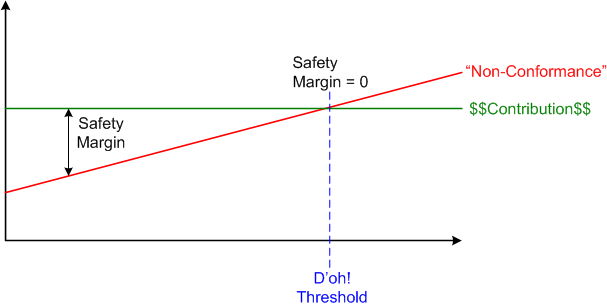
The more bureaucratic or dictatorial the org, the more the threshold shifts to the left (the less the positive safety margin and the more the negative safety margin). Since bureaucrats and dictators care more about conformance to their arbitrary and personally concocted rules than contribution to the “whole“, the “D’oh Threshold” wobbles all over the place. Its setting can vary month to month, day to day, minute to minute, group to group, individual to individual – depending on the emotional state and perceptions of those who run the circus.
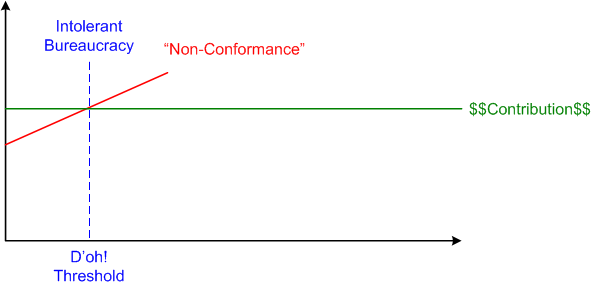
When humans are involved in organized group efforts, there is no escape from subjectivity. But in high performing orgs, the “D’oh Threshold” set point is relatively stationary, far to the right, and everybody knows where they stand.
B and S == BS
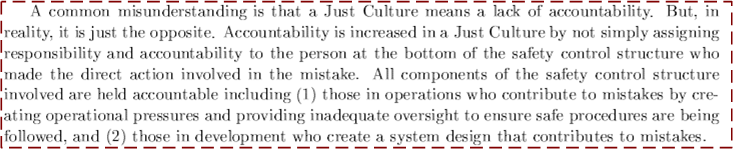
About a year ago, after a recommendation from management guru Tom Peters, I read Sidney Dekker’s “Just Culture“. I mention this because Nancy Leveson dedicates a chapter to the concept of a “just culture” in her upcoming book “Engineering A Safer World“.
The figure below shows a simple view of the elements and relationships in an example 4 level “safety control structure“. In unjust cultures, when a costly accident occurs, the actions of the low elements on the totem pole, the operator(s) and the physical system, are analyzed to death and the “causes” of the accident are determined.
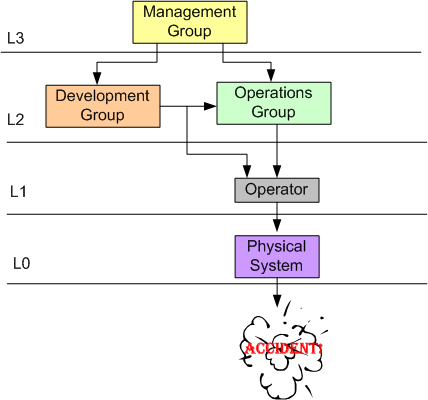
After the accident investigation is “done“, the following sequence of actions usually occurs:
- Blame and Shame (BS!) are showered upon the operator(s).
- Recommendations for “change” are made to operator training, operational procedures, and the physical system design.
- Business goes back to usual
- Rinse and repeat
Note that the level 2 and level 3 elements usually go uninvestigated – even though they are integral, influential forces that affect system operation. So, why do you think that is? Could it be that when an accident occurs, the level 2 and/or level 3 participants have the power to, and do, assume the role of investigator? Could it be that the level 2 and/or level 3 participants, when they don’t/can’t assume the role of investigator, become the “sugar daddies” to a hired band of independent, external investigators?
Scrumming For Dollars
“Systems Engineering with SysML/UML” author Tim Weilkiens recently tweeted:

Tim’s right. Check it out yourself: Scrum Guide – 2011.
Before Tim’s tweet, I didn’t know that “software” wasn’t mentioned in the guide. Initially, I was surprised, but upon further reflection, the tactic makes sense. Scrum creators Ken Schwaber and Jeff Sutherland intentionally left it out because they want to maximize the market for their consulting and training services. Good for them.
As a byproduct of synthesizing this post, I hacked together a UML class diagram of the Scrum system and I wanted to share it. Whatcha think? A useful model? Errors, omissions? Does it look like Scrum can be applied to the development of non-software products?

Weirdos
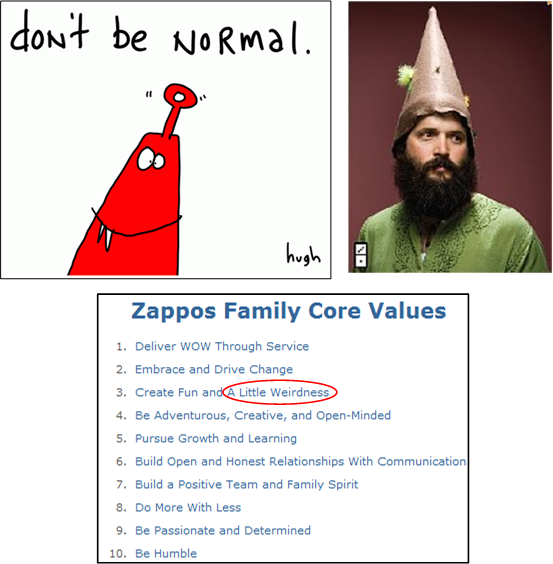
On the top left, we have a recent Hugh MacCleod cartoon. On the top right, we have the cover of Seth Godin’s book, “We’re all Weird“. On the bottom center, we have the Zappos.com 10 core values. Do ya think these people are onto something?
Where are you on this scale?

12/05/11 UPDATE
One courageous reader sent me a pic with his position on the scale:

Any other takers?
Product Lifetime
The UML state transition diagram below depicts the growth, maturity, and retirement of a large, software-intensive product. There are a bazillion known and unknown factors that influence the longevity and profitability of a system, but the greatest determinant is how effectively the work in the upfront “Develop” state is executed.
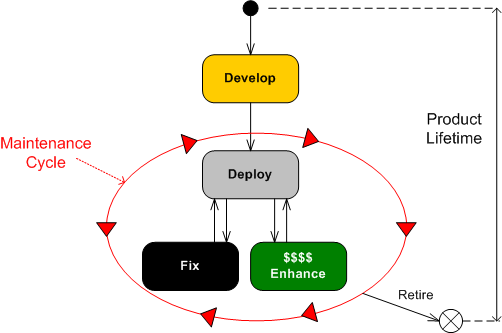
If the “Develop” state is executed poorly (underfunded, undermanned, mis-manned, rushed, “pens down“, etc), then you better hope you’ve got the customer by the balls. If not, you’re gonna spend most of your time transitioning into, and dwelling within, the resource-sucking “Fix” state. If you do have cajones in hand, then you can make the customer(s) pay for the fixes. If you don’t, then you’re hosed. (I hate when that happens.)
If you’ve done a great job in the “Develop” state, then you’re gonna spend most of your time transitioning into and out of the “Enhance” state – keeping your customer delighted and enjoying a steady stream of legitimate revenue. (I love when that happens.)
The challenge is: While you’re in the “Develop” state, how the freak do you know you’re doing a great job of forging a joyous and profitable future? Does being “on schedule” and “under budget” tell you this? Do “checked off requirements/design/code/test reviews” tell you this? Does tracking “earned value” metrics tell you this? What does tell you this? Is it quantifiably measurable?
Chain Of Disapproval

Apple-less
Amazingly, I’ve never owned an Apple product. Despite this fact, I admire Apple and the culture that Steve Jobs brutally, but single-handedly, instilled into the company. These excerpts from “Jobs questioned authority all his life” explain why:
Jobs called the crop of executives brought in to run Apple after his ouster in 1985 “corrupt people” with “corrupt values” who cared only about making money. Jobs himself is described as caring far more about product than profit.
He told (biographer) Isaacson they cared only about making money “for themselves mainly, and also for Apple — rather than making great products.”
Despite Apple’s unprecedented success behind Jobs’ “products, strategy, people” credo, most captains of industry and their mini-me clones just don’t get it – and it looks like they never will. I think capitalism is the least inequitable “ism” there is, but extreme capitalism is no better than any other “ism“.

Collage Of Influence
In a stream of (un)consciousness, I whipped together a collage of people who have greatly influenced my thinking over the years. The criteria for inclusion were: 1) they had to be alive today (with one exception), 2) no one in the entertainment or sports industries, 3) no politicians (that was easy), and 4) I’ve never met them face to face.
 How many of my influencers do you recognize? What would your collage of influence look like?
The Value Zone
Even though it’s been on my Kindle for a year, I just finished reading HCLT CEO Vineet Nayar‘s book, “Employees First, Customers Second“. It was low on my priority list because I already had read a slew of articles about the book when it was first released.
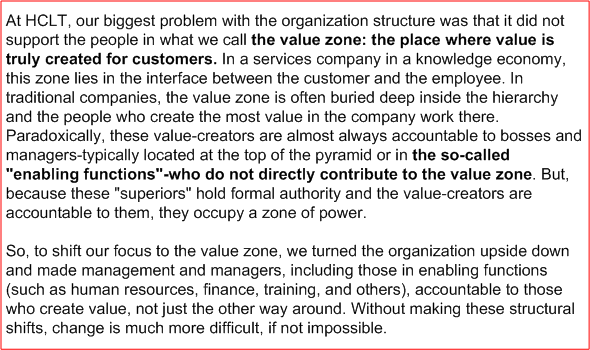
In EFCS, Vineet describes “the value zone” and “the so-called enabling functions” as follows:
So, how did Mr. Nayar “force” the superiors who dwell in the enabling functions to be accountable to the value-creators? He did it by effectively implementing the HCLT “Smart Service Desk” (SSD) – a twist on the typical problem management system employed by most companies to resolve customer issues. Here’s how it works:
- Whenever an employee has a problem or needs information, he or she opens a ticket that is directed to the appropriate department for handling (including senior management and the CEO).
- Each ticket has a deadline for resolution.
- The system is transparent so that all could see the contents of the tickets and where they are in the process.
- The employee who had opened the ticket is the one to determine whether the resolution is satisfactory, or if the issue has been resolved at all.
Shortly after placing the SSD into execution, people “were opening tickets at an average of thirty thousand per month (at a time when there was a total of about thirty thousand employees in the company)“. Vineet sums up the system’s success as follows:
People were embracing the system. It was a victory for honesty, transparency, and openness!

Related articles
- HCL Technologies quarterly net profit rises 50 percent (news.bioscholar.com)
- Why HCL Technologies puts employees ahead of customers (tech.fortune.cnn.com)
- HCL Tech Q1 net up 50% at Rs. 496.7 crore (thehindu.com)
- Valuing Employees (Really!): Lessons from India (forbes.com)
Dejected, Frustrated, Infuriated
How often does this happen to you?

Never, right? Just in case you do experience feelings of dejection, frustration, and infuriation from time to time, how do you you handle those pesky little critters? Suppression? Expression?

Why am I here?
WTF?
Meh!
D'oh!

My BTC Address



 Bulldozer00's Blog