Archive
World Reknowned
WordPress.com is such a sweet blogging platform. The team keeps innovating and adding useful, customer-friendly features to the site. Here’s a recent addition to the stats page that enumerates page hits by country:
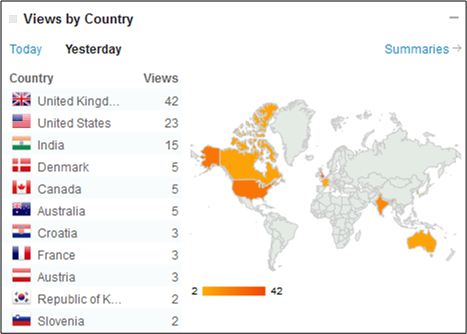
It’s thrilling to see people outside of the USA stopping by and taking a peek at bulldozer00.com. I anxiously await the arrival of viewers from North Korea, Cuba, Iran, the glorious nation of Kazakhstan, and the mud lands of Elbonia.
World Class Help
I’m currently transitioning from one software project to another. After two years of working on a product from the ground up, I will be adding enhancements to a legacy system for an existing customer.
The table below shows the software technologies embedded within each of the products. Note that the only common attribute in the table is C++, which, thank god, I’m very proficient at. Since ACE, CORBA, and MFC have big, complicated, “funky” APIs with steep learning curves, it’s a good thing that “training” time is covered in the schedule as required by our people-centric process. 🙂
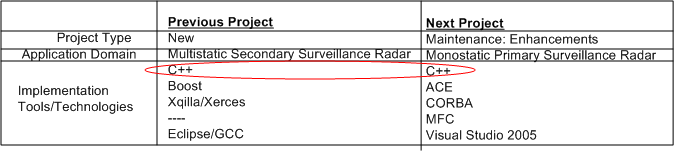
I’m not too thrilled or motivated at having to spin up and learn ACE and CORBA, which (IMHO) have had their 15 minutes of fame and have faded into history, but hey, all businesses require maintenance of old technologies until product replacement or retirement.
I am, however, delighted to have limited e-access to LinkedIn connection Steve Vinoski. Steve is a world class expert in CORBA know-how who’s co-authored (with Michi Henning) the most popular C++ CORBA programming book on the planet:
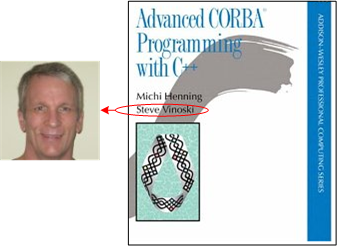
Even though Steve has moved on (C++ -> Erlang, CORBA -> REST), he’s been gracious enough to answer some basic beginner CORBA questions from me without requiring a consulting contract 🙂 Thanks for your generosity Steve!
Whole, Part, Purposeful, Unpurposeful
Perhaps ironically, the various branches of “systems thinking” do not have a consensus definition of “system” archetypes. In “Ackoff’s Best”, Russell Ackoff lays down his definition as follows:
There are three basic types of systems and models of them, and a meta-system: one that contains all three types as parts of it. 1. Deterministic: Systems and models in which neither the parts nor the whole are purposeful (e.g. a computer) 2. Animated: Systems and models in which the whole is purposeful but the parts are not (e.g. you or me). 3. Social: Systems and models in which both the parts and the whole are purposeful (e.g. an institution). All three types of systems are contained in ecological systems, some of whose parts are purposeful but not the whole. For example, Earth is an ecological system that has no purpose of its own but contains social and animate systems that do, and deterministic systems that don’t.


But wait! Why are there no Ackoffian systems whose parts are purposeful but whose whole is un-purposeful? Russ doesn’t say why, but BD00 (of course) can speculate.
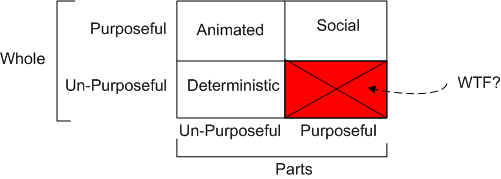 As soon as one inserts a purposeful part into a deterministic system, the system auto-becomes purposeful?
Robot00.com
The other day, I received a package from Amazon and I was popping the packing bubbles to reduce the volume for throwing them away. While robotically popping away, I had a sudden realization that I was thinking about what my next blog post was going to be about. I wasn’t paying attention at freakin’ all to what I was doing.
I reflected further, and then became amazed at how much of my so-called conscious time is spent on autopilot – not thinking in the least about what I’m doing at the moment. I realized that the only time I really think “in the moment” and pay attention to what I’m doing is when I’m designing/writing code, golfing, and writing blog posts. Sadly, that is not the majority of my time. Not even close.

How abut you? Do you find yourself in robopilot mode often?
Picture this
Picture your thoughts as leaves floating down a river. A thought appears in your head, you think it, and then you let it go. Aaaah, what bliss. But wait! One of those leaves just got stuck on a tree root extending out into the water. There it stays, spinning around at a maddening frequency. D’oh! I hate when that happens.
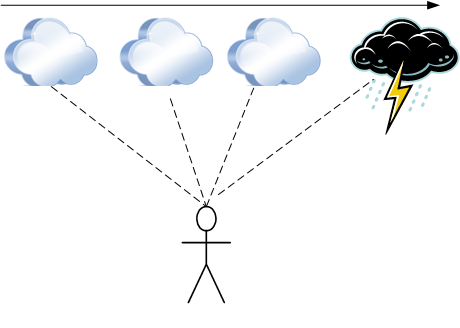
Picture your thoughts as puffy white clouds drifting across the sky. A thought appears in your head, you think it, and then you let it go. Aaaah, what bliss. But wait! One of those clouds just turned dark and started spewing thunder, lightning, and rain. D’oh! I hate when that happens.
Fish On Fridays III
It’s Friday, so it’s time to eat some more fish. Guest blogger “fishmeister” has fried up another tasty treat for you and me to savor.
Firefighter or Fire-proofer: The Tyranny of Today
Software coder. Designer. Thinker.
In those jobs, your primary purpose is to take a blank page and fill it with something that solves an identified problem or need. Often, this requires a great deal of cognitive thinking–noodling out an idea ahead of any actual work. And this takes time.
Unlike a laborer, who’s efforts are immediately apparent as their manual activities produce something tangible, cognitive thinking does not take place on a schedule. You can’t just sit down and say “at 10:30 on Tuesday, I’m going to have a brilliant thought“. It takes time. Sometimes lots of time. And sometimes it happens at odd times when you least expect it.
That ‘eureka moment’ can happen in the car, in the shower, at your desk, in line for coffee–anywhere, anytime. Which brings me to the real reason for this post.
If your work time is spent on putting out fires and solving immediate issues at the expense of thinking strategically about long-term solutions–innovation–you end up getting stuck in the Tyranny of Today–being a fireman instead of a fire-proofer.
Jeffrey Phillips writes a blog that I follow regularly. (BD00’s humble writings and Jeffrey’s are #1 and #2 on my daily morning reading list). ((I won’t say in which order, though)). 🙂
The other day he wrote about The Tyranny of Today. It resonated with me on so many levels that I had to share it with my boss. He outlines everything that we are currently struggling with in our business every day.
We have a large cadre of Designers in our organization, yet we are always being challenged because we don’t think ‘creatively‘. Our deadlines are short–sometimes less than a day between being given a project and expecting a solution to be generated. This creates a dilemma that up until now, I didn’t quite understand. Mr. Phillips puts it most succinctly…
…[The tyranny of today is] An “all hands on deck” mentality, which means that all available resources are focused on today’s issues, today’s needs, today’s problems. Ever more efficient operating models have pared organizations to the bone, meaning that anyone not working on today’s issues seem superfluous. Until the new products and services cupboard is bare because no one was working on new products and services.
We’ve created very powerful “business as usual” engines, and increasingly, these engines no longer serve us, we serve them. The BAU models dictate how we think, how we deploy resources and how we reward people. The tyranny of today is based on our business as usual operating models and the perverted ways in which they drive our strategies, our thinking and the way we apply resources.
We live in an immediate-gratification society these days. Technologies surrounding us have been developed to speed up the processes required to get things done. Back when “I was a kid” designer, developing a concept meant several days of pencil sketches, thumbnails, doodling, and eventually working out a refined concept, that required an artistic skill to draw, paint, and color in a visual representation of an idea up to a sufficient level that someone else (with the purse-strings) would be willing to shell out cash for your idea. All this effort meant that you were “off-line” for any other projects that came along, and as a result, the # of Designers and Freelancers in our studio would increase or decrease based on the workload at the time.
These days, I can bang out a 3-dimensional computer model–complete with textures, surfaces, lighting, and visuals–that looks so convincing that you’d think I’d just taken a picture of a real object in the real world. And I can do this in less than an hour. The tech around me has allowed the mechanical process of simulation to occur at the click of a mouse. But my brain still works the same old way.
At the same time, the down economy has meant that we’ve been cutting back on personnel, letting Designers go and not refilling those positions immediately. Those remaining have to just pick up the load. (“Leveraging resources” is the euphemism we hear every day.) Which means that we rely on our tech to an even greater degree just to get today’s workload completed.
As a result, we have bursts where there is more work that is due right now, than we have bodies in place to handle. Which means that in order to get it all done, I have to take off my propeller-equipped beanie hat and put on my fireman’s helmet. And with all the immediate issues of short-term needs–the fires that take place every day-I put out those fires and sacrifice the time needed to think creatively on another project. I become a victim of the Tyranny of Today.

How about you–do you spend your day sitting under an apple tree waiting for the fruit to smack you on your noggin, or do you piss on fires all day? What can you do in your business to escape the pattern and grow?
Thoers
In case you were wondering how to pronounce the title of this post, it’s “thoo-errs“. It rhymes with “Dewar’s“.
During the rise of the “institution” in the 1900s, Taylorism produced the segregated thinkers/doers model of operation (as shown on the left in the figure below) in order to get things done. Most doers were uneducated and assumed to be lazy/unmotivated barbarians.The “superior” thinkers created the framework of how/what/when work was done; hired some doers; tightly monitored and controlled the process of production.

Relative to the institution-less past, the segregated Thinkers/Doers modus of operandi was an improvement. Via an exchange of pay for work done, institutions provided the means for doers to satisfy Maslow‘s level one/two physiological needs for themselves and their families.
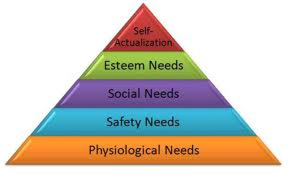
The vast majority of institutions today still operate in accordance with (a milder and veiled form of) Taylor’s segregated thinker-doer model. However, there are some gems (Zappos, Morningstar, Semco, Gore, HCL) out there that operate according the “thoer” model – where everyone is both a thinker and a doer. Although they’re hard to ferret out, these gems proactively provide a work environment in which all 5 levels of Maslow’s hierarchy are attainable to all stakeholders within the organization – not just those in the upper echelons.
Mind Speed
One of my nieces recently sampled my blog and told me: “sometimes the words seem to flow faster than I can read them“. Another person once told me: “you talk faster than I can think“. Alas, such is the downside of having a racy mind.

If you believe the curve above, then the question of how to slow down a speedy mind may have occurred to you. Well, there are tried and true temporary solutions to the dilemma: music, drugs, exercise, alcohol, and meditation.
If you suffer from a racy mind, what works for you? Do you know of any permanent solutions?
Range Checked Vector Access
By now, C programmers who’ve made the scary but necessary leap up to C++ should’ve gotten over their unfounded performance angst of using std::vector over raw arrays. If not, then “they” (I hate people like myself who use the term “they“) should consider one more reason for choosing std::vector over an “error prone” array when the need for a container of compact objects arises.
The reason is “range checked access during runtime“; and I don’t mean using std::vector::at() all over your code. Stick with the more natural std::vector::operator[]() member function at each point of use, but use -D_GLIBCXX in the compiler command line of your “Debug” build configuration. (Of course, I’m talking about the GCC g++ compiler here, but I assume other compilers have a similar #define symbol that achieves the same effect.)
The figure below shows:
- A piece of code writing into the 11th element of a std::vector that is only 5 elements long (D’oh!).
- A portion of the compiler command line used to build the Release (left) and Debug (right) configurations.
- The console output after running the code.

In contrast, here’s what you get with a bad ole array:

The unsettling aspect about the three “D’oh” result cases (unlike the sole “no D’oh” case) is that the program didn’t crash spectacularly at the point of error. It kept humming along silently; camouflaging the location of the bug and insidiously propagating the error effect further downstream in the thread of execution. Bummer, I hate when that happens.
Instantaneous Feedback
Alfie Kohn wrote a whole book on the subject. So, what subject…. you ask? Why, it’s the subject of the “venerable” yearly performance review created in the bygone era of the early 1900s. Specifically, Alfie’s book conscientiously provides details on how to get rid of what Dan Pink describes as the “highly stylized ritual in which people recite predictable lines in a formulaic way and hope the experience ends very quickly“.
In case you don’t want to, or are afraid to read Alfie’s heretical tome for fear of tossing a grenade at your existing mental model, Mr. Pink gives the subject some treatment as point number 12 in his FLIP Manifesto: “Scrap performance reviews”.
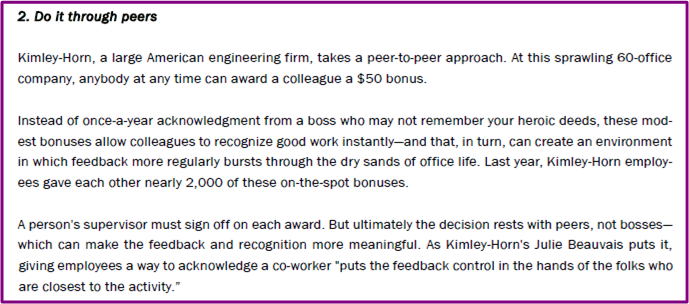
Dan gives not only 1, but 3 ideas for drop kicking the yearly performance review out of the borg and into its rightful place in obscurity. My fave is number 2:
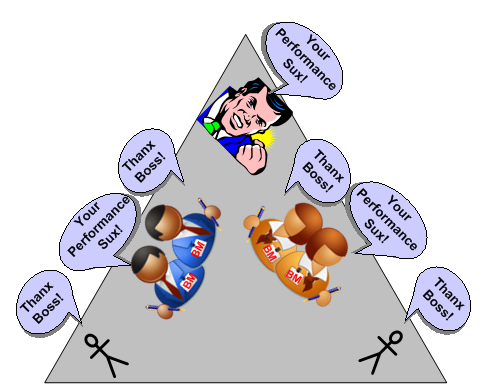
I know, I know. Abolishing the yearly performance review can’t possibly work in your borg. Your business and industry are “different“. It is the way it is because it is the way it has always been and it is the way it has to be. Case closed.

Why am I here?
WTF?
Meh!
D'oh!

My BTC Address



 Bulldozer00's Blog