Archive
Reconfiguration
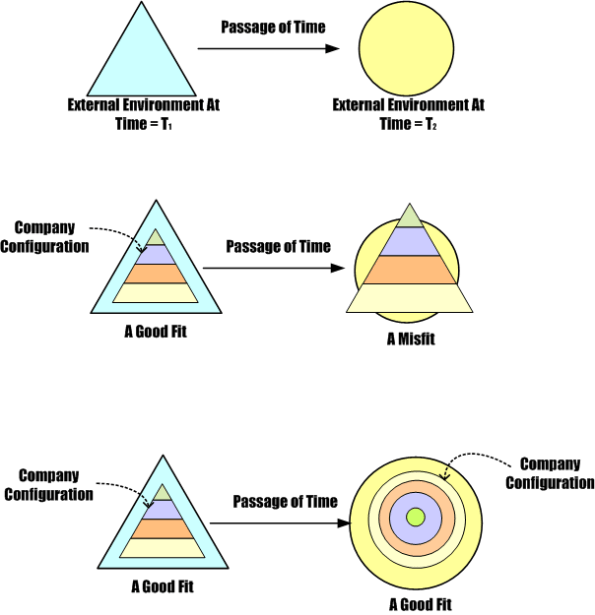
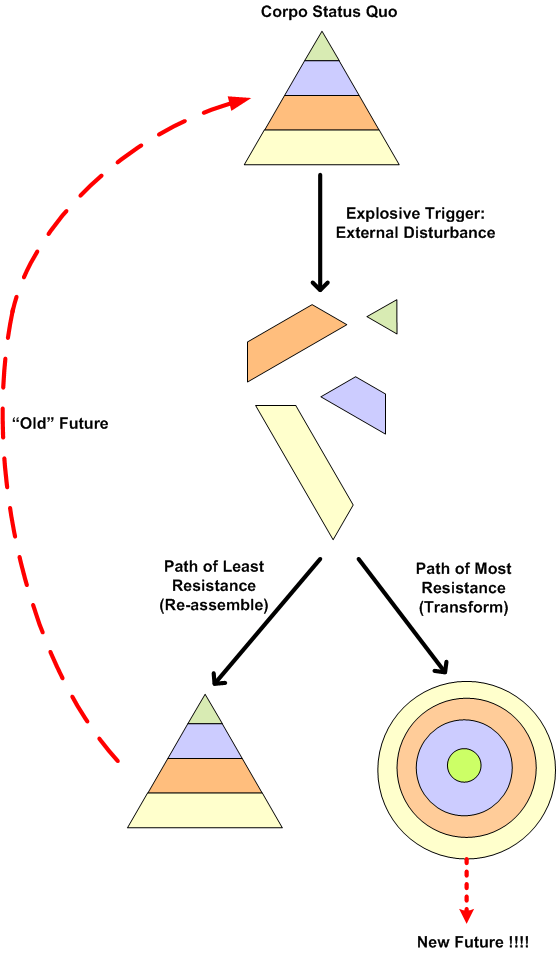
Understandably, companies that achieve success in a business area strive to maintain the behaviors that got them there. However, as they work to continuously stabilize themselves, the external world keeps changing around them. Sometimes the change is gradual, and other times it’s instantaneous and explosive. Regardless of the rate and magnitude of change, if the company does not adapt to the new external situation, they’re hosed.
“When you’re through changing, you’re through.” – Bruce Barton
“Without deviation from the norm, progress is not possible.” – Frank Zappa
One Level Removed
Assume that you’re on the third level or higher in a hierarchical corporate (dis)organization. If you want to know what’s really going on so that you can take action to keep improving the org’s performance, ask the people below you, one level removed. Do it frequently, and do it periodically. If you have lots of people that indirectly report to you two levels down, you could listen to their inputs in small groups or, even better, randomly pick a different person every week to listen to.
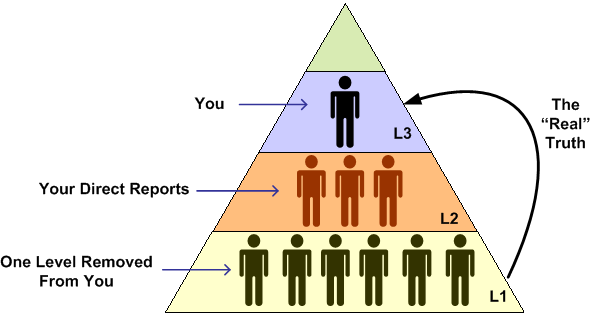
Why should you do this? Since you hand-picked your direct reports and you directly control their salaries, they’ll naturally tend to distort the truth if it makes them or you look bad. You’ll tend to unquestioningly believe them just so you can continue to feel warm and fuzzy inside. If you don’t have a machismo culture of fear that hierarchical structures auto-instill into the lower segments of the org, then at least some of the courageous people two levels down will tell you the truth as they see it. Otherwise, they won’t tell you anything of substance, so don’t waste your time trying to find out the true state of things.
Why don’t most managers frequently survey those people one level removed? Because as one rises up the corpo ladder: they usually get lazier, they get disconnected from the real work that creates and sustains value, and their head expands. Bummer.
“The day soldiers stop bringing you their problems is the day you have stopped leading them. They have either lost confidence that you can help or concluded that you don’t care. Either case is a failure of leadership.” – Karl Popper
Boomerang Effect
Be careful. Be very careful. If you’re at the bottom of the corpo pyramid, don’t even try to break the status quo. Maintaining the status quo in a staid corpo hierarchy is the number one priority of the people at the top of the pyramid. Why? Because they’re at the top, and they’ll do anything to stay there. It doesn’t matter if their actions, or lack thereof, keep the company’s existing products and supporting infrastructure in the dark ages or erode profits, they’ll ensure that they stay on top. Period.
The only thing that a stratified hierarchy is fast at, is fending off attempts to, and squashing ideas designed to, help the company improve. Even if a major idea does somehow miraculously get initiated from the middle or the bottom, as soon as the hierarchs realize that it may result in sweeping change, the crumbling pyramid will do an auto-realignment. Just like that flexible molten metal robot from Terminator III.
To top it off with an exquisite cherry, the top managers will set an example of the poor soul(s) who started the move toward change. The graphic below shows what usually happens. You don’t want to be the guy or gal who tried to kick the field goal 🙂 .
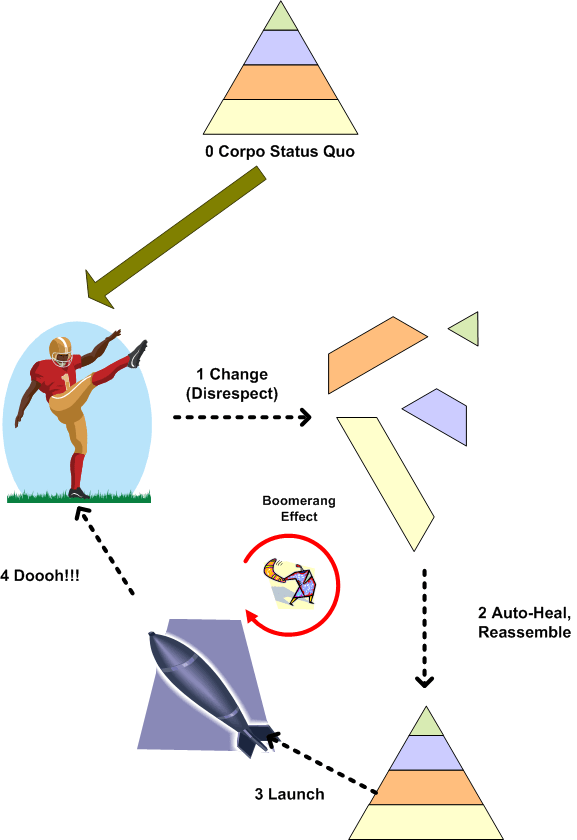
FAI = Frontal Assault Idiot
Since I already have a post regarding the FAE, why not supplement it with one on the FAI?

The other day, my friend and mentor, Bill Livingston, rightfully and truthfully called me an FAI. The picture says it all. No more words are needed, except for: “poor me, boo hoo”.
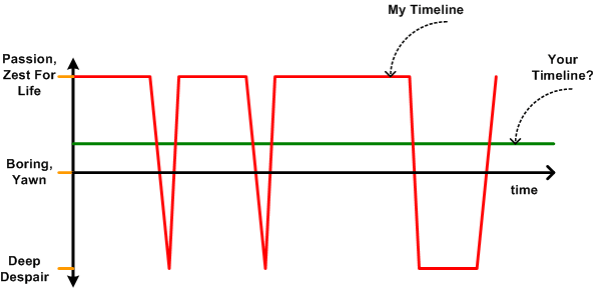
Flatliner?
Given a choice, which trajectory would you select? If neither, what would your preferred trajectory be?
Wannabe
Everybody wants to be a manager or director. Hell, why not? Extracting yourself from the pig sty of hard and sweaty work that directly creates value is the smart thing to do in an obsolete org that is structured as a stratified pyramid. And, how many orgs do you know that aren’t structured as outdated command and control hierarchys? Subjectively of course, I assert that managing and directing others ( fancy words for command and control) is easy relative to doing hard work and constantly getting beat over the head with the schedule stick. Plus, it’s pays more, and you get to have some fancy title of superficial importance appended to your name. Oh sure, you have to put up with whiny direct reports (like me 🙂 ) but does that really warrant more pay and value by fancier and higher paid people positioned even higher up in the pyramid of woe?
I respect people, not titles. If you, as an anointed and highly compensated manager or director:
- listen to your people and treat them as equals,
- actively and visibly help your people get their jobs done better and better each day ,
- pay for ongoing training that’s critical to the company’s future success,
- constantly and diligently take action to repair decaying infrastructure as a result of increasing entropy (2nd law of thermodynamics)
- don’t act two-faced (e.g. pounding your people with schedule while espousing “quality is king”),
- behave congruently and with integrity,
then I’ll respect you and the title that you rode in with. Otherwise, fuggetabout you, your fat head, and your fancy title. Other people, out of the natural fear that all pyramid org structures auto-instill into the minions at the bottom, may feign respect, but I won’t. However, being human, and (hopefully) not too stupid, I do publicly kneel and pay homage to the awesome power to instill fear that is naturally built into the hierarchy – most of the time. Since “most” is not the same as “all”, you can use your imagination to envision my day-to-day experience in a hierarchically structured workplace.
Being a software designer, I’ve learned that different structure types enable or disable different types of behavior. The pointy haired hierarchy, with it’s long history of top down command and control misery, is a disabler of highly creative, adaptive, and efficient human behavior. Since humans (especially those in western countries) are mostly about “me and my story”, and those at the top always accumulate riches at the expense of those at the bottom and on the outside, the pyramid of woe won’t be going away soon.
Regardless of the amount of damage inflicted upon those at the bottom and to external stakeholders, the people at the top will continue to wield their power to keep themselves entrenched. Why continue this irrational behavior? In order to continue living the high life of luxury and consumption, of course. However, the relatively flat network structure fueled by the rise of the internet, will eventually displace the collapsing corpo C & C hierarchy in the future. Those that wait too long will die. Too bad this global maelstrom of change won’t happen in my lifetime.
Ineffective Immediately
“Ninety percent of what we call ‘management’ consists of making it difficult for people to get get things done” – Peter Drucker
If you believe this classic Drucker quote to be true, then whenever you receive an executive e-mail that contains the standard MBA textbook words “effective immediately”, mentally replace them with “ineffective immediately”. That way, you won’t be disappointed or surprised when your local work environment doesn’t change at all, or it changes for the worse.
To be fair, managers, like you and me, are just trying their best to make things better for all stakeholders. It’s just that they, for the most part (90% to be exact) have no clue on how to go about doing that.
Archeosclerosis
Archeosclerosis is sclerosis of the software architecture. It is a common malady that afflicts organizations that don’t properly maintain and take care of their software products throughout the lifecycle.
The time lapsed figure below shows the devastation caused by the failure to diligently keep entropy growth in check over the lifetime of a product. On the left, we have a four process application program that satisfies a customer need. On the right, we have a snapshot of the same program after archeosclerosis has set in.
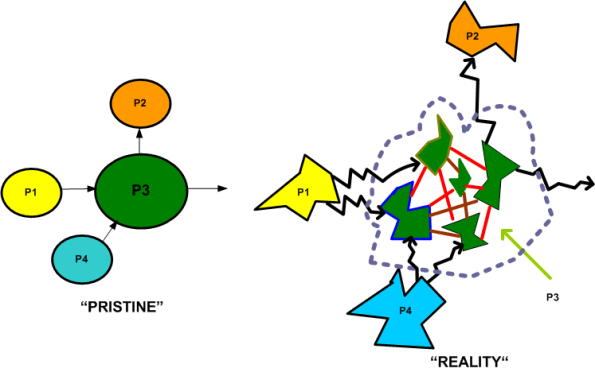
Usually, but not always, the initial effort to develop the software yields a clean design that’s easy to maintain and upgrade. Over time, as new people come on board and the original developers move on to other assignments, the structure starts turning brittle. Bug fixes and new feature additions become swashbuckling adventures into the unknown and lessons in futility.
Fueled by schedule pressure and the failure of management to allocate time for periodic refactoring, developers shoehorn in new interfaces and modules. Pre-existing components get modified and lengthened. The original program structure fragments and the whole shebang morphs into a jagged quagmire.
Of course, the program’s design blueprints and testing infrastructure suffer from neglect too. Since they don’t directly generate revenue, money, time, and people aren’t allocated to keep them in sync with the growing software hairball. Besides, since all resources are needed to keep the house of cards from collapsing, no resources can be allocated to these or any other peripheral activities.
As long as the developer org has a virtual monopoly in their market, and the barriers to entry for new competitors are high, the company can stay in business, even though they are constantly skirting the edge of disaster.
Schedule Policy

Just about every corpo mediocracy in the world has a proverbial “Quality Policy” that it proudly displays all over the place. The inspirational words of wisdom, that hierarchs profess staunch adherence to, are inscribed on framed posters, and/or cute little magnetic sheets. These false idols are distributed far and wide within the cathedral walls for everyone to worship.
However, everyone down in the boiler room knows that the true corpo allegiance is to schedule. How do the serfs know this? It’s easy, and it doesn’t require an Einsteinian intellect to figure it out. Just walk around the cubicle farm and count the number of times you hear managers mention the word “quality”. Then count the number of times that you hear “schedule”. Voila, you then have your answer, and it doesn’t involve rocket science math. Companies that have higher schedule to quality ratios are much more likely to fill the ranks of the average and boring herd.
Schedule worship, at whatever the human and organizational cost, is one of those issues that Chris Argyris calls “undiscussable”. Anyone who points out the fact that the quality policy is actually a lame attempt to camouflage the true and unconditional allegiance to schedule, gets beheaded in true shoot-the-messenger form. Nobody in their right mind “discusses” the quality versus schedule irony because, well, it’s “undiscussable”. 🙂
I propose that all companies develop, distribute, and display their very own authentic schedule policy. One could go something like this:
“The Duefiss corporation is proudly dedicated to meeting schedule. Our allegiance is unconditional. At Duefiss Inc., we will aggressively cut every corner and apply any amount of pressure to our human resources to meet any schedule. It doesn’t matter how laughable or unrealistic any given schedule is. We will commit our minions to it, no matter what the consequences to them, their families, our product quality, or our long term credibility and profitability. When we fall behind the hallowed schedule, we guarantee to turn up the heat on those responsible for the slip, and increase the frequency of status meetings to reinforce our commitment.”
What would your schedule policy be?
The FAE
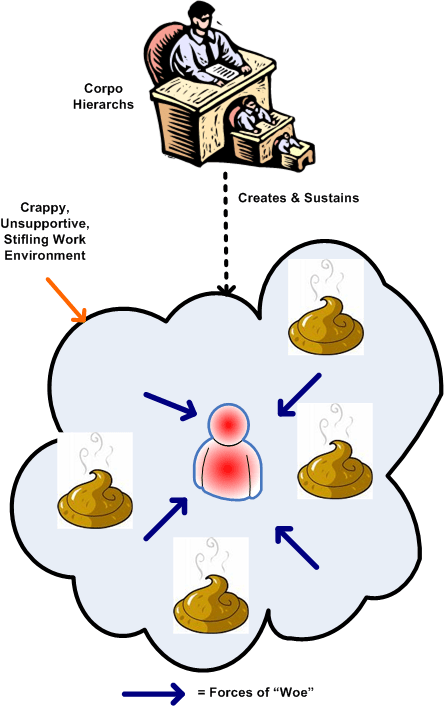
Over the years, I’ve read quite a few books and articles on managing the soft side of an organization. In many of these info sources, I’ve seen the term FAE = Fundamental Attribution Error mentioned. The FAE represents the tendency of a manager to instinctively and unthinkingly blame a person’s character and/or work ethic for under-performance. The real cause, which cannot possibly be true in a corpo manager’s conditioned mind, is likely that his/her inability to create, nurture, and continuously sustain a helpful, supportive, learning work environment is killing productivity and creating under-performers.
Of course, the FAE cannot account for all under-performance in an absolute sense. There are self-made underperformers (like BD00) in every org, regardless of the quality of the surrounding work environment.

Why am I here?
WTF?
Meh!
D'oh!

My BTC Address



 Bulldozer00's Blog