Archive
It Has To Be This Way
This Fortune blarticle, “When you’re the boss, who gives you reviews?”, starts out with:
“A chief executive at a fast growing tech start-up recently approached executive coach Dave Kashen with an all-too common problem. The CEO frequently reached out to his executive team for feedback, but whenever he sought their opinions, his subordinates seemed to shut down and withdraw.”
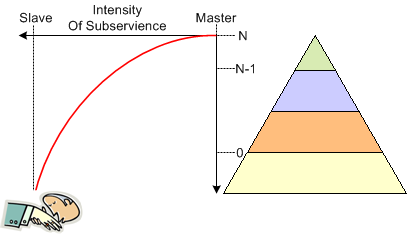
Well, duh. This systemic behavior is the result of the cultural environment that CCH forms of governance auto-install into each bozone layer – all the way down the pyramidal stack. In corpo CCHs, the dudes at level N-1 are “taught” by the system to be subservient to their bosses at level N. Dudes at level N-2 are “taught” to be even more subservient to the bosses at level N than their own boss man at level N-1.
This “that’s just the way it has to be” indoctrination is so successful that it works the other way too. The dudes at level N are “taught” by the system to require subservience by the lessers at all levels below them. I wonder if the flustered CEO in the quote realizes this.
If the corpo system wasn’t designed to work this way, there would be anarchy and annihilation. No “ifs“, “ands“, or “buts” about it……… right?
FOSTMA And NASHMA
Whoo Hoo! I thought of a positive complement to my negative FOSTMA acronym. It’s, it’s, it’s….. NASHMA = Nayar, Semler, Hsieh MAnagement:
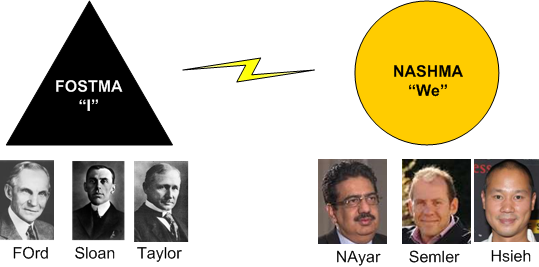
Of course, in order to prevent chaos, NASHMA orgs still have hierarchical structures, but they’re not run as stratified caste system CCHs. In NASHMA orgs, there’s real, two way accountability; and symmetric relationships exist up and down all levels. Most managers in NASHMA groups are PHORs and not STSJs who spend all their “valuable” time planning, watching, controlling, and evaluating.
Now mind you, to avoid the trap of dualistic thinking, an org shouldn’t be judged as fully belonging to one class or the other. There can be pockets of FOSTMA groups in a NASHMA org and vice versa. Nevertheless, my scientifically collected and analyzed data revealed this current distribution of institutions along the FOSTMA-NASHMA continuum:

Over time, hopefully the threshold will move to the left – increasing the currently miniscule NASHMA to FOSTMA ratio. However, there will always be powerful and scary psychological forces opposing the movement.
Rabble-Rousing And Anarchy-Instigation
Because he’s passionate, energetic, and prolific, I like Tom Peters. Check out this twitter conversation I recently had with him:

What are your thoughts?
DYSCO Dancer
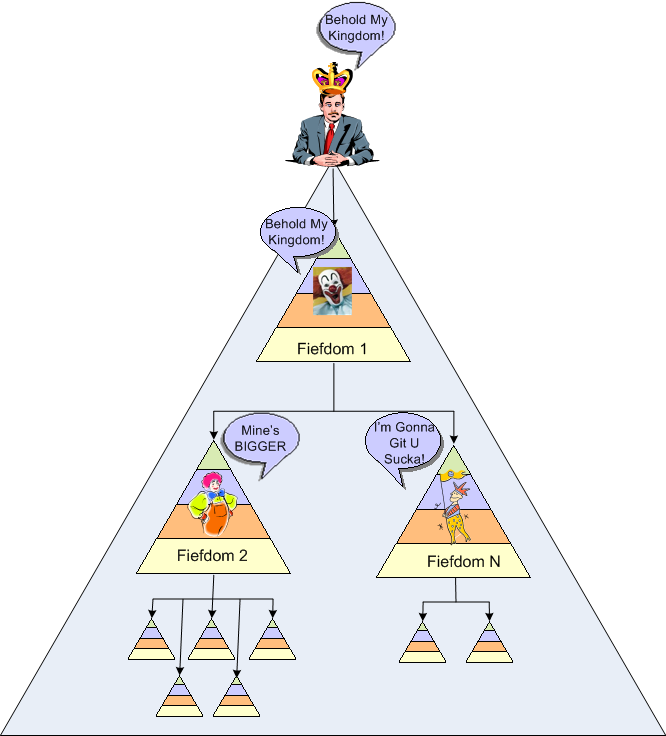
The figure below shows the top three levels of an N level textbook corparchy. Virtually all corpo monarchs present some visual camouflage like this to model their beloved corpricracy. The massive illusions that a diagram like this intends to project are:
- an orderly flow of timely, accurate status information upward;
- intelligent direction and guidance downward;
- cooperative collaboration both sideways and diagonally;
- a paragon of efficiency and excellence for all external and (especially) internal observers to embrace without inquiry.
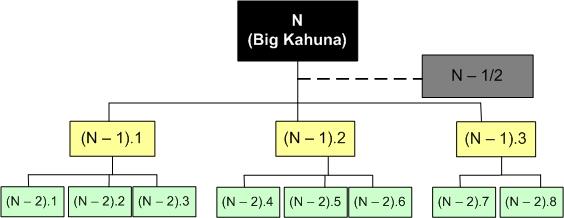
Now, splash some cold water on your face and observe an example of a pseudo-realistic model of a typical DYSCO dance:
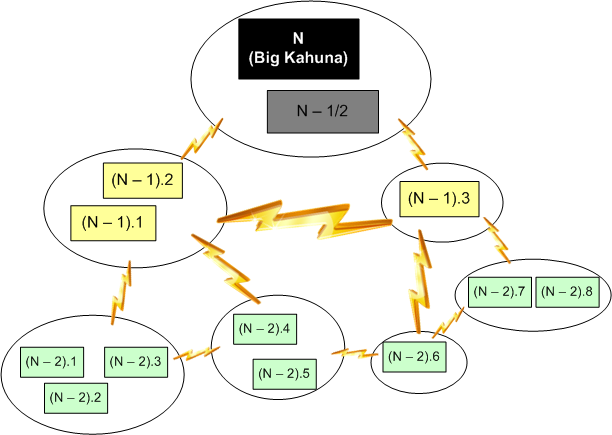 If you’ve inferred that the lightning bolt connections represent clever, but antagonistic and counterproductive relationships between rival DYSCO dancing factions, then you’d be right.
Some of my friends(?) have told me that I’m an elite DYSCO dancer. Are you?

N Minus One Half
Other than chief patriarch, where do you think the best position is on a stratified N + 1 layer corpo org chart? Consider the N – 1/2 position. You know, the coveted “dotted line” reporting position where, for some strange reason, the lowly paid and respected exec admin is always listed with the exalted, treasury raiding conciglieres. Here’s why it’s my top choice for you to aspire to:
- By definition, and probably not by your accomplishments (if any), you’re over compensated since you’re so high up on the chart.
- You don’t have any direct reports or whining sub-hierarchies of people under you to placate.
- You have the job security that independent, highly paid consultants (who may actually add value) at your level of so-called expertise don’t have.
- You have unfettered access to the corpo monarch. This gives you virtually unlimited time to kiss arse.
So, are you gonna go for it? Not me. Just give me something interesting to work on with a group of competent people and a PHOR project manager who gets the RIRPRT. Oh, and of course, pay me fairly too.

Nested Monarchies
Once again, I’m verklempt, so tawk amongst yourselves. I’ll give you a topic: “nested monarchies”.
Real-Time, Face-To-Face
Criticism is something we can avoid easily by saying nothing, doing nothing, and being nothing. – Aristotle
Ain’t that the truth? You can’t relate to it because you keep your trap shut out of fear of reprisal, no? Don’t worry, you’re not alone. Gracefully giving and (especially) receiving criticism in real-time, face-to-face is an art that I haven’t mastered. In those rare cases where I’m giving or receiving, either I’m meekly submissive or I blow a gasket; mostly the latter. Unlike when I’m blogging or e-mailing (a.k.a hiding behind the keyboard like a lot of engineers do), I’m too spontaneous to ponder, agonize over, and cunningly strategize over every word.
In corpricracies, criticism (real-time and face-to-face, or electronically) directed upward from the boys and girls down in the boiler room is verboten via one of the many rules written in invisible corpo ink, no? If not, then what purpose does the invention of anointed titles and structured CCH caste systems serve? What’s the purpose of the term “individual contributor” other than to divide and conquer? What’s the purpose of statements that start with “Effective immediately, management has decided…” other than to subtlely imply who’s allowed to criticize whom? How often do conquerees criticize conquerers, and when they miraculously do decide to profer some criticism, what’s the typical outcome? A subtle, unseen, but intensely felt top down psychological whuppin’?
On the bright side, at least civilization has “matured” from the time when the messenger who served up a pu pu platter was literally beheaded, no?

“The problem with any unwritten law is that you don’t know where to go to erase it.” – Glaser and Way
The DORK Is Born
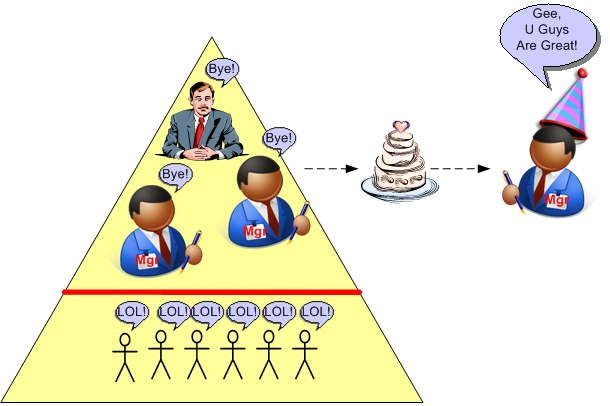
Unlike upstanding citizens, I’m both internally and externally verbally weird. For example, I think that when a proven, in-the-trenches, problem-solving, core worker jumps ship to another org it often hurts a corpricracy more than when a BM, CCRAT, BUTT, CGH or other non-DORK leaves. Because of anointed (not necessarily earned) positional power, non-DORK managerial workers are given the opportunity to positively influence an org’s social and economic performance. However, as all of us know, not all managers exert any positive influence at all. Au contraire, the really “bad ones” just flit from meeting to meeting conjuring up innovative procedural and financial obstacles to getting work done while simultaneously collecting super-sized paychecks. Who says managers aren’t innovative?
Because of this so-called distorted (and “bad”?) attitude, it makes me laugh when I hear of frantic counter offers being made when non-DORK managers leave, while nary a whisper is uttered when a highly productive, problem solving DORK rides off into the sunset. I laugh even more heartily when a non-DORK SCOL is presented with a going away cake or even better; an org-financed buh-bye party. Why laugh? Because the alternatives are much less palatable.
Breaking News: One of the byproducts of writing this stupidly RUU blarticle was the emergence of the “DORK” acronym from the bad-person corner of my psyche. I’m giddy with excitement cuz now I can interchange usage of the venerable “DIC” acronym with “DORK” in my future ramblings. Whoo Hoo, a landmark event!
Union Deterioration
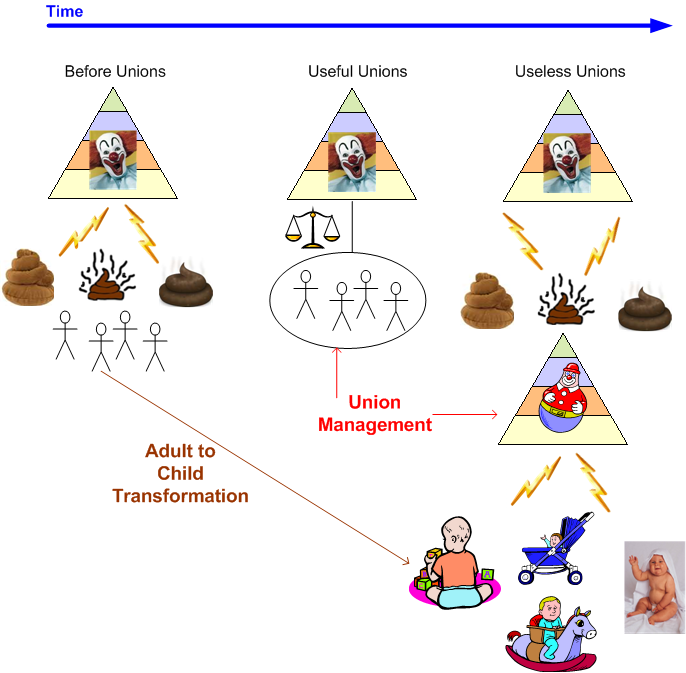
It took me forever to concoct this dorky picture, so I’m not gonna try to ‘splain it with any accompanying words. Hopefully, you’ll understand my message. If you need clarification on my interpretation, please ask.
Cows And Babies
From The End of Management – WSJ.com:
“Corporations, whose leaders portray themselves as champions of the free market, were in fact created to circumvent that market.”
“In the relatively simple world of 1776, when Adam Smith wrote his classic “Wealth of Nations,” the enlightened self-interest of individuals contracting separately with each other was sufficient to ensure economic progress. But 100 years later, the industrial revolution made Mr. Smith’s vision seem quaint.”
“In recent years, however, most of the greatest management stories have been not triumphs of the corporation, but triumphs over the corporation.”
“The best corporate managers have become, in a sense, enemies of the corporation.”
“Corporations are bureaucracies and managers are bureaucrats. Their fundamental tendency is toward self-perpetuation. They were designed and tasked, not with reinforcing market forces, but with supplanting and even resisting the market.”
“The thing that limits us,” he (Gary Hamel) admits, “is that we are extraordinarily familiar with the old model, but the new model, we haven’t even seen yet.”
Alas, many smart people have been predicting the demise of mechanistic, coercive, command and control hierarchies for decades. But like Tom Peters said in a semi-recent tweet:

Looking on the bright side, since the herd will be practicing self-serving hierarchy till kingdom come, if you split with the cows and truly install a decentralized participative meritocracy that leverages all of the creative brains in your org instead of treating them like children, then you’ll kick ass. But, uh, how do you do that? Hah, the devil’s in the delicious details. I certainly don’t know how – I’m just a standard, run ‘o the mill RUU DIC.


Why am I here?
WTF?
Meh!
D'oh!

My BTC Address



 Bulldozer00's Blog