Archive
Team Formation
Assuming all other things equal, which method of forming problem solving teams will produce the best results? Method A, of course. Why? Because Method B has never been tried. Why? Because…. that’s just the way it is – Method A only. Why? Cuz everyone knows, the boss is the smartest dude in the room. Why? Well, just because – dammit!

The led must not be compelled, they must be able to choose their own leader – Albert Einstein
Three Ways
Oh crap! If you think my Rush Limbaugh-like, anti-hierarchical rants are over the top now, they may get “worse” moving forward. I just discovered a small, academic publisher in the U.K. that solely publishes books on alternatives to hierarchical org structures: Triarchy Press. Since books like these are either burned, shunned, or ignored by those they are intended to help, I hope they don’t go out of business.

Have you even ever heard of the “heterarchy” or “autonomous responsibility” alternatives to the hierarchy beast? If not, it shows how firmly entrenched the hierarchical mindset is in most people’s psyches, no?
In one of Triarchy Press’s flagship books, “The Three Ways Of Getting Things Done“, author Gerard Fairtlough postulates that some magic combo of the three legs of triarchy is the most economically efficient and socially redeeming way of achieving org goals.

Hierarchy is so entrenched that a complete replacement, if it does prove desirable, will take centuries. – Gerard Fairtlough
Hierarchy will never go away. Never! – Tom Peters
Chain Of Responsibility
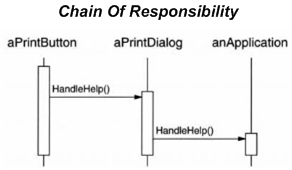
One of the well known design patterns in the object-oriented software world is named “Chain Of Responsibility“. The UML sequence diagram below shows an example of how the software objects in the pattern collaborate with each other in order to ensure that a user initiated help request is handled somewhere in the GUI of an application.
 As you might surmise, the world of hierarchical superiority has an analogous pattern, err anti-pattern, named “Chain Of Irresponsibility“. Do ya think I need to add words to explain the inter-object collaborations for this pattern as shown in the UML sequence diagram that follows?
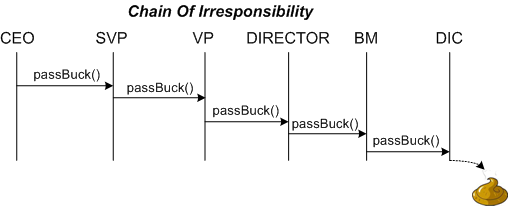
In case you were wondering, S = Senior, BM = Bozo Manager, and DIC = Dweeb In the Cellar.
Exit = Treason, Voice = Mutiny
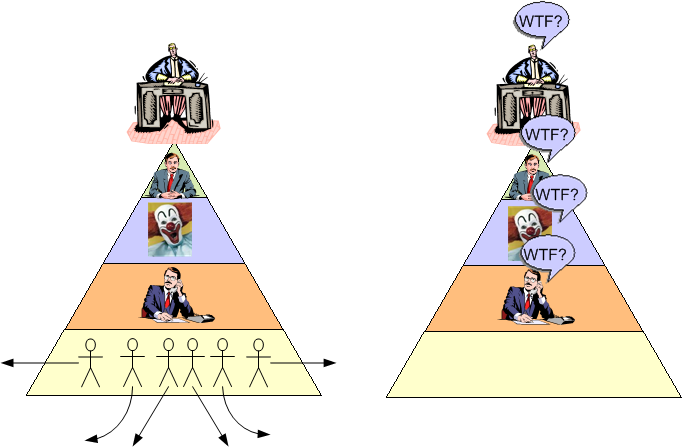
In “Three Ways Of Getting Things Done” (hierarchy, heterarchy, autonomous responsibility), Shell chemicals ex-CEO and Celltech founder Gerard Fairtlough defines the only two ways that subordinates can take action against hierarchies as: exit and voice. Of course, the 2000 year old dictatorial mindset that’s firmly cemented into corpo CGHs everywhere always unconditionally interprets DICster exits as treason and DICster-voiced opinions that counter hierarch-imposed policy, mutiny. The reason: the paternal self-perception of infallibility. If you think you’re perfect, “they” must be traitors and mutineers, no?
In times of institutional stability, when the DIC exit rate is low and the frequency of counter-voice is low, subordinate exits and counter-voices are ignored by the self-proclaimed best and brightest. When the exit and voice rates rise high enough so that their corrosive effects on the corpricracy can’t be ignored any longer, the treason/mutiny interpretation auto-kicks in as a self-medicating defense mechanism – and it’s back to business as usual. Even when the base of the pyramid becomes a hollow and voiceless shell incapable of feeding the ravenous fat cats up the chain of infallibility with spiritual adoration and material wealth, it’s……. still business as usual. In fact, it’s always business as usual until external forces inevitably and surely cause it to become unusual.
Buckshot
Welcome my son, welcome to the machine – Pink Floyd
Is your borg structured like the impending disaster depicted below? Since it’s so ubiquitous, publicly unquestioned, and taken for granted as a “best practice“, the odds are that it is. Note that the products are second class citizens at the bottom of the chart (if they’re even shown at all) and the people supposedly responsible for product integrity are blasted like buckshot across the DYSCO.
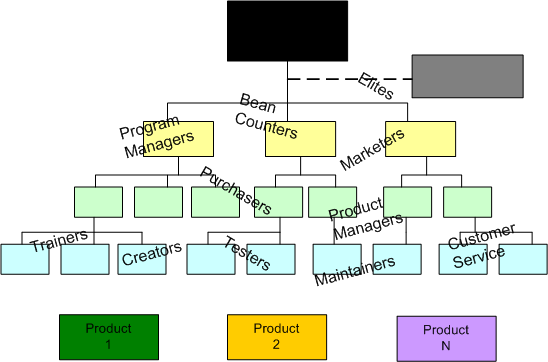
When a self-important SCOL, BOOGL, BUTT, CORKA, or BM is asked to sketch out a model of their beloved borg, you’ll likely get a cookie cutter picture just like it – yawn. In their brainwashed minds, what’s important is who reports to who and who (not what) funds their livelihood. Everybody, including the DICforce, is primarily concerned about who is above and below them in the pecking order. Despite what is espoused, everything else is secondary – especially the real stars in the borg – the product portfolio.
The figure below shows an alternative, flattened, product-centric arrangement highlighted with cross-learning links and dynamic job rotations. How many of these weird animals have you seen? Why not? Is it possible to transform the soulless, stationary borg above into the vibrating pancake below? What would it take? Who could do it? Should it be done?

Thirty-Six Lucky Ones
With all this ranting that I do against hierarchical orgs, you’d think I would have been burned badly in the past by a succession of tyrant bosses. You’d be wrong. I’m fifty-two years old (D’oh!) and I’ve been working in hierarchies since I was 16. Throughout those 36 years, I can honestly say that I’ve never had a horrendous boss. I’ve worked for a handful of terrific ones that I deeply admire and respect. I’ve also worked for several good ones, and many average ones. In absolute terms, I’ve never felt underpaid, but in relative terms, I have (Waaah and Boo-Hoo!).

The “bad” experiences I’ve had within the hallowed halls of hierarchy were with 1 dimensional program managers, project managers, and product managers (damn-the-people-schedule-is-all-that-matters). Interestingly, the most friction I’ve been a co-creator of has been with manager wannabes. You know, those so-called technical peers who:
- talk a good, jargon-filled game to cover up their incompetence,
- continuously obstruct progress to fill their time and simultaneously cover up their own lack of contribution,
- don’t create any value directly – not even spreadsheets or Gannt charts in preparation for their upward advancement into the guild of management.
When those dudes do get promoted, and IMHO it has happened unconscionably often throughout my “career“, I steer clear of them. It’s BM city and my car ain’t gonna drive through it.
Even though I’ve been incredibly lucky with hierarchical bosses, I’ve known quite a few fellow DICsters over the years who’ve felt that they weren’t treated fairly by hierarchs – even by some of the exact same bosses that I’ve had.
How about you, what’s your boss story? Why won’t you tell me about it?
Peer Relationships
As you move up into the Bozone layers in a DYSCO, in addition to honing your Kiss-Up-Kick-Down skills, your horizontal relationships with your peers mysteriously start to change…..

Of course, the diagram is totally wrong and it lacks credible scientific evidence to back it up, no? Hey, what do you expect from a L’artiste?
Caught Chetan Again!
It’s sad, so sad. It’s a sad, sad situation. And it’s gettin’ more absurd. – Elton John
Sometimes, actually, a lot of times, I like to commiserate with like-minded people (isn’t that what community is all uh-boot?). Thus, when I recently hooked up with new e-friend and author of “Why Your Boss Is Programmed To Be A DICtator“, Chetan Dhruve, we commiserated about the current stagnant state of leadership in the business world. In one of our exchanges, Mr. Dhruve asked:
May I request a favor. Could you please post your review of my book on Amazon.com? This is because many readers email me their comments directly after reading the book – with the result that the number of reviews is low (only 3 reviews currently). In many cases, readers are afraid to put up reviews for fear of being being found out and victimized at their workplaces, and hence don’t want to take any chances. In fact, many people have told me that they are afraid to even place the book on their workplace desks in full view, simply because of the book’s title. – Chetan Dhruve
Of course, that statement sent a shiver down my spine, but I did what he asked because – a man’s gotta do what he’s gotta do (for me, replace the word “man” with “child“). Upon further dialog, Chetan continued on with a couple of other scary vignettes:
A friend of mine (in the US) who loved the book bought 10 copies to give to clients. He then had the thought: “What if my clients feel that I’m implying they are bad bosses? Maybe I will lose their contracts.” So instead of giving the books to clients, he gave the books to relatives. He told me all this saying, “The book’s title will scare people, and it’s going to be a problem for you.” Indeed, he has proven to be correct.
A similar thing happened with another friend of mine. She gave a copy of my book as a gift to a friend of hers, whereupon the friend was instantly offended and got defensive saying, “I promise I will try hard to be a good boss.” This was even before reading the back cover of the book!
The irony is that the book doesn’t blame individuals but the system. And these gut-reaction behaviors only prove the point that we have dictatorship systems at our workplaces. It’s terrible, absolutely terrible, to know that people are frightened to simply have such a book on their table! I didn’t anticipate that the fear levels would be so high, that too in a free country.
I hate to sound like a know-it-all (well, maybe not), but I coulda told Chetan of the reality of his last sentence before he shockingly discovered it for himself. No matter how much one abstracts an anti-hierarchy message and directs it away from specific people, people above level 0 in a hierarchy are going to get offended at the slightest hint that you resonate with Chetan’s blasphemous message. After all, hierarchy has a sacred origin and religion has always been at the top of the heap when it comes to instilling fear into people, no?.

The statements that make people mad are the ones they worry might be believed. I suspect the statements that make people maddest are those they worry might be true. – Paul Graham
Related Articles
Healthy And Stress Free
Via the Netflix “Watch Instantly” service, I recently viewed this wonderful and scary National Geographic documentary: “Stress: Portrait Of A Killer“. The program focused on the results of these two studies:
- A thirty year study on African baboon troupes by a dedicated Stanford University professor.
- A forty year study, called the “Whitehall Study“, on 18,000 British civil service employees (hint: hierarchy)
Ready to be surprised? In both studies, the results showed that the higher up in the hierarchy you ascend, the healthier and less stressed you become. Yepp, that’s right. Fuggedabout the crap that’s been drilled into your brain about the increased stress that comes with the so-called increase in “responsibility” as one ascends the corpo ladder. The reality is that the higher up you go:
- the more titles you accumulate (for your impressive LinkedIn profile),
- the more money you make for taking on more responsibility that you’re not held accountable for,
- the less “dirty and visible work” you have to do, uh, except for aimless and agenda-less meetings where you toot your own horn over others,
- the more control over “others” you have – to deflect blame when you screw up – which you never do.
How can that be stressful and detrimental to your health? By all means fellow DICsters, keep scratchin’ and clawin’ your way toward the top. It’s healthy fer ya.
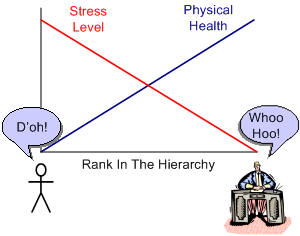
I actually wasn’t surprised by the show. Well over 20 years ago, friend and mentor William L. Livingston opened my eyes to the Whitehall study results in his epically disturbing “Have Fun At Work” book. It stunned me back then, but makes me laugh now.
To be fair, I have no doubt that there are many non-BMs in hierachical DYSCOs who do feel the increased stress their job should bring on. These are the people who thoughtfully and endlessly struggle with the conflicting demands of the wide ranging set of stakeholders who have an interest in the org’s economic and social performance. Thankfully, I have known, and do know, some of these people. How about you?
Note: If you want more detail on the documentary, check out my notes plus audio livescribe pencast on the program here.
Your Chetan Heart
OK, OK. The title of this post has nothing to do with its content. It just “felt” right.
The “Chetan” in the post title is a placeholder for “Chetan Dhruve”, the author of the splendidly candid and hard-hitting “Why Your Boss Is Programmed To Be A Dictator“. Recently, Chetan (I don’t know how to pronounce his name but I’ll bet it doesn’t sound like “cheetin'”) contacted me via LinkedIn. He graciously asked if he could use the content of my “Leader Or Dictator” post on his web site. Of course, being the needy, fame-seeking, egomaniac that I am, I used my “power of authority” to “approve” of his request – after he filled out all of the proper forms and paid the licensing fee, of course. Check out Mr. Dhruve’s site here – and then buy the freakin’ book.
 Note: The “man” on book cover is actually a collage of six of the most notorious dictators of all time. Can you guess who they are? If not, you can find out on Mr. Dhruve’s site.

Why am I here?
WTF?
Meh!
D'oh!

My BTC Address



 Bulldozer00's Blog