Archive
Keystone Koppers
Here’s just one entertaining excerpt from Bill Livingston’s darkly insightful and mind-bending book, “D4P4D“:
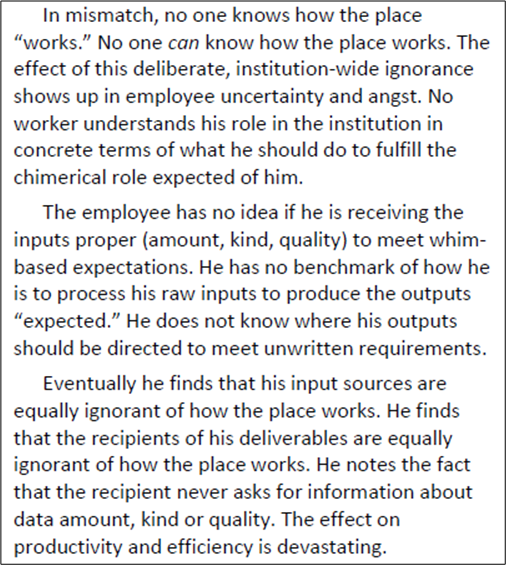
The key word in the whole excerpt is “mismatch“. When there is a “match“, all is well, and “business as usual” gets the job done effectively and efficiently.
So, whadya think? Fearful fact? Funny fiction? A touch of both?

A Blank Stare In Return
In a previous life, I once was commiserating with a manager about how difficult and time consuming it was to keep up with technological change in the software development industry. She said “That’s why I went into management“. After sharing a chuckle, I asked her if there were any other reasons for movin’ on up. I received a blank stare in return.
In a previous life, I once was talking to a software lead and hinted that maybe he should do more than watching schedules and doling out tasks (like cutting some code from time to time or keeping the technical documentation in synch with the code or doing some exploratory testing on the code base or taking on the role of buildmaster). I received a blank stare in return.
In a previous life, I once asked a software lead why he moved out of “coding” and into the periphery of management. He said: “For more money“. When I asked him if there were any other reasons, I received a blank stare in return.
At least they were honest. They could’ve offered up the classic management textbook response: “to take on more responsibility“. Better yet, they could’ve said “to help people do their jobs better” or “to help improve the quality of our processes by reducing red tape and eliminating low value steps“.
So, are they “selfish” people? Nah. This ubiquitous behavior is simply a side effect of how the vast majority of reward and power distribution systems are structured in hierarchical orgs. It’s been that way for 100 years and it looks like it will stay that way for the next 100 years. But then again, maybe not.
Us And Them
BD00 speculates that all non-psycho leaders would love to dissolve the “us vs them” attitude that most likely pervades their org. Alas, it’s not easy to do when your org is structured as, and operates like, a standard command and control hierarchy. Here’s a list of reasons why the “us vs them” conundrum endures within the walls of the CCH:
- We unilaterally set the rules, policies and procedures they are required to unquestioningly follow
- We get bonuses and they get COLAs (Cost Of Living Adjustments)
- We plan their work and evaluate them; and there is no “quid pro quo Clarisse“
- We have a loose set of criteria for evaluating for ourselves and a strict set for evaluating them
- We have nicer offices than them
- We promote/demote them, not vice versa
- We conform them to the org and we conform the org to us.
- We physically co-locate our team in a corner and fragment their teams throughout the org
Got any other “us and them” reinforcers to add to the list?

Profound Shift In Focus
The following quote comes from John Hagel via this Peter Vander Auwera blog post: “Corporate Rebels United” – the start of a corporate spring?”:
The key answer that defines the post-digital enterprise is to shift attention from the cost side to the value side. Rather than treating employees as cost items that need to be managed wherever possible, why not view them as assets capable of delivering ever-increasing value to the marketplace? This is a profound shift in focus. For one thing, it moves us from a game of diminishing returns to an opportunity for increasing returns. There is little, if any, limit to the additional value that people can deliver if given the appropriate tools and skill development. – John Hagel
For big, established companies who can’t even remember what it was like to focus on value, “profoundly shifting” from a cost mindset back to a value mindset is a tall order indeed.
As the state machine based figure below illustrates, successful startups are totally “value focused” in the sun-up phase of their life. But over time, as they obsessively grow and misguidedly try to become more efficient by adding layers upon layers of cost watchers, the vast majority of them (with few Apple-like exceptions) morph into “cost focused” borgs.

Once a formerly vibrant org has moved into the sundown phase of its life, the borgdom hardens. It’s cost-focus till death, with no memory of any prior, value-focused behavior.

Unstated, But Deeply Rooted
Maturity is a state that most companies eventually reach. To break out of – or avoid – maturity, innovation is required: new products or services, new marketing or markets, more of what is different, not more of the same. – Russell Ackoff
Not only is “maturity” reached by most orgs, it is actively pursued in order to fulfill an unstated, but deeply rooted amygdalayian desire to transition from org to borg. The hilarity of the situation is that while a “maturing” org’s behaviors and processes unceasingly and silently nudge it toward rigid borgdom, the esteemed leadership continuously cries out for innovation. Do as I say, not as I do. D’oh!

Lacking Smarts
Check out the title of this article and have a LOL with (or at) BD00: “People Aren’t Smart Enough for Democracy to Flourish, Scientists Say“.
The research, led by David Dunning, a psychologist at Cornell University, shows that incompetent people are inherently unable to judge the competence of other people, or the quality of those people’s ideas.
D’oh! Too stupid to judge. That’s BD00 in a nutshell when he attempts to unfairly scald the guild of management and its continued, often subtle, application of Tayloristic techniques in the 21st century.
…democracies rarely or never elect the best leaders. Their advantage over dictatorships or other forms of government is merely that they effectively prevent lower-than-average candidates from becoming leaders.
If that’s “merely” true for democracies, then un-democracies must merely suck. How well do you think undemocratic boards of directors do in choosing executives and how well undemocratic executives do in anointing subordinate managers and how well undemocratic managers do in hiring DICsters and how well DICs do in….? Oops, I almost forgot that DICs aren’t allowed to choose or anoint.
Of course, this research on incompetence doesn’t apply to the elites who run institutions because boards of directors, executives, and managers are infallibly competent in their profession.
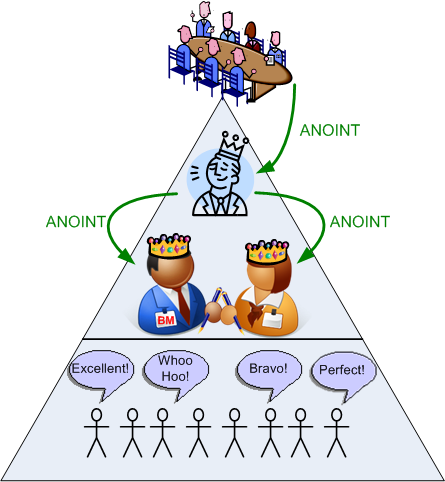
Ya gotta love this Wikipedia definition of anointment:
To anoint is to pour or smear with perfumed oil, milk, water, melted butter or other substances, a process employed ritually by many religions. People and things are anointed to symbolize the introduction of a sacramental or divine influence, a holy emanation, spirit, power or God.
At my anointment, I want to be smeared with… peanut butter and melted Godiva chocolate. How about you? What’s your substance of choice – assuming you have a choice?
The Uncrossable Threshold
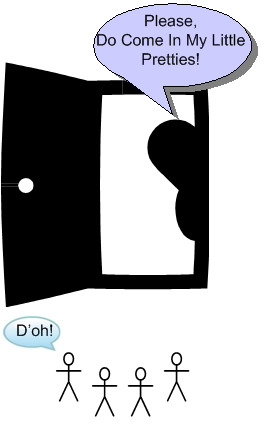
Unless you work in a Chinese sweatshop, the likelihood is high that your management has an “open door” policy. After all, it’s been the right thing to do since the 80’s, right? However, the likelihood that anyone but their “direct reports” casually cross the threshold to chat about problems and ideas for improvement at any level in the org is low, no?
So why is that? Could it be an unwritten rule in hierarchies that “little” people aren’t allowed to “whine” to stratospheric luminaries? Could it be a culture of fear of reprisal? Could it be a dearth of trust? Could it be the perception that bosses don’t like to hear bad news? What do you think it could be?
Ingrained Internal Shared Mindset
All Models are wrong, but some are useful – George Box
One of the models below puts the owners and managers of an enterprise at the top and the other model places them at the bottom. Which system design do you think is capable of creating more wealth for all stakeholders over the long term?

ReOrg City
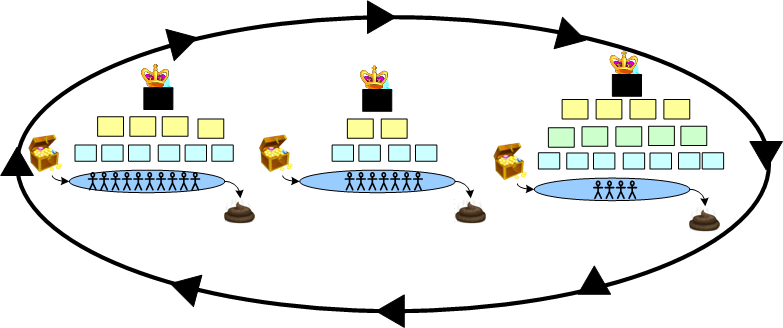
The structure of the “whole” and the behaviors at both the top and bottom remain the same. Only the width and/or height of the pyramid changes with each reorg. But alas, that’s just “the way it has to be“, no?

Behavior Compression
I’m gonna be an “absolutist” in today’s post. I’m gonna use the word “all” instead of “most“.
In all man-made orgs, as one ascends the hierarchy, the range of behaviors exhibited by members of a given level is compressed relative to the level below it:

So, why is this? It’s because org members unconsciously understand that as one’s stature rises via anointed promotion, an unseen pressure to project an image of infallibility increases. In order to be perceived as perfectly omniscient and omnipotent, behaviors that can be interpreted as less than impeccably pristine by the population below must be jettisoned. So, why is this? Well, it’s just… because BD00 said so.
The sad thing about this system behavior is that it takes a lot of energy and work to shed deviant behaviors and exude a false image of perfection. Instead of asking “Do you have what it takes to get to the top?“, maybe the question that should be asked is “Do you have what it doesn’t take to get to the top?“.


Why am I here?
WTF?
Meh!
D'oh!

My BTC Address



 Bulldozer00's Blog