Archive
Temporary Enlightenment
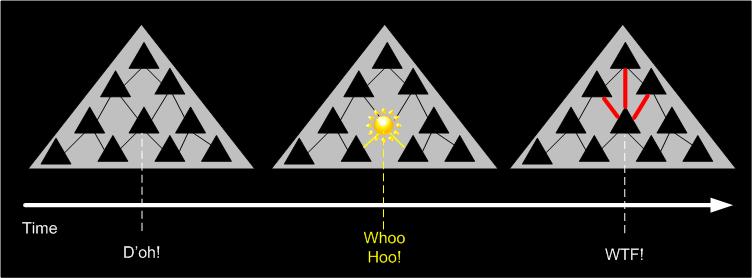
Four Reasons
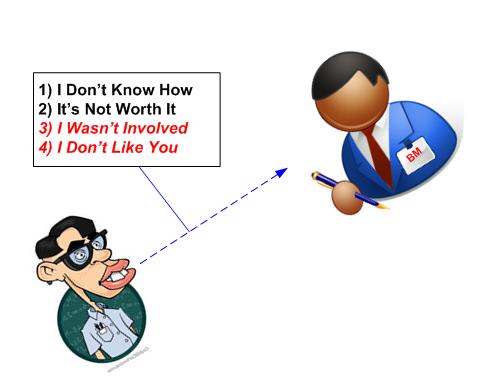
When I don’t do something that I’m “supposed” to do, it comes down to one of two reasons:
- I don’t know how to do it because of a lack of expertise/experience (ability).
- I don’t believe it adds any, or enough, value (motivation).
But wait, I lied! There are also two more potential, but publicly undiscussable reasons. They’re elegantly put into words by Mr. Alexander Hamilton:
Men often oppose a thing merely because they have had no agency in planning it, or because it may have been planned by those whom they dislike. – Alexander Hamilton
How about you? When you don’t do something expected of you, why don’t you do it?
Command Vs. Control
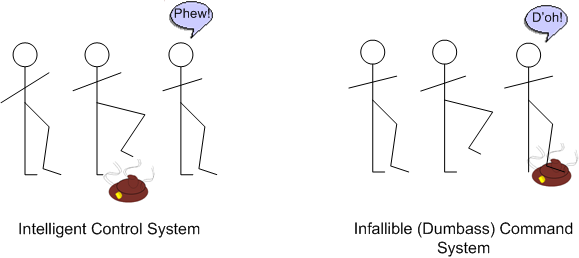
One of the acronyms in BD00’s evil glossary is “CCH“. It stands for “Command and Control Hierarchy” because BD00 thought that command and control were fused together like Forrest Gump‘s peas and carrots. However, In “Making Sense Of Behavior“, Bill Powers distinguishes between a command hierarchy and a control hierarchy in an interesting way.
In a command hierarchy, a command dictates a specific action (git ‘r done!). In a control hierarchy, a command is a reference signal that specifies the state in which a particular perception is desired to be at in a future point in time; a vision, if you will.
For example, a sequence controlling system doesn’t order the limbs to be in a particular configuration; it tells a lower level control system to perceive the limbs as being in a particular position, then another, then another. By receiving a less specific reference signal, the lower level position control system can compensate for unforeseen disturbances (wind, gravity, physical obstructions) without distracting the higher level control system from its purpose.
Healthy Debates
The article, “Overconfidence May Be a Result of Social Politeness”, opens up with:
Since society has taught us not to hurt other people’s feelings, we rarely hear the truth about ourselves, even when we really deserve it.
Phew, BD00 is glad this is the case. Otherwise BD00 would be inundated with “negative feedback” for being a baddy. Uh, he actually does get what “he deserves” occasionally, but what da hey.
Florida State University researcher Joyce Ehrlinger, upon whose research the article is based, empirically validated the following hypothesis to some degree:
If person A expressed views to a political subject that person B found contradictory to their own, the result would not be a healthy debate, but just silence from B – and an associated touch of overconfidence from A.
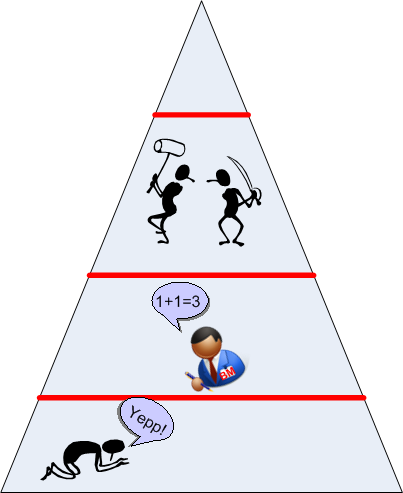
Now, imagine applying this conjecture to a boss-subordinate relationship in a hierarchical command and control bureaucracy. Bureaucratic system design natively discourages healthy debate up and down the chain of command and (almost) everybody complies with this design constraint. As a result, overconfidence increases as one moves up the chain. Healthy debates can, and do, occur among peers at any given level, but up-and-down-the-ladder debates on issues that matter are rare indeed. Hasn’t this been your experience?
Building The Perfect Beast
The figure below illustrates a simplified model of a Starkermann dualism. My behavior can contribute to (amity), or detract from (enmity) your well being and vice versa.

Mr. Starkermann spent decades developing and running simulations of his models to gain an understanding of the behavior of groups. The table below (plucked from Bill Livingston’s D4P4D) shows the results of one of those simulation runs.
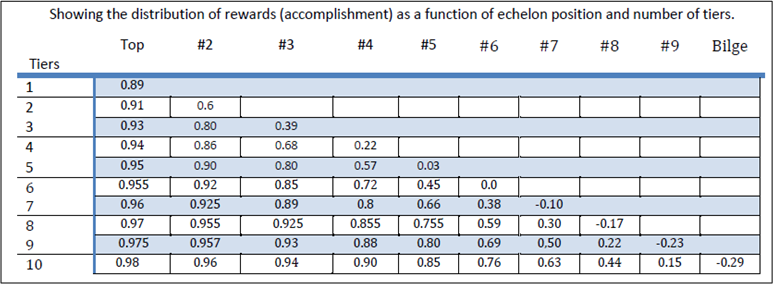
The table shows the deleterious effects of institutional hierarchy building. In a single tier organization, the group at the top, which includes everyone since no one is above or below anybody else, attains high levels of achievement (89%). In a 10 layer monstrosity, those at the top benefit greatly (98% achievement) at the expense of those dwelling at the bottom – who actually gain nothing and suffer the negative consequences of being a member of the borg.
What do you think? Does this model correspond to reality? How many tiers are in your org and where are you located?
Nine Plus Levels
In William T. Powers’ classic and ground-breaking book “Behavior: The Control Of Perception“, Mr. Powers derives a theoretical model of the human nervous system as a stacked, nine-level hierarchical control system that collides with the standard behaviorist stimulus-response model of behavior. As the book title conveys, his ultimate heretical conclusion is that behavior controls perception; not vice-versa.
The figure below shows a model of a control system building block. The controller’s job is to minimize the error between a “reference signal” (that originates from “somewhere” outside of the controller) and some feature in the external environment that can be “disturbed” from the status quo by other, unknown forces in the environment.
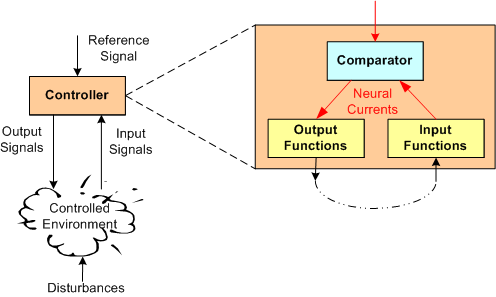
Notice that the comparator is one level removed from physical reality via the transformational input and output functions. An input function converts a physical effect into a simplified neural current representation and an output function does the opposite. Afterall, everything we sense and every action we perform is ultimately due to neural currents circulating through us and being interpreted as something important to us.
So, what are the nine levels in Mr. Powers’ hierarchy, and what is the controlled quantity modeled by the reference signal at each level? BD00 is glad you asked:

Starting at the bottom level, the controlled variables get more and more abstract as we move upward in the hierarchy. Mr. Powers’ hierarchy ends at 9 levels only because he doesn’t know where to go after “concepts“.
So, who/what provides the “reference signal” at the highest level in the hierarchy? God? What quantity is it intended to control? Self-esteem? Survival? Is there a “top” at all, or does the hierarchy extend on to infinity; driven by evolutionary forces? The ultimate question is “who’s controlling the controller?“.
This post doesn’t come close to serving justice to Mr. Powers’ work. His logical, compelling, and novel derivation of the model from the ground up is fascinating to follow. Of course, I’m a layman but it’s hard to find any holes/faults in his treatise, especially in the lower, more concrete levels of the hierarchy.
Note: Thanks once again to William L. Livingston for steering me toward William T. Powers. His uncanny ability to discover and integrate the work of obscure, “ignored”, intellectual powerhouses like Mr. Powers into his own work is amazing.
Shall And Shall Not
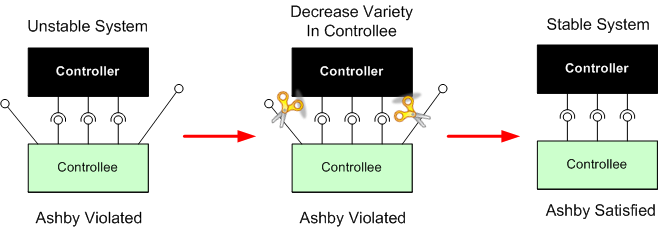
For a controlled system to remain viable and stable, Ashby’s law of requisite variety requires that the system controller(s) exhibit a wider variety of behavior than the system controllee(s). This can be accomplished by either the controller increasing its variety of responses to controllee disturbances, or by decreasing the variety of controllee disturbances relative to its own variety of control responses, or both.
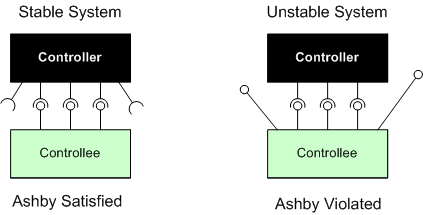
In order to comply with Ashby’s law (in conjunction with several other natural laws – 2nd law of thermo, control theory, Turing’s infallible/intelligence thesis, etc), Bill Livingston asserts that membership in any institution requires the internalization, either consciously or (more likely) unconsciously, of the following set of “shall” and “shall not” rules:
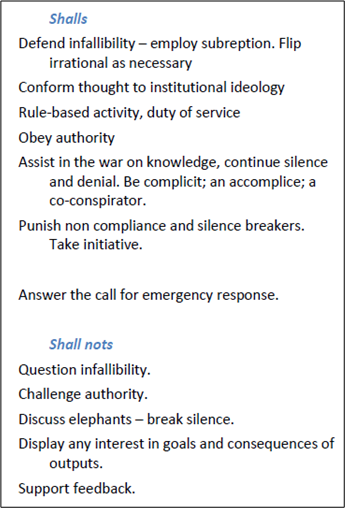
As you can see, suppressing variety in the controllee population is the preferred method of a controller aiming to satisfy Ashby’s law. The alternative, increasing its own variety of response relative to controllee variety of disturbance, requires learning and development. By definition, infallible controllers don’t need to learn and develop. They stopped learning when they achieved the status of “infallible” – either by force or by illusion.
So, what do you think? Did Mr. Livingston hit the bullseye? Miss by a mile?
Quid Pro Quo
Forget about the superficial, ceremonial, “empoyee survey” that is often ignored and quickly forgotten. Wouldn’t it be a great quid-pro-quo move to “allow” each employee in an org to formally judge his/her organization’s behavior, I mean performance, once a year? The content of the review form could be similar to the one in which the employee him/herself is evaluated. After filling out a set of multiple choice questions and allowing for free-form input to justify the selections, an overall behavioral rating could close the review. The rating could be selected from an enumerated list similar to this:
- Exceeds Expectations
- Meets Expectations
- Needs Improvement
- Unacceptable
Based on the final rating, instead of giving the org a merit increase, the employee would communicate the level of commitment that he/she will really provide in the coming year:
- Total Commitment
- Half-assed Commitment
- Feigned Total Commitment
Of course, much like parents and teachers are expected by “the entrenched social system” to evaluate their children, but not vice-versa, this idea doesn’t have a chance of making it into the mainstream. Nevertheless, BD00 speculates that the practice is done somewhere as part of a continuous improvement initiative?
Pragmatic?
Scripted Behavior
Since I’m on a mini-roll hoisting excerpts from W. L. Livingston’s D4P book, here’s yet another one (I had to type the example in by hand because it only appears in the print version and not in the pdf. D’oh!):
In project review meetings, the whimsical plan, riddled with entropy and misinformation, is used as gospel to measure “actual” progress. Since everyone at the meeting knows the measurement is useless as a control, it becomes an instrument of management to manage the project. Invariably, management directs a get-well plan be devised to get back on the horribly-flawed milestone plan. Of course, the get-well plan is composed in the same toxic way.
The attending executive proclaims “If you don’t get this mess back on schedule by tomorrow, I’ll get somebody who can.” Everyone has heard this proclamation of executive out-of-control. The impact of this act of desperation on the project is wholesale CYA (Cover Your Ass) and subreption. Information available for forecasting progress becomes nothing but calculated lies. That’s where attempts to defy natural law land you.


Why am I here?
WTF?
Meh!
D'oh!

My BTC Address



 Bulldozer00's Blog