Archive
Bureaucracy Formation
Since I’m not a big fan of bureaucracies, let’s have some fun and see how these resource sucking and dehumanizing orgs are naturally formed right under the noses of the high paid corpo dudes who are ironically “responsible” for keeping costs down. As you’ll see, it may even be worse than you think. The infallible, know-it-all, multi-titled CGHs in charge not only allow their bureaucracy to flourish, they feed and water it as a result of the unconscious and self-centered need for ego expansion.
Check the figure below out for a hypothetical example of the formation of a bureaucracy over time. As usual, I’ve made the example up (cuz I’m a L’artiste) and I’ve simplistically decomposed a complex org into two group archetypes; product and support. In my obviously wrong dream-world, the otherwise highly esteemed management class is a support group sub-type, of course.
At t=Start, when a vibrant and competent startup org is initialized, there are no “support” groups: nada, zilch. There’s only a product development (or service provider) group that does everything needed to sustain and grow a business around the wealth-creating product (or service).

As time tics by and the fledgling enterprise grows, one support group after another is added as another ring of fat around the product development group core. At the beginning, the support groups are few, and they’re subordinate both in stature and compensation to the wealth creation group because everyone knows that the product and/or service brings home the bacon.
As the org matures, an incredulous flip in the stature structure snaps into place (t=T3 in the example above) because, well, because that’s the way it is. The first of many subsequent support groups to rise in stature is the executive level management cadre. As even more corpo maturation accrues, all emotional enthusiasm and passion is expelled from the org because the same-old, same-old, mechanistic, B-school and Wall Street psychology usurps the childlike and immature “let’s change the world” mindset which birthed the org in the first place. The so-called management leadership cabal catalyzes and accelerates the move to bureaucracy by; treating wealth creators as easily replaceable DICs, punishing any publicly expressed passion and enthusiasm, cloning themselves in newly added middle management layers, and growing their personal empires in order to inflate their pocketbooks and sense of importance at the expense of the org as a whole. Bummer.
“Are you here to build a career or to build an organization?” – Peter Block
Don’t Sign That Check!
When someone presses your buttons and tries to insult you or your strongly held beliefs, you don’t have to automatically fall into a defensive position and start your own retaliatory offensive onslaught. It’s like the perp has written out a check from your checkbook, but your signature is required for him/her to cash it in.
The trick is to realize the meteoric rise in emotional temperature before your ego, or what Eckhart Tolle calls the pain body, takes over the steering wheel. Alas, even knowing this, I have the hardest time keeping the cap on the pen.

Pompous?
In “Hackers And Painters“, Paul Graham writes:
Beginning writers adopt a pompous tone that doesn’t sound anything like the way they speak.
Hmmm. When I read that, I thought “Does this quote apply to me?“. Since I’m embedded within the system of interest here, (which is me, me, me, of course!) and not an external observer, I’m not qualified to answer the question. There’s one person that I interact with almost daily that I know reads this blog semi-regularly. If he’s reading the post, could he please profer his opinion?

Play ISTY For Me
In my experience, the more raw technical knowledge an engineer acquires, the more the tendency for him/her to drift unconsciously into ego-centricity and arrogance. The more specialized the knowledge, the more the arrogance. Having personally overcome this malady to at least some extent, I’m facing a conundrum with a brilliant younger colleague. The conundrum is how to teach the youngster to internalize a sense of humility while trying to remain somewhat humble myself.
Like many academically smart kids with a few years of programming experience under his belt, this kid knows a lot of details about a few topics in software engineering (if it can be called engineering) along with a few details about a bunch of others – especially more abstract subjects like large scale design and architecture. On the topics he has little knowledge of (but just enough to be dangerous), he makes sweeping generalizations that I know aren’t correct based on my long but undistinguished career. However, when I try to gently poke holes in his sweeping generalizations and assertions, he digs in. I then lose my patience and tend to get sucked into the awful, I’m-Smarter-Than-You (ISTY) game. The irony of the situation is that my young friend doesn’t lose patience and he stays “cooler” than I do while playing ISTY. D’oh! Because of this ability to remain cool, ignorant, and overconfident, he no doubt has the makings of a future bozo-type manager. Alas, I hope he doesn’t choose that path because he is truly a remarkable technical contributor who creates value.
Oh well, life would be boring without challenges (<- that’s bozo-management-speak for “problems”) to overcome.

What’s REALLY Required
An understanding and application of “Systems Thinking” are pre-requisites to effective leadership in any large socio-technical group endeavor. Since business schools and pundits teach so-called business skills in disconnected, specialized, fragmented chunks and the primary component of systems thinking is the opposite of this classically entrenched Descartesian way of thinking, effective large scale leadership is nowhere to be found except in rare, small pockets of brilliance.
Systems thinking employs analytical thinking as a subordinate to its opposite – synthetic thinking. Since most (the vast majority of?) elite execs intentionally fragment their time to match their thinking style and they don’t know how to synthesize anything but an inflated and infallible image of themselves, they’re eternally stuck in the quagmire of one dimensional analytical thinking without a clue. But hey, ya gotta give them credit for knowing how to stuff their pockets with greenbacks.

Seeking Trouble
I’ve had the Kindle version of it for awhile, but I’ve finally got around to reading “Gurdjieff” by John Shirley. I’m glad I did because early in the book, this passage stirred up some internal energy:
According to the Gospel of Thomas, Jesus said, ‘ Let him who seeks continue seeking, until he finds. When he finds, he will become troubled. When he becomes troubled, he will be astonished, and he will rule over all.'”
It caused an energy surge because I’ve seeked and found trouble, deep trouble, multiple times. I’ve found that virtually everyone, both individually and collectively, behaves unconsciously according to the selfish “I” thought. Of course, this mass of humanity includes me, especially.
So, I’ve seeked, found trouble, and became astonished. However, I’ve yet to “rule over all”, which I think wasn’t meant to be taken literally. Hell, I’d settle for just ruling over my false self. How about you, have you found trouble?

Don’t Keep It A Secret
When I was younger and working at my first real job as a sonar “system engineer”, I was tasked with designing a set of digital filters to process a multiplexed stream of audio signals from a sonar microphone array. During a weekly status meeting, the best manager I ever worked for asked me if I’d written up the design and had it peer reviewed. I told him that I hadn’t and then he hit me with the first of many wise zingers over several years. He told me “Don’t keep it a secret. Write it up, communicate it, share it.” Being the dumbass and naive engineer that I was (and still am?) back then, I hadn’t thought of doing that. I was just gonna slip the resulting design into the system specification, let the software and hardware and test dudes deal with any mistakes/errors downstream, and move onto my next joyful assignment.
When my mentor said “don’t keep it a secret” to me, a terrible fear gripped me: “What if I screwed up and someone points out a major flaw in the work? What would people think? People might laugh at me.” Instead of thinking about adding value to the company and helping others do their jobs better, I was dwelling on self-important thoughts about ME – poor ME. Alas, such is the conditioning that is innocently but surely foist upon us from the moment we start disassociating ourselves from our true being and we start welding ourselves to the “I” thought. This freedom-squelching conditioning process starts with our parents and continues relentlessly throughout school and throughout our working lives.
From what I remember, the writeup and review process went much better than I anticipated. However, even after that first jolt, it still took me a long, long time to overcome the fear of exposing my work to others. Even today, many years later, I sometimes relapse and must fight the fear instinct associated with exposing work to others for scrutiny – especially managers.

How about you? Have you ever experienced a similar feeling? Do you still experience it? Is your goal to jump into management as quickly as possible so that you can escape the fear and transition from scrutinizee to scrutinizer? Have you already successfully done this? Dudes and dudettes, don’t be shy and please gimme some blowback. 🙂
From Searcher To Explorer
Most spiritual teachers advise students to “stop the search!”. Like many other frustrated spiritual aspirants, I don’t know of any other strategy for attaining enlightenment, an awakening, inner peace, relief from suffering, separation from ego, or whatever you want to call it.
To me, “searching” means looking for something specific, like lost keys or oil. Since I don’t have a freakin’ clue as to what “enlightenment” is and I do want to follow the advice of those who purportedly have dissolved the ego (or at least have rid themselves of ego-dominance), I’ve stopped being a searcher. As of today, I’m now (drum roll please) an explorer! Since exploring means probing and sensing for the new and unknown, that’s what I will do from now on.

OK, OK, back to reality. This post is just another self-delusional attempt to fill a new bottle with the same old wine, err, vinegar. Ergo, on with the search!
The Last Remaining Method Of Simplification
In this blog post, “The Collapse of Complex Business Models”, uber-thinker Clay Shirky predicts the impending instantaneous implosion of many (all?) unfathomably complex business models that are currently thought by many to be unassailable. The cruxt of Clay’s compelling argument is based on eerily similar collapses of past complex cultures as told by Joseph Tainter in his aptly named book, The Collapse of Complex Societies.
Tainter’s thesis is that when society’s elite members add one layer of bureaucracy or demand one tribute too many, they end up extracting all the value from their environment it is possible to extract and then some. – Clay Shirky
Adding layer upon layer of bureaucracy (to disconnect themselves from the commoners, of course) and demanding “tributes” in the form of exotic titles, awards, astronomical salaries, and perks (to satisfy their egomania and bolster the false image that they “know what’s best for all“) pushes their elite system over the precipice.
In such systems, there is no way to make things a little bit simpler – the whole edifice becomes a huge, interlocking system not readily amenable to change. When the value of complexity turns negative, a society plagued by an inability to react remains as complex as ever, right up to the moment where it becomes suddenly and dramatically simpler, which is to say right up to the moment of collapse. Collapse is simply the last remaining method of simplification. – Clay Shirky
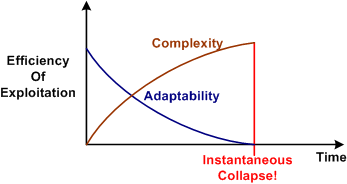
In this 5 minute video talk, “the current economy“, my favorite spiritual guru, Eckhart Tolle, trumps Clay by rising up one level of abstraction. Eckhart predicts the impending collapse of many of the societal structures that are ego based. Ego loves complexity. And how many large, man-made, socio-technical structures (a.k.a institutions) do you think are not ego based?
The problem is not the content, it’s the conditioned structure of the human mind – Eckhart Tolle
A Newly Discovered Universal Constant
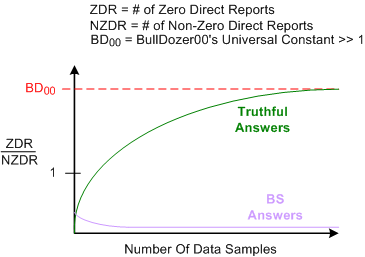
The next time you meet someone with a title of “manager of xxx” or “director of yyy”, ask the dude how many subordinates (a.k.a. DICs) directly report to him/her to be “managed” or “directed”. As you acquire data samples, keep a running tally over time of the ratio of the number of people who truthfully retort with an answer of Zero Direct Reports (ZDR) to the number of people who truthfully reply with an answer of Non-Zero Direct Reports (NZDR). My theory is that, as the number of collected “samples” grows, a truthful ZDR-to-NZDR ratio will increase and then level off to some yet undiscovered universal constant (like the speed of light in a vacuum, Avogadro’s number, or Boltzmann’s constant). Also, the ratio will settle out to a value much greater than one.
My bogus theory is based on the hypothesis that most people covet the esteemed title of “manager” and “director” because it’ll (at least temporarily) jack up their social standing compared to other “non-manager” low lifes and get them higher starting salaries and bonuses if they decide to jump ship. I also hypothesize that most self-proclaimed and artificially-anointed managers/directors who have zero direct reports will fib about it – especially if they’re highly confident that you won’t be able to verify their response as truthful. My advice is to flip the bozo bit from MBAB to IAB whenever you uncover a manager/director with zero direct reports who proclaims he/she has one or more direct reports under his/her control.
Since there seems to be a boatload of managers and directors aggregated there, LinkedIn.com is a fertile experimental lab for collecting data points. So, if you’re interested in exploring this cock-a-mamy, made up theory founded on no basis whatsoever, you can start there – especially if you’re a recruiter of managers and directors for your clients or your company.
So, why don’t I do my own data collecting and number crunching? Because: 1) I have no interest in doing it, 2) I project that I’d become depressed at my findings, and 3) I’m a lazy ass who likes to sit back and make stuff up that pisses some people off and ignites a chuckle in other downtrodden and incorrigible people like me. Of course, this assumes that there actually are others like me. D’oh!
A conscience is what feels bad when everything else feels so good. – Steven Wright

Why am I here?
WTF?
Meh!
D'oh!

My BTC Address



 Bulldozer00's Blog