Archive
Your Chetan Heart
OK, OK. The title of this post has nothing to do with its content. It just “felt” right.
The “Chetan” in the post title is a placeholder for “Chetan Dhruve”, the author of the splendidly candid and hard-hitting “Why Your Boss Is Programmed To Be A Dictator“. Recently, Chetan (I don’t know how to pronounce his name but I’ll bet it doesn’t sound like “cheetin'”) contacted me via LinkedIn. He graciously asked if he could use the content of my “Leader Or Dictator” post on his web site. Of course, being the needy, fame-seeking, egomaniac that I am, I used my “power of authority” to “approve” of his request – after he filled out all of the proper forms and paid the licensing fee, of course. Check out Mr. Dhruve’s site here – and then buy the freakin’ book.
 Note: The “man” on book cover is actually a collage of six of the most notorious dictators of all time. Can you guess who they are? If not, you can find out on Mr. Dhruve’s site.
Super Secret Recipe
Wanna know what the super secret recipe is for building an impenetrable UCB pyramid? OK, you said no – but that t’aint gonna stop me from loosening my lips and sinking ships. Here we go…..
- Directly or (better yet) vicariously experience a real-life situation involving people in which the outcome is a “surprise” to you.
- Judge the outcome as absolutely good or bad (no gradations allowed!)
- Strip and discard all messy contextual meaning from the situation.
- If you judged the outcome as “good”, then ignore it and kick out of this recipe – you’re done! Otherwise…..
- Concoct a reason why the outcome turned out “bad”.
- By removing all the uncomfortable details that don’t align with your existing UCB, vertically abstract your interpretation of the reason for the outcome.
- Horizontally generalize your cause-effect conclusion to subsume any and all situations with any remote resemblance to the experienced situation.
- Pour mental concrete around your newly discovered nugget of knowledge and jam it somewhere into your growing UCB pyramid.
- Pat yourself on the back for “knowing” how the world worx. Whoo Hoo!

Every man, wherever he goes, is encompassed by a cloud of comforting convictions, which move with him like flies on a summer day. – Bertrand Russell
Eclipsed!
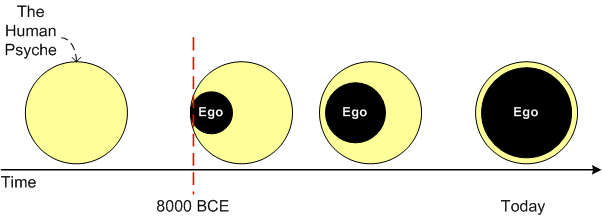
Steve Taylor‘s “The Fall” is an epic work. It’s both an academic and spiritual tour de force that covers the birth and subsequent explosion of the human ego throughout history. Using documented evidence from a wide range of archaeologists and anthropologists, he presents (what I opine is) an overwhelming argument that there is no innate “selfish gene“. You know, the one that everyone seemingly takes for granted and conveniently blames for man’s inhumanity to man.
In a nutshell, Mr. Taylor asserts that before 8000 BCE (yes, he goes all the way back to the dawn of man and painstakingly traces the life of the ego right up to us) all the available historical evidence points to the non-existence of war, oppression, patriarchy, and human exploitation of others. Please bookmark this page, read the book for the juicy details, and report your personal conclusions back here. Regardless of whether your UCB has been altered, I’d love to hear your before-and-after thoughts on the subject.
Double Loop Learning
Chris Aryris is a giant in the field of organizational development. LinkedIn e-colleague Gene Bellinger recently posted this classic Argyris article, “Teaching Smart People How To Learn“, to his “Systems Thinking” group. In the missive, Mr. Argyris gives a great example of double loop learning:
I have coined the terms ‘‘single loop’’ and ‘‘double loop’’ learning…. To give a simple analogy: a thermostat that automatically turns on the heat whenever the temperature in a room drops below 68 degrees is a good example of single-loop learning. A thermostat that could ask, ‘‘Why am I set at 68 degrees?’’ and then explore whether or not some other temperature might more economically achieve the goal of heating the room would be engaging in double-loop learning.
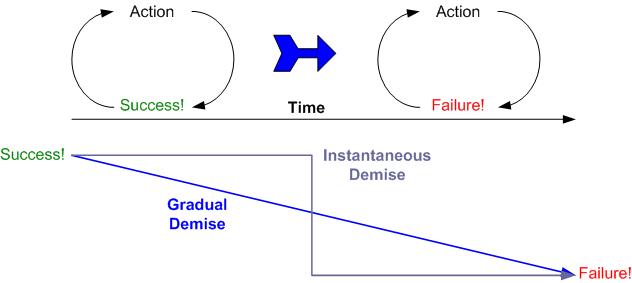
Because of the Law Of Impermanence (LOI), it’s inevitable that what worked in the past won’t work at some unknowable time in the future. The top half of the figger below illustrates the LOI in action. On the left, we have a successful org or individual happily humming along. The successful “entity” repeatedly performs actions that lead to success. As long as the external environment doesn’t change, this self-reinforcing loop of success can be sustained for quite a long time. However, since the LOI is constantly and relentlessly operating in the background, insanely doing the same thing over and over again will eventually guarantee failure. The failure may occur instantaneously like a broken axle while driving on the freeway, or it may manifest gradually like an excruciating death by a thousand cuts. Bummer.
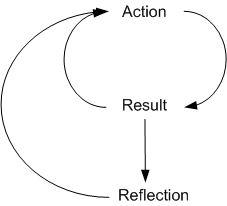
Possibly the only way of keeping the LOI at bay is to institute double loop learning. The figger below shows the painful, transformational process of adding a second action-result-reflection loop to the system. By adding the skill of reflection, deteriorating results can be detected and action can be periodically tuned to accommodate a changing world.
Just because “deteriorating results can be detected and action can be tuned” doesn’t mean they will be. The forces against truthful org and individual reflection on poor results are formidable. Denial, angst, and fear, which are all dysfunctions of the individual and collective human ego, conspire against improving system robustness and viability via change. Reorgs, appointing the same people to funky new titles, bumping up compensation/perks, cutting costs, and attempting to apply all other textbook management tools amount to wrapping bandaids around a massive hemorrhage. Double bummer.
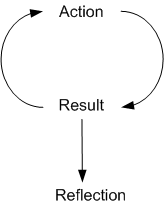
The hardest aspect of getting a double learning loop into operation is connecting the “Reflection” node back to the “Action” node so that actions can be changed. As I know too well, it’s relatively easy to reflect on one’s actions while exhibiting the same insane behavior over and over and over and over………..
“Without deviation from the norm, progress is not possible.” – Frank Zappa
Clever And Mistake-Free
In “The 3 rules of mindsets”, Daniel Pink provides these examples in order to contrast fixed minded thinkers with growth minded thinkers:
- Fixed mindset: Look clever at all costs.
- Growth mindset: Learn, learn, learn.
- Fixed mindset: It should come naturally.
- Growth mindset: Work hard, effort is key.
- Fixed mindset: Hide your mistakes and conceal your deficiencies.
- Growth mindset: Capitalize on your mistakes and confront your deficiencies.
I don’t know about you, but I’m constantly struggling against the “Look clever at all costs” and “Hide your mistakes..” fixed mindset maladies. It’s easy to criticize the “environment” for these shortcomings, but ultimately it’s a personal ego battle, no?

Desire
Since the color of the sky in my world is purple, I think that many people, including me(?) (but not you, of course), want to position themselves where they can maximize their compensation while doing as little as possible and appearing to “others” as though they are working their ass off. If, for some strange reason you believe this is true, why is that? Hell, I don’t know – that’s why I’m asking you!
Spreading Ideas
In the list below, Seth Godin hits the nail on the head when he exposes the top 20 reasons why one person spreads another person’s idea. As I scanned the list, I looked for, and circled the reasons why I try to propagate my own crappy ideas. After all, being a self-centered narcissist, it’s all about me.

Notice that I didn’t circle any of the altruistic ones like the me-version of number 1: “I spread my idea because it makes me feel generous“. How about you? Why do you spread your own ideas?

Accept And Continue, Or Accept And Change

If you’ve acquired a “bad rep” in a group, regardless of whether you think it’s deserved, it doesn’t matter how you present issues, problems, ideas, or solution options to anyone who perceives you as a “bad” person. Your ideas could have the potential to increase the group’s material or spiritual wealth, but……… fuggedabout getting any help from the “good” people. The “good” people are, by definition, those in positions of power who control the resources of production.
Once you understand the key principle of bad_rep == no_help, the first thing to do is get over any frustration and angst that you have from being “unfairly” adorned (how dare they!) with a scarlet letter. It’s out of your control, bozeltine. The next thing to do is to decide whether:
- to continue on being authentic, reinforcing your “bad rep” perception (if so-be-it) and knowing full well the consequences of your M.O.
- to attempt to force yourself into something you’re not. You know, morph into a “good” person so that the “bad rep” perception slowly dissolves in the minds of other “good” people.
I recommend continuing on and doing your thang as only you can do. You see, once your “bad rep” image gets burned into the UCB of one or more “good” people, it can never be erased. That’s because…… and here comes the usual acronym-laden rant that you may have been waiting for…… “good” BMs, CGH’s, SCOLs and BOOGLs are hoarders. They can add images and perceptions to their UCBs, but since they’re infallible, they are incapable of periodically re-assessing its truthiness and cleaning house. Like the Hotel California, “stuff can check in but it can never leave“.

I hate people who think in terms of “us and them”. You know, people like me. – Bulldozer00
Late Breaking News: After I wrote and queued up this vitriolic post, I discovered that one of my heroes, Scott Berkun, wrote a similar, but much more elegant, less offensive, and insightful one. Check it out here: “How To Keep Your Mouth Shut“, and be sure to watch the classic video snippet he points you to. It’s arguably the best caricature of a BM ever created.
A Life Changing Experience?
The article “Undercover Boss’ role opens Republic Airways CEO’s eyes” describes what Republic Airways CEO Bryan Bedford learned while participating on the show “Undercover Boss“. In the show, CEOs go undercover and work on the front lines as a DORK in disguise.

Here’s one thing Mr. Bedford said of his experience:
“What was eye-opening, the most noticeable thing was just the disconnect and (poor) communication between the management team and front-line employees,” Bedford said.
I don’t know what was so eye opening about it. As usual, I just don’t get it. Do you? Do you now understand the meaning of one of the profanely endearing acronyms, CGH, that I often use in this boisterous blog?
Moving on, here’s some more unsurprising (at least to me) commentary :
While working in different roles for the company — including cleaning aircraft, checking baggage, dumping aircraft toilets and standing at the ticket counter — he asked fellow employees why they didn’t take their complaints to management to implore change. The same response came time and time again: “No, I’ve talked to management about this stuff, and they never listen,” Bedford said.
Wow. Huge surprise, no? Why won’t the BMs, BUTTs, and CCRATs in the fatty middle org layers listen to, and act on, DICforce inputs? Because it would require hard work and it could make them look bad. You know, their image of being infallibly in charge might suffer: “Damn the org, it’s all about me and my success“.
“Are you here to build a career or to build an organization?” – Peter Block
I’m almost done with this rant, so bear with me just a couple of more sentences. Summing up his experience, Mr. Bedford relates his epiphany:
When you are actually working side by side and hearing about their struggles, it’s very personal. It’s life-changing. You can never go back to thinking of them as anything other than family.
So, six months from now, after returning to the same-old, same-old business as usual (operating off spreadsheets and powerpoints, communicating solely with his hand picked yes-men junta, caving to pressure from Wall St. and shareholders) do you think Bryan will remember what he said? I hope so, but I doubt it. He’s human just like you and (maybe) me.
How about you? Even if he/she wanted to, would your CEO, or even your immediate manager, be capable of doing your job in order to experience your frustrations at the inefficiency, dysfunction, and red tape that engulfs you?

Self-Assessment
“I’m just an ordinary average guy….. Pick up the dog doo, hope that it’s hard (woof woof).” – Joe Walsh
Okee Dokee. Today is my birthday and it’s self-assessment time. Time to step back and guess who I am and where I stand……
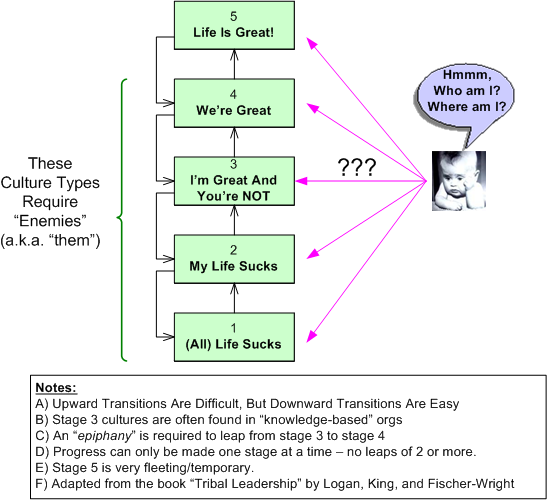
At the present time, I’m a dude with a stage 3 mindset working in a stage 3 benevolent patriarchy. My situation may not be as nirvana-ish as being a stage 5 dude working in a stage 5 DEPAM, but it sure beats being a stage 1 dude imprisoned in a stage 1 malevolent patriarchy, no?
How about you? What’s your self-assessment, today? Awe come on, don’t be shy.

Why am I here?
WTF?
Meh!
D'oh!

My BTC Address



 Bulldozer00's Blog