Archive
Stunning, But Not Surprising
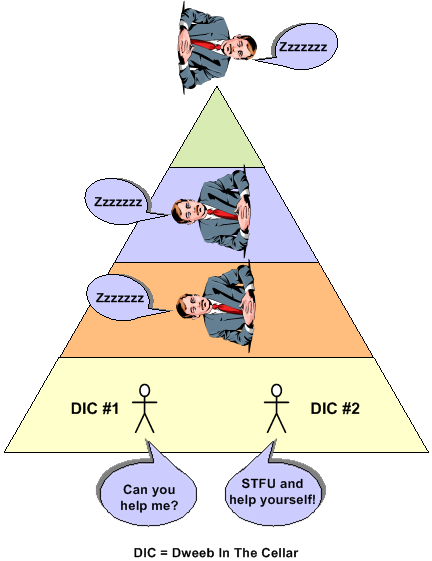
Suppose you had an innately complex product to sell. Now suppose that a potential customer comes up to you and asks for a user’s starter guide to help him/her understand your product for the purpose of making a buy decision. Would you tell that customer “We’re short-handed and have schedules to meet, so write It yourself!“? WTF!
For people who work in CCH bureaucracies but don’t know it (or who do know it, but conveniently ignore it and don’t do squat to dissolve it), this behavior between internal groups is ubiquitous, systemic, and so pervasive that it’s taken for granted. It’s stunning, but not surprising.
Incremental Watts
I don’t know which name I like better, Watts Wacker or Soupy Sales, but this post is about Watts. Watts Wacker is a CEO and futurist who uttered one of my favorite quotes:
You can’t increment your way into the future – Watts Wacker
I think this quote is directed toward leaders of cushy, static, and stanky CCH companies who are so afraid of the future that they move by inches at a time in passive response to external changes. The only way to leapfrog your competitors, since they’re just as afraid as you and are inching along like molassess running up hill, is to make a disruptive leap into the future.
It takes revolutionaries to trigger disruptive leaps into the unknown. Someone (actually, two people) with an innocent but assuredly incremental mindset recently said to me: “Revolutionaries are usually lined up in front of a wall and shot“. My response was “that’s why there are so few of them“. Bummer.

Surprise! GM Is Still Hosed
In a followup to my first post on GM’s initial BS attempt to dismantle their horrendous do-nothing-but-line-management’s-pocket-with-dough Command And Control Hierarchy (CCH), I submit this freshly minted AP article. It describes yet another management shake up at post-bankruptcy, taxpayer-money-sucking GM. The “new” (LOL!) leadership continues to pray that the feeble and well worn tradition of sloganeering and cajoling will stave off annihilation. Geeze, these elite hierarchs are really doing quite a job earning their seven figure paychecks, dontcha think?
In announcing a sudden management overhaul yesterday, GM chairman and acting CEO Ed Whitacre Jr. was speaking Lutz’s words when he told employees that the bureaucracy needs to end and they can take reasonable risks without fear of being fired.
“We want you to step up. We don’t want any bureaucracy,’’ Whitacre said to about 800 GM workers. “We’re not going to make it if you won’t take a risk,’’ he said in the address, which was broadcast to employees worldwide on the Internet.
Uh, yes massa CEO, we’ll do whatever you say, dear leader. We sincerely believe that you’re a man of high integrity and impeccable credentials who speaks the truth and will lead us to the promised land. We’ll gladly storm the machine gun nests that guard the status quo for you. Blech.
Whitacre, 68, who has been frustrated with the pace of change, appointed the 77-year-old Lutz as a top adviser, creating an alliance of hard-charging veteran executives to lead the troubled company.
Yeah, that’ll do it. A 145 year duo of machine age, assembly line thinkers who probably don’t know WTF “WTF” means. Social intra-networking? Corpo-wide sharing of accessible and findable information? Sincere collaboration within and between layers of rank and status? Transparency, Authenticity, and Openness? Sorry to be so negative, but not a chance.
Sadly, I await the next big GM makeover and press release.

Watercooler Whining
Regardless of whether they work for a world class org or a brutal and oppressive CCH bureaucracy, I assert that most DICs “discuss” among themselves what they think is wrong with their org at all layers in the caste system. The difference is that in CCH abominations, the discussions are confined to the local environment and well out of earshot of the BMs in charge (In CCHs, BMs, as opposed to PHORS, are always in charge). As soon as the whiff of cologne and bright beams of light emitted by an approaching self-important BM is detected by the “whining” DICs, all dialog stops and the malcontents disperse as if someone let loose an SBD stanker.
 It doesn’t take Sherlock’s genius to realize that most of the water-cooler discussions ‘tween DICs are self-serving and myopic BS stories about how they are “victims” and how they have been “wronged” by other fellow DICs and disconnected BMs. However, some, just maybe some complaints are about legit, systemically baked-in problems that, if competently addressed, would improve corpo performance. In most cases, the DICs don’t know how to solve the org issue or they don’t have the authority and clout to try out their solutions.
“The day soldiers stop bringing you their problems is the day you have stopped leading them. They have either lost confidence that you can help or concluded that you don’t care. Either case is a failure of leadership.” – Karl Popper
I’d like to mangle Popper’s brilliant quote with:
“If you haven’t setup and maintained your corpo culture so that your soldiers feel comfortable bringing their problems to you, or you have done so but have continuously ignored their concerns by doin’ nuthin’ of substance to help them, they have either lost confidence that you can help or concluded that you don’t care. Either case is a failure of leadership.” – bulldozer00.
Of course, I just make stuff up and I’m not fit to lead anybody, so don’t pay attention to anything I say.
Conflict Aversion And Cultures Of Fear
With no scientific backing or personal credentials to provide me with any semblance of credibility, I assert that conflict aversion and cultures of fear go together like hand and glove; Jenny and Forrest; peas and carrots; peanut butter and chocolate.

In an org that operates in accordance with a culture of fear, inter-personal and inter-group conflicts are avoided at all costs because of the fear of post-conflict consequences. If a culture of fear doesn’t already exist, all it takes is one or two publicly visible rebukes of a conflict initiator to snap a “culture of fear” into place. Common forms of rebuke are: peek-a-boo visits, compensation ceilings, withholding of career development opportunities, placement on a formal performance improvement plan (affectionately called a “PIP”), and covert persecution. The closer to home that a conflict initiator treads to a hairball problem that is eroding performance of the whole, the more severe the rebuke.
In a culture of fear, because there’s no sane incentive for motivating well-meaning people to point out emergent org problems that everybody already knows about, nobody does nuthin’ of substance until there’s a crisis. When a crisis inevitably manifests because of problem neglect, conflict aversion temporarily goes out the window because real feelings and passions bubble to the surface. Under the duress of a crisis, the conflicts that do emerge in a normally conflict averse org are much more explosive and damaging than those that occur in a continuously conflict-accepting org. Thus, when the crisis passes, the left over socio-communication system infrastructure wreckage breeds poorer future performance and a regression back into – you guessed it – the same old, same old, conflict averse way of operation. Bummer.
Culture Adjustment
I think that almost everyone heard about this week’s glitch in the air traffic control system that caused hours of flight delays. Here’s an interesting quote from the government’s GAO (FAA computer failure reflects growing burden on systems — Federal Computer Week):
“However, FAA faces several challenges in fulfilling NextGen’s objectives, including adjusting its culture and business practices, GAO concluded.”
Well, duh. Every mediocre and under performing corpo borg needs to “adjust its culture and business practices”. It’s just that none of them have the competence to do it, regardless of how many titles and credentials that the corpocrats running the show adorn themselves and their sycophants with.
Under Pressure
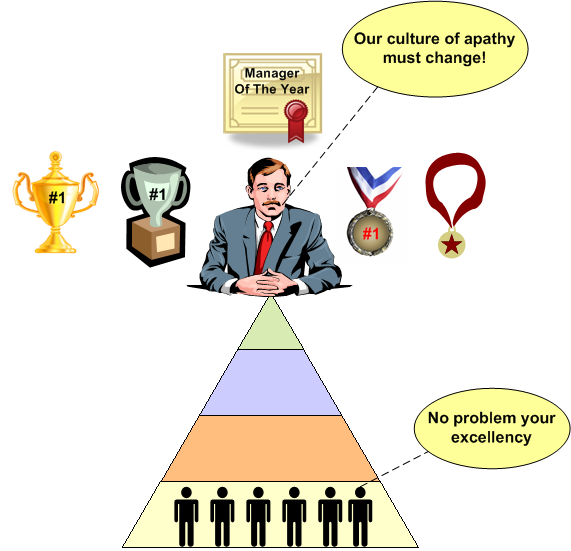
Uh oh. One of my favorite companies, the SAS Institute, is under increasing pressure from big, deep pocketed rivals. This NY Times article, Rivals Take Aim at the Software Company SAS – NYTimes.com, elaborates on the details. Since I’m confident that they’ll overcome the competitive threat, that’s not what this post is about. It’s about what the SAS leadership, led by founder, CEO, and PHOR, Jim Goodnight, does to continuously grow and develop both the company and its people. Here are some snippets from the article and this linked-to 60 minutes article that reinforce my faith in the company’s ability to overcome all odds:
There is the subsidized day care and preschool. There are the four company doctors and the dozen nurses who provide free primary care. The recreational amenities include basketball and racquetball courts, a swimming pool, exercise rooms and 40 miles of running and biking trails. There is a meditation garden, as well as on-site haircuts, manicures, and jewelry repair. Employees are encouraged to work 35-hour weeks.
The office atmosphere is sedate. There are no dogs roaming the halls, no Nerf-ball fights, no one jumping on trampolines — no whiff of Silicon Valley. The SAS culture is engineered for its own logic: to reduce distractions and stress, and thus foster creativity.
Employee turnover at SAS averages 4 percent a year, versus about 20 percent for the overall software industry.
SAS has never had a losing year and never laid off a single employee.
“No, we’re not altruistic by any stretch of the imagination. This is a for-profit business and we do all these things because it makes good business sense,” says Jeff Chambers, director of human resources at SAS.
“You know, I guess 95 percent of my assets drive out the front gate every evening,” says Goodnight. “It’s my job to bring them back.”
Academics have studied the company’s benefit-enhanced corporate culture as a model for nurturing creativity and loyalty among engineers and other workers.
SAS invested heavily in research and development, and even today allocates 22 percent of the company’s revenue to research. The formula has paid off in steady growth, year after year. Revenue reached $2.26 billion in 2008, up from $1.34 billion five years earlier.
Unlike many other tech companies, SAS has had no recession-related layoffs this year. “I’ve got a two-year pipeline of projects in R & D,” Mr. Goodnight says. “Why would I lay anyone off?”
Mr. Goodnight recalls those days as a brief period of New Economy surrealism, and going public as a path wisely avoided. SAS, he says, is a culture averse to the short-term pressures of Wall Street, which he characterizes as “a bunch of 28-year-olds, hunched over spreadsheets, trying to tell you how to run your business.”
Goodnight says it’s pressure from Wall Street to please shareholders by delivering rising quarterly earnings that has poisoned the corporate well.
Mr. Goodnight, though 66, has no plans to retire himself. His fingerprints, colleagues say, remain all over the business, especially in meeting with customers and in overseeing research.

A Flurry Of Activity
It’s always fun to watch the initial stages of euphoria emerge and then disappear when a corpo-wide initiative that’s intended to improve performance is attempted. The anointed “design” team, which is almost always filled exclusively with managers and overhead personnel who conveniently won’t have to implement the behavioral changes that they poop out of the initiative themselves, starts out full of energy and bright ideas on how to solve the performance problem. After the kickoff, a resource-burning flurry of activity ensues, with meeting after meeting, discussion after discussion, and action item after action item being tossed left and right. When the money’s gone, the time’s gone, and the smoke clears, business returns to the same old, same old.
As a hypothetical example, assume that an initiative to institute a metrics program throughout the org has been mandated from the heavens. At best, after spending a ton of money and time working on the issue, the anointed design team generates a long list of complicated metrics that “someone else” is required to collect, analyze, and act upon. The team then declares victory and self-congratulatory pats on the back abound. At worst, the team debates the issue for a few meetings, conveniently forgets it, and then moves on to some other initiative – hoping that no one notices the useless camouflage that they left in their wake. Bummer.
We Promise To Change, And We Really Mean It This Time
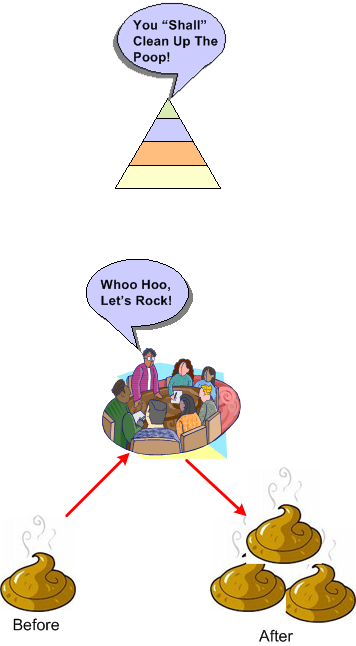
GM is a classic example of a toxic Command and Control Hierarchical (CCH) corpocracy. In this NY Times article, the newly anointed hierarchs and their spin doctors promise that “things will be different” in the future. Uh, OK. If you say so.
According to corpo insiders, here’s the way things were.
…employees were evaluated according to a “performance measurement process” that could fill a three-ring binder.
“We measured ourselves ten ways from Sunday,” he said. “But as soon as everything is important, nothing is important.”
Decisions were made, if at all, at a glacial pace, bogged down by endless committees, reports and reviews that astonished members of President Obama’s auto task force.
“Have we made some missteps? Yes,” said Susan Docherty, who last month was promoted to head of United States sales. “Are we going to slip back to our old ways? No.”
G.M.’s top executives prized consensus over debate, and rarely questioned its elaborate planning processes. A former G.M. executive and consultant, Rob Kleinbaum, said the culture emphasized past glories and current market share, rather than focusing on the future.
“Those values were driven from the top on down,” said Mr. Kleinbaum. “And anybody inside who protested that attitude was buried.”
In the old G.M., any changes to a product program would be reviewed by as many as 70 executives, often taking two months for a decision to wind its way through regional forums, then to a global committee, and finally to the all-powerful automotive products board.
“In the past, we might not have had the guts to bring it up,” said Mr. Reuss. “No one wanted to do anything wrong, or admit we needed to do a better job.”
In the past, G.M. rarely held back a product to add the extra touches that would improve its chances in a fiercely competitive market.
“If everybody is afraid to do anything, do we have a chance of winning?” Mr. Stephens said in one session last month.
The vice president would say, ‘I got here because I’m a better engineer than you, and now I’m going to tell you how bad a job you did.’ ”
The Aztek was half-car, half-van, and universally branded as one of the ugliest vehicles to ever hit the market. … but his job required him to defend it as if it were a thing of beauty.
Here’s what they’re doing to change their culture of fear, malaise, apathy, and mediocrity:
G.M.’s new chairman, Edward Whitacre Jr., and directors have prodded G.M. to cut layers of bureaucracy, slash its executive ranks by a third, and give broad, new responsibilities to a cadre of younger managers.
Replacing a binder full of job expectations with a one-page set of goals is just one sign of the fresh start, said Mr. Woychowski.
Mr. Lauckner came up with a new schedule that funneled all product decisions to weekly meetings of an executive committee run by Mr. Henderson and Thomas Stephens, the company’s vice chairman for product development.
Mr. Stephens has been leading meetings with staff members called “pride builders.” The goal, he said, was to increase the “emotional commitment” to building better cars and encourage people to speak their minds.
“But now we need to be open and transparent and trust each other, and be honest about our strengths and weaknesses.”
So, what do you think? Do you think that these “creative” CCH dissolving solutions and others like them will do the trick? Do you think they’ll pull it off? Is it time to invest in the “new” GM’s stock?
Construction Sequence
The figure below depicts a static structural bent SysML model of a small but non-trivial software program that I recently finished writing and testing. It’s a simulator harness that’s used to explore/test/improve candidate “Target Extractor” algorithms for inclusion into a revenue generating product.
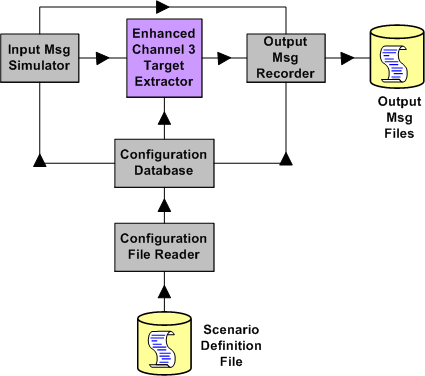
On program launch, a user-created scenario definition file is read, parsed, error-checked, and then stored in an in-memory database. Subsequent to populating the database, the program automatically:
- Generates a simulated stream of target message fragments characterized by the scenario definition that was pre-specified by the user
- Injects the message stream into the target extractor algorithm under test
- Processes the message stream in accordance with the plot extraction state machine algorithm specification
- Records the target extractor output response message stream to disk
The figure above is a model that represents the finished product – which ended up being the third build in a series of incremental builds. The figure below shows the functionality in the first two builds of the trio.
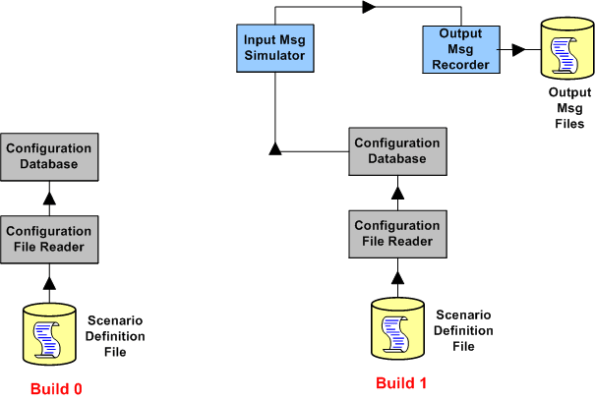
Even though the construction process that I used appears to have progressed in a nice and tidy linear and sequential flow (like the left portion of the figure below depicts), it naturally didn’t work out that way. The workflow progressed in accordance with the right portion of the figure below, with lots of high frequency single-step feedback loops and (thankfully) only a few two-step and three-step feedback loops.
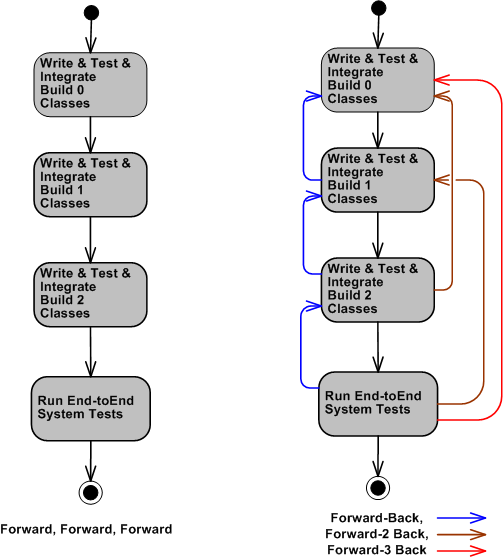
In a perfect world, the software construction process proceeds in a linear and sequential fashion. In the messy real world, mistakes and errors are always made, and stepping backward is the only way that these mistakes and errors can be corrected.
In standard textbook CCH orgs where an endless sea of linear and sequential thinking BMs rule the roost, going backwards is “unacceptable” because “you should have done it right the first time“. In these types of irrational macho cultures, fear of punishment reigns supreme – and nobody dares to discuss it. Fearful development teams either don’t go backwards to correct mistakes, or they try to fix mistakes covertly below the corpo radar. What type of org do you work for?

Why am I here?
WTF?
Meh!
D'oh!

My BTC Address



 Bulldozer00's Blog