Archive
N Minus One Half
Other than chief patriarch, where do you think the best position is on a stratified N + 1 layer corpo org chart? Consider the N – 1/2 position. You know, the coveted “dotted line” reporting position where, for some strange reason, the lowly paid and respected exec admin is always listed with the exalted, treasury raiding conciglieres. Here’s why it’s my top choice for you to aspire to:
- By definition, and probably not by your accomplishments (if any), you’re over compensated since you’re so high up on the chart.
- You don’t have any direct reports or whining sub-hierarchies of people under you to placate.
- You have the job security that independent, highly paid consultants (who may actually add value) at your level of so-called expertise don’t have.
- You have unfettered access to the corpo monarch. This gives you virtually unlimited time to kiss arse.
So, are you gonna go for it? Not me. Just give me something interesting to work on with a group of competent people and a PHOR project manager who gets the RIRPRT. Oh, and of course, pay me fairly too.

The Sparfish
On a tip from HCL Technologies CEO Vineet Nayar, I purchased and started reading “The Starfish And The Spider“. In the book, authors Brafman and Beckstrom define seven principles of decentralized orgs of people:
- When attacked, a decentralized org tends to become even more open and decentralized.
- It’s easy to mistake decentralized orgs (starfish) for centralized orgs (spiders).
- A decentralized org doesn’t have central intelligence; the intelligence is spread throughout the system.
- A decentralized org can easily mutate.
- A decentralized org sneaks up on you.
- As industries become decentralized, overall profits decrease.
- Put people into a decentralized org and they’ll automatically want to contribute.
Because of numbers 3 and 6, owners and SCOLs of centralized command and control hierarchies will never embrace the “starfish” concept. The self-centered need for SCOLs to project the image that “I’m great and you’re not” (number 3) and the constant external pressure to generate increasing profits (number 6) guarantee the status quo for all but the most enlightened leaders. However, because number 7 is the holy grail for the CGHs that sit on the throne, they try their best to feign being a starfish while remaining a spider. This systemic and self-defeating behavior is recursively nested all the way down the CCH; from the upper echelon of VPs and directors down through the fatty middle management layers and ultimately down to the BMs that rule at the interface with the DICforce.
Like Mr. Nayer, I don’t buy into the Brafman/Beckstrom set of principles 100%. Their starfish/spider metaphor works well up to a point. For example, a spider is much more mobile than a starfish; which enables it to be more proactive in acquiring the resources it needs to survive. Specifically, I believe that a hybrid “sparfish” org can increase profits while simultaneously providing an environment in which all members automatically want to contribute. By distributing resources more equitably via democracy and implementing a true meritocracy, the best of both species can be merged. The trick is figuring out how to freakin’ do it, no?

Personal Fulfillment Needs

What type of org do you work for? A DEPAM like Org A, a stinkpot CCH like Org D, or somewhere in between in a mediocre hierarchy that works to some extent?
If you run an Org, reflect on which type you think you preside over. Then, after making your decision, ask your people what they think – and not in some big public forum where they have no choice but to say what you want to hear. In other words, don’t forget to make it “safe” for them to really express what their true feelings are. On second thought, fuggedaboutit and keep your infallible tiara firmly in place. You can’t risk the chance of getting hurt and externally showing that you’re only a human being – cuz that would be terrible for the org. Or would it?
Don’t Ask, Don’t Tell
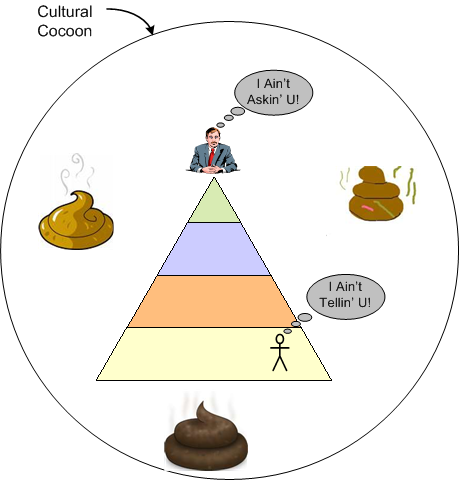
The corpocratic version of the “don’t ask don’t tell” policy is “SCOLs don’t ask what’s wrong, DICs don’t tell what’s wrong“. SCOLs, CGHs, BUTTs, and BOOGLs ensconced in self-images of infallibility don’t need to ask because they always know:
- what’s wrong,
- when it went wrong,
- who’s “responsible” for the wrong.
Likewise, the aforementioned management team always knows how to fix what’s wrong by launching initiatives that “get the job done“. Of course, when you don’t ever establish a baseline or periodically evaluate post-launch progress, initiatives will always be successful and reinforce the image of infallibilty, no? The funny thing is, if SCOLs always know the what, why, and who of dysfunction, how come they didn’t prevent the dysfunction in the first place?
Nested Monarchies
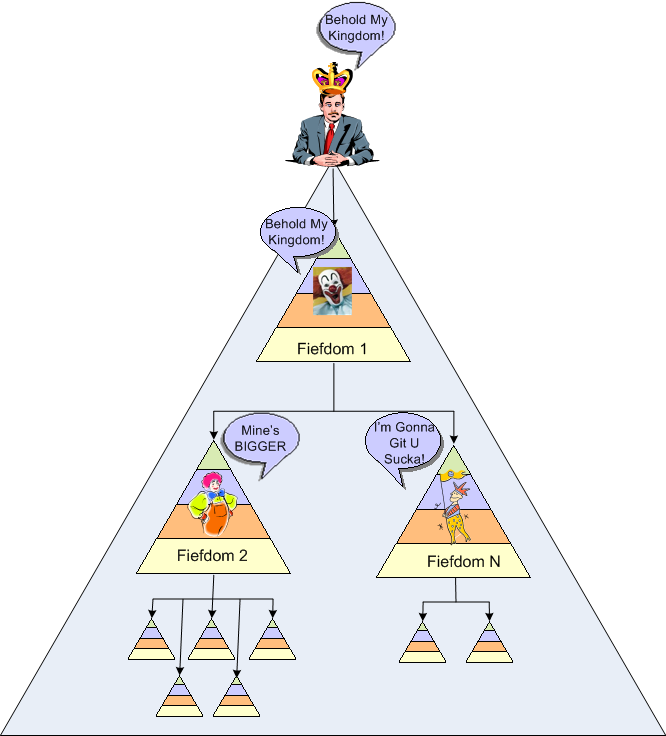
Once again, I’m verklempt, so tawk amongst yourselves. I’ll give you a topic: “nested monarchies”.
All Hands Meeting: Open To The Public
Check out this e-mail invite from Zappos.com:
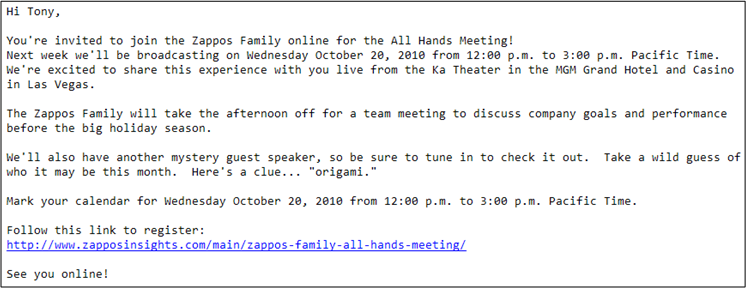
I participated as a cyber-attendee at the previous Zappos.com online all hands meeting. It wasn’t scripted, and some topics were discussed that your grandfather’s company of yesteryear would never air in public. Of course, your grandfather’s company of yesteryear, stuck in its FOSTMA mindset, could never even conceive of the idea of broadcasting an all hands meeting online.
“Few people are capable of expressing with equanimity opinions which differ from the prejudices of their social environment. Most people are even incapable of forming such opinions.” – Albert Einstein
Since clicking on the link in the above graphic won’t work, here’s a clickable signup link: Zappos All Hands Meeting Signup. Attend the meeting if you can and judge for yourself whether or not it’s a pure propaganda play.
Stylistic Versatility
Except for his interviews with several famous people that were involved in the development of successful software systems, consuming Sam Lightstone’s “Making It Big In Software” didn’t do a whole lot for me. However, when he wasn’t writing like a know-it-all patriarch, Sam did provide several nuggets of wisdom to absorb. One of those nuggets was the disclosure of Hay & McBer’s 6 leadership styles as uncovered via a study of 3,871 executives. For your convenience (uh, actually my convenience), I’ve copied and pasted the leadership style table below.
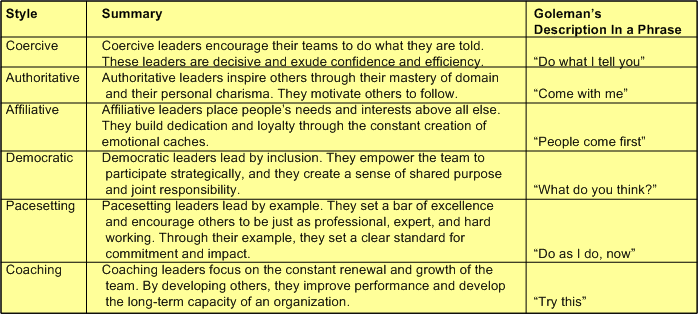
Lightstone rightly says that the versatile leader (and how many versatile, multidimensional leaders do you know?) applies the right style at the right time:
- Use coercion only in crises situations
- Use authority when charting a new course
- Use affiliation to heal a team
- Use democracy for collaboration
- Use pacesetting for sprints
- Use coaching for improvement
Regarding effectiveness of style, Lightstone writes:
Although each style has its pros and cons, (Daniel) Goleman’s article citing the Hay and McBer research found that the coercive and pacesetting styles have the most negative impact on an organizations. Nobody likes to be bullied, and the hallmark of a coercive style is a dictatorial approach. Pacesetting styles force employees to run at a pace that might not be comfortable or sustainable for them.
I think that BOOGLs, BUTTs, and CGHs, of which there are many, are one dimensional SCOLs who apply the only style they know, coercion, in all situations. These one-trick-pony dudes and dudettes either don’t believe the other five styles exist, or they don’t utilize the styles because they’re expected to be “in control” at all times by the toxic culture that pervades the corpricracy.
I’m not a leader, so I don’t/can’t practice applying any of the Hay & McBer styles. How about you? Are you a versatile leader, or are you a culturally conditioned control freak?
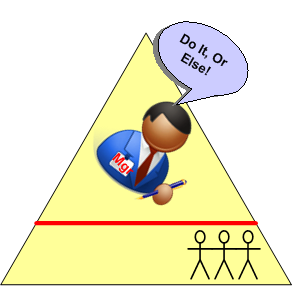
Assimilated And Digested
This is another one of my dorky pictures that doesn’t contain any accompanying words of explanation. “I’m a little verklempt, so talk amongst yourselves. I’ll give you a topic: Acquisition” – Linda Richman.

Thanx for the link dB!
Tribal Leadership
In “Tribal Leadership” (the audio version of the book is downloadable for free here), the authors summarize the results of their ten-year, 24,000 person research. Their tag line is: “Birds flock, fish school, and people tribe“. As a result of their experience, they’ve categorized organizational cultures into five “staged” types based on the general attitude of tribe participants.
The figure below and its accompanying annotations show my understanding of the TL authors’ message.

Notice that as one moves up the scale, the focus shifts from “me” to “we” and “all“. That’s why the authors assert that an epiphany is required to make the leap from stage 3 to stage 4. Successful people who are tired and frustrated at playing the dog-eat-dog game against other individuals at stage 3 shed their “it’s all about me” mindset and transform into sharers and effective catalysts for group advancement. Books and articles of techniques and tips for getting ahead, a multi-billion dollar industry targeted at the Donald Trump wannabes of the world, instantaneously become useless and irrelevant to stage 4 leaders. Those books and articles that concentrate on platitudes, community, and inspiration, formerly considered to be useless new age drivel, take on new meaning and serve as guidance for stage 4 leaders.
Reflecting on my behaviors and modus operandi over the years, I’m seemingly stuck in the isolationist world of stage 3 and impatiently waiting for the epiphany. How about you? Where are you, and are you at peace with your position?
Pyramid Conversion
In this Inc. blog post, Joie de Vivre hotel chain founder Chip Conley says:
The most contagious emotion in most companies is fear. Most companies do such a poor job communicating that most employees get stuck in a place of survival and don’t have a lot of room for creativity, innovation, or ingenuity.
Every survey that’s been done in the U.S. tends to show money is not the primary, secondary, or third; It’s fourth place on why people leave their jobs.
We took the Maslow pyramid and turned it into an employee pyramid with three basic themes: survival the base, succeed at the middle, and transformation at the top. Applying that to employees, it’s money, recognition, and meaning.

Once people are satisfied with how much money they are making, the next human desire they need fulfilled at work is recognition. According to Conley: “What really is meaningful to people is genuine appreciation shown in real time“. The key words are “genuine” and “real time“. I interpret this to mean; not months after a significant accomplishment has been achieved or once a year at an all hands meeting where a boring and generic “atta boy” is delivered from on-high down to the DICforce.
If you just sit in the control tower and solely monitor the numbers that result from the effort without recognizing the effort itself in the moment, then you’re behaving just like the herd and you deserve what you get – mediocrity. Mooooooooooo.


Why am I here?
WTF?
Meh!
D'oh!

My BTC Address



 Bulldozer00's Blog