Archive
Watercooler Whining
Regardless of whether they work for a world class org or a brutal and oppressive CCH bureaucracy, I assert that most DICs “discuss” among themselves what they think is wrong with their org at all layers in the caste system. The difference is that in CCH abominations, the discussions are confined to the local environment and well out of earshot of the BMs in charge (In CCHs, BMs, as opposed to PHORS, are always in charge). As soon as the whiff of cologne and bright beams of light emitted by an approaching self-important BM is detected by the “whining” DICs, all dialog stops and the malcontents disperse as if someone let loose an SBD stanker.
 It doesn’t take Sherlock’s genius to realize that most of the water-cooler discussions ‘tween DICs are self-serving and myopic BS stories about how they are “victims” and how they have been “wronged” by other fellow DICs and disconnected BMs. However, some, just maybe some complaints are about legit, systemically baked-in problems that, if competently addressed, would improve corpo performance. In most cases, the DICs don’t know how to solve the org issue or they don’t have the authority and clout to try out their solutions.
“The day soldiers stop bringing you their problems is the day you have stopped leading them. They have either lost confidence that you can help or concluded that you don’t care. Either case is a failure of leadership.” – Karl Popper
I’d like to mangle Popper’s brilliant quote with:
“If you haven’t setup and maintained your corpo culture so that your soldiers feel comfortable bringing their problems to you, or you have done so but have continuously ignored their concerns by doin’ nuthin’ of substance to help them, they have either lost confidence that you can help or concluded that you don’t care. Either case is a failure of leadership.” – bulldozer00.
Of course, I just make stuff up and I’m not fit to lead anybody, so don’t pay attention to anything I say.
Growth And Development
Two of my favorite bureaucracy-busting systems thinkers, Russell Ackoff and John Warfield, died this year. I’ll miss them both because whenever I’ve read something written by these guys, I always learned something new.
In a tribute to Mr. Ackoff, I’m currently reading Ackoff’s Best: His Classic Writings On Management. One of his off-the-beaten-path insights that he’s passed on to me is the independence between growth and development. Growth is an increase in size or wealth, while development is an increase in capability or competence as a result of learning. According to Ackoff, dumb-ass corpocracies automatically and unquestioningly equate growth with development, and that’s why the vast majority of orgs are obsessed with growth at all costs. Of course, growth and development can, and often do, reinforce each other, but neither is necessary for the other.
Ackoff points out that a system can experience growth without development, and vice versa. A heap of rubbish, or equivalently, a bureaucracy, can grow indefinitely without developing, and artists can develop without growing. If an undeveloped company or company is showered with money, it becomes richer but not more developed. On the other hand, if a well developed company or country is suddenly deprived of wealth, it doesn’t become less developed.
 What is your org doing? Growing? Developing? Both? Neither?
Culture Adjustment
I think that almost everyone heard about this week’s glitch in the air traffic control system that caused hours of flight delays. Here’s an interesting quote from the government’s GAO (FAA computer failure reflects growing burden on systems — Federal Computer Week):
“However, FAA faces several challenges in fulfilling NextGen’s objectives, including adjusting its culture and business practices, GAO concluded.”
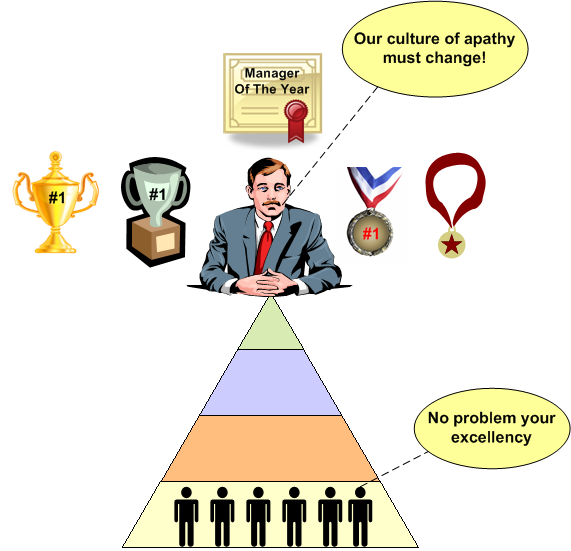
Well, duh. Every mediocre and under performing corpo borg needs to “adjust its culture and business practices”. It’s just that none of them have the competence to do it, regardless of how many titles and credentials that the corpocrats running the show adorn themselves and their sycophants with.
A Flurry Of Activity
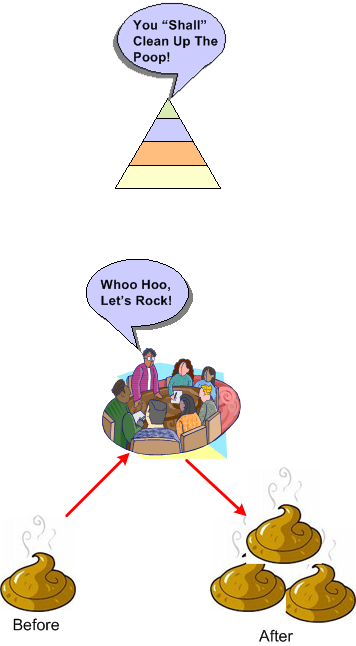
It’s always fun to watch the initial stages of euphoria emerge and then disappear when a corpo-wide initiative that’s intended to improve performance is attempted. The anointed “design” team, which is almost always filled exclusively with managers and overhead personnel who conveniently won’t have to implement the behavioral changes that they poop out of the initiative themselves, starts out full of energy and bright ideas on how to solve the performance problem. After the kickoff, a resource-burning flurry of activity ensues, with meeting after meeting, discussion after discussion, and action item after action item being tossed left and right. When the money’s gone, the time’s gone, and the smoke clears, business returns to the same old, same old.
As a hypothetical example, assume that an initiative to institute a metrics program throughout the org has been mandated from the heavens. At best, after spending a ton of money and time working on the issue, the anointed design team generates a long list of complicated metrics that “someone else” is required to collect, analyze, and act upon. The team then declares victory and self-congratulatory pats on the back abound. At worst, the team debates the issue for a few meetings, conveniently forgets it, and then moves on to some other initiative – hoping that no one notices the useless camouflage that they left in their wake. Bummer.
We Promise To Change, And We Really Mean It This Time
GM is a classic example of a toxic Command and Control Hierarchical (CCH) corpocracy. In this NY Times article, the newly anointed hierarchs and their spin doctors promise that “things will be different” in the future. Uh, OK. If you say so.
According to corpo insiders, here’s the way things were.
…employees were evaluated according to a “performance measurement process” that could fill a three-ring binder.
“We measured ourselves ten ways from Sunday,” he said. “But as soon as everything is important, nothing is important.”
Decisions were made, if at all, at a glacial pace, bogged down by endless committees, reports and reviews that astonished members of President Obama’s auto task force.
“Have we made some missteps? Yes,” said Susan Docherty, who last month was promoted to head of United States sales. “Are we going to slip back to our old ways? No.”
G.M.’s top executives prized consensus over debate, and rarely questioned its elaborate planning processes. A former G.M. executive and consultant, Rob Kleinbaum, said the culture emphasized past glories and current market share, rather than focusing on the future.
“Those values were driven from the top on down,” said Mr. Kleinbaum. “And anybody inside who protested that attitude was buried.”
In the old G.M., any changes to a product program would be reviewed by as many as 70 executives, often taking two months for a decision to wind its way through regional forums, then to a global committee, and finally to the all-powerful automotive products board.
“In the past, we might not have had the guts to bring it up,” said Mr. Reuss. “No one wanted to do anything wrong, or admit we needed to do a better job.”
In the past, G.M. rarely held back a product to add the extra touches that would improve its chances in a fiercely competitive market.
“If everybody is afraid to do anything, do we have a chance of winning?” Mr. Stephens said in one session last month.
The vice president would say, ‘I got here because I’m a better engineer than you, and now I’m going to tell you how bad a job you did.’ ”
The Aztek was half-car, half-van, and universally branded as one of the ugliest vehicles to ever hit the market. … but his job required him to defend it as if it were a thing of beauty.
Here’s what they’re doing to change their culture of fear, malaise, apathy, and mediocrity:
G.M.’s new chairman, Edward Whitacre Jr., and directors have prodded G.M. to cut layers of bureaucracy, slash its executive ranks by a third, and give broad, new responsibilities to a cadre of younger managers.
Replacing a binder full of job expectations with a one-page set of goals is just one sign of the fresh start, said Mr. Woychowski.
Mr. Lauckner came up with a new schedule that funneled all product decisions to weekly meetings of an executive committee run by Mr. Henderson and Thomas Stephens, the company’s vice chairman for product development.
Mr. Stephens has been leading meetings with staff members called “pride builders.” The goal, he said, was to increase the “emotional commitment” to building better cars and encourage people to speak their minds.
“But now we need to be open and transparent and trust each other, and be honest about our strengths and weaknesses.”
So, what do you think? Do you think that these “creative” CCH dissolving solutions and others like them will do the trick? Do you think they’ll pull it off? Is it time to invest in the “new” GM’s stock?

Guilt And Coercion
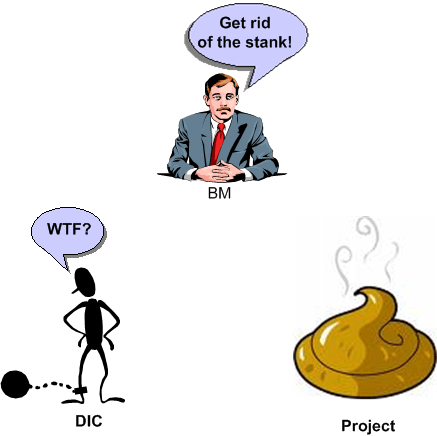
In a classic CCH (Command and Control Hierarchy), the only two tools of motivation known to BMs (Bozo Managers) for getting people to sign up for no-win projects are Guilt and Coercion. Bad CCH BMs use both, and really bad BMs with a sweatshop mentality use coercion exclusively. Attempts to instill guilt are often prefaced with “Don’t you wannabe a team player?” or “It’s very important for the company”. A classic coercive one-liner is “Do this project or else!”
So, why don’t many smart DICs (Dweebs In the Cellar) step up and volunteer to lead tough projects? One reason is because smart DICs know that the toxic, fragmented, and stifling environment (created and nurtured by the very same BMs who are coercing and inflicting guilt) guarantees failure. Another reason is because textbook CCHs are bureaucracies and not meritocracies – regardless of what they espouse. Thus, all work is treated the same and everyone gets the same 3% raise no matter how hard they work or how much they neglect their own lives to “get the job done” . Can you think of other reasons?
Standard CCH Blueprint
The figure below is a “bent” UML (Unified Modeling Language) class diagram of a standard corpo CCH (Command and Control Hierarchy). Association connectors were left off because the diagram would be a mess and the only really important relationships are the adjacent step-by-step vertical connections. Each box represents a “classifier”, which is a blueprint for stamping out objects that behave according to the classifier blueprint. The top compartment contains the classifier name, the second compartment contains its attributes, and the third compartment houses the classifier’s behaviors. Except for the DIC Product Development Team, the attributes of all other classifiers were elided away because the intent was to focus on the standard cookie-cutter behaviors of each object in the “system”. Of course, the org you work for is not an instantiation of this system, right?

Weakly Status Ritual
Everyone knows about the “weakly” status reporting ritual. It’s where the DICs (Dweebs In The Cellar) fill out and submit written status reports to the manager in charge (sic).

Did you ever wonder why status reporting is a one way street and it’s unquestioningly accepted as the norm in corpocracies everywhere? Whatever happened to “lead by example”? Why don’t managers fill out their very own weakly status reports and distribute them to their captive DICS? It’s because they don’t contribute or accomplish anything other than stapling the DIC reports together and kicking the result upstairs to the NLM (Next Level Manager) – who promptly ignores the POP (Package Of Poop) too. Side note: that’s where the term “POP server” originated.
If managers were required to submit weakly status reports to the DIC-force, what would they look like?

Initiative Initiation
Assume that the graph below describes the rise and fall of a hypothetical CCH (Command and Control Hierarchical) business. During the party time phase of increasing profits (whoo hoo!), the CCH corpocrats in charge pat themselves on the back, stuff their pockets, and slowly inflate their heads with bravado and delusions of infallibility.
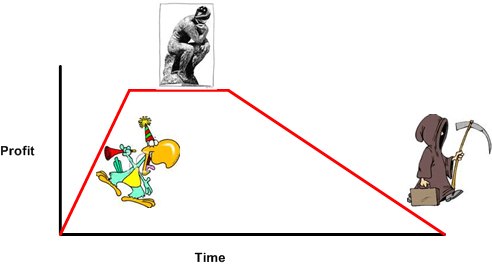
In order to extend the increasing profit trajectory, an undetectable status quo preserving mindset slowly but surely kicks in. Hell, if it ain’t broke, don’t touch the damn thang. Since what the CCH (so-called) leadership is doing is working, any individual or group from within or without the cathedral walls who tries to deviate significantly from the norm is swiftly “dealt with” by the corpocrats in charge. Everthing needs to get approved by a gauntlet of “important” people. However, while the shackles are being tightened and the ability to scale for success is being snuffed, the external environment keeps changing relentlessly in accordance with the second law of thermodynamics. Profit starts eroding and tension starts ratcheting upwards. Out of fear of annihilation, the cuffs are tightened further and the death dive has begun. Bummer.
During the free fall to obscurity, the now brain-dead and immobile corpocrats in charge start “taking aggressive action” to stem the flow of red ink. Platitudes and Matt Foley-like motivational speeches are foisted upon the DICs (Dweebs In the Cellar) in frantic attempts to self-medicate away the pain of stasis and failure. Initiatives with cute and inspiring names are started but never finished (because it takes real hands-on leadership, sweat, and work to follow through). As corposclerosis accelerates, silver-bullet-bearing consultants are brought in and the frequency of initiative initiation increases. Calls for accountability of “them” pervade the corpocracy from the top down and vice versa.
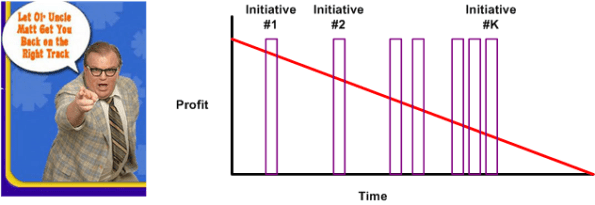
After being hammered by pleas to “improve performance” and being pounded by the endless tsunamis of hollow initiatives, the DICs disconnect and distance themselves from the lunacy being doled out by the omnipotent dudes in the politboro. Since the DICs expect the corpocrats to effect the “turnaround” and the corpocrats expect the DICs to strap on their Nikes and “just do it”, no one takes ownership and nothing of substance changes. As you might surmise, it’s a Shakespearian tragedy with no happy ending. Bummer squared.
Leaderless CCHs deserve what they get; a fearful, disconnected workforce and a roller coaster ride to oblivion.
Scaleability
The other day, a friend suggested plotting “functionality versus size” as a potentially meaningful and actionable measure of software development process prowess. The figure below is an unscientific attempt to generically expand on his idea.

Assume that the graph represents the efficiency of three different and unknown companies (note: since I don’t know squat and I am known for “making stuff up”, take the implications of the graph with a grain of salt). Because it’s well known by industry experts that the complexity of a software-intensive product increases at a much faster rate than size, one would expect the “law of diminishing returns” to kick in at some point. Now, assume that the inflection point where the law snaps into action is represented by the intersection of the three traces in the graph. The red company’s performance clearly shows the deterioration in efficiency due to the law kicking in. However, the other two companies seem to be defying the law.
How can a supposedly natural law, which is unsentimental and totally indifferent to those under its influence, be violated? In a word, it’s “scaleability“. The purple and green companies have developed the practices, skills, and abilities to continuously improve their software development processes in order to keep up with the difficulty of creating larger and more complex products. Unlike the red company, their processes are minimal and flexible so that they can be easily changed as bigger and bigger products are built.
Either quantitatively or qualitatively, all growing companies that employ unscaleable development processes eventually detect that they’ve crossed the inflection point – after the fact. Most of these post-crossing discoverers panic and do the exact opposite of what they need to do to make their processes scaleable. They pile on more practices, procedures, forms-for-approval, status meetings, and oversight (a.k.a. managers) in a misguided attempt to reverse deteriorating performance. These ironic “process improvement” actions solidify and instill rigidity into the process. They handcuff and demoralize development teams at best, and trigger a second inflection point at worst:
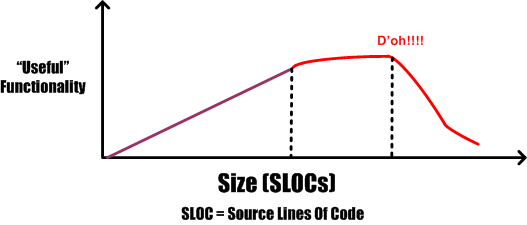
More meetings plus more documentation plus more management does not equal more success. – NASA SEL
Is your process scaleable? If so, what specific attributes make it scaleable? If not, are the results that you’re getting crying out for scaleability?

Why am I here?
WTF?
Meh!
D'oh!

My BTC Address



 Bulldozer00's Blog