Archive
Self Inquiry
I used to follow a bunch of spiritual and motivational teachers on Twitter, but I’ve “unfollowed” most of them since I didn’t connect much with their tweets – meh. It reached the point where I equated their mostly-boring tweet floods with spam. However, “brite2briter“ hits the sweet spot because her tweets invite her tweetees to practice “self inquiry” like the more well known Byron Katie (Is it absolutely true?) and Ramana Maharshi (Who am I?).
Recently, brite2briter fired off a couple of tweets that hit home. Here they are, along with my replies:
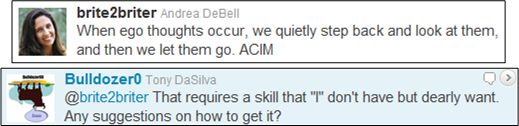

Do these examples do anything fer ya? Too far out and new agey? Meh?
Personal Fulfillment Needs

What type of org do you work for? A DEPAM like Org A, a stinkpot CCH like Org D, or somewhere in between in a mediocre hierarchy that works to some extent?
If you run an Org, reflect on which type you think you preside over. Then, after making your decision, ask your people what they think – and not in some big public forum where they have no choice but to say what you want to hear. In other words, don’t forget to make it “safe” for them to really express what their true feelings are. On second thought, fuggedaboutit and keep your infallible tiara firmly in place. You can’t risk the chance of getting hurt and externally showing that you’re only a human being – cuz that would be terrible for the org. Or would it?
Five Levels
According to Russell Ackoff, there are five types of conceptual content. In order of increasing scarcity, they are Data, Information, Knowledge, Understanding, and Wisdom.
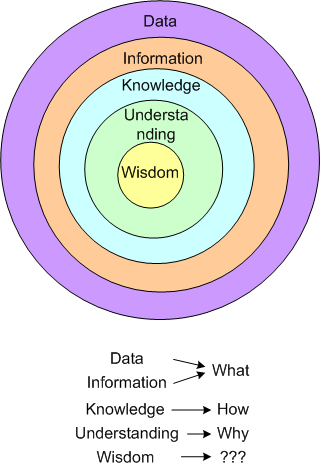
Data and information answer “what something is” questions. Knowledge answers “how something works” questions. Understanding answers “why something is the way it is” questions. Wisdom, the rarest form of conceptual content, is altogether a different beast. It answers all questions.
The acts of probing, sensing, and measuring produce raw data. The filtering, integration and association of data fragments creates information. The mistake-prone application of information and learning from errors leads to knowledge. The application of holistic, systems thinking to knowledge creates understanding.
Unlike the other four types of content, which integrate up and progress sequentially from each other, wisdom may not. Wisdom may appear instantaneously on its own by the grace of some higher power. It has to be that way. If it wasn’t, then only highly educated and experienced intellectuals would be capable of acquiring wisdom – and we know that isn’t true, don’t we? Wisdom is accessible to all human beings regardless of race, age, culture, wealth, or any other trait. The trouble is that society, especially western societies, wants us to think otherwise. No?
Tribal Leadership
In “Tribal Leadership” (the audio version of the book is downloadable for free here), the authors summarize the results of their ten-year, 24,000 person research. Their tag line is: “Birds flock, fish school, and people tribe“. As a result of their experience, they’ve categorized organizational cultures into five “staged” types based on the general attitude of tribe participants.
The figure below and its accompanying annotations show my understanding of the TL authors’ message.

Notice that as one moves up the scale, the focus shifts from “me” to “we” and “all“. That’s why the authors assert that an epiphany is required to make the leap from stage 3 to stage 4. Successful people who are tired and frustrated at playing the dog-eat-dog game against other individuals at stage 3 shed their “it’s all about me” mindset and transform into sharers and effective catalysts for group advancement. Books and articles of techniques and tips for getting ahead, a multi-billion dollar industry targeted at the Donald Trump wannabes of the world, instantaneously become useless and irrelevant to stage 4 leaders. Those books and articles that concentrate on platitudes, community, and inspiration, formerly considered to be useless new age drivel, take on new meaning and serve as guidance for stage 4 leaders.
Reflecting on my behaviors and modus operandi over the years, I’m seemingly stuck in the isolationist world of stage 3 and impatiently waiting for the epiphany. How about you? Where are you, and are you at peace with your position?
Fighting With The Present Moment
Scott Kiloby is the most recent spiritual teacher that I’ve been listening to. In “Love’s Quiet Revolution“, he says that people spend the vast majority of, if not all, their psychological time in one of three states:
- Regretting the past,
- Worrying about the future,
- Resisting/fighting with the present.
I’ve heard of the first two states, but the third one was depressingly new to me. To test out this assertion, I googled my horrendously inadequate memory to dig up several instances where I “fought” with the present moment yesterday:
- I got pissed when the dumb bell weights I use in my workout routine were missing from their slots.
- I got pissed off when the shower water turned scalding hot after someone flushed the terlet.
- I got pissed off when I spilled my bottle of Brute in the gym.
And these events happened within the space of just one hour at the gym! If I tried to recall all my bouts with the present moment yesterday, I’d probably need several more pages to recount them. How about you? How many fights with the present moment were you in yesterday?

If You Want To Write
Brenda Ueland’s “If You Want To Write” is not just about learning how to write. As Guy Kawasaki has noted, it’s a moving tribute to the human spirit and the innate ability to create that resides in each of us.
If you’re not into spirituality, you won’t buy into what I’m going to say next. IYWTW impacted me like some of the best spiritual works that I’ve read; but without using explicit, spiritual terms like “enlightenment, awakening, surrender, non-duality, universal consciousness“, etc. The best spiritual works are hard to describe and summarize in words. They must be felt and experienced via graceful tingles and enveloping shivers down your spine. They can’t be understood by the rational mind. IYWTW is one such work.
If you want to explore spirituality from an unusual and different point of view, then you may want check out IYWTW because it contains much more than its title suggests. The book brought, if only for a few brief moments, “the peace that passeth all understanding” to me, and it may for you.

Cradle To Grave Indoctrination
“Few people are capable of expressing with equanimity opinions which differ from the prejudices of their social environment. Most people are even incapable of forming such opinions.” – Albert Einstein
To me, the second sentence is the most insightful part of this quote. My subjective interpretation is that Einstein discovered that the cradle-to-grave indoctrination of most individuals teaches them to become subservient to the herd mindset prevailing during their time on earth. This indoctrination is so effective and so complete that they don’t have a clue that their capacity to think afresh has been vastly constrained by their social environment. What do you think Einstein meant when he said the words? Your interpretation is as invalid as mine.
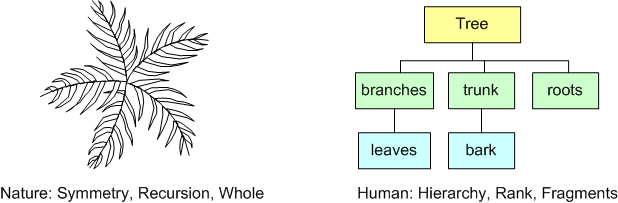
I don’t think there’s any conspiracy theory here, it’s just the natural course of development in any society that has been “trained” to revere human-concocted hierarchical structures of governance. I say “human-concocted” because there are no hierarchies in nature. We automatically and impulsively impose hierarchies on everything we observe because that’s the only way we know how to make sense of, understand, and (attempt to) control the world. Building command and control hierarchies and requiring unquestioning subservience to those arbitrarily placed “above” you in the caste system is the way of the human race – today. Do you think this situation will remain that way for your lifetime? How about, forever?
Don’t Sign That Check!
When someone presses your buttons and tries to insult you or your strongly held beliefs, you don’t have to automatically fall into a defensive position and start your own retaliatory offensive onslaught. It’s like the perp has written out a check from your checkbook, but your signature is required for him/her to cash it in.
The trick is to realize the meteoric rise in emotional temperature before your ego, or what Eckhart Tolle calls the pain body, takes over the steering wheel. Alas, even knowing this, I have the hardest time keeping the cap on the pen.

How Many Tines….
…does a fork have? Hoytee-toytee forks have three, and regular-people forks have four. On a totally different plane of thought, how many tines have you considered taking decisive action on something that really mattered to you but decided not to because of your fear of “what other people (especially the hoytee-toytee dudes with authority over you) would think“? Even worse, how many tines have you not taken action on something important to you, but you didn’t know you remained inert because you weren’t aware of your subconscious tendency to submit to authority? Obviously, you couldn’t count how many tines you did this because if you weren’t aware, you wouldn’t have any freakin’ idea of when to increment your counter.
It is only by risking our persons from one hour to another that we live at all.”- William James

Seeking Trouble
I’ve had the Kindle version of it for awhile, but I’ve finally got around to reading “Gurdjieff” by John Shirley. I’m glad I did because early in the book, this passage stirred up some internal energy:
According to the Gospel of Thomas, Jesus said, ‘ Let him who seeks continue seeking, until he finds. When he finds, he will become troubled. When he becomes troubled, he will be astonished, and he will rule over all.'”
It caused an energy surge because I’ve seeked and found trouble, deep trouble, multiple times. I’ve found that virtually everyone, both individually and collectively, behaves unconsciously according to the selfish “I” thought. Of course, this mass of humanity includes me, especially.
So, I’ve seeked, found trouble, and became astonished. However, I’ve yet to “rule over all”, which I think wasn’t meant to be taken literally. Hell, I’d settle for just ruling over my false self. How about you, have you found trouble?


Why am I here?
WTF?
Meh!
D'oh!

My BTC Address



 Bulldozer00's Blog