Archive
Motorcycle And Software Maintenance
Robert Pirsig’s “Zen And The Art Of Motorcycle Maintenance” is one of my fave books of all time. I have a soft cover copy that I bought in the nineties. Because of its infinite depth and immersive pull, I’ve read it at least three times over the years. Thus, when Amazon.com sent me a recommendation for the kindle version of it for $2.99, I jumped at the chance to e-read it and capture some personally meaningful notes from it.
(Published in 1974) the book sold 5 million copies worldwide. It was originally rejected by 121 publishers, more than any other bestselling book, according to the Guinness Book of Records. – Wikipedia
In a nutshell, ZATAOMM is about a college professor (Pirsig himself) who ends up going insane over his obsession with trying to objectively define what the metaphysical concept of “quality” means.
Quality…you know what it is, yet you don’t know what it is. But that’s self-contradictory. But some things are better than others, that is, they have more quality. But when you try to say what the quality is, apart from the things that have it, it all goes poof! There’s nothing to talk about. But if you can’t say what Quality is, how do you know what it is, or how do you know that it even exists? If no one knows what it is, then for all practical purposes it doesn’t exist at all.
During my fourth read of ZATAOMM, I started noticing how much of the wisdom Mr. Pirsig proffers up applies to the “art” of software development/maintenance:
When you want to hurry something, that means you no longer care about it and want to get on to other things.
This comes up all the time in
mechanicalsoftware work. A hang-up. You just sit and stare and think, and search randomly for new information, and go away and come back again, and after a while the unseen factors start to emerge.Sometimes just the act of writing down the problems straightens out your head as to what they really are.
The craftsman isn’t ever following a single line of instruction. He’s making decisions as he goes along. For that reason he’ll be absorbed and attentive to what he’s doing even though he doesn’t deliberately contrive this. He isn’t following any set of written instructions because the nature of the material at hand determines his thoughts and motions, which simultaneously change the nature of the material at hand.
Any effort that has self-glorification as its final endpoint is bound to end in disaster.
Stuck. No answer. Honked. Kaput. It’s a miserable experience emotionally. You’re losing time. You’re incompetent. You don’t know what you’re doing. You should be ashamed of yourself.
This gumption trap of anxiety, which results from overmotivation, can lead to all kinds of errors of excessive fussiness. You fix things that don’t need fixing, and chase after imaginary ailments. You jump to wild conclusions and build all kinds of errors into the machine because of your own nervousness.
Impatience is close to boredom but always results from one cause: an underestimation of the amount of time the job will take. You never really know what will come up and very few jobs get done as quickly as planned. Impatience is the first reaction against a setback and can soon turn to anger if you’re not careful.
Impatience, stuckness, underestimation, anxiety, and carelessness. These are just a subset of the feelings and behaviors that pervade dysfunctionally soulless organizations whose sole focus is on “following prescribed process and meeting schedule“.

Stirred, And Then Unstirred
When a cock-eyed idea for a blog post appears in my discombobulated mind, I sometimes write the post to completion and promptly place it in the publication queue. At other times, I simply toss a link, some sentences, and/or a quick picture on the page and store it away for future elaboration in my “drafts” folder. As a result, I have over 100 drafts stored in the underground catacombs of this site. The oldest one is dated back to 3/10/2009!

Every once in awhile, when I’m suffering from writer’s block, I browse through the drafts pile in reverse chronological order to select my next earth-shattering post. However, since for me writing is all about emotion (positive or, most likely negative), I often find myself chucking many drafts into the trash. For those drafts, the second time around is just a dispassionate “meh“.
Since all emotions naturally ebb and flow, it makes sense that what stirs me today may not stir me tomorrow – and vice versa. But that’s a wonderful thing because when emotions stop changing, life sucks the big ‘un. When I “successfully” force emotions to stay longer with me than nature meant them to stay with me, I tend to get myself into trouble. Does this apply to you too?
One Hit, One Miss
In “So Far from Home: Lost and Found in Our Brave New World“, Margaret J. Wheatley hits the mark with BD00:
The interactive nature of the Net distinguishes it from all earlier technologies; from the start, it was based on public interactions, not on private use such as with books or recordings. It fed on two powerful human needs— to be visible and to connect— at a time when we were already feeling lonely and invisible. Our insatiable appetites for self-creation and self-expression have transformed us into twenty-first-century hunter-gatherers. We’ve become addicted to what else we might find, where the next click might lead us, so we incessantly keep hunting.
Meg also misses the mark with:
…we’ve abandoned the thinking skills we humans developed over many centuries of evolution: abstract thinking, nuanced language, envisioning, moral reasoning, the scientific method.
Note that the hit and miss only apply to BD00; according to BD00. How do they apply to you; according to you?

The Uncertainty Of It All
From my personal perspective, I’ve discovered that one way of inching toward inner peace is to become more and more comfortable with uncertainty. I’m no Buddha (I’m a wanna be!), but learning to accept the fact of uncertainty often ameliorates the coupled feelings of anxiety and loss-of-control.
As an example, take a look at these five unproductive blank entries from my “gym notes” journal:
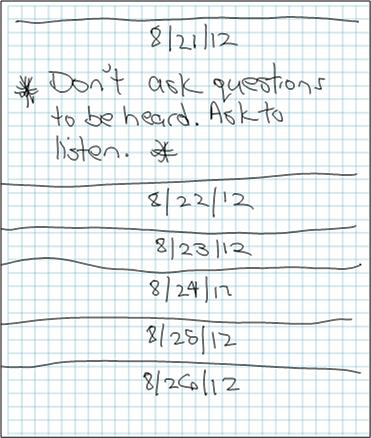
I don’t recall if something “I thought serious to ME” was dominating my mind at the time and contributing to the writer’s block, but I do remember not getting my knickers in a bunch. I remember thinking: “Oh well, I’m sure I’ll start filling the entries with inane thoughts soon. If not, then so what.”
Soon enough, my unorthodox thought stream reemerged on 8/27/17:
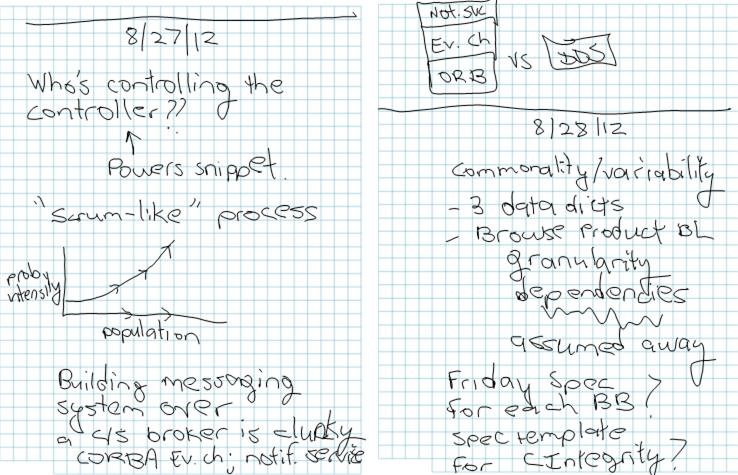
The uncertainty of it all. It’s wonderful, no?
Holding On For Too Long
I’ve always admired Linus Torvalds. Thus, I found this slashdot.org article, “Linus Torvalds Answers Your Questions“, fascinating. Particularly, this Q & A struck a chord in me:
Q: You must of been burned out on Linux kernel development multiple-times over by now… how do you deal with it?
Linus: Oh, I really enjoy what I do. And I actually enjoy arguing too, and while I may swear a lot and appear like a grumpy angry old man at times, I am also pretty good at just letting things go. So I can be very passionate about some things, but at the same time I don’t tend to really hold on to some particular issue for too long, and I think that helps avoid burn-out.
Obsessing about things is important, and things really do matter, but if you can’t let go of them, you’ll end up crazy.
I’ve found that when I can’t let go of something that “shouldn’t be like it is“, the world suddenly stops. I get stuck; immobilized by a stagnating cesspool of circular thoughts and wondering if I’ll ever get unstuck.
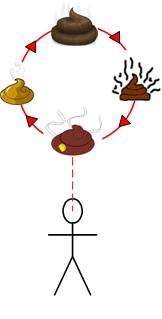
The key for me to getting unstuck and moving forward again is to realize that I can’t control or fix everything to “my” liking. As hard as it is to accept, the world doesn’t exist to accommodate “ME“. Thus, when I can remember it (which is a challenge in itself), my favorite prayer is:
BD00, please grant the “other” BD00 the serenity to accept the things he cannot change,
The courage to change the things he can,
And the wisdom to know the difference.
How about you? Do you ever get stuck? What gets you unstuck?
Temporary Enlightenment
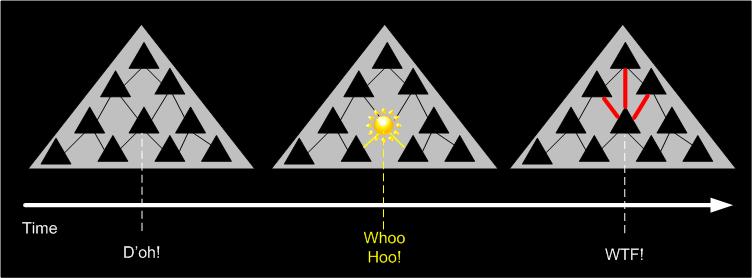
Bedeviled
I don’t know about you, but this quote seems magical to me:

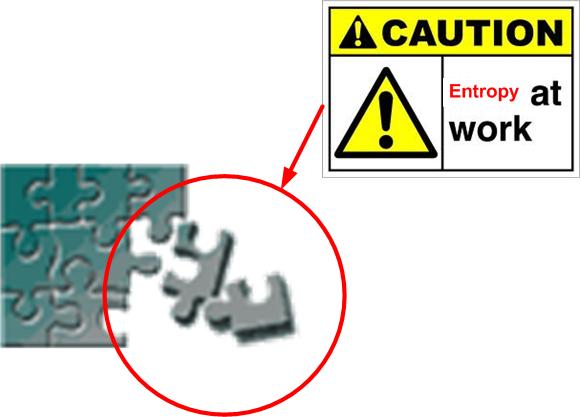
So, in the midst of the relentless erosion of integrity of all matter over time, how in the hell does anything ever get organized in the first freakin’ place? While something is being created in real-time, be it you or me or our own creations, the 2nd law of thermo is magically suspended from doing its damage.
It takes “work” to create something. As soon as the entropy-defying work stops, the disintegration of that something begins.
Dependence Over Autonomy
Matthew Gill’s “Accountant’s Truth” provides a fascinating analysis and expose of the attitudes and culture of the accounting industry through a series of in-depth interviews with practicing accountants. As I’m reading the book, I’m using the Kindle’s marvelous “share” feature to tweet snippets like this one out into the ether:

Now, compare this excerpt with the following pair of tweets from one of my fave spiritual teachers, Byron Katie:
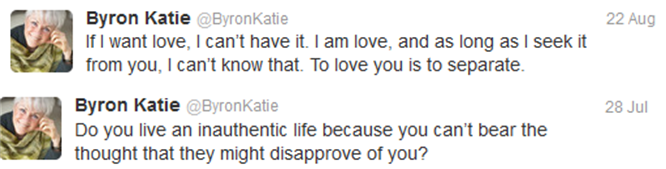
Interesting, don’t you think?
Nine Plus Levels
In William T. Powers’ classic and ground-breaking book “Behavior: The Control Of Perception“, Mr. Powers derives a theoretical model of the human nervous system as a stacked, nine-level hierarchical control system that collides with the standard behaviorist stimulus-response model of behavior. As the book title conveys, his ultimate heretical conclusion is that behavior controls perception; not vice-versa.
The figure below shows a model of a control system building block. The controller’s job is to minimize the error between a “reference signal” (that originates from “somewhere” outside of the controller) and some feature in the external environment that can be “disturbed” from the status quo by other, unknown forces in the environment.
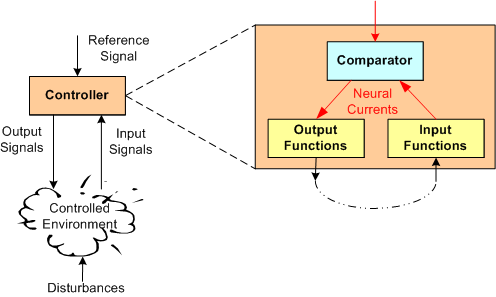
Notice that the comparator is one level removed from physical reality via the transformational input and output functions. An input function converts a physical effect into a simplified neural current representation and an output function does the opposite. Afterall, everything we sense and every action we perform is ultimately due to neural currents circulating through us and being interpreted as something important to us.
So, what are the nine levels in Mr. Powers’ hierarchy, and what is the controlled quantity modeled by the reference signal at each level? BD00 is glad you asked:

Starting at the bottom level, the controlled variables get more and more abstract as we move upward in the hierarchy. Mr. Powers’ hierarchy ends at 9 levels only because he doesn’t know where to go after “concepts“.
So, who/what provides the “reference signal” at the highest level in the hierarchy? God? What quantity is it intended to control? Self-esteem? Survival? Is there a “top” at all, or does the hierarchy extend on to infinity; driven by evolutionary forces? The ultimate question is “who’s controlling the controller?“.
This post doesn’t come close to serving justice to Mr. Powers’ work. His logical, compelling, and novel derivation of the model from the ground up is fascinating to follow. Of course, I’m a layman but it’s hard to find any holes/faults in his treatise, especially in the lower, more concrete levels of the hierarchy.
Note: Thanks once again to William L. Livingston for steering me toward William T. Powers. His uncanny ability to discover and integrate the work of obscure, “ignored”, intellectual powerhouses like Mr. Powers into his own work is amazing.
Human_Being:preserveSelf
As the UML sequence diagram below shows, an “unnamed” Nature object with an infinite lifeline asynchronously creates and, uh, kills Human_Being objects at will. Sorry about that.

So, what’s this preserveSelf routine that we loop on until nature kicks our bucket? I’m glad you asked:

Have a nice day! 🙂

Why am I here?
WTF?
Meh!
D'oh!

My BTC Address



 Bulldozer00's Blog