Archive
Brandolini’s Law
Thanks to twitter friend @SerialMom, I recently learned of the existence of Brandolini’s law:
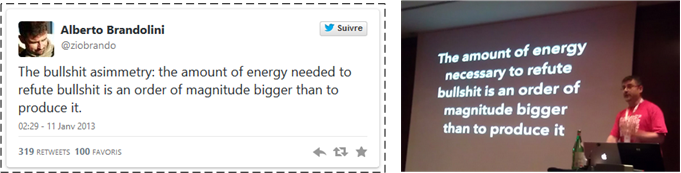
Damn, I wish I thought of that!
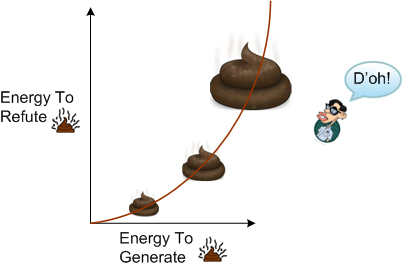
Sometimes, in the case of interacting with peers and colleagues, it may indeed be worth expending 100 units of your energy to flush 10 units of bullshit down the terlit. However, with management, don’t even think about refuting 1 unit of managerial-generated BS with 2 units of your intellectual energy – unless you want to get bitch-slapped down. Attempting to refute 100 units of management BS with 1000 units of your personal energy is downright suicidal.
Beer Tip
On a 90 degree day a couple of weeks ago, I hired a crew to come out to my house and seal my driveway. In lieu of cash, I gave the team this bucket o’ joy as a tip….
 Do ya think they would have preferred cash?
Pick Your Path
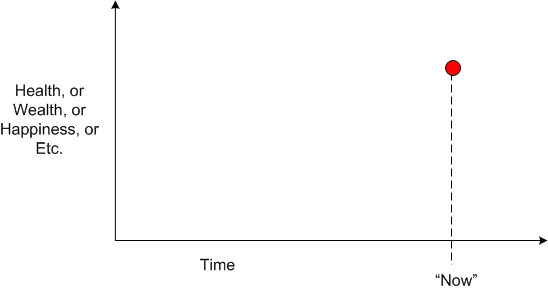
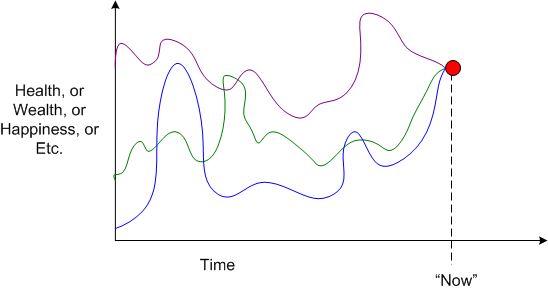
Make a measurement, one measurement, of any personal metric you might fancy… right now. Next, plot your sample point on a graph where time is the independent variable on the x-axis:
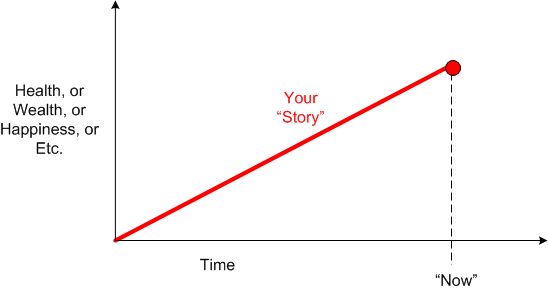
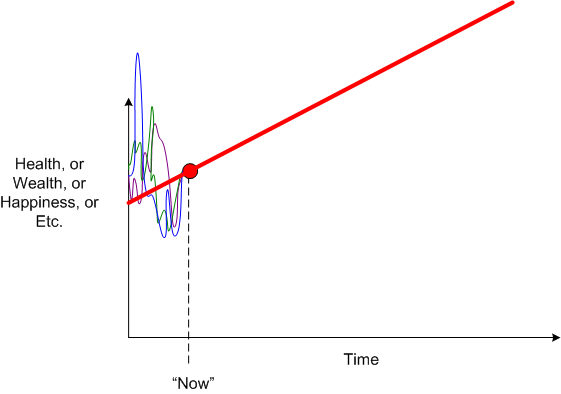
Next, even though you most likely have no prior measurements to plot, reflect on the path that got you to “now“. You’re likely to concoct a smooth, logical, linear narrative like this:
However, because of our propensity to be, as Nassim Taleb says, easily “fooled by randomness“, you’re most likely to have traveled one of the ragged, noisy paths plotted on this graph:
Because of the malady of linear-think, you’re most likely to envision the future as a continued journey on the smooth, forward projection of your made-up narrative. Good luck with that.
The TBTF Threshold
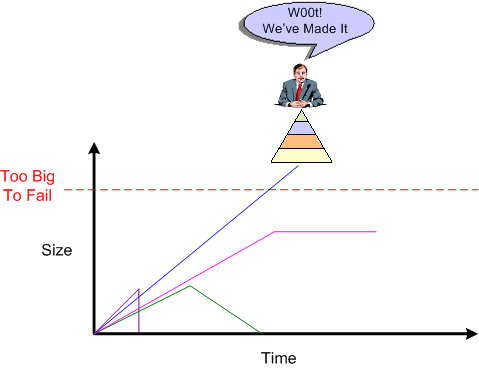
Did you ever wonder why companies are obsessed with growth? Check out the growth trajectories of four hypothetical companies below. Although company stewards may not explicitly state it, the goal of every for-profit enterprise is to become Too Big Too Fail (TBTF). At the moment the TBTF threshold is crossed, the risk of going bust disappears. Well, it doesn’t disappear, it simply gets transferred from the TBTF menace itself to the public via taxpayer bailouts by politicians who love to play with other people’s money – yours and mine.
In nature, nothing organic is Too Big To Fail. I wish the same could be said for man-made systems. Timber!!!!!
Second Time Around
Since his philosophical ideas are refreshingly new, counter-intuitive, and mind-boggingly deep, I decided to re-read all four of Nassim Taleb’s books. I just finished re-reading “Antifragile” and am now well into my second pass through “The Black Swan“.
As with all good books that resonate with me, I find that re-reading them brings new learning, excitement, and joy. It’s almost like I’m reading them for the first time.
The reason I’m magnetically drawn to Mr. Taleb’s work is because his mission is truly noble and humanitarian. It is to make the world a better place by creating a system in which so-called elites (e.g. economists, politicians, academicians, Harvard-trained managers, high frequency traders) with no “skin in the game” cannot harm millions who follow their predictions/advice/policies without being harmed themselves. Requiring big-wigs to place some “skin in the game” (Mr. Expert, does the content f your portfolio align with your forecasts/advice?) precludes the alarming and increasingly asymmetric transfer of anti-fragility from regular Joe Schmoes like you and me to smug, self-serving elites.
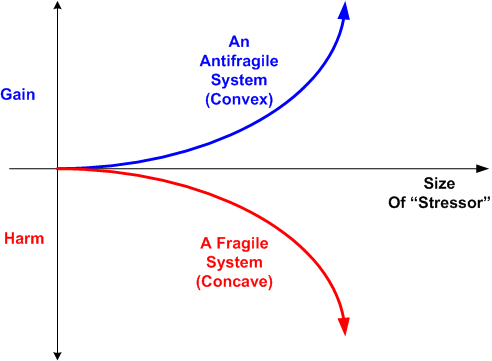
 In case you are new to the concept of antifragility, consider the figure below. A fragile system is one in which, as the magnitude of an external stressor is applied, the harm it experiences increases non-linearly. An antifragile system is the exact opposite. It is more than simply resilient or robust. It actually gains from volatility (up to a point, of course).
Since you can’t know what’s going to happen in the next five minutes, let alone far into the future, you can’t guarantee your own personal antifragility. But you can take concrete action to reduce your fragility and minimize the risk of someone stealing whatever antifragility you do have. Eliminating debt decreases fragility. Adding redundancy (e.g. two kidneys, two lungs) and “having options” reduce fragility. Government bailouts transfer antifragility from taxpayers to executives and shareholders. Lack of term limits transfers antifragility from voters to politicians. Corporate mergers and buyouts transfer antifragility from employees to executives. Increasing size and centralization increases fragility. Lack of exercise increases fragility. Long periods of obsessively manufactured stability increase fragility. The ultimate fragilizer, and the one in which we can only accept, is…….. TIME.
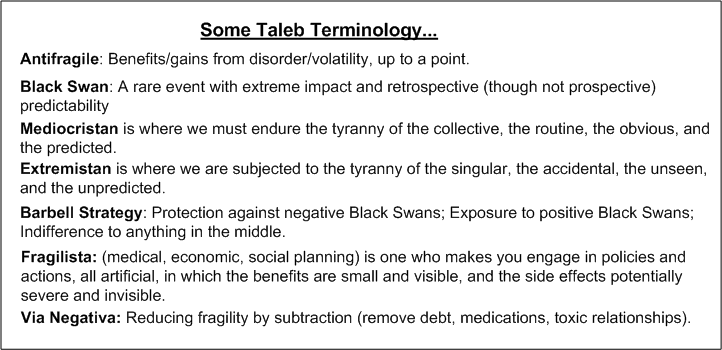
Firm Substructure And Soaring Liberty
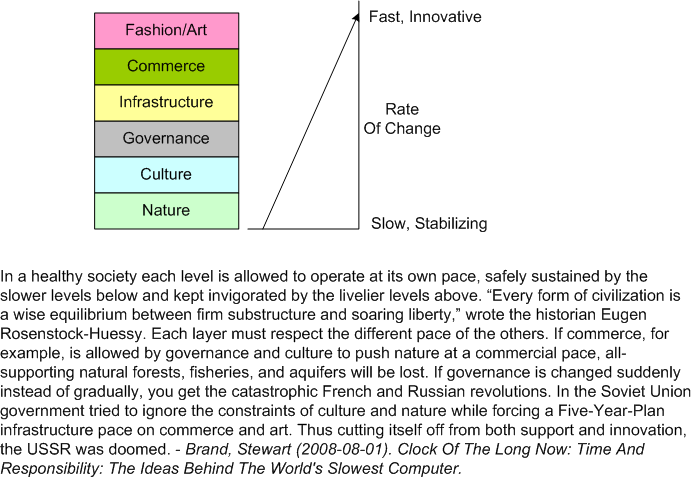
Placed Above The Herd
Alfie Kohn‘s “Punished By Rewards” is the classic go-to book on why/how rewards destroy intrinsic motivation and fuel intra-group competition and politicking. In “Want To Stay Productive? Turn Down The Next Award You Win“, Drake Baer gives yet another example of the motivation-busting effect of reward systems.

Do medals, advanced degrees, fancy titles, and huge bonuses tend to fatten the heads of their receivers (and their givers) to the point of lazyness? Do they create an attitude of entitlement in the minds of their receivers (and their givers)?
W00t! I’ve arrived! No need to do real work anymore. I’ve been placed above the herd by those who have the “authority” to do so – and who, by extension, are two levels above the herd.
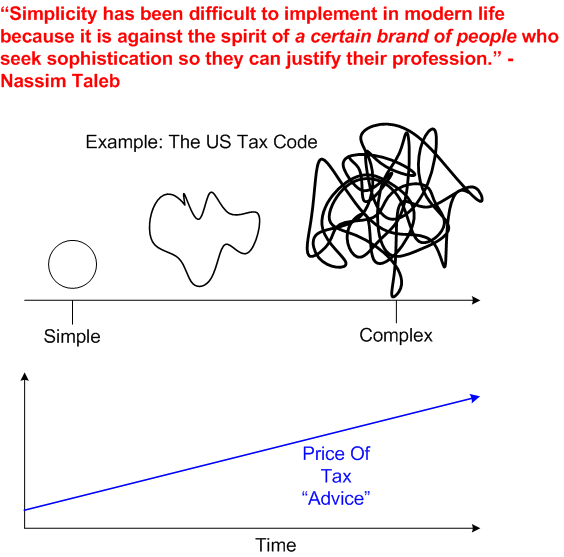
1D And 2D
In case you didn’t already know, I draw dorky diagrams often, really often. My motivation is to increase understanding by transforming a constricted, sequential, 1D word description of a new, interesting topic into a spatially loose, 2D visualization. To me, the resulting diagrams are not as important as the act of creating them. The iterative thinking and reflection required by the process anchors an understanding (which in fact may turn out to be wrong) in place. Maybe you should give it a try?
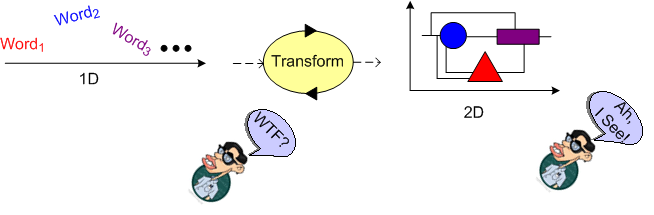
Context Is Everything
Right along side with POSIWID (the Purpose Of a System Is What It Does), one of my favorite sayings is CIE (Context Is Everything).
Given a problem to solve and a person (or team) designated to solve it, the person will seek a solution in accordance with the constraints imposed on him/her by the surrounding context. As the figure below shows, his/her perceptions and thoughts of the problem will be colored by the context. The problem itself will most likely be perceived differently as a function of the context (as signified in the picture by slightly different poop types). In one or more contexts, the problem might not even be perceived as a problem at all (it’s not a bug, it’s a feature)!

While writing this post, I suddenly realized that there is no difference between the word “context” and “culture” – but only in the context of this post. 😀


Why am I here?
WTF?
Meh!
D'oh!

My BTC Address



 Bulldozer00's Blog