Archive
Context Switching
“There is time enough for everything in the course of the day, if you do but one thing at once, but there is not time enough in the year, if you will do two things at a time.” – Lord Chesterfield (1740)
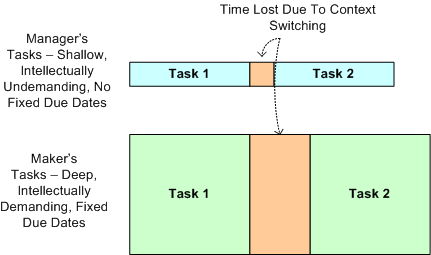
Study after study after study have shown that, due to the natural imperfections built into human memory, multitasking is inefficient and unproductive compared to single-tasking. The bottom line is that humans suck at multitasking. Unlike computers, when humans switch from doing one thought-intensive task to another, the clearing out of memory content from the current task and the restoration of memory content from the previous task greatly increases the chances of errors and mistakes being made.
So why do managers multitask all the time, and why do unenlightened companies put “multitasking prowess” on their performance review forms? Ironically, they do it to reinforce an illusion that multitasking is a key contributor of great productivity and accomplishment. When a “performance reviewer” sees the impressive list of superficial accomplishments that a multitasker has achieved and compares it to a measly list of one or two deep accomplishments from a single-tasker, an illusion of great productivity is cemented in the mind of the ignorant reviewer. Most managers, huge multitaskers themselves, and clueless to the detrimental effects of the malady on performance, tend to reward fellow multitaskers more than non-multitasking “slackers“. Bummer for all involved; especially the org as a whole.
Just The Facts Ma’am
The other day, I had a confrontation with an anointed leader. (Being the insensitive and self-righteous jerk that I am, and supposedly incapable of being a leader myself, that happens a lot). After I made some normally “undiscussable” assertions as to the poor leadership behavior (more like NO leadership behavior) being exhibited by my confrontee, he/she accused me of not having all the facts. My counter was, “You’re absolutely right, but when does anyone have ALL the facts before they make a judgment regarding a FUBAR situation or a person’s behavior?“.
How does one know when ALL the facts have been discovered? Is there such a thing as ALL the facts? Even if ALL the facts can be unearthed, is it a foregone conclusion that every fact will always interpreted the same way by all people? Can words or, for the fellow engineers in the house, equations convey any universal truth, or are they just approximations?
Unscalable Orgs
My friend Byron Davies sent me a link to this 3 minute MIT Media Lab video in which associate Media Lab Director Andy Lippman challenges us to recognize four common flaws plaguing all of our institutions. Obtaining a new awareness and understanding of the plague is the first step toward meaningful redesign.
According to Lippman, the top four reasons for organizational decline are:
- They’re out of scale – they’ve grown too big to perform in accordance with their original design
- They’re monocultures – they all act the same
- They’re opaque – nobody from within or without understands how they freakin’ work
- They’ve lost their original mission – A summation of the previous three reasons.
Because of the pervasive institutional obsession for growth, Lippman seems to think that solving the scaling problem through the development of nested communities is the most promising strategy for halting the decline.
Staffing Profiles
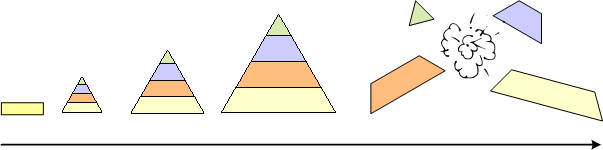
The figure below shows the classic smooth and continuous staffing profile of a successful large scale software system development project. At the beginning, a small cadre of technical experts sets the context and content for downstream activity and the group makes all the critical, far reaching architectural decisions. These decisions are documented in a set of lightweight, easily accessible, and changeable “artifacts” (I try to stay away from the word “documentation” since it triggers massive angst in most developers).
If the definitions of context and content for the particular product are done right, the major incremental development process steps that need to be executed will emerge naturally as byproducts of the effort. An initial, reasonable schedule and staffing profile can then be constructed and a project manager (hopefully not a BM) can be brought on-board to serve as the PHOR and STSJ.

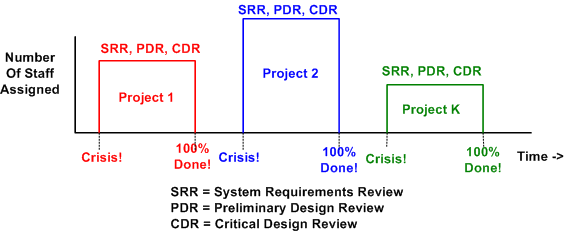
Sadly, most big system developments don’t trace the smooth profiling path outlined above. They are “planned” (if you can actually call it planning) and executed in accordance with the figure below. No real and substantive planning is done upfront. The standard corpo big bang WBS (Work Breakdown Structure) template of analysis/SRR/design/PDR/CDR/coding/test is hastily filled in to satisfy the QA police force and a full, BM led team is blasted at the project. Since dysfunctional corpocracies have no capacity to remember or learn, the cycle of mediocre (at best) performance is repeated over and over and over. Bummer.
Zero Cost Risk Mitigation
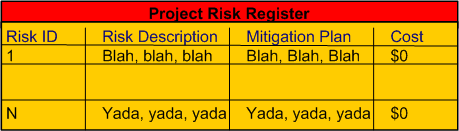
Why do managers and executives require project technical leaders to develop comprehensive “risk mitigation plans” while at the same time fully expecting the plans to cost nothing (no people, no time, no money). Formal and rigorously filled out risk registers (with no cost column) make it look like due diligence is being performed, but it’s all a ruse to sustain the illusion that management is “in control”. WTF?
Both Ends Of The Spectrum
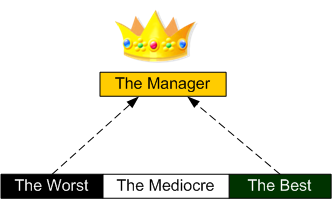
Why does it seem that both the best engineers and the worst engineers always gravitate towards becoming managers? Because of a lack of training in the art of humanistic influence and true leadership skills, they usually (but not always) end up turning into STSJ BMs. The real tragedy is the continuous loss of the best engineers into the ranks of corpo elitism. Why? Because the revenue generating products and services they leave in the dust for fame and fortune suffer the consequences of their departure. Thus, the whole company suffers. Bummer.
A Unique Core Value
Unless they’ve been cleverly camouflaging their sinister ways from the world’s prying eyes, the people at Zappos.com truly do live and breathe their corporate values every day. My favorite, and perhaps most unique Zappos core value is number three: “Create Fun and a Little Weirdness“. Here’s how the Zappos team describes this precious gem from the viewpoint of their “Core Values Frog” (CVF):
Our CVF has a sense of humor; he knows that it’s good to laugh at yourself every once in a while. Work shouldn’t be synonymous with drudgery; CVF can find fun and weirdness even when the rubber meets the road and we’re getting lots done. Being a little weird requires being a little innovative, and CVF is always looking for a chance to fully engage in his work and bring out the fun and weird side of it.
In tribute to CV #3, the people at Zappos have held impromptu parades, hula hoop contests, head shavings, and all kinds of other weird events both on and off the company’s premises.
Of course, Zappos is just a lowly $1B retail shoe company and your business is much more different, respectful, and prestigious. Thus, it’s patently obvious that Zappos core value #3 can’t possibly work in your corpo palace. Right?

Accessible And Accessed
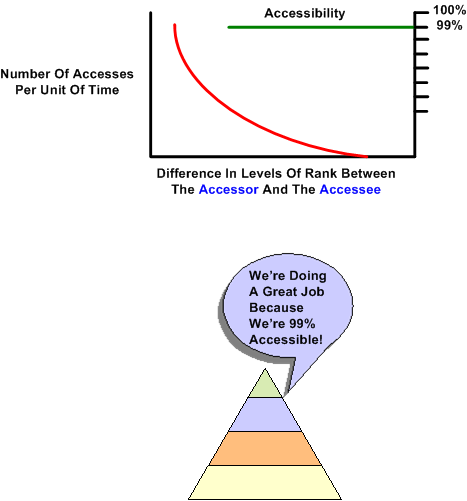
One of the metrics that a lot of corpo hierarchs assess themselves on is how accessible they are to their people. However, being accessible (textbook open door policy, walking the halls, e-mail, pseudo-mandated all hands meetings) doesn’t mean being accessed. For obvious reasons, they don’t measure themselves on this important metric, especially how frequently they are accessed (voluntarily and unsolicited) by their non-direct reports. In the vast majority of corpocracies, the number of accesses per unit of time goes down as the difference between caste levels of the accessor and accessee goes up. Just because that’s the way it’s always been doesn’t mean that’s the way it should or could be.
A Democratic Workplace? No Freakin’ Way!
“We’ll send our sons anywhere in the world to die for democracy,” says Ricardo Semler (CEO of Semco), “but don’t seem to apply the concept to the workplace. This is a tragic error, because people on their own developing their own solutions will develop something different“.
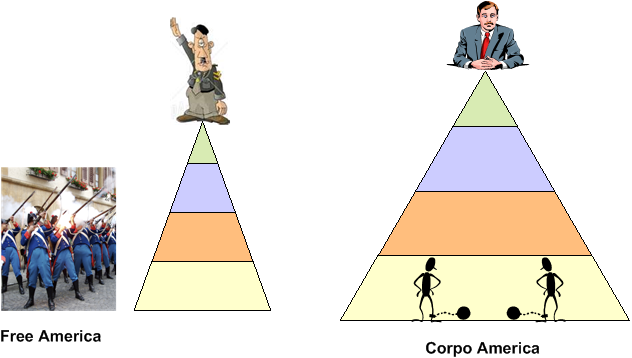
In Semler’s own firm, there are no five-year business plans (which he views as wishful thinking), but rather “a rolling rationale about numbers.” A project takes off only if a critical mass of employees decides to get involved. Staff determine when they need a leader, and then choose their own bosses in a process akin to courtship, says Semler, resulting in a corporate turnover rate of 2% over 25 years.
Interested in hearing more from Mr. Semler? Then check out this video of a lecture he gave to elite MIT business students way back in 2005:
Blasphemy! We know what’s best for all the cake eaters in our kingdom because we’re infallible, of course. That couldn’t possibly work here because our business is too different. It’s “not applicable“.
Four Managers And An Engineer
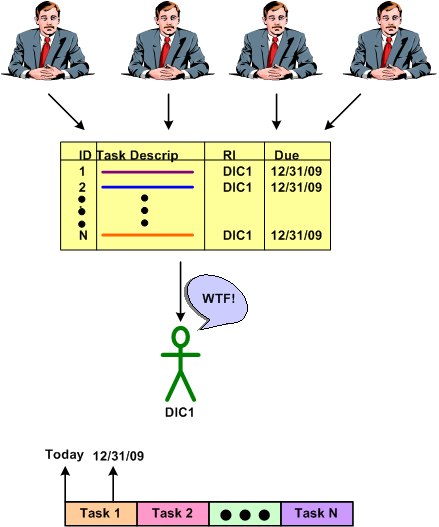
A lot of people have heard of the blockbuster movie “Four Weddings And A Funeral”, but no one has heard of the cinematic release in incubation titled “Four Managers And An Engineer“. The story line goes like this:
- One manager calls a “planning” meeting and invites three peer managers (actually two peers and one pseudo-manager) and one enginerd.
- The meeting host manager presents an initial powerpoint plan to the group.
- At the bottom of each and every plan page, the one enginerd’s name appears in a colored box coupled with a non-trivial task to do and a critical “need by” date.
- The enginerd points out the irony of the four-to-one ratio of managers to enginerds present at the meeting when other more important managers up the chain are crying out for higher profit numbers.
- To further build tension in the melodrama, the enginerd asks why no one else on the team was assigned any of these critically important tasks.
- One more Hershey kiss is added to the pile of poop when the enginerd graphically shows that sequentially placing the task boxes end-to-end (since they’re assigned to one bottleneck taskee) would blow the “planned” schedule out of the water.
- As the coup de grace, the enginerd asks what non-technical management tasks the managers assigned to themselves, and why they’re not in the plan with their names next to them.
- In a coordinated rage, the managers attack the engineer and bludgeon him/her to death with their blackberrys and leather bound Covey planners.
- The managers then; hide the body, replace the name of the deceased engineer on every page of the powerpoint plan with that of another enginerd, call another meeting, and invite themselves along with the next victim to their group-conspired serial killing spree.
Like another blockbuster movie, “Ground Hog Day”, the cycle repeats itself ad-infinitum. Unlike Ground Hog Day, there’s no breaking out of the loop and no transitioning to a happy Hollywood ending. The movie drones on until the audience gets bored to death and leaves the theater or the projector breaks down, whichever comes first. Wanna role in my movie? Wanna be the director? Wanna finance it?

Why am I here?
WTF?
Meh!
D'oh!

My BTC Address



 Bulldozer00's Blog