Archive
Maintenance Cycles And Teams
The figure below highlights the unglamorous maintenance cycle of a typical “develop-deliver-maintain” software product development process. Depending on the breadth of impact of a discovered defect or product enhancement, one of 4 feedback loops “should” be traversed.
In the simplest defect/enhancement case, the code is the only product artifact that must be updated and tested. In the most complex case, the requirements, architecture, design, and code artifacts all “should” be updated.
Of course, if all you have is code, or code plus bloated, superficial, write-once-read-never documents, then the choice is simple – update only the code. In the first case, since you have no docs, you can’t update them. In the second case, since your docs suck, why waste time and money updating them?
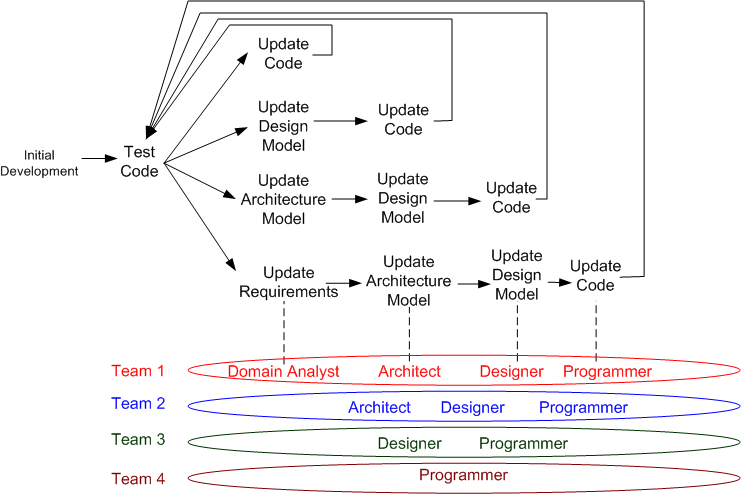
After the super-glorious business acquisition phase and during the mini-glorious “initial development” phase, the team is usually (but not always – especially in DYSCOs and CLORGs) staffed with the roles of domain analyst(s), architect(s), designer(s), and programmer(s). Once the product transitions into the yukky maintenance phase, the team may be scaled back and roles reassigned to other projects to cut costs. In the best case, all roles are retained at some level of budgeting – even if the total number of people is decreased. In the worst case, only the programmer(s) are kept on board. In the suicidal case, all roles but the programmer(s) are reassigned, but multiple manager type roles are added. (D’oh!)
Note that there does not have to be a one to one correspondence between a role and a person; one person can assume multiple roles. Unfortunately, the staff allocation, employee development, and reward systems in most orgs aren’t “designed” to catalyze and develop the added value of multi-role-capable people. That’s called the “employee-in-a-box” syndrome.
The Mythical Dual Ladder
The figure below shows a typical skill development timeline. At “t=0” ignorance reigns and learning begins. After a period of learning/applying/practicing, which varies widely from person to person, the status of “Novice” is achieved. After yet another period of learning/applying/practicing, the transition from novice to amateur occurs – and so on up to the level of master and beyond.

The key attribute to focus on in the timeline is the change in length of time required to transition from one level of competence to the next. It doesn’t stay the same or get smaller, it gets longer. Thus, with exceptions of course, the time required to transition from expert to master is greater than the time to transition from amateur to expert.
To remain viable, every product development company requires a critical mass of expertise in the core technologies that comprise the soul of its product portfolio. World class companies actively “nourish and catalyze” the novice-to-expert pipeline via continuous investments in targeted training and conference attendance. Average companies neither nourish or catalyze the pipeline, they “hope for the best” in that their employees will keep up with technology advancements on their own time. In the extreme, CLORGS and DYSCOs unconsciously “toxify and inhibit” the pipeline – if one is even recognized at all. They do this by implicitly encouraging experts to move out of technology and into management via higher compensation and stature for those experts/masters who jump from the mythical technical ladder to the coveted management ladder.

Care-full
Check out this tweet from Stefan Stern:

21st century leaders “get” this recipe for building two way trust and respect. 20th century leaders demand that followers (willing or coerced) unconditionally care about what the leader wants. To them, establishing and nurturing a symmetrical, two-way caring relationship is not in the cards.
Quid pro quo Clarisse…. Quid pro quo – Hannibal Lecter
BMs Of The Year
Since BD00 is a bombastic and boisterous blasphemer of the “B” word, I just HAD to meta-blog about this infoworld blog post after I stumbled upon it: “The tech industry’s biggest bozos of 2011”.
And the winners are…..
- Léo Apotheker: former HP CEO
- Mark Zuckerberg: current Facebook CEO
- Reed Hastings: current Netflix CEO
- Jim Basillie & Mike Lazardis: current co-CEOs of RIM
Because Netflix is one of the companies on my faves list (and I’m a stockholder!), I’m really bummed about the Hastings-Netflix fiasco. Since I think Mr. Hastings and Netflix will recover from the faux pas, I’m keeping them on the list.

Salesmen And Accountants
No one has ever failed to find the facts they are looking for. – Peter Drucker
Mr. Drucker may have gotten it wrong, at least in BD00’s case. It seems like the “facts” that I desperately need to continuously confirm my distorted world view come right up to me out of hiding and bite me in the bumpkiss. (If they don’t, I simply make some pseudo-facts up to feed the need).
Here’s one of the latest confirmations, and it’s in the form of another quote:
“It is difficult to get a man to understand something, when his salary depends upon his not understanding it.” – Upton Sinclair
Say what, you ask? That quote deftly closes this Forbes article written by “radical” Steve Denning: “Why Big Companies Die”.
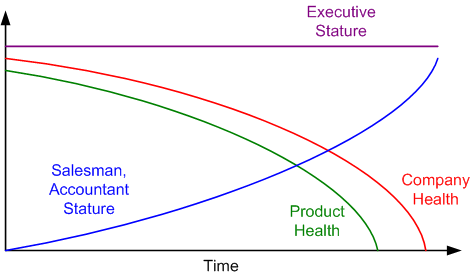
Quoting Steve Jobs on where salesmen come into play, and adding his own two cents on where accountants come into play, “rad” Steve describes an oft repeated pattern of corpo demise:
“The company does a great job, innovates and becomes a monopoly or close to it in some field, and then the quality of the product becomes less important. The company starts valuing the great salesman, because they’re the ones who can move the needle on revenues. So salesmen are put in charge, and product engineers and designers feel demoted: Their efforts are no longer at the white-hot center of the company’s daily life. They “turn off.”” – Steve Jobs
“The activities of these people (the accountants) further dispirit the creators, the product engineers and designers, and also crimp the firm’s ability to add value to its customers. But because the accountants appear to be adding to the firm’s short-term profitability, as a class they are also celebrated and well-rewarded, even as their activities systematically kill the firm’s future.” – Steve Denning
The dorky BD00 graph below attempts to map the above words onto an unscaled timeline.
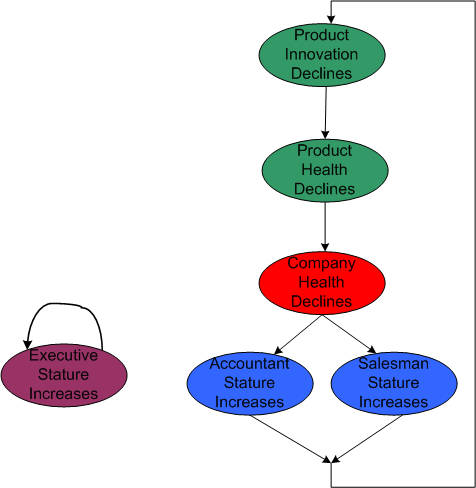
Or, if you prefer, here’s an alternative view of this unconscious pattern of demise:
Cribs And Complaints
HCL Technologies CEO Vineet Nayar‘s “Employees First, Customers Second” is one of the most refreshing business books I’ve read in awhile. One of the bold measures the HCLT leadership team considered implementing to meet their goal of “increasing trust through transparency” was to put up an intranet web site called “U & I“. After weighing the pros and (considerable) cons, the HCLT leadership team decided to go for it. Sure enough, the naysayers (Vineet calls naysayers the “Yes, But“s) were right:
The U&I site was clogged with cribs and complaints, harangues and imprecations that the company was wrong about everything. The continents and questions came pouring in and would not stop. Most of what people said was true. Much of it hurt.
However, instead of placing draconian constraints on the type of inputs “allowed“, arbitrarily picking and choosing which questions to answer, or taking the site down, Vineet et al stuck with it and reaped the benefits of throwing themselves into the fire. Here’s one example of a tough question that triggered an insight in the leadership team:
“Why must we spend so much time doing tasks required by the enabling functions? Shouldn’t human resources be supporting me, so I can support customers better? They seem to have an inordinate amount of power, considering the value they add to the customer.”
This question suggested that organizational power should be proportionate to one’s ability to add value, rather than by one’s position on the pyramid. We found that the employees in the value zone were as accountable to finance, human resources, training and development, quality, administration, and other enabling functions as they were to their immediate managers. Although these functions were supposed to be supporting the employees in the value zone, the reality was sometimes different.
That question led to the formation of the Smart Service Desk (SSD), which helped the company improve its operations, morale, and financial performance.
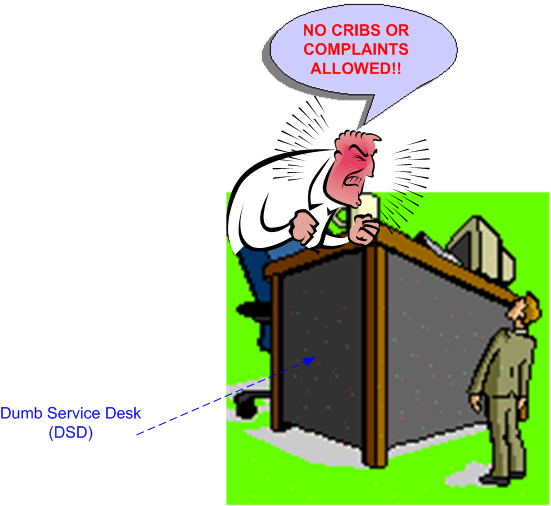
So, how did the SSD work, you ask? It worked like this: SSD. Not like this:
Ooh Ooh, Pick Me, Pick Me!
Quiz time! Who’s this kid….

In “You’re Not So Smart“, David McRaney describes how to overcome the debilitating scourge of “groupthink” in hierarchical organizations:
True groupthink depends on three conditions—a group of people who like one another, isolation, and a deadline for a crucial decision. It turns out, for any plan to work, every team needs at least one asshole who doesn’t give a shit if he or she gets fired or exiled or excommunicated. For a group to make good decisions, they must allow dissent and convince everyone they are free to speak their mind without risk of punishment.
Tome Peters said much the same thing is one of his bazillion books: “Put someone on your staff you don’t like“.
Semi-enlightened orgs hire consultants to fill the asshole role. Even though that’s a viable alternative, it’s only going half-way. The fact that an inside employee (or rotating employees) isn’t (aren’t) placed in the role says as much about the org’s culture as not “allowing” the role at all.
BD00 just had an epiphany! He’s concluded that he was put on this earth to fulfill “The Yes Asshole Rule“, and he’s willing to take job offers from far and near to fulfill his destiny. How many offers do you think will be forthcoming?

Related articles
- You Are Not So Smart: A Field Guide to the Psychology of Our Stupidity (brainpickings.org)
- Clanthink, Groupthink, Spreadthink (bulldozer00.com)
Behavior Compression
I’m gonna be an “absolutist” in today’s post. I’m gonna use the word “all” instead of “most“.
In all man-made orgs, as one ascends the hierarchy, the range of behaviors exhibited by members of a given level is compressed relative to the level below it:

So, why is this? It’s because org members unconsciously understand that as one’s stature rises via anointed promotion, an unseen pressure to project an image of infallibility increases. In order to be perceived as perfectly omniscient and omnipotent, behaviors that can be interpreted as less than impeccably pristine by the population below must be jettisoned. So, why is this? Well, it’s just… because BD00 said so.
The sad thing about this system behavior is that it takes a lot of energy and work to shed deviant behaviors and exude a false image of perfection. Instead of asking “Do you have what it takes to get to the top?“, maybe the question that should be asked is “Do you have what it doesn’t take to get to the top?“.

The D’oh Threshold
The figure below introduces the concept of the “D’oh Threshold“. Every institution has their own purely subjective “D’oh Threshold“. It is arbitrarily set by whoever is in charge.
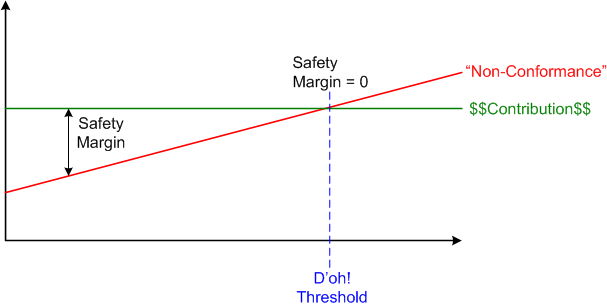
The more bureaucratic or dictatorial the org, the more the threshold shifts to the left (the less the positive safety margin and the more the negative safety margin). Since bureaucrats and dictators care more about conformance to their arbitrary and personally concocted rules than contribution to the “whole“, the “D’oh Threshold” wobbles all over the place. Its setting can vary month to month, day to day, minute to minute, group to group, individual to individual – depending on the emotional state and perceptions of those who run the circus.
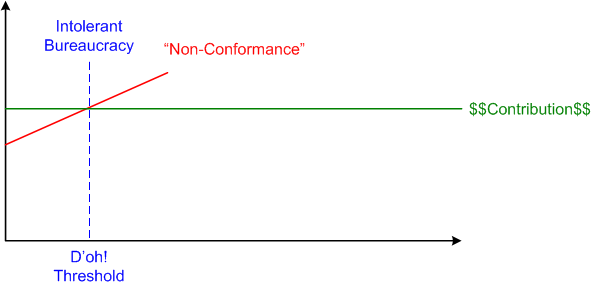
When humans are involved in organized group efforts, there is no escape from subjectivity. But in high performing orgs, the “D’oh Threshold” set point is relatively stationary, far to the right, and everybody knows where they stand.
Chain Of Disapproval


Why am I here?
WTF?
Meh!
D'oh!

My BTC Address



 Bulldozer00's Blog