Archive
More Bureaucratic Than A Bureau
Tsukasa Makino is one of the Harvard Business Review/McKinsey “Beyond Bureaucracy Challenge” winners. In “From bureaucratic, divided, passive, and exhausted to productive, creative, autonomous, and happy company”, Tsukasa tells the transformational story of Tokio Marine Nichido Systems (TMNS) from a classic, robotic, unhealthy borg into a vibrant community.
In 2005, Hideki Iwai, a system engineer, proposed a corporate culture assessment by an outside consulting firm. Management “approved” of the idea and here was the bottom line:

D’oh!
Taking the bull by the horns, Hideki formed the “Work Style Reform committee” to change the culture. Despite being a “committee” the communist-sounding group worked! It spawned, and followed through on, a slew of blockbuster initiatives:

The challenge presented by bullet number 4 seems daunting. How did they vanquish it? They just said “NO!”
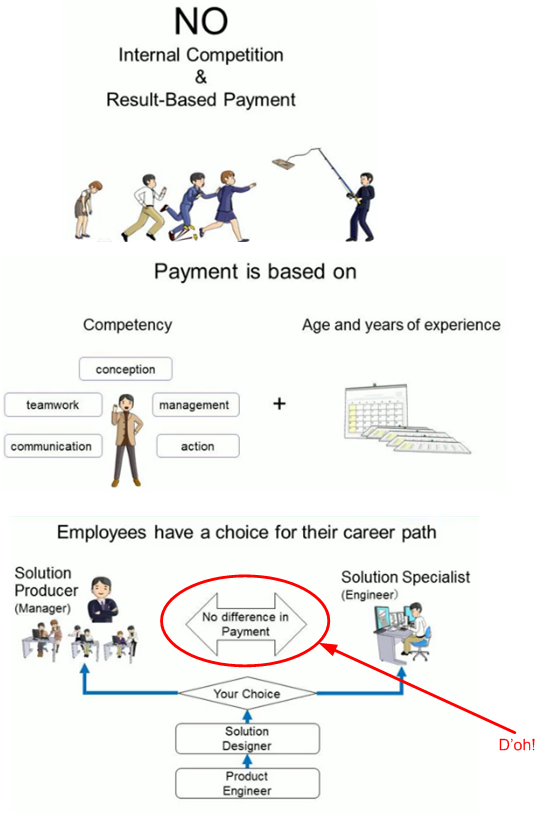
I love finding heartwarming stories like this. They’re hard to find, but thanks to web sites like Gary Hamels’ MIX, it’s getting easier.
The Daily Question
In his latest book, Gary Hamel proposes that executives and managers ask an important question every day:

It would be a refreshing change from these daily questions:
- How can I get Wall St. off my back?
- How can I get the board to give me a bigger bonus?
- How can I stop my VPs from bickering with each other and kissing my ass?
- Can I blame my poor performance on the economy, fickle customers, and a natural disaster in China?
- How can I squeeze more productivity out of my DICs and trade nothing in return?
- What new management position can I create to extinguish this latest fire?
- How can I ensure that my legacy will be revered?

Us And Them
BD00 speculates that all non-psycho leaders would love to dissolve the “us vs them” attitude that most likely pervades their org. Alas, it’s not easy to do when your org is structured as, and operates like, a standard command and control hierarchy. Here’s a list of reasons why the “us vs them” conundrum endures within the walls of the CCH:
- We unilaterally set the rules, policies and procedures they are required to unquestioningly follow
- We get bonuses and they get COLAs (Cost Of Living Adjustments)
- We plan their work and evaluate them; and there is no “quid pro quo Clarisse“
- We have a loose set of criteria for evaluating for ourselves and a strict set for evaluating them
- We have nicer offices than them
- We promote/demote them, not vice versa
- We conform them to the org and we conform the org to us.
- We physically co-locate our team in a corner and fragment their teams throughout the org
Got any other “us and them” reinforcers to add to the list?

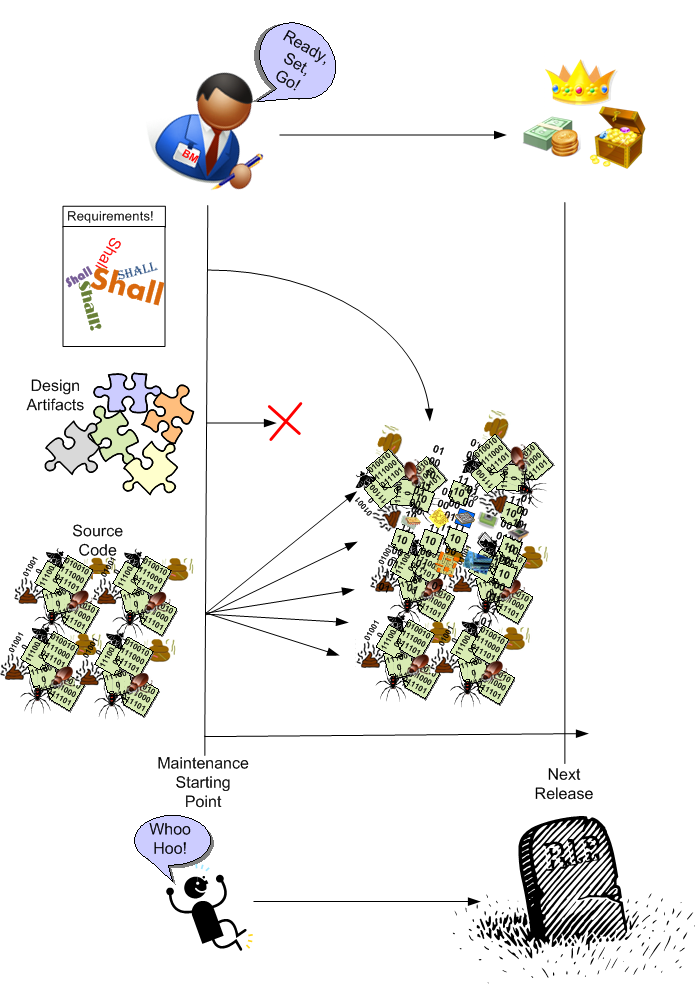
Ready, Set, Go!
Protocol Deterioration
Russ Ackoff once said something like: “A system is not the sum of its parts. It’s the product of its part-interactions“. With that Ackoffism in mind, lo and behold the slooow and relentless process of inter-part protocol deterioration.
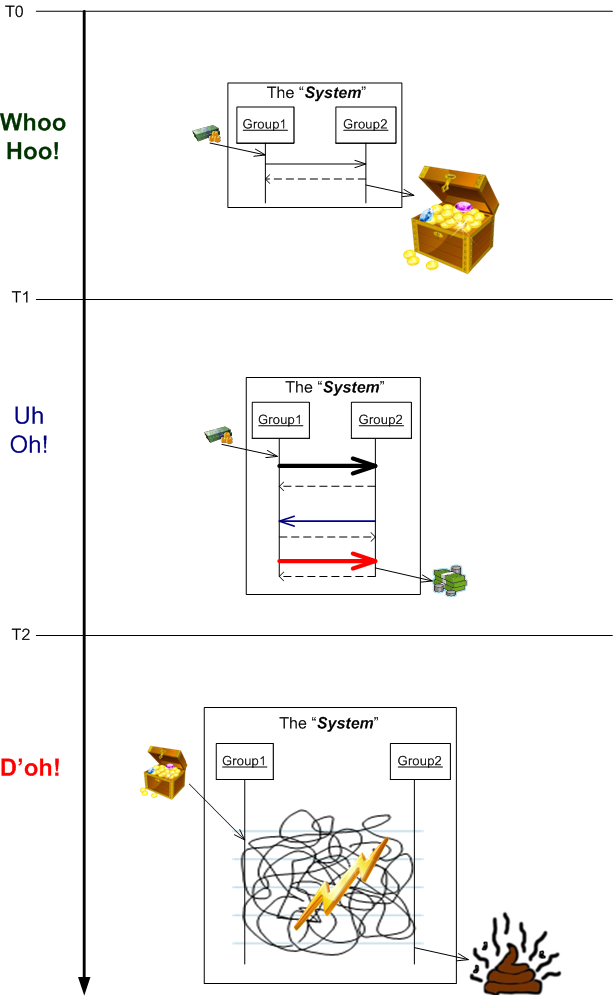
What state are your org protocols in? “Whoo Hoo!“, “Uh Oh!“, “D’oh!“, or “I Dunno!“?
Value And Effectiveness
A few weeks ago, my friend Charlie Alfred challenged me to take a break from railing against the dysfunctional behaviors that “emerge” from the vertical command and control nature of hierarchies. He suggested that I go “horizontal“. Well, I haven’t answered his challenge, but Charlie came through with this wonderful guest post on that very subject. I hope you enjoy reading Charlie’s insights on the horizontal communication gaps that appear between specialized silos as a result of corpo growth. Please stop by his blog when you get a chance.
——————————————————————————————————————————–
In “Profound Shift in Focus“, BD00 discusses the evolution of value-focused startups into cost-focused borgs. There’s ample evidence for this, but one wonders what lies at the root?
One clue is Russell Ackoff’s writings on analysis and synthesis. Analysis starts with a system and takes it apart, in the pursuit of understanding how it works. Synthesis, starts with a system, identifies the systems which contain it, and studies the role of the original system within its containing systems in the pursuit of understanding why it must work that way.
Analytical thinking is the engine that powered the Industrial Revolution and many of the most important scientific advances of the 21st century. Understanding how things work is essential to making them work better (also known as efficiency). Today, we have better automobiles, airplanes, computers, phones, and TV’s than our parents. And we owe much of this to analytical thinking.
But one of the side effects of analytical thinking is specialization. As understanding deepens, the volume of subject matter knowledge explodes. This leads to the old joke.
Q: What’s the difference between an engineer and an executive?
A: Every day engineers learn more and more about less and less, until one day they know everything about nothing, while executives learns less and less about more and more, until one day they know nothing about everything.
But all joking aside, this is a serious concern. The vast majority of organizations today are organized functionally: sales, marketing, finance, engineering, manufacturing, HR, IT, etc. And withing these organizations, there are even more specializations. Marketing has specialists in advertising, public relations, research, distribution channels, and product management. Engineering has chemical, mechanical, electrical, firmware, and software engineers. Even in software development, you have specialists in user interfaces, networking, databases. realtime embedded and project management.
One of the critical problems is that most people working in each of these areas become overspecialized. They spend so much time accumulating and applying specialized knowledge, that they can only communicate with people in their own specialty. If you don’t believe me, observe a two hour meeting involving somebody from sales, market research, product management, mechanical engineering, electrical engineering, finance, and purchasing.
In Mythical Man Month, Frederick Brooks retells the Tower of Babel as a project management story. It fits perfectly, because the root cause of the Tower of Babel failure was overspecialization and a failure to communicate. Today, instead of talking Hebrew, Arabic, Persian and Greek, we talk gross margin, differentiation, segmentation, tensile strength, electromagnetic interference, and virtual inheritance.
And our communication has another quality. Solution focus. We routinely argue the flaws and merits of solutions with only the foggiest understanding of what the problem is. And we use the vast levels of specialized knowledge from our respective disciplines to shout down the cretans who disagree with us.
Cost reduction and efficiency live in the same neighborhood as specialization and analytical thinking:
- If we replace these two steps with this one, the process will be faster.
- If we replace this part with this other part, the unit cost will be reduced by 2%.
- If we consolidate these three models into one, we can reduce inventory by 20%.
If efficiency is “doing things the right way”, then effectiveness is “doing the right things the right way.” Value lives next door to effectiveness and both live in the same neighborhood as synthesis. Value, like beauty, is in the eye of the beholder. Products and services can deliver benefits, but only the buyers and users can apply these benefits to realize value. Consider smartphones. Some people only use their phones for mobile calls, others for text messaging, some to read books on the train.
So in the end, there are a couple of reasons that startups are inherently focused on value. First, because they are small, specialization is a liability. Most people in startups do several jobs (well), by necessity. Second, because they are not yet profitable and self-sustaining, their survival is highly dependent on their surroundings (e.g. customers, competitors, economic conditions). This requires more synthesis than analysis.
As they grow, their strategy shifts to cost. Michael Porter writes about this in Competitive Advantage. And guess what, every one of us bargain-hunting, coupon-clipping, “buy one get one free” consumers is the root cause of this. Why mention this? Because synthetic thinkers love systems with feedback loops!
Profound Shift In Focus
The following quote comes from John Hagel via this Peter Vander Auwera blog post: “Corporate Rebels United” – the start of a corporate spring?”:
The key answer that defines the post-digital enterprise is to shift attention from the cost side to the value side. Rather than treating employees as cost items that need to be managed wherever possible, why not view them as assets capable of delivering ever-increasing value to the marketplace? This is a profound shift in focus. For one thing, it moves us from a game of diminishing returns to an opportunity for increasing returns. There is little, if any, limit to the additional value that people can deliver if given the appropriate tools and skill development. – John Hagel
For big, established companies who can’t even remember what it was like to focus on value, “profoundly shifting” from a cost mindset back to a value mindset is a tall order indeed.
As the state machine based figure below illustrates, successful startups are totally “value focused” in the sun-up phase of their life. But over time, as they obsessively grow and misguidedly try to become more efficient by adding layers upon layers of cost watchers, the vast majority of them (with few Apple-like exceptions) morph into “cost focused” borgs.

Once a formerly vibrant org has moved into the sundown phase of its life, the borgdom hardens. It’s cost-focus till death, with no memory of any prior, value-focused behavior.

Unstated, But Deeply Rooted
Maturity is a state that most companies eventually reach. To break out of – or avoid – maturity, innovation is required: new products or services, new marketing or markets, more of what is different, not more of the same. – Russell Ackoff
Not only is “maturity” reached by most orgs, it is actively pursued in order to fulfill an unstated, but deeply rooted amygdalayian desire to transition from org to borg. The hilarity of the situation is that while a “maturing” org’s behaviors and processes unceasingly and silently nudge it toward rigid borgdom, the esteemed leadership continuously cries out for innovation. Do as I say, not as I do. D’oh!

Behind The Scenes
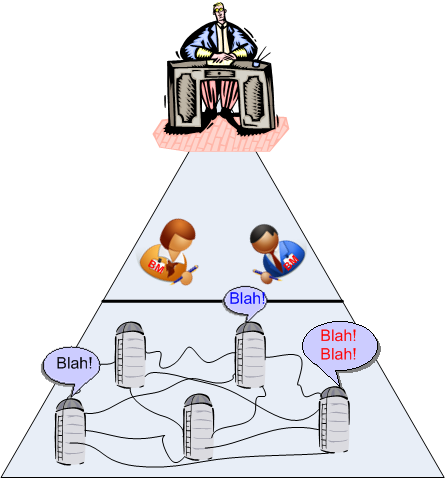
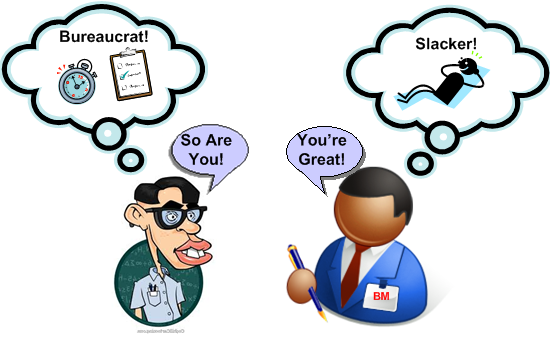
In really dysfunctional orgs, do you think much of this goes on……?
Lacking Smarts
Check out the title of this article and have a LOL with (or at) BD00: “People Aren’t Smart Enough for Democracy to Flourish, Scientists Say“.
The research, led by David Dunning, a psychologist at Cornell University, shows that incompetent people are inherently unable to judge the competence of other people, or the quality of those people’s ideas.
D’oh! Too stupid to judge. That’s BD00 in a nutshell when he attempts to unfairly scald the guild of management and its continued, often subtle, application of Tayloristic techniques in the 21st century.
…democracies rarely or never elect the best leaders. Their advantage over dictatorships or other forms of government is merely that they effectively prevent lower-than-average candidates from becoming leaders.
If that’s “merely” true for democracies, then un-democracies must merely suck. How well do you think undemocratic boards of directors do in choosing executives and how well undemocratic executives do in anointing subordinate managers and how well undemocratic managers do in hiring DICsters and how well DICs do in….? Oops, I almost forgot that DICs aren’t allowed to choose or anoint.
Of course, this research on incompetence doesn’t apply to the elites who run institutions because boards of directors, executives, and managers are infallibly competent in their profession.
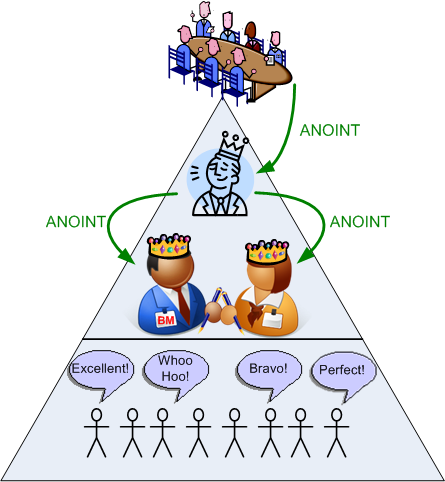
Ya gotta love this Wikipedia definition of anointment:
To anoint is to pour or smear with perfumed oil, milk, water, melted butter or other substances, a process employed ritually by many religions. People and things are anointed to symbolize the introduction of a sacramental or divine influence, a holy emanation, spirit, power or God.
At my anointment, I want to be smeared with… peanut butter and melted Godiva chocolate. How about you? What’s your substance of choice – assuming you have a choice?

Why am I here?
WTF?
Meh!
D'oh!

My BTC Address



 Bulldozer00's Blog