Archive
Metadata Code Bloat
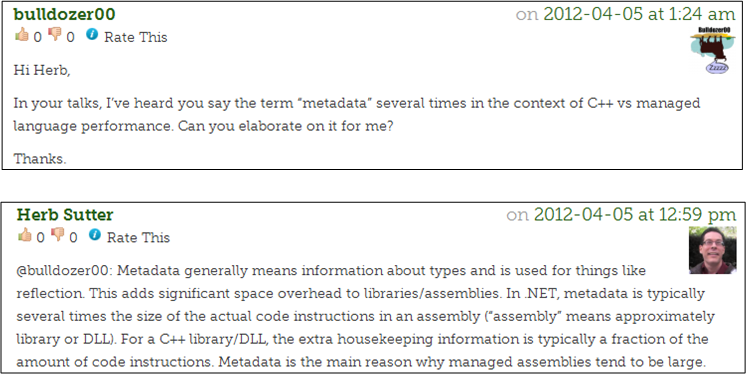
In many of his (terrific) talks and lectures, Herb Sutter often says that “always on garbage collection“, “default virtual dispatch“, and “metadata” are valid reasons as to why managed language programs written in C# and Java are typically slower and bigger than native languages like C++ and C. I understand the first two issues, but not the “metadata” argument. Thus, I asked Herb to “splain dis to me Lucy“.
Here’s my question and Herb’s gracious answer:
The “Void Star” Crowd
During the “Ask Us Anything” panel discussion at the “Going Native 2012” conference, one of the questions asked was: how do you get the “void *” guys to move forward toward a more type-safe and abstract C++ style of programming?“.
By “void *“, the questioner meant programmers who still cling to writing code like this:

instead of this:

The panelists admitted that it was a big challenge, and they gave the following suggestions:
- Ask them what problems they’re having and then show them the solution by doing it for them in C++ style. (Stroustrup)
- Set a personal example of increased productivity. (Alexandrescu)
- Show them compiler generated assembly output comparing the “void *” C-style code with a more expressive, less error-prone, more readable C++ equivalent. Odds are that the compiler-optimized C++ code will be much shorter than the hand-crafted C code. (STL)
Bjarne Stroustrup seemed especially frustrated at the pervasiveness of “void *” mindset. As a professor at Texas A&M, he said that as people come out of high school, most of them want to write games and they’ve convinced themselves and each other that, beyond a shadow of a doubt, “void *” is as fast as one can get. That’s exacerbated by the fact that many professors and “greybeards” still code in the type unsafe, barely readable, and error prone “void *” way.
I can sympathize with Bjarne and the panel. When I made the transition from C to C++, it took me what-seemed-like forever to “graduate” from arrays and naked pointers to containers and smart pointers and algorithms. Luckily, I did it in spite of myself. I can’t even remember the last time I used “void *” in any of the code I wrote.

Efficient Abstraction
In “The Design And Evolution Of C++“, Bjarne Stroustrup presents a tree-like picture on the history of programming languages and how they’ve influenced each other. For your studying pleasure, BD00 surgically extracted and augmented a slightly more C++ focused sub-tree. In other words, BD00 committed yet another act of plagiarism. I hope you like the result.
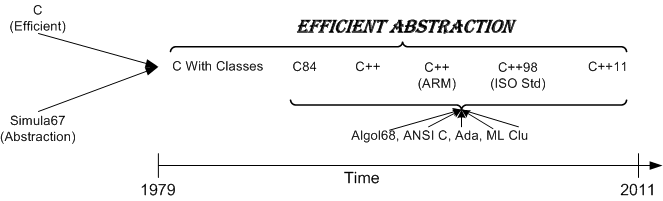
All through the 30+ years of C++’s evolution, Bjarne and the ISO C++ standards committee have maintained a fierce and agonizing determination to march to the tune of “efficient abstraction” over theoretical purity. Adding increasing support for abstraction without sacrificing much in efficiency is more of an art than science.
D&E is not just a history book. As the figure below shows, it won one of the “Software Development Productivity Awards” from Software Development magazine waaay back when. That’s because knowing “why” and “how” the (or any) language became the way it is gives a qualitative edge to those programmers over those who just know “what” the language is.

Cover of The Design and Evolution of C++
The Lost Decade?
I think you’ll be hard pressed to find many knowledgeable C++ programmers who won’t admit that managed languages provide higher per-programmer productivity than native languages (because they’re easier to learn, have bigger libraries, and are not as “picky“). Likewise, I think you won’t find many “reasonable” managed language advocates who won’t admit that native language programs are more efficient (smaller and faster for a given solution) than their managed language counterparts. Having said that, take a look at this chart:

According to Herb Sutter, efficiency has(will) usurped(usurp) productivity as the dominating cost factor for software-intensive products in this decade (battery life in mobile devices, power consumption in the data center). Agree?
If you’re interested in watching the video and/or downloading Herb’s slides, here’s the link: “C++ and Beyond 2011: Herb Sutter – Why C++?“.
World Class Help
I’m currently transitioning from one software project to another. After two years of working on a product from the ground up, I will be adding enhancements to a legacy system for an existing customer.
The table below shows the software technologies embedded within each of the products. Note that the only common attribute in the table is C++, which, thank god, I’m very proficient at. Since ACE, CORBA, and MFC have big, complicated, “funky” APIs with steep learning curves, it’s a good thing that “training” time is covered in the schedule as required by our people-centric process. 🙂

I’m not too thrilled or motivated at having to spin up and learn ACE and CORBA, which (IMHO) have had their 15 minutes of fame and have faded into history, but hey, all businesses require maintenance of old technologies until product replacement or retirement.
I am, however, delighted to have limited e-access to LinkedIn connection Steve Vinoski. Steve is a world class expert in CORBA know-how who’s co-authored (with Michi Henning) the most popular C++ CORBA programming book on the planet:
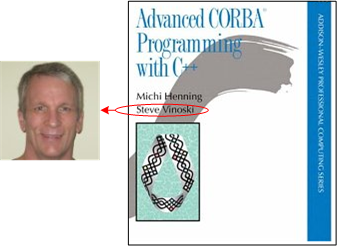
Even though Steve has moved on (C++ -> Erlang, CORBA -> REST), he’s been gracious enough to answer some basic beginner CORBA questions from me without requiring a consulting contract 🙂 Thanks for your generosity Steve!
Sandwich Dilemma
In this dated, but still relevant paper, “Evolving a language in and for the real world“, Bjarne Stroustrup laments about one of the adoption problems that (still) faces C++:

Since the overarching theme of C++ is, and always has been, “efficient abstraction“, it’s not surprising that long time efficiency zealots and abstraction aficionados would be extremely skeptical of the value proposition served up by C++. I personally know this because I arrived at the C++ camp from the C world of “void *ptr” and bit twiddling. When I first started studying C++, its breadth of coverage, feature set, and sometimes funky syntax scared me into thinking that it wasn’t worth the investment of my time to “go there“.

I think it’s easier to get C programmers to make the transition to C++ than it is to get VM-based and interpreter-based programmers to make the transition. The education, more disciplined thinking style, and types of apps written (non-business, non-web) by “close to the metal” programmers maps into the C++ mindset more naturally.

What do you think? Is C++ the best of both worlds, or the worst of both worlds?
Vectors And Lists
In C++ programming, everybody knows that when an application requires lots of dynamic insertions into (and deletions from) an ordered sequence of elements, a linked list is much faster than a vector. Err, is it?
Behold the following performance graph that Bjarne Stroustrup presented during his keynote speech at “Going Native 2012“:

So, “WTF is up wit dat?”, you ask. Here’s what’s up wit dat:
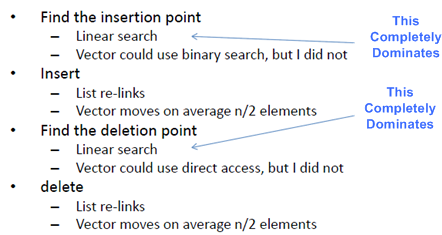
The CPU load happens to be dominated by the time to traverse to the insertion/deletion point – and KNOT by the time to actually insert/delete the element. So, you still yell “WTF!“.
The answer to the seeming paradox is “compactness plus hardware cache“. If you’re not as stubborn and full of yourself as BD00, this answer “may” squelch the stale, flat-earth mindset that is still crying foul in your brain.
Since modern CPUs with big megabyte caches are faster at moving a contiguous block of memory than traversing a chain of links that reside outside of on-chip cache and in main memory, the results that Bjarne observed during his test should start to make sense, no?
To drive his point home, Mr. Stroustrup provided this vector-list example:

In addition to consuming more memory overhead, the likelihood that all the list’s memory “pieces” reside in on-chip cache is low compared to the contiguous memory required by the vector. Thus, each link jump requires access to slooow, off-chip, main memory.
The funny thing is that recently, and I mean really recently, I had to choose between a list and a vector in order to implement a time ordered list of up to 5000 objects. Out of curiosity, I wrote a quick and dirty little test program to help me decide which to use and I got the same result as Bjarne. Even with the result I measured, I still chose the list over the vector!
Of course, because of my entrenched belief that a list is better than a vector for insertion/deletion heavy situations, I rationalized my unassailable choice by assuming that I somehow screwed up the test program. And since I was pressed for time (so, what else is new?), I plowed ahead and coded up the list in my app. D’oh!
Update 4/21/13: Here’s a short video of Bjarne himself waxing eloquent on this unintuitive conclusion: “linked list avoidance“.
Ghastly Style
In Bjarne Stroustrup‘s keynote speech at “Going Native 2012“, he presented the standard C library qsort() function signature as an example of ghastly style that he’d wish programmers and (especially) educators would move away from:
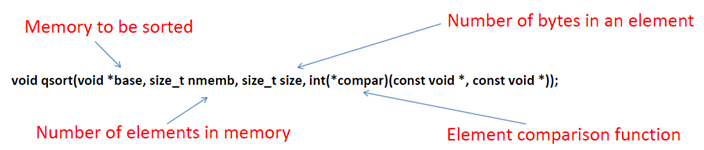
Bjarne then presented an alternative style, which not only yields cleaner and less error prone code, but much faster performance to boot:

Bjarne blames educators, who want to stay rooted in the ancient dogma that “low level coding == optimal efficiency“, for sustaining the unnecessarily complex “void star” mindset that still pervades the C and C++ programming population.
Because they are taught the “void star” way of programming by teaching “experts“, and code of that ilk is ubiquitous throughout academia and the industry, newbie C and C++ programmers who don’t know any better strive to produce code of that “quality“. The innocent thinking behind the motivation is: “that’s the way most people write code, so it must be good and kool“.
I can relate to Mr. Stroustrup’s exasperation because it took perfect-me a long time to overcome the “void star” mental model of the world. It was so entrenched in my brain and oft practiced that I still unconsciously drift back into my old ways from time to time. It’s like being an alcoholic where constant self-vigilance and an empathic sponsor are required to keep the demons at bay. Bummer.
Yet Another Nit
Programming in C++, I “prefer” composition over inheritance. Thus, for that reason alone, I’d use “ComposedLookupTable” over “InheritedLookupTable” every time:

In addition, since (on purpose) no STL container has a virtual destructor, I’d never even consider inheriting from one – even though those who do would never try to write this monstrosity:

Of course, this can be seen as yet another childish BD00 nitpick. But hey, what else is BD00 gonna do with his time? Solve world poverty? Occupy the org?
Quality is in all the freakin’ details, and when you see stuff like this in product code, it makes you wonder how many other risky, idiom-busting, code frags are lurking within the beast. But alas, where does one draw the line and let things like this slide?
As a final note, beware of disclosing turds like this to their authors; especially in mercenary cultures where everyone is implicitly “expected to” project an image of infallibility in order to “advance” their kuh-rearends. If you can excise turds like this yourself without getting caught, then please do so.
An Array Of Vectors Of Tuples
Yepp, that’s what I concocted recently to implement an algorithm. Pretty fugly, no?
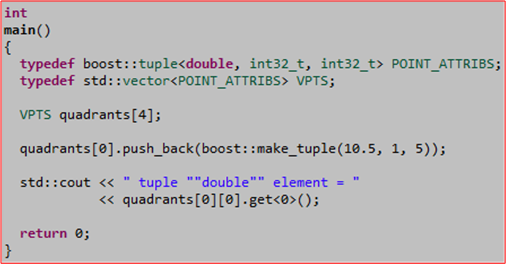
If I told you what the algorithm is, I’d have to dispatch a missile carrying drone to seek out and kill you.

Why am I here?
WTF?
Meh!
D'oh!

My BTC Address



 Bulldozer00's Blog