Archive
Three Bottom Lines
“Management measures what’s easy, not what’s important.” – Unknown
“You can only measure 3% of what matters.” – W. E. Deming
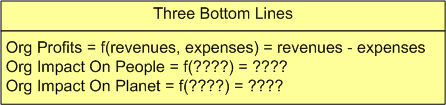
I don’t recall where, but I remember seeing the idea of “three bottom lines” being proposed somewhere in an online article. The three bottom lines are “profits, people, and planet“.
As in quantum physics, the hurdle to overcome is “the measurement problem“. Unlike profits, which are simple to measure and track, how do you come up with standard, objective measures of an org’s effect on its people and on the planet?
Rising Inequity
While stumbling along the jagged trail of life, I tripped over this FastCompany.com post: Infographic of the Day: 15 Facts About America’s Income Inequality.
For instance, did you know that the average CEO’s pay is 1,039 times more generous than that of the average worker? And it’s not as if we’ve always lived that way. Forty years ago, CEOs were only being paid 39 times that of the average worker. Some companies these days are tying CEO pay to the pay of the least compensated employee at the same company. Clearly not that many.

And though GDP has risen, wages have remained stagnant (except for those CEOs), which has contributed to the top 10% of the wealthiest Americans controlling nearly three-quarters of all the money in America.
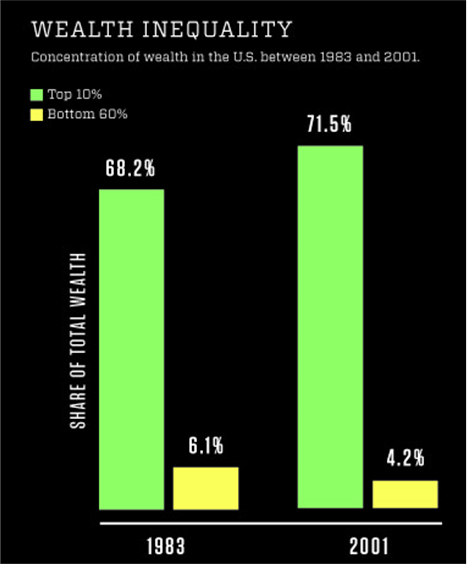
Note that over the decades between the inequity measurements, control of the federal government has flip-flopped back and forth between the democratic and the republican parties. So much for blaming one side over the other. The only equity in this post is that both parties are equally inept at running the country, no?
It doesn’t have to be yours, of course, but BD00’s opinion is that no matter what type of “ism” system of governance is used to tie people together, when some critical threshold of top-to-bottom inequity is exceeded, a revolution by the governees against the governors is sure to follow. In the grand ole USA, do you think we are close to the precipice?
Doing More With Less
Zappos.com core value number 8 is: “Do more with less“. Assume that you miraculously experience an epiphany and eagerly subscribe to this noble value. Using the figure below as a reference, how would you go about increasing profits while simultaneously flattening the “Resource Consumption” trace? Can it be done in your org?

When The Spigot Runs Dry
It was recently hinted to me that, for a legitimate business reason, the fun and exciting distributed systems IR&D (Internal Research and Development) software project that I’m working on might get canned. I sadly agree that if there are no customers for a product, and day-to-day fires are burning all over the place, it’s most definitely a legitimate business reason to turn off the financial spigot.
In addition to the “hint“, several important technical people have been reassigned to other maintenance projects. Bummer, but shite happens.

Judgment, Integrity, Credibility, Honesty, And $53M
The often (but not always) incestuous relationship between hand picked corpo board of directors yes-men and CEOs has come to the fore again: “HP orders probe into Hurd’s departure”. Why would Hewlett Packard, as represented by its board of derelicts, I mean directors, investigate their own handling of Hurd’s dismissal? They’re not doing it because it’s the right thing to do. They’re only doing it because they’re being forced to:
“HP’s plan for an outside investigation follows a lawsuit in San Jose, Calif., by shareholders who allege that the company’s directors wasted money by giving Hurd $53 million in severance.”
Yepp, a gift of $53 million to Mr. Hurd for exhibiting:
A profound lack of judgment. It (Hurd’s dismissal) had to do with integrity, it had to do with credibility and it had to do with honesty.” – Mike Holston, HP’s general counsel
After doling out that kind of dough, can’t the same be said about HP’s board? Well, that’s what we may find out after the dust settles. In the meantime, HP’s board may have gotten what they deserved. Mr. Hurd has Madoff nicely by skidaddling over to one of HP’s biggest competitors, Oracle Inc. He and his buddy, Oracle oracle Larry Ellison, sure do know how to make money.
“Mark did a brilliant job at HP and I expect he’ll do even better at Oracle,” said CEO Larry Ellison in a statement.
The real question is: “How isolated are these types of incidents?“. Just because they get reported in the press doesn’t mean that dishonesty runs rampant in the bozone layers of big business. Nevertheless, it begs the question: “Is the taken-for-granted, rarely-questioned process in which CEOs and boards of directors are chosen broken?“. Boards anoint CEOs (who coincidentally are often the chairman of the board) and CEOs nominate board members for election. What do you think of the process? How can it be made better?

Loops Of Distrust
Mistrust reigns everywhere. Governments distrust big businesses and vice versa. Big business heads (and I mean it both literally and figuratively), even though they often superficially espouse otherwise, distrust their low level, non-executive people.
The two cause-effect loop diagrams below crystallize the situation, no? On the left, more regulation begets more lobbying and lawyering – which begets more regulation. Bummer. On the right, more red tape begets more subversion – which begets more red tape. Double freakin’ bummer.
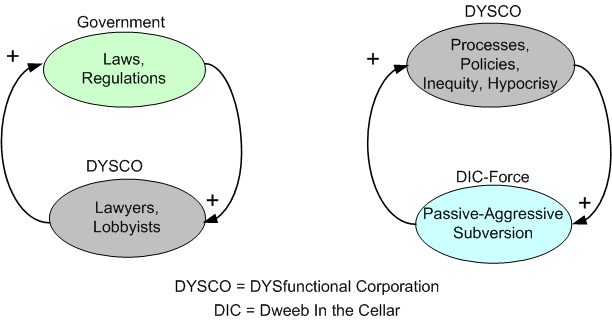
In the government-DYSCO cat-and-mouse duel, government, even though it’s a massively dysfunctional CCH itself, wants its version fairness and equity to prevail. In the DYSCO-DICforce scenario, the DICforce wants its version of fairness and equity to prevail. In both scenarios, the DYSCO DJs want an unfair advantage.
Note: Not all companies are DYSCOs. Only DYSCOs are DYSCOs. Every once in a blue moon I state a disclaimer like this because some people may think I’m a black-and-white binary thinker.Those that do may be binary thinkers themselves?
Which Path?
To all front line managers out there: “which path below did you take when you were promoted out of DIC-land?” To all DICs out there who want to, or are on a course to, move into the brave new world of management, uh, I mean formally anointed leadership: “which path below do you plan on taking?“.
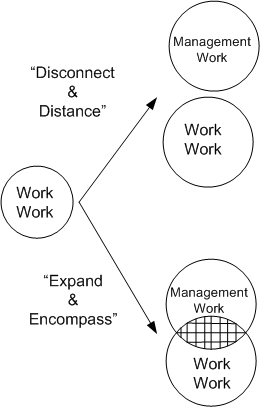
To all those who took or prefer the D&D path, please leave this page now. To the remaining E&E takers and preferrers, please peruse this follow-on diagram:

Will you allow the natural and effortless course of increasing entropy occur after you’ve made your choice, or will you temporarily “hold it together” with effortful due diligence throughout your career – no matter how high you go or how much pressure you feel from your peers?
Is it even reasonable to ask for any overlap between work-work and management-work as one ascends higher up in a hierarchically structured CLORG? For example, in a 10 layer hierarchy, is it insane to expect the dudes in the upper echelons to know something, anything, about the nature of the work that goes on down in the boiler room?
Culture Convergence?
Many, many articles and books targeted at executives and senior managers spew out all kinds of elixirs, formulas, and lists guaranteed to catapult a business to the top of the heap. For example, take this squeaky clean and slightly redacted list from a book that will remain unnamed.
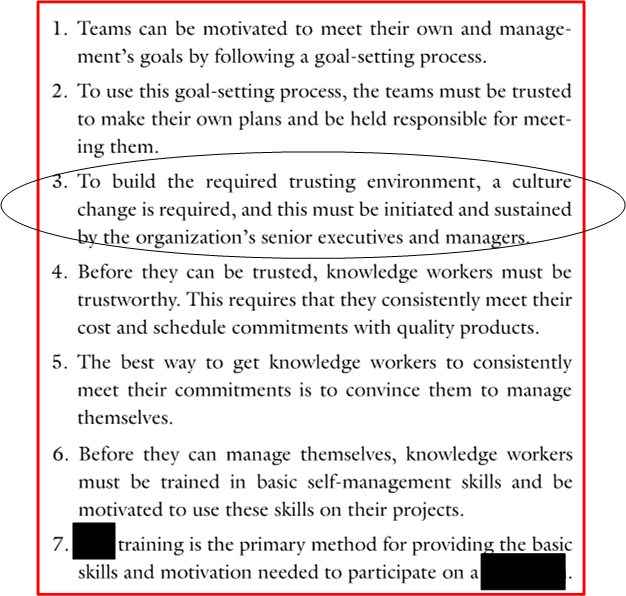
The one common, across the board demand that all these gurus impose on top leadership teams is that “you must change the culture“. The hidden assumption in these words is that one culture exists. Well, does it?…….
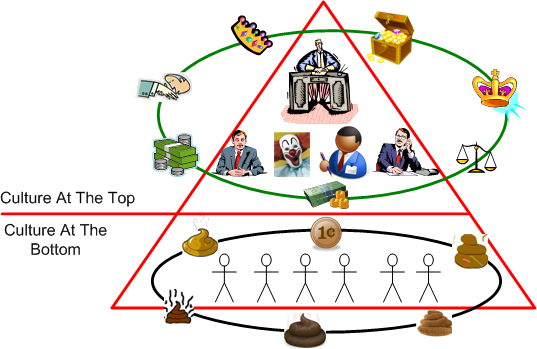
Maybe all these revered business gurus should talk about culture convergence instead of changing “the one culture“…..
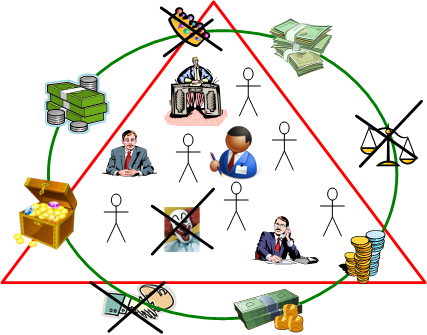
How naive of me to think that there are two or more cultures in an org, no?

Repeat Champion
Fortune magazine recently hatched its coveted list of the “Best 100 Companies to work for in 2011“. Two top ten winners, repeat champion SAS, and Zappos.com, have been on my faves list for a loooong time. Who’s on your list?

Berkun Myths
Steven Johnson‘s book, “Where Good Ideas Come From“, seems to have garnered more accolades and publicity, but Scott Berkun‘s “The Myths Of Innovation” is also an insightful, well crafted, and surprising read on much-the-same topic. I haven’t read Steven’s book yet (it’s on my list), but I’ve read and enjoyed both editions of Scott’s book.
Here is Scott’s list of the 10 myths of innovation:

My faves are numbers 4, 6, and 7. Regarding number 4, one of my favorite quotes fits the bill:
Don’t worry about people stealing your ideas. If your ideas are any good, you’ll have to ram them down people’s throats. – Howard Aiken
What are your faves? Are there any myths missing from the list? What do you think are the “truths” of innovation? Are they just the inverses of the list?

Why am I here?
WTF?
Meh!
D'oh!

My BTC Address



 Bulldozer00's Blog