Archive
The Wall
The figure below shows the financial performance of a successful hypothetical company. During the startup phase, both revenue and profit increased at a linear pace, and then something interesting happened. As revenue rose, profit growth hit a wall and leveled off. Dooh!
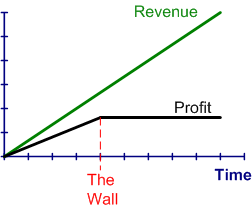
So, what happened? In business lingo, the costs to execute the business rose faster than the costs to acquire the revenue. Since we are not company insiders, we can only speculate as to the underlying cause(s) of the performance slip, but here are two out of a bazillion possibilities:
- More bureaucrats were added at a faster rate than people with the skills and ability to execute.
- The company’s execution processes were unscaleable.
Let’s explore these two performance busters.
More bureaucrats were added at a faster rate than people with the skills and ability to execute.
With revenue pouring in, it’s easy to become sloppy and careless with all that dough. Egotistical managers, unconsciously trying to outdo one another by building personal empires, convince their disconnected and aloof next-level managers that they need more people for business execution, regardless of whether they actually do need them. These new additions are often specialists who are only capable of executing narrow slivers of the business. Thus, they spend most of their time in idle mode; consuming more from the company than they contribute.
On the other hand, the new additions may be ambitious, unskilled fellow managers who are tasked with doing what their bosses couldn’t – increase execution performance with the people that they currently have. By adding more sub-managers, each super-manager builds his/her empire and further buffers him/herself from where the rubber hits the road in the execution trenches.
The company’s execution processes were unscaleable.
Unless the company produces widgets or some other simple product that doesn’t require knowledge synthesis and frequent human situational decision-making skills, its business execution processes may be unscaleable. In a sincere but misguided attempt to control and increase execution performance, the company’s managers actually decrease scaleability and they inhibit performance gains by piling more constraining rules and procedures on top of the people who create, manufacture, test, and sustain the product portfolio. Rather than rolling up their sleeves and jumping in with their people to help them get the job done, these managers spend all of their time running around taking status and ensuring that all the rules and procedures are followed.
Can you think of any other reasons why this successful company may have stumbled?
All in all you’re just another brick in the wall. – Pink Floyd
What Happened To Ross?
In the ideal case, an effectively led company increases both revenues and profits as it grows. The acquisition of business opportunities grows the revenues, and the execution of the acquired business grows the profits. It is as simple as that (I think?).
ROS (Return On Sales) is a common measure of profitability. It’s the amount of profit (or loss) that remains when the cost to execute some acquired business is subtracted from the revenue generated by the business. ROS is expressed as a percentage of revenue and the change in ROS over time is one indicator of a company’s efficiency.
The figure below shows the financial performance of a hypothetical company over a 10 year time frame. In this example, revenues grew 100% each year and the ROS was skillfully maintained at 50% throughout the 10 year period of performance. Steady maintenance of the ROS is “skillful” because as a company grows, more cost-incurring bureaucrats and narrow-skilled specialists tend to get added to manage the growing revenue stream (or to build self-serving empires of importance that take more from the org than they contribute?).

For comparison, the figure below shows the performance of a poorly led company over a 10 year operating period. In this case the company started out with a stellar 50% ROS, but it deteriorated by 10% each subsequent year. Bummer.
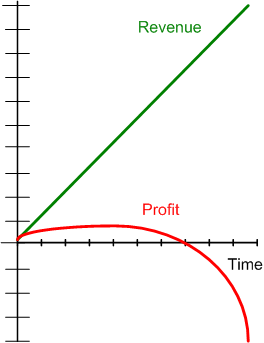
So, what happened to ROS? Who was asleep at the wheel? Uh, the executive leadership of course. Execution performance suffered for one or (more likely) many reasons. No, or ineffective, actions like:
- failing to continuously train the workforce to keep them current and to teach them how to be more productive,
- remaining stationary and inactive when development and production workers communicated ground-zero execution problems,
- standing on the sidelines as newly added “important ” bureaucrats and managers piled on more and more rules, procedures, and process constraints (of dubious added-value) in order to maintain an illusion of control,
- hiring more and more narrow and vertically skilled specialists that increased the bucket brigade delays between transforming raw inputs into value-added outputs,
may have been the cause for the poor performance. Then again, maybe not. What other and different reasons can you conjure up for explaining the poor execution performance of the company?
Lesson Unlearned
Whoo hoo! We finally said screw it, we overcame our fears, and we mustered enough courage and determination to say “hasta la vista baby” to the stifling corpo citadels that we were shackled to. We huddled together, we created a flexible plan, we busted the cuffs, we scaled the prison wall, and holy crap; we actually freakin’ succeeded. We started our own company. And it’s growing. And our people feel useful and appreciated. And life is good. Ahhhhhhh!
Well duh, of course we need to track and manage revenues and costs, but in our company, unlike the herd we left behind (mooo!), those two obviously important metrics will always take a back seat to taking care of, and leading the people who create, develop, build, and sustain our product portfolio. Because we’ve personally experienced living in the quagmire, we’ve learned our lesson. We get “it” and we’ll never forget “it”. There’s no way, we mean no way, that we’re not gonna end up like our previous corpo hierarchs, who managed to turn it all backasswards – numbers first and people second (even though they innocently espoused the opposite).
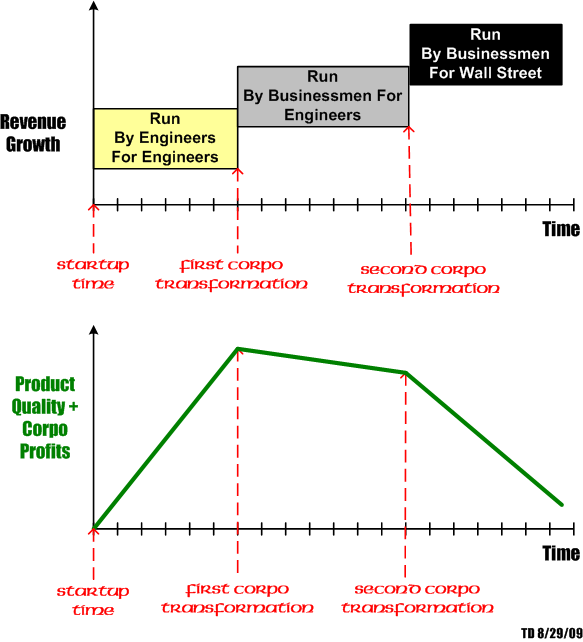
Ummmm, yeah…… right. Check out the two parallel timelines below that purport to track the growth and maturity of a hypothetical startup company in the technology industry. I honestly don’t know squat, but I assert that the story reflected by the graphical depiction below is pervasive and ubiquitous, especially throughout the western world. If you could possibly be delirious enough to resonate with the content of this blarticle, then you may interpret the situation as a hopelessly sad state of affairs. Believe it or not, I interpret the situation as neither good nor bad. It just is what it is.
Directagers
Director of communications, director of operations, director of engineering, director of marketing, director of strategy. Yada, yada, yada. Everyone is, or wants to become, a “Director” of something. The ultimate directorship, of course, is to be elected to sit on one or more cushy Boards Of “Directors”.
Not discounting the title of “Chief”, the title of “Director” seems to have overtaken “Manager” as the coveted corpo title dujour. Compared to an honorable and esteemed “Director”, a “Manager” is now almost as unimportant as an “associate”, or equivalently, an “in-duh-vidual contributor” (gasp!). The title of “Manager” is……. so yesterday.
So what’s the next title to be inserted into the divisive corpo caste system, the “Directager“? Come on, take a guess.

Hierarchical Growth
I’m currently in the process of reading Donella Meadows’s Thinking In Systems. Donella says that successful hierarchical systems grow from the bottom up, one layer at a time.
 In the case of a human-made system of humans, as an assembled group of people becomes successful at what it does, it starts growing horizontally. The group finds a way to extract what it needs to sustain and grow itself (like money in exchange for products and services) from its surrounding environment.

In order to keep the group aligned and coordinated, the next higher level is formed from a small sub-group within the first level. Both levels feed each other in a mutually beneficial relationship and the organization keeps growing sideways. At a certain point, the second level becomes wide enough to require a third level to keep it synchronized with the group’s overall organizational goals. As growth continues, more and more layers are needed to keep the overall system from diverging from its true purpose.
At some unpredictable point in time, a strange and seemingly irrational inversion starts taking place as growth continues. The smaller, but higher layers in the hierarchy start consuming a more disproportionate share of the fruits of the organizational effort. The original, mutually beneficial, two way relationship transforms into an unbalanced one way relationship that is strangely accepted and taken for granted by everyone at all levels.

As a result of the imbalance, the bottom layers begin to atrophy from a lack of nourishment. As the one way upward flow of nourishment continues, the weight of the top layers increases and the strength of the lower layers decreases. In the worst case, the organization loses its balance and comes crashing to earth in a disintegrated mess.

In the early stages of growth, everyone in the organization fully understands that each successive layer is put in place to take care of the layer below it, and vice versa. When this understanding gets lost, all is lost. It’s just a matter of time until disaster strikes. Can the process be reversed? Sure it can, by restoring the balance and never losing sight of why the upper layers were created in the first place.
Three Things
Three things: people, money, and time. These three interdependent resource types are the weapons that managers can deploy to create and sustain wealth for an organization. Managers are tasked with the challenge of judiciously apportioning these raw resources to the creation and sustainment of value-added products and services that solve customer problems. In addition to the creation and sustainment of products and services, the difficulty of continuously aligning and steering large groups of people toward the goals of growth and increasing profitability causes problem “fires” to be ignited within the corpo citadel. Bloated processes and warring factions are just two examples of the infinite variety of “pop up” fires that impede growth and profitability.
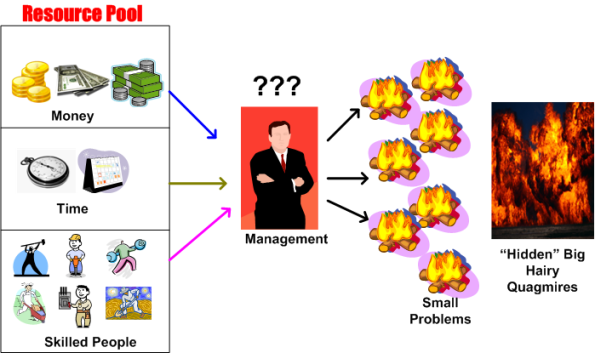
Left unchecked, internal brush fires always grow and merge into paradoxically massive, but hidden, forest fires that consume valuable resources. Brush fires feed on neglect and ignorance. Instead of creating wealth and continuously satisfying the external customer base, the three resource pools get exhausted by constantly being allocated to extinguishing internal fires.
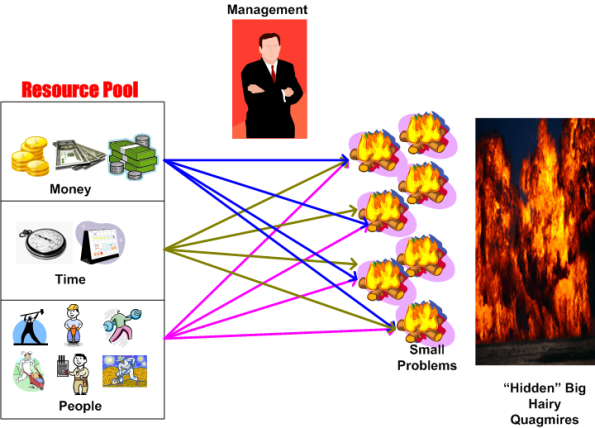
Unless managers can “see” the growing fires, one or more massive fireballs can burn the organization to the ground. So, how can managers prevent massive fireballs from consuming would-be profits and customer goodwill? By constantly listening to, and investigating, and smartly acting on, the concerns of their people and their customers. Just listening is not enough. Just investigating is not enough. Just listening and investigating is not enough. Just listening and investigating and ineffective action is not enough. Listening, investigating, and effective action are all required.
Sloppy and Undisciplined
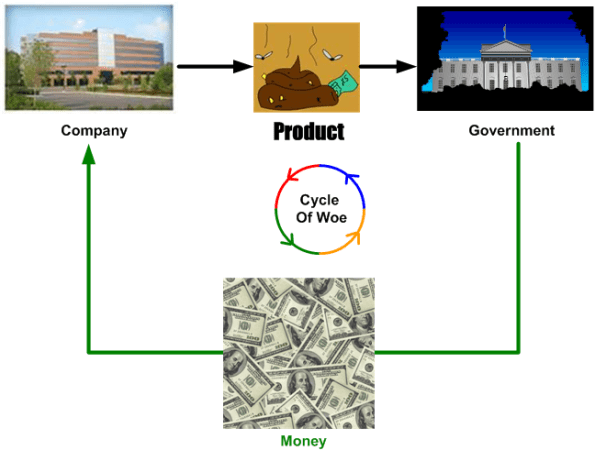
If a company is sloppy and undisciplined in execution, then almost all of its value-creation resources (people, time, money) are constantly putting out legacy product fires instead of developing new products/services – creating wealth. Revenues and, especially, profits may suffer. “May” and not “will” you ask? Yes, I say. You see, if a company can get customers to continuously pay for the messes that the company has innocently but surely created, then financial performance may actually be perpetually “good”, or even “excellent”. Say what? Hoodwinking customers to pay for cleaning up your messes? What customers in their right mind would do this? Government customers who love to spend other people’s money, of course. Nice work if you can get it.
Favorite Companies
Over the years, I’ve been on a constant watch for unique companies. By unique, I mean those that stand apart from the rest of the herd in the way that the executive leadership balances the needs of all stakeholders – not just the shareholders, or especially, themselves. Of course, unless you’ve worked at a company, it’s pretty tough to know if the company really lives up to its core values and “walks the talk”. That’s because all companies project the image that they are great places to work, regardless of whether they really are.
So, how do I decide whether a company is a cut above the rest? Via subjective evaluation of external observations, of course. Here’s my unscientific list of “research” methods:
- Read third party accounts of experience given by former and current non-management employees.
- Read, listen, and watch multiple interviews with CEOs and executives.
- Scour publicly available mission statements, visions, core values and cultural descriptions for authenticity, lack of corpo jargon, and attention to detail.
- Stay away from glossy annual reports.
- Ignore whatever the hand picked company spokesperson(s) say.
Of course, my methods aren’t perfect, but do you know of any better ones?
Here’s my current list of faves. What are yours?
Netflix Culture
I’m constantly scouring the landscape for companies with cultures that stand apart from the herd (moooo!). Via my e-friend Byron Davies’ discovery, I’ve just added another gem to my list: Netflix. Here’s the link that triggered the addition: Netflix Culture. It’s a simple, unadorned (content over format), behemoth 128 page presentation, but it’s so authentically different and norm-busting that it’ll stir your emotions (yuk, can’t have emotions in business, right?) if you’re a culture hound like me. Just in case you’re curious, but short on time, here are some zingers that rang my bell:
- The real company values, as opposed to the nice sounding values, are shown by who gets rewarded, promoted, or let go.
- We particularly value these nine skills and behaviors: judgment, communication, impact, curiosity, innovation, courage, passion, honesty, selflessness.
- You focus on results and not process.
- You challenge prevailing assumptions when warranted, and suggest better approaches.
- You say what you think, even if it’s controversial.
- You question actions inconsistent with our values.
- You only say things about fellow employees you will say to their face.
- You share information openly and proactively.
- It’s about effectiveness, not effort or hard work.
- Responsible people thrive on freedom and are worthy of freedom.
- Most companies curtail freedom as they grow bigger and to avoid errors, thus, we try to increase freedom.
- Process-focus drives talent to leave.
- The key to managing growth and complexity is to increase talent density; not to institute more freedom-constraining processes.
- We value simplicity, not the simplistic.
- Freedom is not absolute, a few basic and common sense rules are needed.
- In environments that demand creativity, fixing errors is cheaper than (fruitlessly) trying to prevent them via religious process adherence.
- Regularly scheduled strategy and context meetings.
- Flexibility is more important than efficiency in the long term.
- Set the context for your people instead of trying to control them.
- Highly aligned and loosely coupled as opposed to monolithic or siloed.
- Goal: fast, flexible AND big.
- Titles are not very helpful (all major league pitchers aren’t major league talents).
- No centrally administered “raise pools” every year.
- Whether Netflix is prospering or floundering, we pay at the top of the market.
- It’s a healthy idea, not a traitorous one, to understand what other firms would pay you, by interviewing and talking to peers at other companies.
- No bonuses, just include in salary. No free stock options – just big salary; and let people decide where to invest it.
- Rapid innovation AND excellent execution, creativity AND discipline, are required for continuous growth.
Here is my number one zinger:
- Netflix vacation and tracking policy: there is no vacation policy or tracking.
You read it right. One day, an employee pointed out that “we don’t track hours worked per day, night, or on weekends, so why do we track vacation days?“. The Netflix leadership responded to the challenge by removing the “N days per year” vacation rule. Pretty rad, removing rules instead of continuously piling them on, no?
Even if you’re extremely skeptical and can’t believe the Netflix leadership “walks the talk”, you gotta at least give them credit for writing down, in detail and with underlying rationale, the culture that they’re trying to build – so that they could be held accountable. No?

Cisco CEO “Gets It”
Cisco Systems Inc. CEO John Chambers “gets it”. In this interview, he states:
“Today’s world requires a different leadership style — moving more into a collaboration and teamwork, including learning how to use Web 2.0 technologies. If you had told me I’d be video blogging and blogging, I would have said, no way. And yet our 20-somethings in the company really pushed me to use that more.”
Ossified corpo executive teams that still operate according to the 1920’s doctrine of separation, closed door meetings, and infrequently used, one-way communication channels, deserve what they get – mediocrity and a disconnected work force.
On the subject of interviewing potential leaders, Mr. Chambers also “gets it”:
“Then I ask them who are the best people you recruited and developed, and where are they today? And that tells an awful lot.”
He knows that in order to build a viable, sustainable, and robust company, you’ve got to actively develop people and not just sit on your throne issuing brilliant commands from an omniscient position of superiority.

Why am I here?
WTF?
Meh!
D'oh!

My BTC Address



 Bulldozer00's Blog