The Wall
The figure below shows the financial performance of a successful hypothetical company. During the startup phase, both revenue and profit increased at a linear pace, and then something interesting happened. As revenue rose, profit growth hit a wall and leveled off. Dooh!
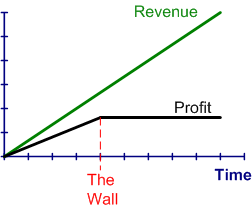
So, what happened? In business lingo, the costs to execute the business rose faster than the costs to acquire the revenue. Since we are not company insiders, we can only speculate as to the underlying cause(s) of the performance slip, but here are two out of a bazillion possibilities:
- More bureaucrats were added at a faster rate than people with the skills and ability to execute.
- The company’s execution processes were unscaleable.
Let’s explore these two performance busters.
More bureaucrats were added at a faster rate than people with the skills and ability to execute.
With revenue pouring in, it’s easy to become sloppy and careless with all that dough. Egotistical managers, unconsciously trying to outdo one another by building personal empires, convince their disconnected and aloof next-level managers that they need more people for business execution, regardless of whether they actually do need them. These new additions are often specialists who are only capable of executing narrow slivers of the business. Thus, they spend most of their time in idle mode; consuming more from the company than they contribute.
On the other hand, the new additions may be ambitious, unskilled fellow managers who are tasked with doing what their bosses couldn’t – increase execution performance with the people that they currently have. By adding more sub-managers, each super-manager builds his/her empire and further buffers him/herself from where the rubber hits the road in the execution trenches.
The company’s execution processes were unscaleable.
Unless the company produces widgets or some other simple product that doesn’t require knowledge synthesis and frequent human situational decision-making skills, its business execution processes may be unscaleable. In a sincere but misguided attempt to control and increase execution performance, the company’s managers actually decrease scaleability and they inhibit performance gains by piling more constraining rules and procedures on top of the people who create, manufacture, test, and sustain the product portfolio. Rather than rolling up their sleeves and jumping in with their people to help them get the job done, these managers spend all of their time running around taking status and ensuring that all the rules and procedures are followed.
Can you think of any other reasons why this successful company may have stumbled?
All in all you’re just another brick in the wall. – Pink Floyd

Why am I here?
WTF?
Meh!
D'oh!

My BTC Address



