Archive
Mistake Recognition
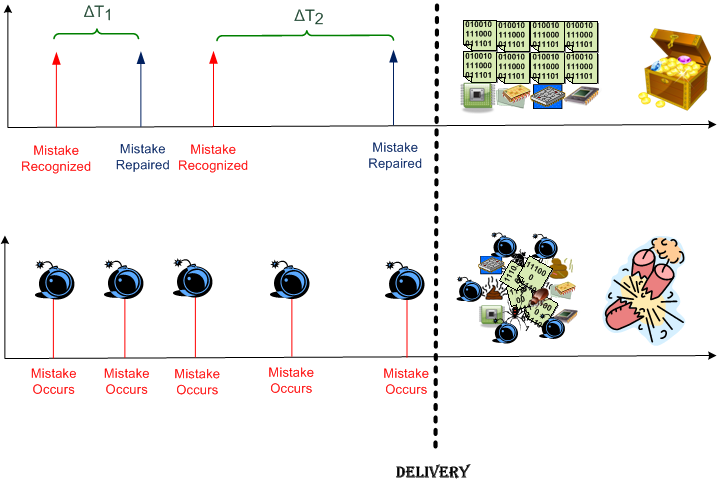
First question: Is “mistake recognition” allowed in your organization? Second question, if, and only if, the answer to the first question is “yes“: How many different “enabler” groups are required by your process to “have a say” in the path from “recognized” to “repaired”
If the answer to the first question is a cultural “no“, then as the lower trace in the dorky diagram shows, out the door your cannonballs go!
Glide On The Peace Train
The other day at work, while diligently plying away on an interface design, I just happened to notice that I was singing the (artist formerly known as) Cat Stevens’ tune “Peace Train“ to myself. Not out loud (thankfully), but to myself – in my head. This is just another example that reinforces the fact that “we don’t think; thinking happens to us“. No?
It may be scary to some to discover that thinking unconsciously and automatically happens to us, but the saving grace is that at least we can consciously choose how to react to those thoughts. Well, most of the time. Well, some of the time?

What was the last song you sang to yourself?
Roster Of System Thinkers
Someone on Twitter, I can’t remember who, tipped me off to a terrific “Complexity Thinking” Slideshare deck. I felt the need to snip out this slide of system thinkers and complexity researchers to share with you:

So far, I’ve read some of the work of Ackoff (my fave), Deming, Drucker, Meadows, Senge, Weinberg, and Jackson. In addition, I’ve studied the work of “fringe” system thinkers Rudy Starkermann, John Warfield, Bill Livingston, Ludwig von Bertalanffy, Thorstein Veblen, Ross Ashby, Stafford Beer, and Norby Wiener.
I look forward to discovering what the others on the roster have to say.
Empty Lifeline
Check out this “bent” pair of UML sequence diagrams:
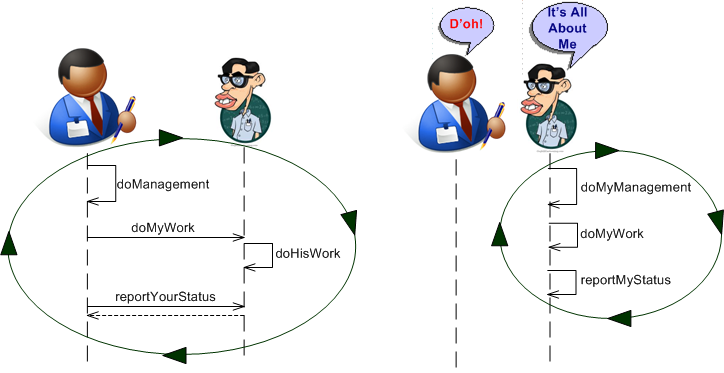
The system on the right is pretty loosely coupled, no?
Metadata Code Bloat
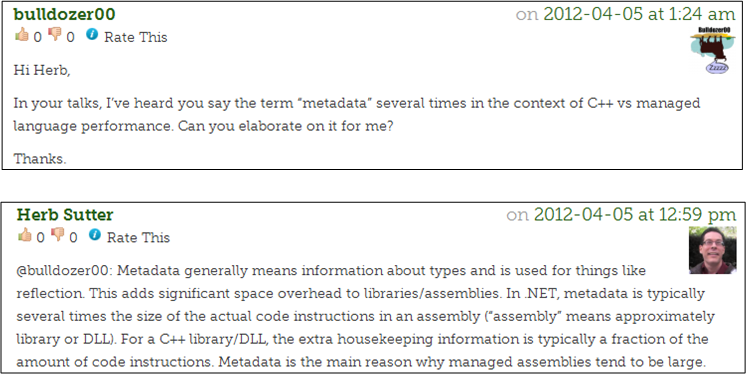
In many of his (terrific) talks and lectures, Herb Sutter often says that “always on garbage collection“, “default virtual dispatch“, and “metadata” are valid reasons as to why managed language programs written in C# and Java are typically slower and bigger than native languages like C++ and C. I understand the first two issues, but not the “metadata” argument. Thus, I asked Herb to “splain dis to me Lucy“.
Here’s my question and Herb’s gracious answer:
The “Void Star” Crowd
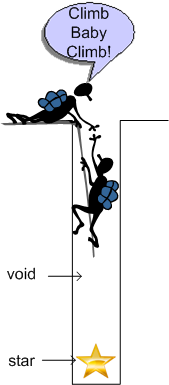
During the “Ask Us Anything” panel discussion at the “Going Native 2012” conference, one of the questions asked was: how do you get the “void *” guys to move forward toward a more type-safe and abstract C++ style of programming?“.
By “void *“, the questioner meant programmers who still cling to writing code like this:

instead of this:

The panelists admitted that it was a big challenge, and they gave the following suggestions:
- Ask them what problems they’re having and then show them the solution by doing it for them in C++ style. (Stroustrup)
- Set a personal example of increased productivity. (Alexandrescu)
- Show them compiler generated assembly output comparing the “void *” C-style code with a more expressive, less error-prone, more readable C++ equivalent. Odds are that the compiler-optimized C++ code will be much shorter than the hand-crafted C code. (STL)
Bjarne Stroustrup seemed especially frustrated at the pervasiveness of “void *” mindset. As a professor at Texas A&M, he said that as people come out of high school, most of them want to write games and they’ve convinced themselves and each other that, beyond a shadow of a doubt, “void *” is as fast as one can get. That’s exacerbated by the fact that many professors and “greybeards” still code in the type unsafe, barely readable, and error prone “void *” way.
I can sympathize with Bjarne and the panel. When I made the transition from C to C++, it took me what-seemed-like forever to “graduate” from arrays and naked pointers to containers and smart pointers and algorithms. Luckily, I did it in spite of myself. I can’t even remember the last time I used “void *” in any of the code I wrote.
Where Did The Soldiers Go?
If you’re a leader (anointed or otherwise) and the only access to you is communicated via the classic “my door is always open” and “suggestion box” yawners, then you won’t have to mind-wrestle with this vexing Poppercornism:
The day soldiers stop bringing you their problems is the day you have stopped leading them. They have either lost confidence that you can help or concluded that you don’t care. Either case is a failure of leadership. – Karl Popper

More Bureaucratic Than A Bureau
Tsukasa Makino is one of the Harvard Business Review/McKinsey “Beyond Bureaucracy Challenge” winners. In “From bureaucratic, divided, passive, and exhausted to productive, creative, autonomous, and happy company”, Tsukasa tells the transformational story of Tokio Marine Nichido Systems (TMNS) from a classic, robotic, unhealthy borg into a vibrant community.
In 2005, Hideki Iwai, a system engineer, proposed a corporate culture assessment by an outside consulting firm. Management “approved” of the idea and here was the bottom line:

D’oh!
Taking the bull by the horns, Hideki formed the “Work Style Reform committee” to change the culture. Despite being a “committee” the communist-sounding group worked! It spawned, and followed through on, a slew of blockbuster initiatives:

The challenge presented by bullet number 4 seems daunting. How did they vanquish it? They just said “NO!”
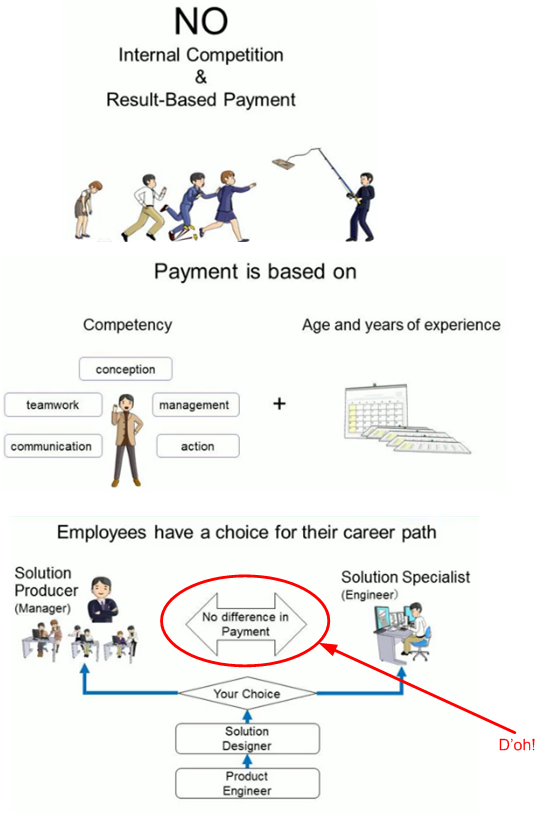
I love finding heartwarming stories like this. They’re hard to find, but thanks to web sites like Gary Hamels’ MIX, it’s getting easier.
Visualizing And Reasoning About
I recently read an interview with Grady Booch in which the interviewer asked him what his proudest technical achievement was. Grady stated that it was his involvement in the creation of the Unified Modeling Language (UML). Mr. Booch said it allowed for a standardized way (vs. ad-hoc) of “visualizing and reasoning about software” before, during, and/or after its development.

The Daily Question
In his latest book, Gary Hamel proposes that executives and managers ask an important question every day:

It would be a refreshing change from these daily questions:
- How can I get Wall St. off my back?
- How can I get the board to give me a bigger bonus?
- How can I stop my VPs from bickering with each other and kissing my ass?
- Can I blame my poor performance on the economy, fickle customers, and a natural disaster in China?
- How can I squeeze more productivity out of my DICs and trade nothing in return?
- What new management position can I create to extinguish this latest fire?
- How can I ensure that my legacy will be revered?


Why am I here?
WTF?
Meh!
D'oh!

My BTC Address



 Bulldozer00's Blog