Archive
LOL-Worthy
There are some creatively funny, LOL-worthy, parody accounts worth following on Twitter . Here’s a list of those that I laughingly trail.

Got any other recommendations for BD00?
Agile Software Factories
The next big thing in software development is here….
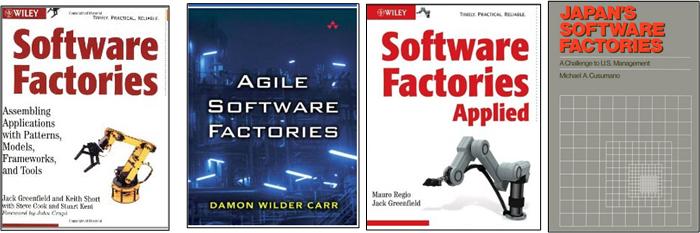
Where’s my hard hat? Whoo Hoo!

What Is It?
Ok dear reader, it’s quiz time! How does an enduring album come into the world? How does a revered painting emerge into being? How does a beloved novel spring forth? Please describe the “Process” in your own words….

Agile Overload
Since I buy a lot of Kindle e-books, Amazon sends me book recommendations all the time. Check out this slew of recently suggested books:
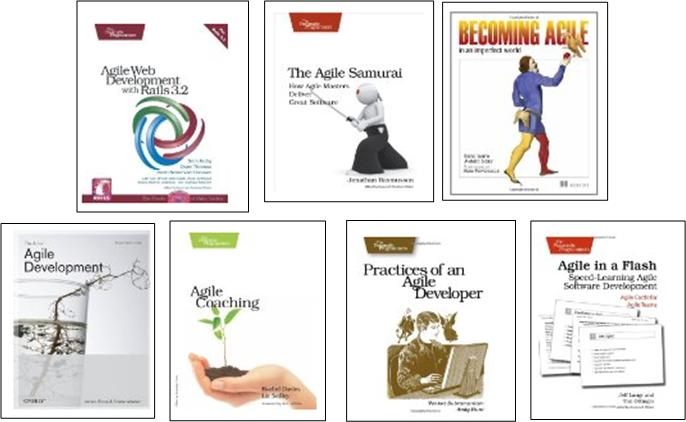
My fave in the list is “Agile In A Flash“. I’d venture that it’s written for the ultra-busy manager on-the-go who can become an agile expert in a few hours if he/she would only buy and read the book. What’s next? Agile Cliff notes?
“Agile” software development has a lot going for it. With its focus on the human-side of development, rapid feedback control loops to remove defects early, and its spirit of intra-team trust, I can think of no better way to develop software-intensive systems. It blows away the old, project-manager-is-king, mechanistic, process-heavy, and untrustful way of “controlling” projects.
However, the word “agile” has become so overloaded (like the word “system“) that….
Everyone is doing agile these days, even those that aren’t – Scott Ambler
Gawd. I’m so fed up with being inundated with “agile” propaganda that I can’t wait for the next big silver bullet to knock it off the throne – as long as the new king isn’t centered around the recently born, fledgling, SEMAT movement.
What about you, dear reader? Do you wish that the software development industry would move on to the next big thingy so we can get giddily excited all over again?

Freakin’ Oops!
With great power there must also come… great responsibility – Stan Lee
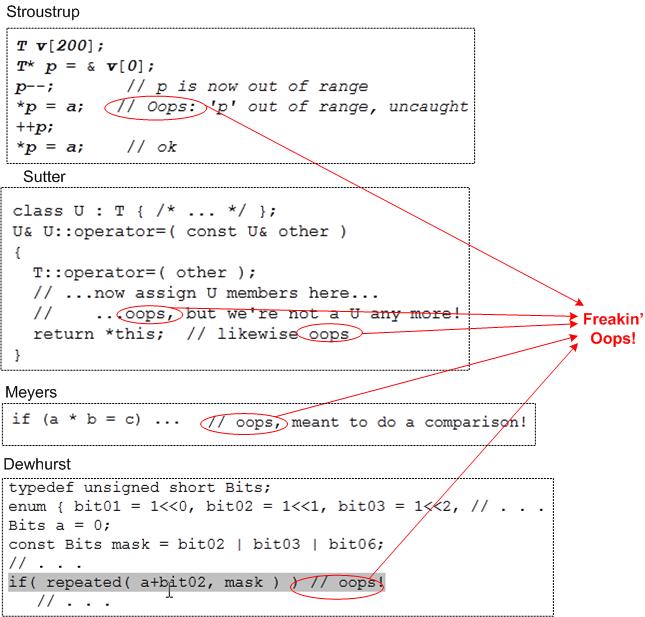
C++, being as sprawling and powerful and flexible as it is, rightly gets dinged for its propensity to bite you in the ass (if you don’t fully understand a language feature you’re trying to use). Thus, many C++ programming book authors point out common “gotchas” while teaching the language to their readers.
The graphic below depicts some “watchout!” snippets from four different, popular C++ programming books. As you might surmise from the picture, my favorite word in a C++ programming book is (freakin’) “Oops!”.
Going Turbo-Agile
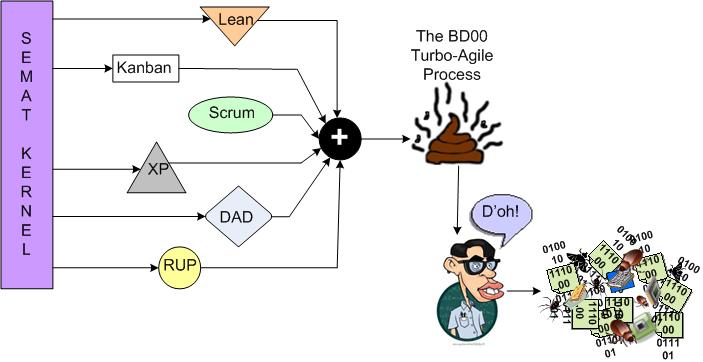
I’m planning on using the state of the art SEMAT kernel to cherry-pick a few “best practices” and concoct a new, proprietary, turbo-agile software development process. The BD00 Inc. profit deluge will come from teaching 1 hour certification courses all over the world for $2000 a pop. To fund the endeavor, I’m gonna launch a Kickstarter project.
What do you think of my slam dunk plan? See any holes in it?
Alternative Considerations
Before you unquestioningly accept the gospel of the “evolutionary architecture” and “emergent design” priesthood, please at least pause to consider these admonitions:
Give me six hours to chop down a tree and I will spend the first four sharpening the axe – Abe Lincoln
Measure twice, cut once – Unknown
If I had an hour to save the world, I would spend 59 minutes defining the problem and one minute finding solutions – Albert Einstein
100% test coverage is insufficient. 35% of the faults are missing logic paths – Robert Glass

The Ability To Function
While writing the “Rule-Based Safety” post of a few days ago, this quote kept interfering with my thoughts:
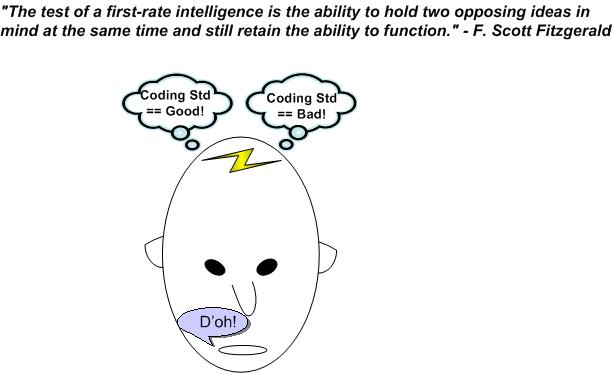
Whenever I end up simultaneously holding two opposing ideas in my head, most of the time one of them automatically wins the battle quickly and boots out the loser. Phew, the victory relieves the mental tension. On the down-side, the winner is much too effective at preventing the opposition from ever entering the contemplation chamber again. I hate when that happens.
make_unique
On my current project, we’re joyfully using C++11 to write our computationally-dense target processing software. We’ve found that std::shared_ptr and std::unique_ptr are extremely useful classes for avoiding dreaded memory leaks. However, I find it mildly irritating that there is no std::make_unique to complement std::make_shared. It’s great that std::make_unique will be included in the C++14 standard, but whenever we use a std::unique_ptr we gotta include a fugly “new” in our C++11 code until then:
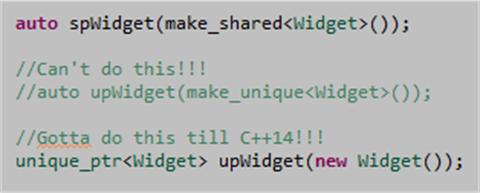
But wait! I stumbled across this helpful Herb Sutter slide:

A variadic function template that uses perfect forwarding. It’s outta my league, but….. Whoo Hoo! I’m gonna add this sucker to our platform library and start using it ASAP.
Rule-Based Safety
In this interesting 2006 slide deck, “C++ in safety-critical applications: the JSF++ coding standard“, Bjarne Stroustrup and Kevin Carroll provide the rationale for selecting C++ as the programming language for the JSF (Joint Strike Fighter) jet project:
First, on the language selection:
- “Did not want to translate OO design into language that does not support OO capabilities“.
- “Prospective engineers expressed very little interest in Ada. Ada tool chains were in decline.“
- “C++ satisfied language selection criteria as well as staffing concerns.“
They also articulated the design philosophy behind the set of rules as:
- “Provide “safer” alternatives to known “unsafe” facilities.”
- “Craft rule-set to specifically address undefined behavior.”
- “Ban features with behaviors that are not 100% predictable (from a performance perspective).”
Note that because of the last bullet, post-initialization dynamic memory allocation (using new/delete) and exception handling (using throw/try/catch) were verboten.
Interestingly, Bjarne and Kevin also flipped the coin and exposed the weaknesses of language subsetting:

What they didn’t discuss in the slide deck was whether the strengths of imposing a large coding standard on a development team outweigh the nasty weaknesses above. I suspect it was because the decision to impose a coding standard was already a done deal.

Much as we don’t want to admit it, it all comes down to economics. How much is the lowering of the risk of loss of life worth? No rule set can ever guarantee 100% safety. Like trying to move from 8 nines of availability to 9 nines, the financial and schedule costs in trying to achieve a Utopian “certainty” of safety start exploding exponentially. To add insult to injury, there is always tremendous business pressure to deliver ASAP and, thus, unconsciously cut corners like jettisoning corner-case system-level testing and fixing hundreds of “annoying” rules violations.
Does anyone have any data on whether imposing a strict coding standard actually increases the safety of a system? Better yet, is there any data that indicates imposing a standard actually decreases the safety of a system? I doubt that either of these questions can be answered with any unbiased data. We’ll just continue on auto-believing that the answer to the first question is yes because it’s supposed to be self-evident.

Why am I here?
WTF?
Meh!
D'oh!

My BTC Address



 Bulldozer00's Blog