Archive
Who Can I Talk To And Where Can I Go?
When I discovered and learned it, I automatically subscribed to the simple but profound principle of POSIWID: the “Purpose Of a System Is What It Does” (not what its stewards say it does). Because of this belief in POSIWID, I’ve always been highly skeptical of supreme experts and people in positions of anointed authority. Almost without fail, and sometimes unconsciously, many of these elites have internally motivated, self-serving agendas while externally offering up their vaunted expertise to “help” you and me. According to POSIWID, their purpose is to serve themselves first, while projecting the appearance of serving others first.
As Daniel Kahneman and other behavioral economics practitioners have discovered, people have an innate tendency to fall prey to the “confirmation bias“. The confirmation bias is where you and I take to heart any and all evidence that we’re “right” on a strongly held belief while ignoring any and all evidence to the contrary. Thus, in order to reinforce my deeply held disdain for supreme experts/authorities, I’ve read all of Nassim Taleb’s books along with these two:

All of the aforementioned books are jam packed full of examples in many domains (medical, financial, political, business, academia) where experts and authorities royally fucked up and negatively impacted the physical and material lives of thousands or millions of people. It wouldn’t be so bad if the perpetrators suffered mightily along with their victims as a result of their own expert bullshit, but it’s galling when they escape unscathed. It’s particularly outrageous when incompetent gurus gain while their constituents lose big.
The most recent egregious example of elites winning big at the expense of the multitude is when Wall St. bankers kept getting bonuses (in order to, uh, retain “talent“) while common people were going bankrupt as a result of their “expert” actions during the 2008 crisis. Even today, six years later, not a single financial big wig was stripped of his/her wealth and/or tossed in jail as a result of his dumbass, irresponsible decisions. Another good example is when an “expert” CEO gets tossed a big golden parachute after being booted out of the company he/she crippled. Applying POSIWID to these types of systems results in:
The purpose of a profit seeking institution is to enrich its elites without regard to the impact of its behavior on the well being of any of its other internal and external stakeholders.
I’d love to explore the flip side of this particular belief, which is the “Purpose Of A System Is What It Says It Does“, but who can I talk to and where can I go to read about it?
Trivial Trivia
I was going through some old project stuff and stumbled upon the chart below. I developed it back when I was the software lead of a nine person sub-team on an embedded system product development effort:

Putting all those indecipherable acronyms adorning the chart aside, note that the project was performed in 2004 – a mere 3 years after the famous “Agile Manifesto” was hatched. I can’t remember if I knew about (or read) the manifesto at the time, but I do know that Tom Gilb’s “Evo“ and Barry Boehm’s “Spiral“ processes had radically changed my worldview of software development. Specifically, the (now-obvious) concept of incremental development and delivery rang my bell as the best way to mitigate risk on challenging, software-intensive, projects.
As the chart illustrates, the actual hand-off of each of the seven builds (to the system integration test team) was pretty much dead nuts right on target. Despite the fact that the project front end (requirements definition and software design) was managed as a “waterfall” endeavor, the targets were met. Thus, I’m led to believe the following trivial trivia:
Not all agile projects succeed and not all waterfall projects fail.
It Simply Happens
Last week, I attended the retirement party of one of the three most influential mentors I ever had: Mr. Marc Viggiano. It was a really nice send off, and deservedly so.
During the early years of my (so-called) career, Marc helped me become a better engineer. At the time, we were both smokers and we held many deep technical/philosophical conversations while puffing away on smoke breaks outside the building. Because of those priceless learning experiences, I don’t regret having wasted 10 years of my life sucking on coffin nails. The tradeoff was worth it.
When our small company started growing, Marc zoomed up the corporate ladder (as a result of true merit; not by being a suck-up or phony-crony). In spite of his executive rise, Marc always retained a sense of humility and kept his feet firmly planted on the ground. Since I remained in the trenches and strove for horizontal development while Marc moved up and strove for vertical growth, we pretty much lost touch and our interests diverged. But hey, thus is the process of life. It simply happens.

Dueling Quagmires
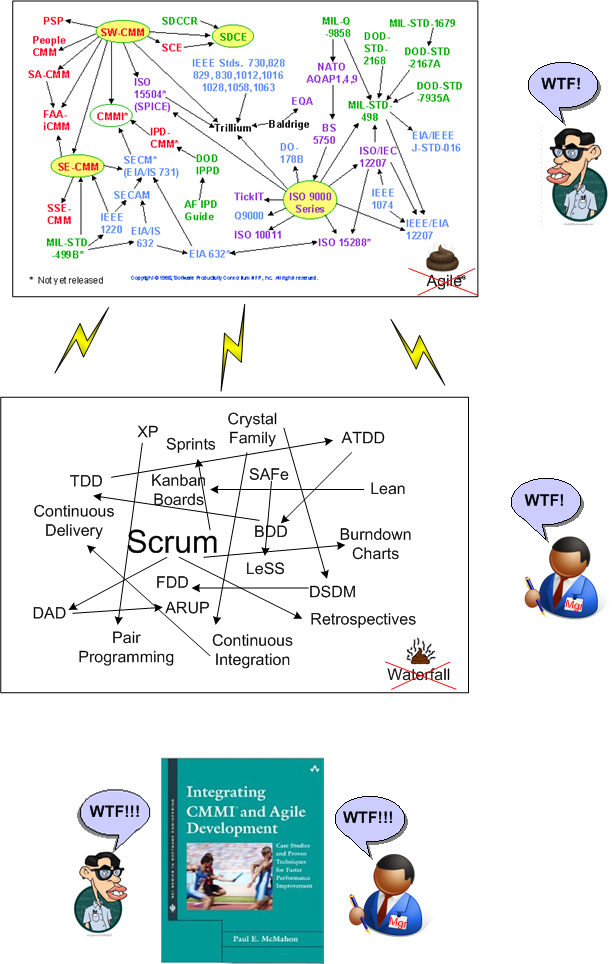
To BD00, the agile movement, even though it is a refreshing backlash against the “Process Models And Standards Quagmire” (PMASQ) perpetrated by a well-meaning but clueless mix of government and academic borgs who don’t have to create and build anything, has spawned its own quagmire of “Agile Process Frameworks And Practices Quagmire” (APFAPQ). Like the PMASQ community has ignited a cottage industry of expensive consultants, certifiers, assessors, trainers, and auditors, the APFAPQ movement has jump-started an equivalent community of expensive consultants, coaches, trainers, certifiers.
Government Governance
The figure below highlights one problem with government “governance” of big software systems development. Sure, it’s dated, but it drives home the point that there’s a standards quagmire out there, no?

Imagine that you’re a government contractor and, for every system development project you “win“, you’re required to secure “approval” from a different subset of authorities in a quagmire standards “system” like the one above. Just think of the overhead cost needed to keep abreast of, to figure out which, and to comply with, the applicable standards your product must conform to. Also think of the cost to periodically get your company and/or its products assessed and/or certified. If you ever wondered why the government pays $1000 for a toilet seat, look no further.
I look at this random, fragmented standards diagram as a paranoid, cover-your-ass strategy that government agencies can (and do) whip out when big systems programs go awry: “The reason this program is in trouble is because standards XXX and YYY were not followed“. As if meeting a set of standards guarantees robust, reliable, high-performing systems. What a waste. But hey, it’s other people’s money (yours and mine), so no problemo.
Maturity and Responsibility
In a terrific InfoQ.com talk on software craftsmanship, Kevlin Henney uttered a great line: “Growing old is mandatory. Growing up is optional.” In a Twitter exchange on the topic, @dancres concocted an equi-wise line: “I like ‘growing old disgracefully’“.
At age 55, as all you two regular readers well know, I have yet to exercise my option. At this point in time, I have no plan to ever exercise it. Hell, I’m not even sure I have a choice in the matter. For all I know, my genetic core may forbid it.
The reason I abhor the concepts of “growing up” and “getting your shit together” is because my main motivational force comes from Dick Werthimer: “The purpose of life is to fight maturity“. Another reason is that I don’t equate “growing up” (aka marching toward maturity) with “becoming more responsible“, or child-like with child-ish. I think one can be simultaneously immature AND responsible. A third reason is that I’ve watched family and friends “grow up” over the years and I’m not thrilled with the patterns of bland, too-serious behavior that “growing up” leads to.

How about you, dear reader? What are your thoughts on the relationship between maturity and responsibility?
The Ridiculously Obvious
Over the years, I don’t know how many times I’ve heard smug, self-important consultants and coaches spout things like: “If your org doesn’t do what I say and/or you don’t get what you want, you should just leave“. Of course, like much of what they say is, it is literally true – you can indeed leave. However, here’s an interesting counterpoint:
“To say people have choice when they are in no position to make one is disingenuous.” – John Seddon
Consultants and coaches love to spout platitudes and self-evident truths couched in the fancy “new” language of the latest fad. Amazingly, stating the ridiculously obvious is what they get paid the big bux to do. To these high-horse riders, life for others is always much simpler than it really is. As outsiders looking in, they have what Nassim Taleb calls: “no skin in the game“. The only thing they have to concern themselves about is sucking up enough to the executives who run the show so that they can get hired back after their $2k/day gig is done. And saying the right things, no matter how impractical they are to implement, is the way they do it.
Difficult To Describe
Last Wednesday, I returned home from a six day stint down in New Orleans as an active participant in the greatest party on earth: Mardi Gras! As I write this post seven days later, I’m still suffering from the well-known phenomenon of post-vacation depression. You all know this feeling. It’s the acute, but thankfully temporary, sadness that comes with the requirement to return to “normal” thinking, and doing, and being, after experiencing a glorious reprieve from the grind of responsible daily living.

This year’s MG trip was the fifth consecutive year (and eighth overall) in which: I danced the streets, watched the spectacularly colorful parades and creative street acts, tossed and caught beads from balconies, ate Po-boys/Muffalettas/Jambalaya/Beignets, and joyfully bathed in the fabulous sights, sounds, and atmosphere that is unique to Mardi Gras.

The Mardi Gras experience is difficult to describe to non-participants. It’s a time and place where 100s of thousands of people converge into one great big ball of intertwined happiness and generosity; and this includes the battalions of local and state police tasked to maintain a semblance of order amongst the cheerful, self-organized chaos.

With all the booze and energy that flows, you would think that many incidents of malfeasance and ill-will take place during the festivities. But remarkably, there are very few. That’s because we travel the streets in the French quarter with smiles on our faces, free and unburdened minds, and we savor each and every present moment as it unfolds. Ironically, the only unfriendly and uptight people at MG are the small clusters of self-righteous Jesus freaks sporting annoying bullhorns and big, nasty signs. They march around passing judgement down upon people they don’t know anything about.

I can’t wait till next year. I’ve already marked my calendar for Fat Tuesday: Feb 17, 2015. Perhaps you might want to mark yours too!
 Rainee, this post is for you 🙂
In Defense Of Hierarchy
The word “hierarchy” gets no respect. Except for popes, generals, executives, and managers, who tend to thrive exquisitely in command and control hierarchies, many people associate hierarchical social structures with ineffectual bureaucracy, back-stabbing politics, patronization, unfair distribution of status and rewards, and suppression of individual initiative.
Despite all the bad press, hierarchically structured social systems do have benefits; even for those residing in the lowest tiers of the pyramid. One benefit that hierarchy serves up is… orderly execution of operations:
Imagine if students argued with their teachers, workers challenged their bosses, and drivers ignored traffic cops anytime they asked them to do something they didn’t like. The world would descend into chaos in about five minutes. – Duncan J. Watts
In “Influence” Robert Cialdini writes:
A multi-layered and widely accepted system of authority confers an immense advantage upon a society. It allows the development of sophisticated structures for resource production, trade, defense, expansion, and social control that would otherwise be impossible. The other alternative, anarchy, is a state that is hardly known for its beneficial effects on cultural groups and one that the social philosopher Thomas Hobbes assures us would render life “solitary, poor, nasty, brutish, and short.”
I don’t agree with Mr. Cialdini that the alternative to hierarchy is pure anarchy, but his point, like Mr. Watts’s, is a good one.
Management “guru” Tom Peters (to whom I used to closely listen to prior to reading Matt Stewart’s brilliant “The Management Myth“), sums it up nicely with:
Hierarchy will never go away. Never!

Not That Different, No?
Check out this slide I plucked from a pitch that will remain unnamed:
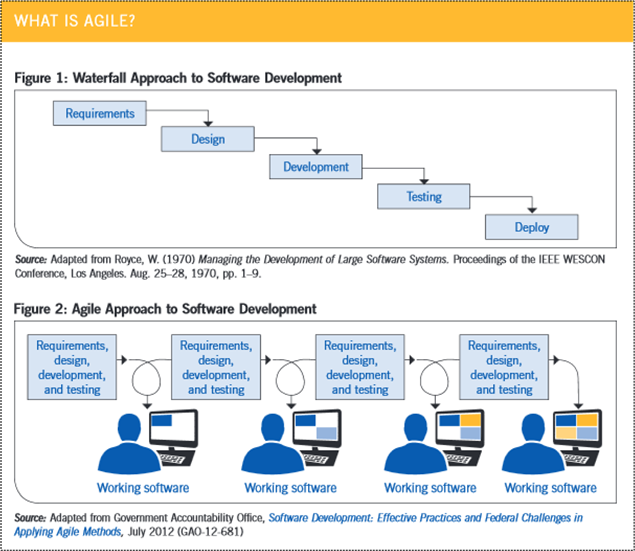
Notice the note under the waterfall diagram. Now, let’s look at the original, “unadapted” version and accompanying quote from Winston W. Royce’s classic 1970 paper:
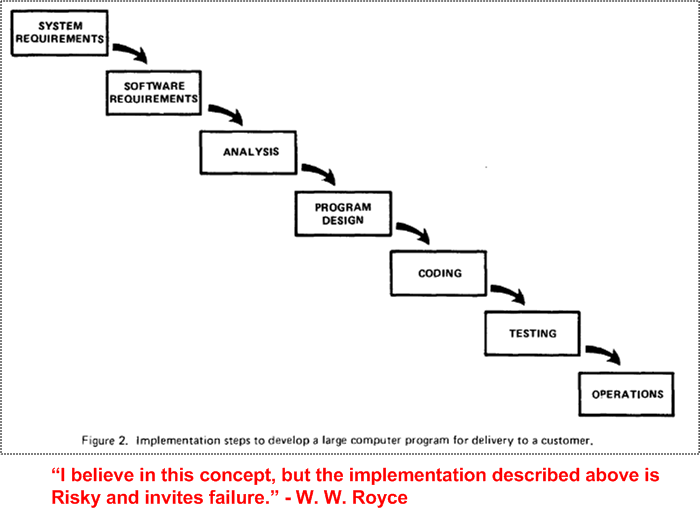
Notice that Mr. Royce clearly noted in his paper that the sequential, never-look-back, waterfall process is a stone cold loser. Next, let’s look at another diagram from Mr. Royce’s paper; one that no fragilista ever mentions or shows:
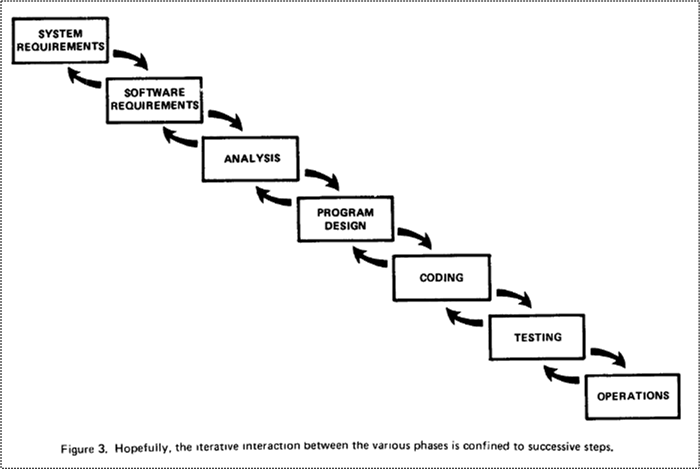
OMG! An iterative waterfall with feedback loops? WTF!
Finally, let’s look at BD00’s syntegrated version of the agile, lower half of our consultant’s diagram and the iterative waterfall diagram from Mr. Royce’s paper:
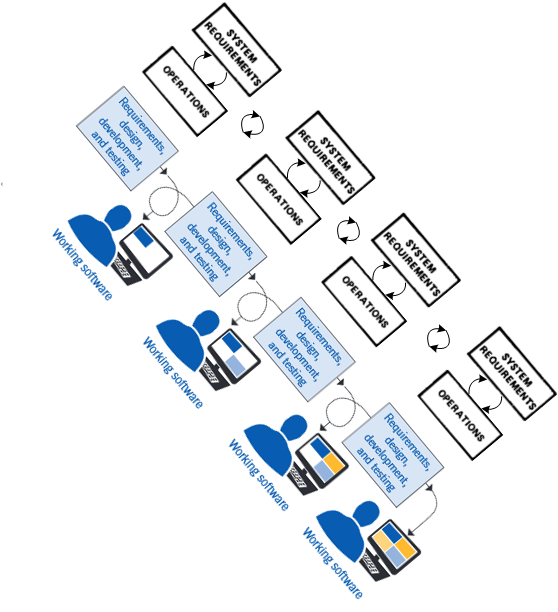
Comparing the agile and “chunked“, iterative, waterfall models shows that, taken in the right context, they’re not that different…. no?

Why am I here?
WTF?
Meh!
D'oh!

My BTC Address



 Bulldozer00's Blog