Archive
Round And Round We Go
Engineering Councils, Master Engineering Groups, Centers of Excellence, yada-yada-yada. Has your company repeatedly formed and dissolved elite groups like these over the years? The purpose of sanctioning these groups is always well-intentioned, but always doomed. Why are they doomed? Because:
- they are always underfunded and, at the first hint of corpo financial stress, they are abandoned because they are an overhead expense group that doesn’t create or add value.
- all of the sitting members have real day jobs that need to get done in order to put money in the corpo coffers and food on the table.
- they don’t actively solicit input from the people who have to operate by their decisions – if they ever make any decisions and produce non-verbal output at all.
- they ignore input from non-members when they do get it – losing credibility and respect in the process.
- they never agree to a systematic method of making decisions when they are formed.
- they spend all their time in philosophical debates, with each elite member trying show how smart he/she is.
I could probably make up some more excuses for the repeated cyclical failure of elite councils, but I’ll leave it as an exercise for you, dear reader, to add your own reasons to the list. Feel free to add your own thoughts on this via the comments section.
Each time the elite council idea is recycled, nobody seems to remember the failures of the past and the same unproductive group behavior emerges. Everybody but the BOTG (Boots On The Ground) innocently thinks that this time it will be “different”. I’ve participated in these elite groups in the past, but from now on, I’ll always respectfully decline membership when asked. The last time I was asked, I declined to sit on one of these boards (that’s exactly what they do – just sit) . However, I offered up my services to work on any specific and funded task that the group deemed important. Unsurprisingly, nobody has taken me up on my offer. Bummer :^)
So how can the elite council idea be successful and add value to an org? Just invert the reasons-for-failure list above. Even if you do manage to change the context from disabling to enabling, it still might not work but, at least it will have a chance.
Stagnation Or Growth?
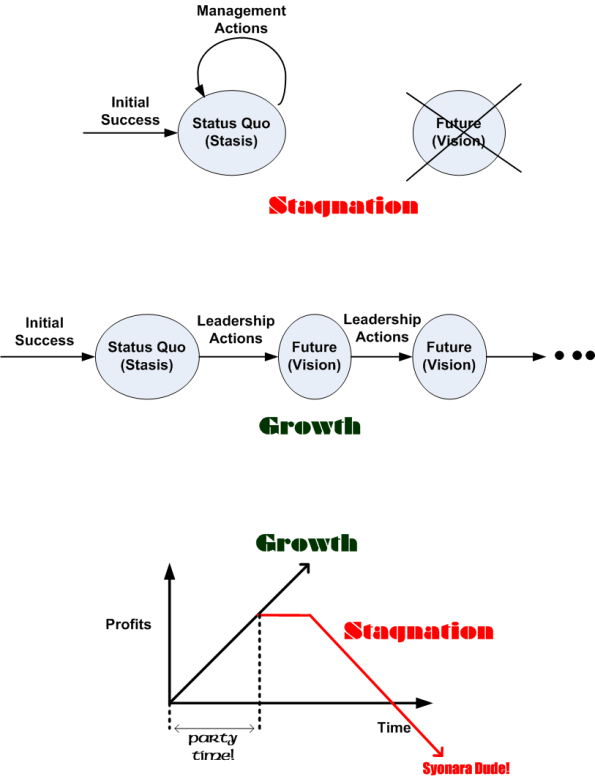
What type of system do you work in, day in and day out? Do you work for scared managers or courageous leaders?
Unnecessarily Complex, or Sophisticated?
I recently stumbled upon the following quote:
“A lot of people mistake unnecessary complexity for sophistication.” – Dan Ward
Likewise, these two quotes from maestro da Vinci resonate with me:
“Simplicity is the ultimate sophistication.” – Leonardo da Vinci
“In nature’s designs, nothing goes wanting, and nothing is superfluous.” – Leonardo DaVinci
When designing and developing a large software-intensive system, over-designing it (i.e. adding too much unessential complexity to the system’s innate essential complexity) can lead to disastrously expensive downstream maintenance costs. The question I have is, “how do you know if you have enough expertise to confidently judge whether an existing complex system is over-designed or not?”. Do you just blindly trust the subjective experts that designed the system when they say “believe me, all the complexity in the system is essential”? If you’re a true layman, then there is probably no choice – ya gotta believe. But what if you’re a tweener? Between a layman and an expert? It’s dilemma city.
The figure below depicts a simple model of a generic multi-sensor system. The individual sensors may probe, detect, and measure any one or more of a plethora of physical attributes in the external environment to which they are “attached”. For example, the raw sensor samples may represent pressure, temperature and/or wind speed measurements. They also may represent the presence of objects in the external environment, their positions, and/or kinematic movements.

The fusion processor produces an integrated surveillance picture from the inputs it receives via all of the individual sensors. This fused picture is then propagated further downstream for:
- display to human users,
- additional value-added processing,
- automatically issuing control actions to actuators (e.g. gates, lights, valves, motors) embedded in the external environment .
Now assume that you are given a model of a multi-sensor system as shown in the figure below. Is the feedback interface from the fusion processor back to one (and only one) sensor evidence of an over-designed system and/or unnecessary added complexity? Well, it depends.

If the feedback interface was purposely designed into the system in order to increase the native functionality or performance of the individual sensor processor that utilizes the data, then the system may not be over-designed and the added complexity introduced by designing in the interface may be essential. If the feedback loop only serves to “push back” into the sensor processor some functionality that the fusion processor can easily do itself, then the interface may be interpreted as adding some unessential complexity to the system.
In any system design or system analysis/evaluation process, effectively judging what is essential and what is unessential can be a difficult undertaking. The more innately complex a system is, the more difficult it is to ferret out the necessary from the unnecessary.
Scouts
The figure below is intended to show a successful and profitable company operating in an external environment that’s changing over time. Since the corporation achieved its current successful state by employing strategies and practices that worked well to get it there, it naturally employs the same techniques over and over again. This causes the corpo walls to harden and protect those inside of the org from the forces of external change.

If the external winds of change are characterized by a low velocity (more like a breeze than a tornado), then the company’s success may last for quite a long time even though it’s unconsciously stuck in neutral and not adapting to the external environment. However, as the breezy external environment transforms into a maelstrom of tornadoes as a result of new competitors appearing and the sudden emergence of game changing technologies like the internet, company revenues/profits and the corpo pyramid may come tumbling down. Conscious and enlightenend company leaders know that stasis is a corpo killer, but textbook spreadsheet managers don’t.
One way to “sense” when change is needed is to formally designate a cadre of “scouts” at all functional levels of the org, from marketing all the way down the corpo steps to engineering and customer service. I first heard about the concept of scouts from Steve McConnell many years ago, before the internet and the exponential rise of third world engineering know how. At the time, I thought it was a novel idea and now I think it may be essential for survival.
As the picture below illustrates, scouts can serve as external sensors/probes that monitor and make meaning of the rapidly changing external environment. They separate the wheat from the chaff and, if they’re paid attention and nurtured, they can provide accurate information to corpo decision makers regarding which new technology and practices to embrace, and which new products to prototype and try.

Of course, dysfunctional org executives who think highly of themselves but don’t think much of their people (while simultaneously praising them as the company’s most valuable assets), will get what they deserve. They won’t create the role of a “scout” and they’ll ignore or subtlely berate self-motivated people who voluntarily perform the role of a scout. In their minds, they think they are the only ones who are capable of steering the company toward the future – using the same worn out , obsolete thinking that used to work but is virtually useless. Bummer.

System Science And Fat Heads
I recently finished reading John Warfield’s An Introduction To System Science . John asserts that whenever you try to design a system that will involve human beings during its operation (and what non-trivial system doesn’t? ), you must take into account these two universal human characteristics:
- The primal instinct to survive
- Miller’s number: 7 plus or minus 2
If your technical system design doesn’t pay homage to these human frailties, it will most likely fail – big time. The money will be gone, the time will be gone, and the damn thing won’t work. Warfield claims that his generic system design process effectively deals with these issues. In his book, John describes his process and cites several examples of it’s success in the public, private, and educational domains.
Warfield also says that the biggest hurdle to overcome, which he doesn’t have a solution for, is the propensity of high level executives for refusing to accept/acknowledge great ideas founded on firm principles from subordinates. I believe what John says, but in my layman’s mind, I equate this strange and unproductive behavior with egomania. The higher up you go and the more titles that you acquire, the bigger and fatter your head gets. Of course, there are always exceptions to every rule :^)
The Beauty Of Quotes Is…
that they are both dense and concise. When I hear a quote that hits close to home it rocks my world like a Mike Tyson power punch (when he was in his prime). Sometimes the effect is positive and sometimes it’s negative, but it’s always impactful. Here’s a top 10 list of my current favorites:
- “Nothing is impossible for the man who doesn’t have to do it himself.” – A. H. Weiler
- “An undefined problem has an infinite number of solutions.” – Robert A. Humphrey
- “A picture is worth a thousand words. A metaphor is worth a thousand pictures.” – Ben Tamari
- “Comprehensiveness is the enemy of comprehensibility.” – Martin Fowler
- “Creation is an intimate act of communication between the creator and the created.” – W. L. Livingston
- “Facts are useful because they give the conscious mind something to do while the emotions decide what’s true” – Dale Dauten
- “I hold great hopes for UML, which seems to offer a way to build products that integrate hardware and software, and that is an intrinsic part of development from design to implementation. But UML will fail if management won’t pay for quite extensive training, or toss the approach when panic reigns.” – Jack Gannsle
- “If I had an hour to save the world, I would spend 59 minutes defining the problem and one minute finding solutions” – Albert Einstein
- “I know that I am intelligent, because I know that I know nothing.” – Socrates
- “It is only by risking our persons from one hour to another that we live at all.” – William James
What’s your current favorite list?
Product Development Systems
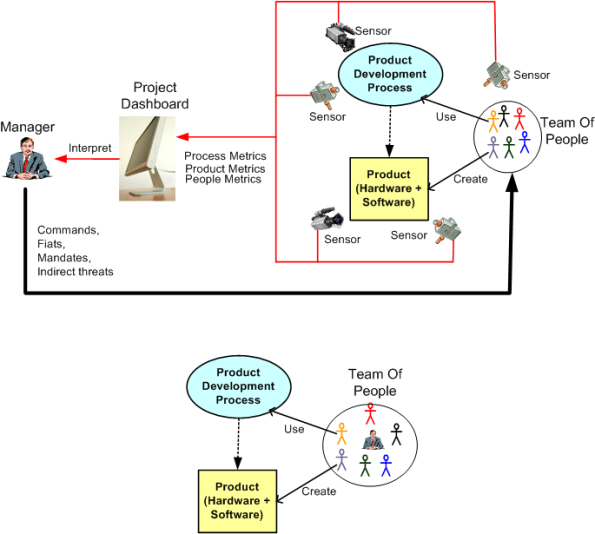
The figure below shows two (out of a possibly infinite number of) product development systems. Which one will produce the higher quality, lower cost product in the shortest time? Would a hybrid system be better?
Scary Stuff
Since the word “manager” appears directly in their title, I can certainly understand (and maybe even empathize a little, just a little) why a product manager, program manager, and a general manager would obsess about meeting the schedule. However, it gets real freakin’ scary when all the engineers are talking about schedule too! It makes me think:
If everybody on the project is concentrating on the schedule, who the hell is doing the freakin’ work?
Serendipity
Don’t ya just love serendipity? After hearing the oft-repeated “why does software take so long?” question for the bazillionth time in my career, a fuzzy version of a quote I heard a long time ago came to mind. It was something like “anything is easy for the man who doesn’t have to do it himself”. I fuzzily thought that Mark Twain was the originator of the quote. For at least 20 minutes, I googled “Mark Twain” and various phrasings of the quote in an attempt to try and find the exact version of it. Alas, it was not to be and I moved on with my life.
A couple of days ago, guess what happened? Serendipity came to the rescue via my RSS reader. One of the blogs that I subscribe to is called “Quotes Of the Day”. Sure enough, this showed up as one of them:
“Nothing is impossible for the man who doesn’t have to do it himself.”- A. H. Weiler
Kool huh? I was so thrilled that serendipity paid me a visit that I incorporated the quote into my e-mail signature.
Anti-Collaboration
I’d like to think that most people would agree with me when I make the following assertion:
Dysfunctional corpo orgs that consciously (or unconsciously) maintain a localized lock on knowledge, expertise, and experience steer themselves toward inefficient and mediocre organizational performance.
Thus, it pains me when I come across (so-called) leaders who ignore social collaboration tools that could bust the chastity belt lock wide open and tremendously boost corpo performance. Believe it or not, some managers go beyond the call of duty. Because of their innate fear of change and their instinctual desire to maintain the status quo, they discourage the use of these tools by never using them to contribute and by privately ostracizing the people that are trying to use them for the company’s benefit. Yet, they always seem to be going to meetings where cost reduction and productivity improvements are the burning fires of the day. What a wonderful world :^)

Why am I here?
WTF?
Meh!
D'oh!

My BTC Address



