Archive
Pile On The Rules
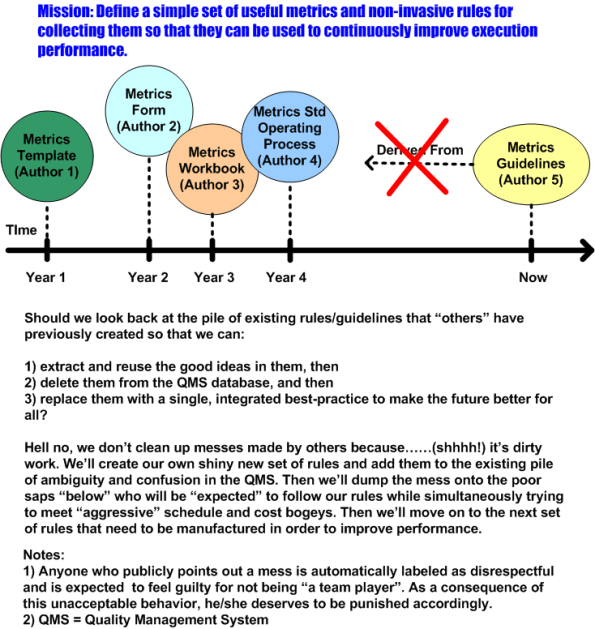
Two Playbooks
When revenues and/or profits go flat or they start eroding, one of the 3 textbook moves that a mediocre company usually make is to reorganize (yet again). The other two moves in the utterly uncreative and standard MBA playbook are: 2) fire people; 3) instill fear via coercion and adding more rigid/constraining processes to extract more productivity from the value creation team at the bottom of the corpo hierarchy. Sometimes, especially in a time of crisis, all three actions are executed. Notice that all 3 moves are attempts to cut costs and not to raise revenues. Raising revenues requires exploring, discovering, and finding new customers along with developing successful new products that open up new markets. These actions require creativity, innovation, new ways of thinking, leadership, and courage. Sadly, these attributes are not the forte of mechanistic and Newtonian MBAs who are trained to solely look at data and compute fancy state-of-the art derivative business metrics.
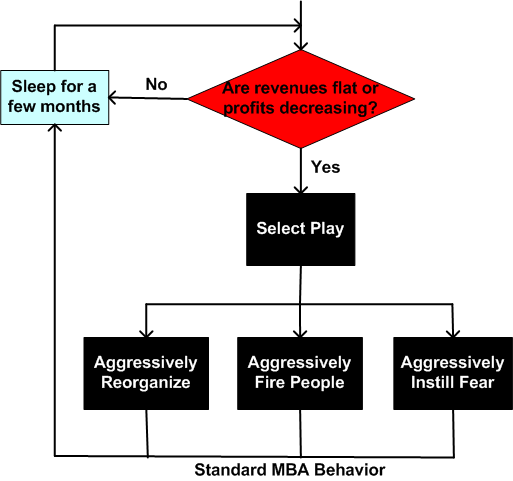
When a company reorganizes, which is the least painful action that can be applied to the productive members at the bottom of the org, grand new titles are created, groups are renamed, and new layers are added/subtracted. Management temporarily feels better and optimism permeates the top of the stratified pyramid. The people down in the dirty boiler room know better. Since the reorg usually consists of shuffling the same people with the same old crusted mindsets into new positions, no deep and lasting change happens. If, during the reorg, people with new ideas are promoted from the bottom or brought in from the outside, they are quickly “set in their place” by the old guard that remains. They get absorbed by the borg. Blech.

Past Present Future
How do you “allocate” your thinking time? Do you spend the largest percentage of your time fearing the future? Regretting the past? Constantly switching between worrying about the future and regretting the past? Experiencing and feeling the wonders that are happening in the present moment?

Let’s say that you are self-aware enough to realize that your thinking state is dominated by circular rumination over what has happened in the past. What techniques/practices can one employ to redirect more of your thinking time to the present moment? Can one actually “control” their thinking state?
In my case, I tend to spend most of my “thinking time” regretting the past and missing out on the grace and glory of the present moment. In the cases where I do recognize that I’m continuously spinning on the stale past, just the act of “thought recognition” brings me back into the present moment. However, just as soon as I transition into the present moment, I unconsciously switch out of that tranquil state and go back to the same old, same old. I’ve made, and continue to make, many half-assed attempts at meditation in order to spend more time in the present moment, but I’ve frustrated myself out of diligently practicing this ancient art of self-actualization.
Imposers And Imposees
“Never tell people how to do things. Tell them what to do and they will surprise you with their ingenuity.” – George S. Patton
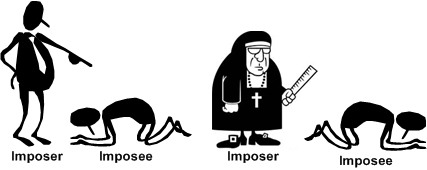
Isn’t it amazing at how people and groups, especially those in positions of authority, are always exhorting others to perform work exactly the way that they want the work to be done? Instead of carefully clarifying “what” needs to be done, which is much more difficult and requires leadership over management, the “imposers” obsess over every little detail of the “how” – which is management over leadership. Leaders focus on the “what”, but managers obsess over the “how”. What’s really mind-boggling, is that if you ask an imposer for helpful examples of excellence that they’ve personally created before they were promoted from an imposee to an imposer, you get some kind of evasive smokescreen answer, or some combo of body and facial movement that conveys this message: “it’s taboo for you to ask that question”. When that happens, credibility and professional respect, extremely tough to earn but easily lost, go right down the crapper. Is asking for leadership-by-example a disrespectful thing to do? In dysfunctional orgs where there are few, if any leadership-by-examples of excellence, asking probing questions is considered an act of subordination that is not easily forgiven or forgotten.
Under the veil of “industry best practices”, and the unspoken but clearly understood directive that imposees are required to learn the details of the “how” fully and instantaneously on their own time, the pounding into submission by imposers continues. The pounding only stops when enough camouflage has been generated by the imposee(s) to anesthesize the imposers into thinking that they’ve prevailed. It’s only a temporary high. Sooner or later, everyone finds out, sometimes spectacularly, that the neglected “what” is FUBAR. In dysfunctional organizations that behave in accordance with these “industry worst practices”, it’s no wonder that the majority of employees become cynical, apathetic, disengaged, and disgruntled camouflage creators.
“You do not lead by hitting people over the head – that’s assault, not leadership” – Dwight D. Eisenhower
So, am I a “do as I say not as I do” imposer and hippocrate? Well, I try not to be one, but I might be failing miserably at it. Judge for yourself by reading one or more of the rants on this blog. Do I overdo it sometimes or, uhhh, always? Decide for yourself.
A Classic Response
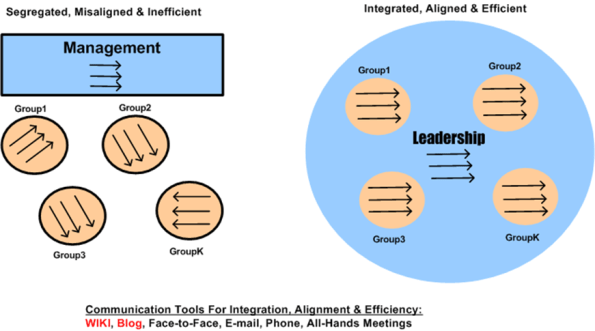
In a product development organization, when schedules are consistently missed, costs are rising, and profits are decreasing, a classic management response is to add more “oversight” to turn things around. This sincere, but often counterproductive response to deteriorating performance, exacerbates the mess by adding more cost and further slowing progress.
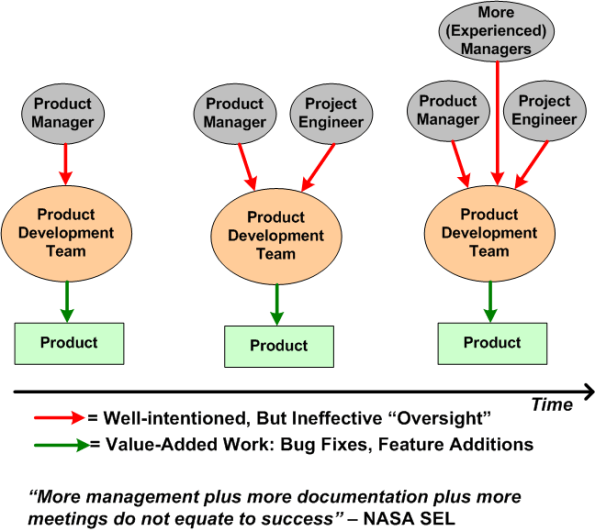
The above figure graphically shows the deterioration in performance over time ignited by the “classic response” to perceived poor execution. The additions to the management team somehow magnify the illusion of control that managers think they have over the product development/maintenance process. The act of piling on more management serves as an anesthesia that temporarily relieves the pain of poor performance. When the numbers show that performance hasn’t improved, the next step is to keep the top heavy structure in place, but replace one or more members of the management team with “proven” managers. Sick city.
So what’s an alternative to the “classic response”? Take a look at the figure below. In this response, the product manager rolls up his/her sleeves and gets dirty with the product development team. She dives deep into the product infrastructure and scours the landscape for missing information, erroneous information, and “camouflage”. Armed with this realistic, unfiltered “status” data, effective decisions can be made and productive direction can be given. In addition, by visibly doing some non-status-taking and non-schedule-hawking work, credibility and trust (which are difficult to acquire but easy to lose) are gained.
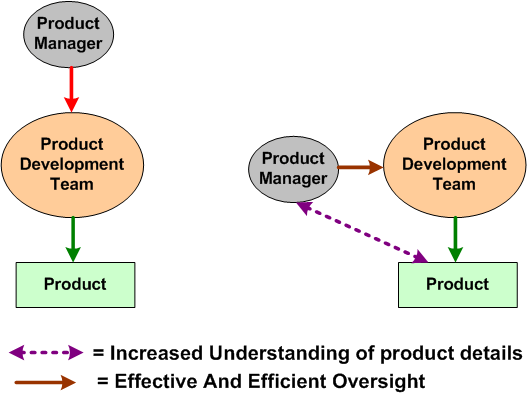
Sadly, during the transition from doer to manager, an automatic mindset switch occurs. Instead of growing into a 3D status taker plus schedule jockey PLUS, most importantly, a helper, only the first two responsibilities are internalized. “I’ve arrived and I don’t have to do any hard, messy work anymore”. Even worse, upper management innocently, but surely, encourages this post-transition mindset because it’s the same mindset that guides their behavior. Bummer.
“You have to know a lot to be of help. Learning is slow and tedious. You don’t have to know much to cause harm. It’s fast and instinctive.” – Rudolph Starkermann

Trees
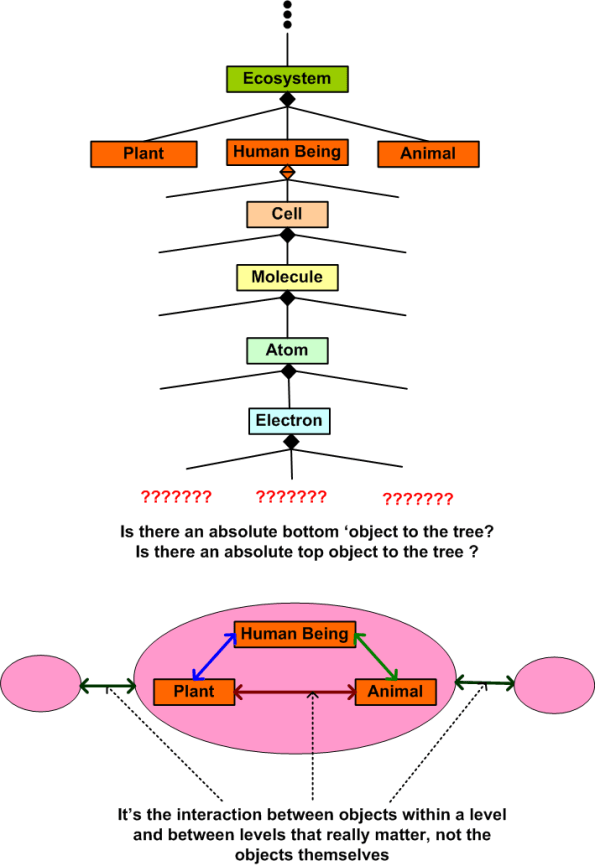
This tree below is my personal creation. You’re tree would likely be different than my tree. Nature creates perfect trees. Man tends to destroy nature’s trees and to create arbitrary artificial trees to suit his needs. Man must create, either consciously or unconsciously, conceptual trees to make sense of the world. How attached are you to your trees? Are your trees THE right trees and are my trees wrong? Are trees created by ‘experts’ the trees that all should unquestionably embrace? Who are the ‘experts’?
Creating the vertical aspect of the tree is called leveling. Creating the horizontal aspect of the tree is called balancing. Leveling and balancing, along with scoping and bounding, are powerful systems analysis and synthesis tools.
The Peek-A-Boo Pattern
This behavior pattern occurs when your boss, or someone else higher up in the titular chain of command, actively seeks you out for misbehaving according to some set of unwritten corpo rules. You “need talking to”.
The bigger the title of your scolder, the more serious the behavior transgression. After you’ve been “talked to”, the boss disappears behind his/her title to do “the important stuff that keeps the organization running”. He/she is nowhere to be seen until your next episode of bad behavior. Notice that the boss never stops by to ask you if there’s anything that he/she can do to help you get the job done.
Peek-a-boo, I see you!

Too Late!
As a result of studying the works of many spiritual teachers , I try hard to be consciously aware of my thoughts as they occur in real-time. I try to be simultaneously both the observer and the observee. However, I’m always too late in recognizing self-defeating behaviors triggered by negative thoughts. I have a negative thought, spout out some toxic verbal diarrhea , and then recognize my stupidity after the fact. It almost seems like I’d be better off if I stayed blissfully unconscious and unaware of my thoughts and behavior.
Internal thoughts produce internal feelings, and internal feelings drive external behavior. You can’t control which thoughts magically appear in your head, but if you’re vigilantly aware and awake, you can consciously choose to let hurtful thoughts naturally float away without taking action. The more ego-dominated you are, the less likely you are to release the negative thoughts and preempt stupid behavior. Having said that, I realize that I’m totally dominated by ego. How about you?

Why am I here?
WTF?
Meh!
D'oh!

My BTC Address



