Archive
Fierce Transparency
I’ve been trying to figure out why I admire Zappos.com (I know, I know, they had a nasty security breach recently), Semco, and HCL Technologies so much. Since I have a burning need to understand “why“, I’ve concocted at least one reason: Tony Hsieh, Ricardo Semler, and Vineet Nayar ensure that fierce transparency is practiced within their companies and all their “initiatives” are rooted there.
Working in an environment without transparency is like trying to solve a jigsaw puzzle without knowing what the finished picture is supposed to look like. – Vineet Nayar. Employees First, Customers Second: Turning Conventional Management Upside Down (Kindle Location 547). Kindle Edition.
Of course, I’m making up all this transparency stuff, but hey, it reinforces my weltanschauung (<- I had to look up the spelling a-freakin-gain!). That’s what humans do to give themselves comfort. No?

Concurrency Support
Assuming that I remain a lowly, banana-eating programmer and I don’t catch the wanna-be-uh-manager-supervisor-director-executive fever, I’m excited about the new features and library additions provided in the C++11 standard.

Specifically, I’m thrilled by the support for “dangerous” multi-threaded programming that C++11 serves up.

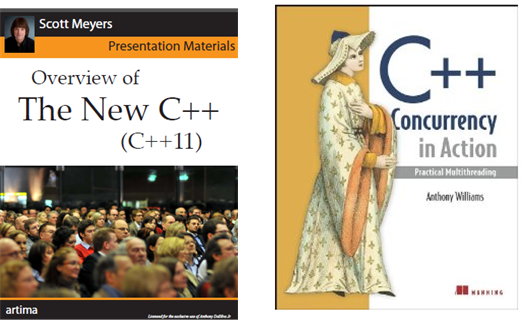
For more info on the what, why, and how of these features and library additions, check out Scott Meyers’ pre-book training package, Anthony Williams’ new book, and Bjarne’s C++11 FAQ page.
HW And SW ICs
Because software-intensive system development labor costs are so high, the holy grail of cost reduction is “reusability” at all levels of the stack; reusable requirements, reusable architectures, reusable designs, reusable source code. If you can compose a system from a set of pre-built components instead of writing them (over and over again) from scratch, then you’ll own a huge competitive advantage over your rivals who reinvent the wheel over and over again.
One of the beefs I’ve heard over the years is “why can’t you software weenies be like the hardware guys“. They mastered “reusability” via integrated circuits (IC) a looong time ago.
One difference between a hardware IC and a software IC is that the number of input/output (IO) pins on a physical chip is FIXED. Because of the malleability and ephemeral nature of software, the number of IO “pins” is in constant flux – usually increasing over time as the software is created.
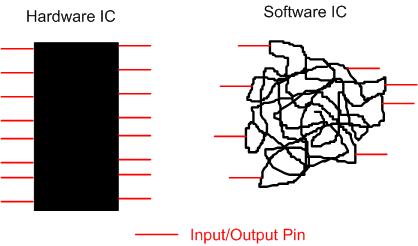
Even when a software IC is considered “finished and ready for reuse” (LOL), unlike a hardware IC, the documentation on how to use the dang thing is almost always lacking and users have to pour through 1000s of lines of code to figure out if and how they can integrate the contraption into their own quagmire.
Alas, the software guys can master “reusability” like the hardware guys, but the discipline and time required to do so just isn’t there. With the increasing size of software systems being built today, the likelihood of software guys and their managers overcoming the discipline-time double whammy can be summarized as “not very“.
Reeking Of Rank
In the 20th century (remember what it was like way back when?), “neutron” Jack Welch unabashedly, successfully, and transparently used a ranking system to catapult GE to the top of the financial world by ex-communicating the bottom 10% on a yearly(?) schedule.
When leadership teams make a corpo-wide policy change, they do so in a sincere attempt to improve some performance metric in the org without inflicting too much collateral damage. For example, take the above policy of “ranking” employees. Orgs that rank their employees may “assert” that rankings will increase engagement, morale, and let people “know where they stand” in relation to their peers.

That’s all fine and dandy as long as the ranking system applies equally to each and every level in the org – especially if it’s asserted to be a guaranteed slam dunk for increasing employee engagement . Hell, if it’s a no-brainer, then why exclude the supervisor, manager, director, and C-level layers? After all they’re “employees” too, no?
I wonder if #1 Jack Welch ranked his direct reports and gracefully escorted his bottom 10% out the door every year?

Process Delays And Variety Suppression
Even though it’s unrealistically ideal and unworkable, I give you this zero-overhead value and wealth creation system as a point of reference:

For speculative comparison to the idealized design, I give you this system “enhancement“:

For the ultimate delay-inducing, variety-suppressing, and assimilating borg, I give you this “optimal” design:

Over time, as an org unconsciously but almost assuredly morphs into a borg, the existing delay-inducing “value-added overhead processes” grow bigger, and more of them are inserted into the pipeline for sincere but misguided performance-increasing reasons. To add insult to injury, more and thicker variety-suppression control channels are imposed on the pipeline from above. If this rings a bell with you, then it’s pure coincidence, because like all other delusionary BD00 posts, it’s totally made up.
Obscured By Me
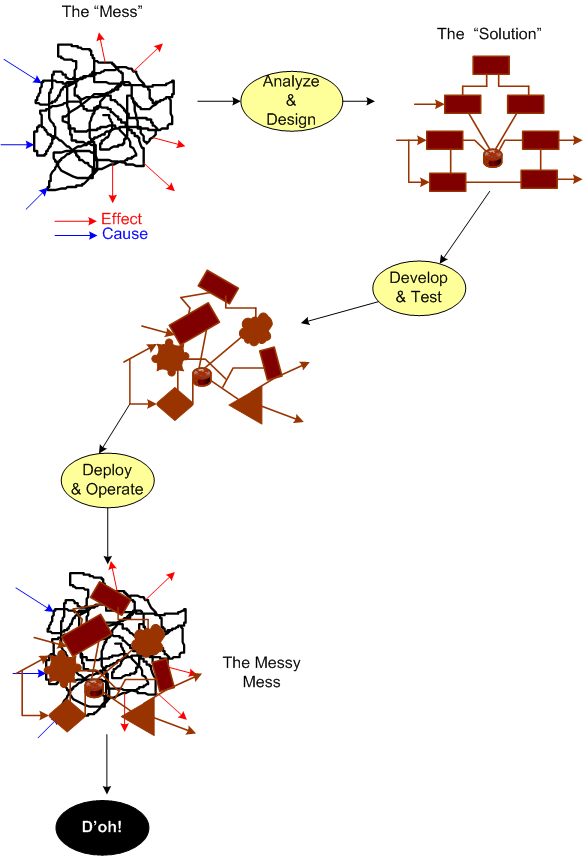
I hate when this happens….

…which is ALL the time. D’oh!
A Bunch Of STIFs
Grady Booch states that good software architectures evolve incrementally via a progressive sequence of STable Intermediat Forms (STIFs). At each point of equilibrium, the “released” STIF is exercised by an independent group of external customers and/or internal testers. Defects, unneeded functionality, missing functionality, and unmet “ilities” are ferreted out and corrected early and often.

The alternative to a series of STIFs is the ubiquitous, one-shot, Unstable Fuming Fiasco (UFF):
 Note: After I converted this draft post into a publishable one and queued it up, I experienced a sense of deja-vu. As a consequence, I searched back through my draft (91) and published (987) post lists. I found this one. D’oh! and LOL! I’m sure I’ve repeated myself many times during my blogging “career“, but hey, a steady drumbeat is more effective than a single cymbal crash. No?
ReOrg City
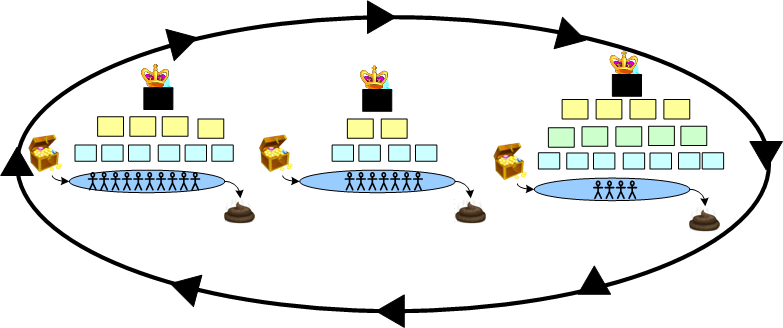
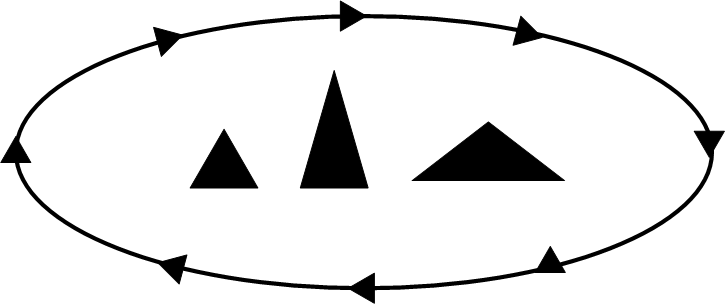
The structure of the “whole” and the behaviors at both the top and bottom remain the same. Only the width and/or height of the pyramid changes with each reorg. But alas, that’s just “the way it has to be“, no?
Matter On The Grid
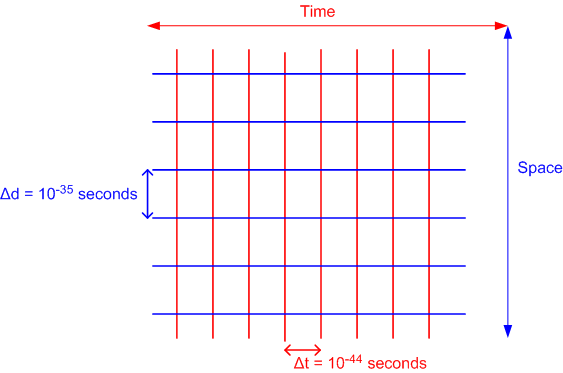
From the irrational logic in a prior post, I “think” the quantized universe may be modeled as the following space time grid:
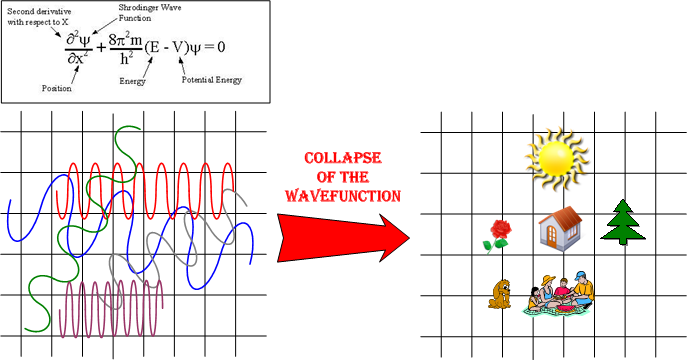
As shown on the left below, before the “collapse“, all matter is in the form of a superposition of infinite possibility energy waves governed by Shrodinger’s wave equation. After the instantaneous collapse of the wave function caused by a “conscious observer“, we get finite objects moving through space and time on the grid.
Alas, I’m on board with Einstein’s mental model:
I like to think that the moon is there even if I am not looking at it – Albert Einstein
Note: Take this post (and all my other ones) with a grain of salt. I have no freakin’ idea what I’m talking about. I’m collapsing the wave function as I go.

Why am I here?
WTF?
Meh!
D'oh!

My BTC Address



 Bulldozer00's Blog