Horse And Buggy
Werner Vogels is Amazon.com’s Chief Technology Officer and author of the blog “All Things Distributed – Building Scalable And Robust Distributed Systems“. I just couldn’t stop myself from laughing when he announced that fellow distributed-systems guru Steve Vinoski had just joined Twitter:

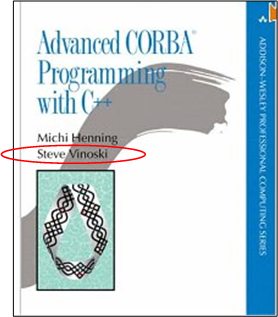
Specifically, the last sentence put me in stitches. As you can see from the book cover below, Steve is a CORBA expert and way back in the dark ages he was a CORBA advocate. However, he’s moved into the 21st century and left that horse and buggy behind – unlike others who cling to their horse whips and ostracize those who point out the obvious.
Categories: technical
corba, Distributed computing, linkedin, postaday2011, Steve Vinoski, Werner Vogels
Leave a reply to PNeumiller Cancel reply

Why am I here?
WTF?
Meh!
D'oh!

My BTC Address



 Bulldozer00's Blog
It cracked me up as well. 🙂
Regarding leaving the horse and buggy behind, that’s very true. Innovation requires constantly taking an objective look at what you’re doing and not only looking for weaknesses and areas that need improvement, but also keeping in mind that there’s very likely a different and better way to do what you’re trying to do and trying to find it. It’s a balance between settling on an approach to get things done while also trying to look forward to try to do it better next time. It’s also important to avoid getting yourself too emotionally attached to your technology, as doing so will ultimately end up preventing you from being able to move forward and improve.
Hi Steve,
Thanks for stopping by! Your last sentence is golden. I suffer from the “too much emotional investment” problem like many others. Strangely, I still get all jacked up about technology I love – even though I’m aware of my rising temperature and I know it will damage relationships – especially with higher-ups. D’oh!
CORBA never really met with the promises that the OMG made about it. I remember being enamoured by CORBA back in ’95 at OOPSLA 10 (which was the dawn of Java as well). Over the years, Microsoft has always “rolled their own” so they never got behind CORBA or Java for that matter, nor did their compiler tools, but their answer to CORBA wasn’t any more successful, i.e. DCOM. Then there was SOAP, EJB, rmi, and DDS. Where will it all end???
Never?
The inexorable forward march of technology will still be going on long after we’re gone – the singularity is near! The trick is (and always has been) choosing the technologies that are right for your products. But alas, the devil (along with a lot of politics and posturing) is in the details.
It depends on “who” you are working with as much as “what” you are working on!
hah! Hint, hint? Someone’s gotta dispense the tough love, right MAYO-NAISE?
Actually I think CORBA did pretty well. It’s still in use, still baked into telco interoperability standards and cable TV backend systems for example, and there are still projects using it. Heck, that book (cover shown above in the blog) still delivers royalties, so someone’s still buying it. 🙂
CORBA works pretty well for small-to-medium controlled systems, like “workgroups,” but where it fails is in larger scale. I once predicted — in a 1998 Communications of the ACM article, no less — that CORBA would start to be used across the Internet because Netscape was building it into their browsers. Thankfully Roy Fielding in his Ph.D. thesis disabused me of my unrealistic notions a couple years later. I think the following articles on this topic from my column a few years back are worth reading:
Click to access IEEE-Serendipitous_Reuse.pdf
Click to access IEEE-Demystifying_RESTful_Data_Coupling.pdf
Click to access IEEE-Convenience_Over_Correctness.pdf
Click to access IEEE-RPC_and_REST_Dilemma_Disruption_and_Displacement.pdf
COBOL did pretty well and is still in use too – but new project starts based on COBOL and/or CORBA? How about promoting a homegrown, CORBA-based infrastructure as the vision of the future? 🙂
Thanks for the list of articles!
REST doesn’t excite me too much since it’s too closely tied to the limitations of TCP/IP. Now if we created a “new REST” with the best features of CORBA, DDS, WS-* and REST principles over SCTP then we would have some rocking distributed comms going on.
No offense, but you really should step back and try taking a different view of REST. The approach of creating architectural styles like REST by applying specific constraints to induce desired properties is classic engineering at its best. It’s eye-opening and completely unlike typical architectural approaches, including CORBA. Worrying about TCP/IP at this level is truly missing the forest for the trees.