Architectural Choices
Assume that a software-intensive system you’re tasked with designing is big and complex. Because of this, you freely decide to partition the beast into two clearly delineated layers; a value-added application layer on top and an unwanted overhead, but essential, support layer on the bottom.
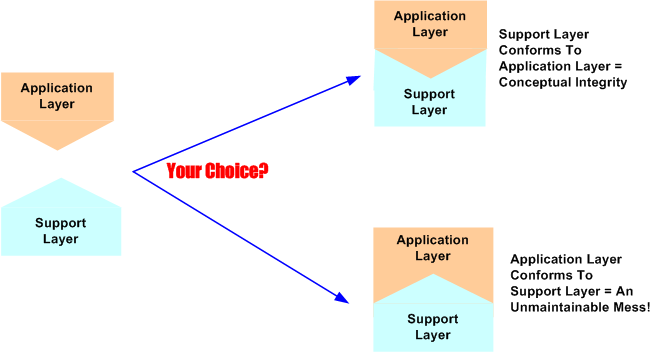
Now assume that a support layer for a different application layer already exists in your org – the investment has been made, it has been tested, and it “works” for those applications it’s been integrated with. As the left portion of the figure below shows, assume that the pre-existing support layer doesn’t match the structure of your yet-to-be-developed application layer. They just don’t naturally fit together. Would you:
- try to “bend” the support layer to fit your application layer (top right portion of the figure)?
- try to redesign and gronk your application layer to jam-fit with the support layer (bottom right portion of the figure)?
- ditch the support layer entirely and develop (from scratch) a more fitting one?
- purchase an externally developed support layer that was designed specifically to fit applications that fall into the same category as yours?
After contemplating long term maintenance costs, my choice is number 4. Let support layer experts who know what they’re doing shoulder the maintenance burden associated with the arcane details of the support layer. Numbers 1 through 3 are technically riskier and financially costlier because, unless your head is screwed on backwards, you should be tasking your programmers with designing and developing application layer functionality that is (supposedly) your bread winner – not mundane and low value-added infrastructure functionality.

Why am I here?
WTF?
Meh!
D'oh!

My BTC Address



