Archive
Breakfast Interpretation
While e-conversing with a colleague the other day, I used the following quote that encapsulates the chicken and pig story:
In a bacon and eggs breakfast, the chicken is involved but the pig is committed – Ken Schwaber
Surprisingly (it’s surprising because my colleague isn’t a member of the management guild), my infallible and self-righteous peer castigated me with a retort of “that’s inappropriate!”.
Dude, gimme a break. You see, just because the quote was created by a semi-famous software dweeb to belittle BMs, it doesn’t have to be interpreted that way. It can be interpreted as the exact opposite:
“managers who decide to provide financial backing for a project have more skin in the game than the engineers who spend the money – because if the project fails, the pecuniary loss is pinned on the manager by his/her manager(s)“.
This interpretation certainly has as much validity as it’s polar opposite, no?
Nevertheless, when I did utter the quote, I was using it to convey Mr. Schwaber’s original intent. Bad dog – as my colleague was quick to point out. He seems to delight himself whenever he clearly points out how stupid I am – which is often. Gotta love pumping yourself up at the expense of others. I should know, cuz I do it all the time. Mooo hah hah hah! Bad dog!

Buy this poster at motivatedphotos.com. Post it on your cubie wall – if you dare.
Wealth And Effort
Any form of “ism” can work if it creates and sustains a large middle class that feels it can make it to the top of the pyramid of privilege by the fruits of their own labor. As soon as the bubble bursts and the middle class feels that the rich keep getting richer without any effort and the poor keep getting poorer regardless of effort, all is lost and a revolution is in the offing. Sure, a powerful police force may temporarily stave off the revolution, but not forever. Over time, the innate human desire for liberty trumps oppression like water dissolves rock.

In the USA, democracy and the right of every person to vote has worked pretty well to stave off the destruction of the middle class. However, when rich elites gain publicly invisible control over all political parties and force the government to allow them to operate unfettered without any oversight, the result is extreme capitalism and the potential fall of the middle class. I don’t know if it’s happening in America, but it sure seems like it. When big fat corpo bureaucracies demand and get capitalism on the way up and socialism (bailouts) on the way down, there’s no risk of consequences to their behavior and they have no reason to change their middle class busting ways. “Too big to fail” and “too little to succeed” sux for the middle class. Let them eat cake.
Competitive Edge
Check out the figure below. Which model more closely maps to your company’s way of operating?
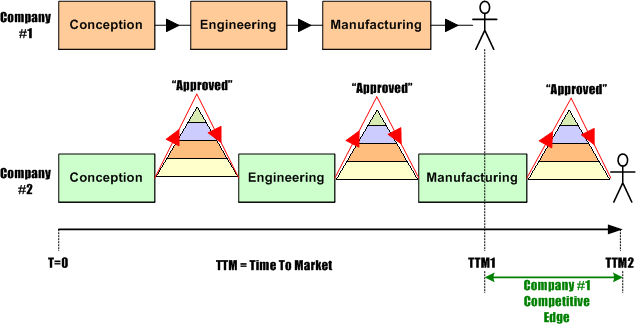
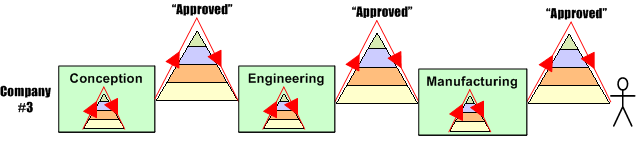
If you picked company #2, does the nested approval model below represent your company even more closely? Does every swingin’ dick (not DIC) in the house with one or more titles feel the need to be informed and bestow his/her approval before anything of substance can get done within the corpo citadel?
Make Me More Effective
In this blog post, 15 great leadership questions, executive and leadership coach John M. McKee asks leaders how often they ask their people:
What can I do to make you more effective?
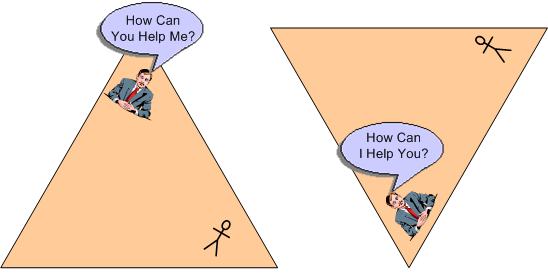
LOL. I’d wager that most leaders don’t ask this question at all. Managers cleverly ask and expect the opposite:
What can you do to make me more effective?
The higher one goes up in a corpo pyramid, the more this question gets asked either explicitly or (more likely) implicitly. You see, one unwritten rule (of many) in CCH bureaucracies is that lesser subordinates are required to make their bosses look good and expect nothing in return except the prevailing industry wage and benefits package. Expecting managers to actively facilitate high quality work and value creation is relegated to a distant second.
The problem with any unwritten law is that you don’t know where to go to erase it. – Glaser and Way
At the beginning of a project, an anointed leader once asked me: “What do you need?“. I was stunned, tongue-tied, and I didn’t know how to respond. Later, when I had some time to think about what I needed, I made my request. Sadly, I didn’t get what I needed but that didn’t really matter that much to me. Just the fact that he asked me the question was enough to instill a feeling of lasting trust and respect within me.
Short Cycle, Long Cycle
Since my memory isn’t that great, I think (but am not sure) that I wrote about short and long cycle run-break-fix before. Nevertheless, I’m gonna do it again because repetition can drive a message home.
In a nutshell, short cycle run-break-fix (SCRBF) and LCRBF are ways of enhancing product quality. High frequency SCRBF iteration jacks up quality by removing errors and fixing design disasters before a product gets shipped to customers. LCRBF is (hopefully) a low frequency technique of error removal after a product has made it into the customer’s hands. In that sense, SCRBF is good and LCRBF is bad. In a perfect world, LCRBF is never needed because the customer gets exactly what he/she wants right out of the shoot.
The figure below depicts side-by-side models of two different company’s day to day operating systems. Which one do you think is more successful? Why do you think the company on the right doesn’t do any SCRBF? Could it be that internal mistakes aren’t tolerated and hence covered up? Do you think it’s innocent ignorance? Do you think it’s because management puts schedule first and quality second – while publicly espousing the opposite? Which model best represents your company’s ingrained way of doing things?
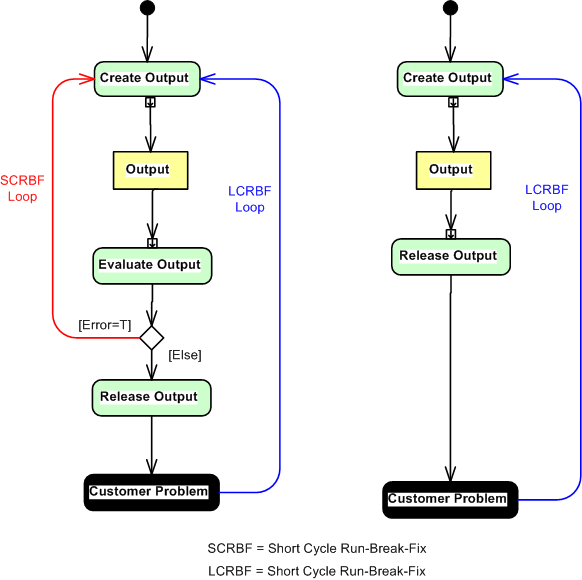
Note: The terms SCRBF and LCRBF were coined by William L. Livingston in his masterful second book, “Have fun at work“.
Trust
In “Design For Prevention” (there’s no link here because the book hasn’t been released yet), friend and mentor Bill Livingston elegantly states:
Trust substitutes for search, negotiation, monitoring, and enforcement; it substitutes for hierarchical control internally and for the legalisms of contracts externally. The core elements of trust include: reciprocity, reputation, and a common semantic.
Reciprocity and reputation align motives, and a common semantic aligns perceptions. People have an innate, passionate desire to contribute, called the instinct of workmanship. Opposing this urge to contribute is fear of rejection, failure, loss, retribution, or embarrassment. Earned trust tips the balance between the urge to contribute and fear. Working in an environment of trust reinforces, validates, and supports trust. – William L. Livingston
The truth in Bill’s words ring loud and clear to me. Trust flattens the hierarchy and nurtures the emergence of a collaborative, wealth creating community. Without trust, a herd-following and hardened mediocracy is guaranteed.
Sadly, because those in the top tiers of CCHs want nothing more than to stay in the penthouse, trust is not allowed within corpocracies. Fine grained, micro-detailed work schedules (that are hopelessly out of date as soon as the ink dries) coupled with useless daily status meetings continuously destroy trust and clearly show “who’s in charge” and who’s supposed to be more important.

A Contrast In Usability
I own two wildly different books dedicated to the topic of software estimation:
- Steve McConnell’s pragmatic and down to earth “Software Estimation: Demystifying the Black Art“
- Richard Stutzke’s massive, academic tome: “Estimating Software-Intensive Systems: Projects, Products, and Processes“
I have several of McConnell’s books and I think that he is a brilliant, understandable teacher of all things software. Steve’s concern for, and empathy towards, the layman software engineer shows. Stutzke, on the other hand, is an impressive equation-wielder and master complexity amplifier who seems more concerned with showing off his IQ to fellow elites than transmitting usable information to the dudes in the trenches. It could take more time to apply Stutzke’s work for estimating the size and effort to develop a large software-intensive system than to build the actual system itself.
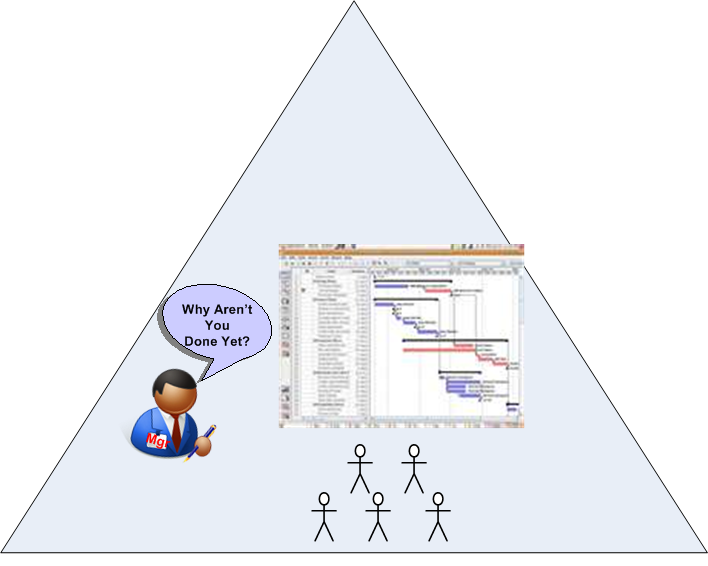
Since McConnell’s book is half the price of Stutzke’s, buy two of them – one for yourself and one for your manager. On the other hand, give the second one to a colleague since most managers, BM or otherwise, don’t read technical stuff. They also don’t believe in estimation. They delusionally believe in certainty so they can populate their massive and useless Microsoft project files with exact numbers and never revise them until the fit hits the shan and it’s time to apportion blame to the DICforce.
Failure, Failure, Failure
There are tons of experts, articles, books, and references on the ephemeral topic of “change”. Over the years, I’ve read my fair share of books on change and one of the best that I’ve stumbled upon (so far) is “It Starts with One: Changing Individuals Changes Organizations“. Authors Black and Gregersen assert that the 3 major brain barriers to organizational change are:
- The failure to see
- The failure to move
- The failure to finish
The book is targeted at leaders who’ve “seen” that major change is needed and who feel compelled to move their orgs into the future. It provides a boatload of examples and solid, pragmatic advice on how leaders can help the DICforce see, move, and follow through on cross cutting change initiatives.
Black and Gregersen should follow up their nice work with a book on a more pervasive problem; the failure of corpo leaders to “see” the need for change in themselves. The sequel would advise the boatloads of leaders in this category to get off their duffs and continuously probe, sense, and decide what changes are needed for their orgs to remain viable in a fast changing and hostile external business environment.
At a certain age institutional minds close up; they live on their intellectual fat. – William Lyon Phelps
Bad leaders fail to “see” the need for change until a crisis jolts them into reality. That’s because the dudes in the head shed get comfortable with past successes and feel no sense of urgency to change anything – regardless of what they say. To paraphrase Carolyn Wells; ” actions, or a lack thereof, lie louder than words“.

Thich Nhat Hanh
Thich Nhat Hanh (don’t fret cuz I don’t know how to feakin’ pronounce his name either) is a man with a remarkable story. This gentle Buddhist monk:
- was banished from his homeland, Vietnam, for opposing the war,
- was educated at Princeton and taught at Columbia and Cornell (thus, he’s got “authorized” credentials),
- was the main influencer of Martin Luther King’s stance against the Vietnam war,
- was nominated by Martin Luther King for the Nobel peace prize,
- has written over 100 books (I’ve read “No Death, No Fear“).

In this interview with Oprah, (yes, I’m a girlie-mahn) Oprah Talks to Thich Nhat Hanh, Thich said some Eckhart Tolle-ishly inspiring words:
If you breathe in and are aware that you are alive—that you can touch the miracle of being alive—then that is a kind of enlightenment. Many people are alive but don’t touch the miracle of being alive.
With mindfulness, you can establish yourself in the present in order to touch the wonders of life that are available in that moment. It is possible to live happily in the here and the now. So many conditions of happiness are available—more than enough for you to be happy right now. You don’t have to run into the future in order to get more.
If you are fully present, you need only make a step or take a breath in order to enter the kingdom of God. And once you have the kingdom, you don’t need to run after objects of your craving, like power, fame, sensual pleasure, and so on.
People sacrifice the present for the future. But life is available only in the present.
Deep listening is the kind of listening that can help relieve the suffering of another person. You can call it compassionate listening. You listen with only one purpose: to help him or her to empty his heart.
In the present moment, you are producing thought, speech, and action. And they continue in the world. Every thought you produce, anything you say, any action you do, it bears your signature.
Wonderful stuff, no? When I read words like those, I temporarily experience a bit of internal calm and realize that all “objects” are divine creations of the universe expressing its love for itself. Before “getting it“, I used to blow off spirituality as new age poo-poo and a collosal waste of time. I’m so grateful for my shift in understanding because before I started my quest for spiritual advancement I rarely experienced personal moments of peace.
Some words that Thich spoke in the Oprah interview hit a bit closer to home:
…we have to be ready to release our knowledge in order to come to a higher understanding of reality.
People suffer because they are caught in their views. As soon as we release those views, we are free and we don’t suffer anymore.
I can confidently say that over the years I’ve gotten better and better at releasing old knowledge, views, and opinions to make room for new and refreshing ones. For the most part, I’m less “binary” and I’m not married to my thoughts. Thus, I don’t suffer as much in terms of anger, anxiety, and fear.
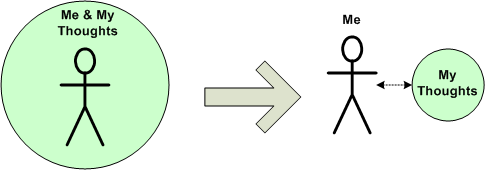
How about you? As you age, are you suffering less and less or more and more? Why?
What Without How
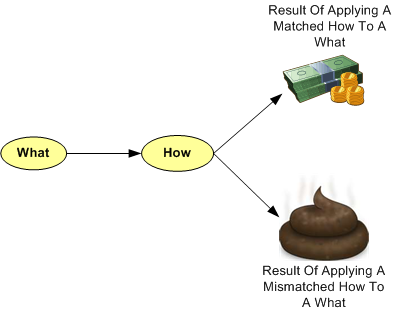
In “Hackers And Painters“, the great essayist Paul Graham states: “asking for what without knowing how is asking for trouble“. I’m on board with that because BMs do that all the time and I’ve seen the wreckage of that approach many times over the years. The higher up the BM, the less he/she knows about the “hows” but the more he/she demands the “whats“. The real damage comes from front line BMs who stop learning and let their “know how” skills atrophy because they’ve been promoted up from the cellar. Hell, they’ve “arrived” and there’s no need for keeping the sleeves rolled up and wrestling in the muck of challenging work that requires continuous learning and sustained immersion.
“The world is full of willing people, some willing to work, the rest willing to let them.” – Robert Frost
But what about when a group suddenly discovers that it needs to try something new to survive and thrive? In this case, everyone may know “what‘s” needed but nobody knows “how” to do the “what” – because it’s never been done by them before. Unless the group can hire outside expertise that has done “what” needs to be done before and therefore knows “how” to do it, the “how” must be learned on the fly in a typical high speed sense-act-reflect-correct feedback loop. Sadly, but expectantly, no time is ever “allocated” for training/learning “how” to do something new by institutional BMs; it costs money, consumes time, and it’s unspoken but expected that everybody knows “how” to do “what” at all times.

Why am I here?
WTF?
Meh!
D'oh!

My BTC Address



 Bulldozer00's Blog