Archive
Skill Acquisition
Check out the graph below. It is a totally made up (cuz I like to make things up) fabrication of the relationship between software skill acquisition and time (tic-toc, tic-toc). The y-axis “models” a simplistic three skill breakdown of technical software skills: programming (in-the-very-small) , design (in-the-small) and architecture (in-the-large). The x-axis depicts time and the slopes of the line segments are intended to convey the qualitative level of difficulty in transitioning from one area of expertise into the next higher one in the perceived value-added chain. Notice that the slopes decrease with each transition; which indicates that it’s tougher to achieve the next level of expertise than it was to achieve the previous level of expertise.

The reason I assert that moving from level N to level N+1 takes longer than moving from N-1 to N is because of the difficulty human beings have dealing with abstraction. The more concrete an idea, action or thought is, the easier it is to learn and apply. It’s as simple as that.
The figure below shows another made up management skill acquisition graph. Note that unlike the technical skill acquisition graph, the slopes decrease with each transition. This trend indicates that it’s easier to achieve the next level of expertise than it was to achieve the previous level of expertise. Note that even though the N+1 level skills are allegedly easier to acquire over time than the Nth level skill set, securing the next level title is not. That’s because fewer openings become available as the management ladder is ascended through whatever means available; true merit or impeccable image.
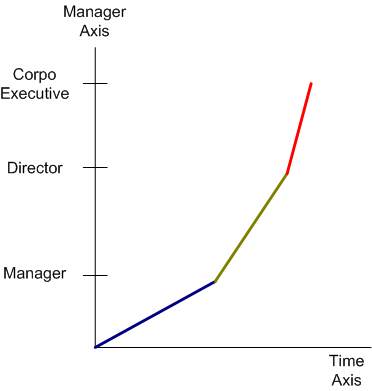
Error Acknowledgement: I forgot to add a notch with the label DIC at the lower left corner of the graph where T=0.
Stakeholders
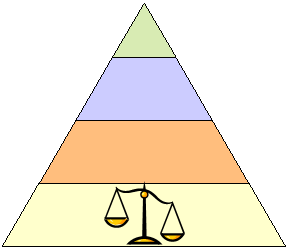
The figure below shows the major stakeholders associated with a profit making institution. Except for the environment, which ironically but generously supplies the raw resources from which all value and profit are extracted, everyone wants the biggest piece of the profit pie they can get. 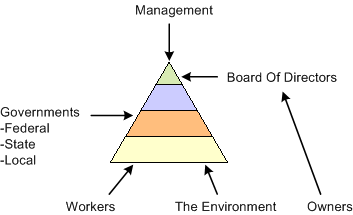
Since management is the biggest influencer of org performance, the dudes in charge feel the greatest pressure to generate profits for themselves and all the other stakeholders. In order to relieve themselves of this pressure and provide themselves with the largest share of the treasury, unscrupulous executive “leadership” teams (and not all of them are so self absorbed) do everything they can to distance themselves from the “other” stakeholders:
- They hire lawyers and lobbyists to fend off taxes and regulations imposed by governments to keep their behavior in check
- They hand pick a group of yes men/women for their board of directors to keep the greedy owners one level removed from themselves
- They keep their workers in check via classic, subtle fear inducing tactics
- They ignore the environment – because it unselfishly makes no direct demands upon them
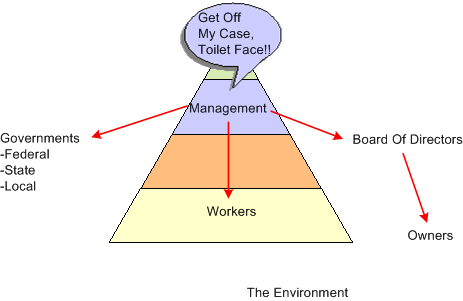
Great leadership teams don’t spend all their waking hours playing defense against the “others” and justifying their exorbitant compensation. They think systemicly and make compassionate decisions that balance the needs of all those involved in the enterprise.
And now, as a preview to next week’s self-righteous do-as-I-say-and-not-as-I-do sermon………………
Loop Dee Loo
I first learned about cause-effect diagrams from one of Jerry Weinberg’s books. I can’t remember which one because I have so many of them and I’m too lazy to browse through them all to find the exact source. Cause-effect diagrams are useful two dimensional tools that can be used to understand cyclical loops of relationships in a system of interacting components.
In the RWEP loop example below, revenue leads to work, which leads to execution, which leads to profit, which leads to more revenue. If a profit seeking organization is well run, the org leaders vigilantly keep track of the “whole” RWEP loop and influence each malleable component so that the loop is positively reinforced and the org prospers. Neglecting one or more of the dominant RWEP loop components can lead to an unstable system that breaks the loop and collapses the system.
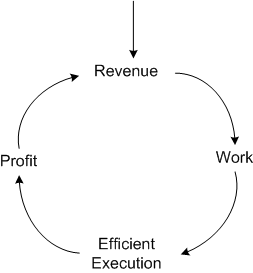
Let’s investigate the ways the loop can break down so we can appreciate what good leaders actually do. The first obvious system buster is a halt to the revenue stream. This single point of failure can bring the whole shebang to a screeching halt in an instant. Since the importance of revenue to institutional viability is so patently obvious and measuring it is ridiculously easy, both good and bad leaders watch revenue closely and act (hopefully) accordingly to keep revenues rising.
The less scrutinized and harder-to-directly-measure system element, “efficient execution”, is a more subtle system buster. Crappy BMs who don’t (cuz they’re lazy or apathetic)) or can’t (because they’re incompetent) directly recognize efficient execution as a system buster take the easy way out by solely measuring profit as an indicator of execution performance. When profit declines, BMs thrash about because they’re at least one level of indirection away from where the rubber meets the road – execution. Since they’re out of touch, BMs make “suboptimal” decisions and issue ineffective mandates that actually accelerate the downward spiral in profits. Good leaders either directly evaluate execution efficiency according to their previous experience or they rely on frequently solicited feedback from those directly executing the work.
So there you have it in simple, maybe simplistic terms. Great leaders watch and positively influence both the (obvious) revenue and (subtle) execution contributors in the RWEP system loop.
Thurman On Buddhism
Via the magical low cost and high quality combo of Roku’s hardware and Netflix‘s “instant watch” feature, I just watched lovable Robert Thurman give a passionate and endearing talk on Buddhism. If you’re not into spiritual “stuff”, then don’t bother watching it cuz you’ll be bored out of your gourd after two minutes. However, if you are interested, please watch it because I think it may put you in a peaceful and wondrous place for its duration.
I first discovered Mr. Thurman a couple of years ago when he gave this moving TED talk. He’s a talented story teller and a tireless promoter of compassion in the true spirit of Buddhism. If you do watch him, be sure to note the gentle passion he exudes. I think it’s quite contagious.

Fieldstones
Since I started blogging over a year ago and I enjoy the intense feeling of liberation it brings forth, I’ve been trying to get better at it. The most helpful book that I’ve read to help me in this personal goal seeking behavior is Jerry Weinberg‘s “Weinberg On Writing – The Fieldstone Method“. Jerry is a well known software consultant who’s spent many years in the trenches and has written over 40 technical books that transcend the disciplines of software and systems engineering.
Jerry’s method is based upon the idea of being diligently aware of, and recording “fieldstones” of personal interest as they serendipitously appear in your consciousness by the grace of god (little “g” on purpose). Since I’ve read that an average of 50,000 thoughts per second (approximately 1 thought every freakin’ 2 seconds!) appear in an individual’s head every day, I figure that 1 or 2 of my thoughts must be helpful in some way to me or others. Thus, I try to, as Jerry recommends, keep paper and pen within striking distance so that I can pull these fieldstones out of the ether and usher them into the physical world. Periodically, I peruse these mostly BS notes and build a fieldstone wall in the form of a blog post that I cast into the wind with the help of wordpress.com.
Here is some of Jerry’s sage, and maybe unconventional, writing advice that resonates with me. Maybe some of it will resonate with you.
Never attempt to write (about) something you don’t care about.
One way for smart people to be happy is to express themselves.
Most of the work is gathering the fieldstones.
The key to effective writing is the human emotional response to the fieldstone. Always be guided by the emotional response (in you).
The secret isn’t in the fieldstone, it’s the response to the stone.
Steal all the words you can. If you steal from one source, it’s plagiarism. If you steal from many, it’s research.
Overabstraction is the number 1 enemy of meaning and understanding.
If you care less about the material after you finish than before you started, then junk it.
Quality is personal.
Gather, then organize.
So what do you think? Ready to start expressing yourself?

Meta-test Tools
A meta test tool ties together other lower level workhorse test tools in one place. Users interface with a meta test tool to launch and control the underlying system tool set that exercises the system under test. However, if you don’t have any low level test tools (out of dumbass neglect or innocent ignorance), a meta test tool is useless. But hey, the user interface and the camouflage it generates look good.

Undiscussable Unfairness
Assume that two similar projects are underway at your company. Also, assume that one of the teams is encumbered by a heavyweight process and the other is given a blank check to do as they please – no processes or procedures to follow, no external reviewers, no forms to fill out, no design or maintenance documentation to be generated. Would you confront management about the inequity? If so, why would you do something so stupid? Don’t you think the dudes in charge know what they’re letting happen? Don’t you think they would be pissed at you for pointing out the obvious but undiscussable stank of unfairness in the air?
I think perfect objectivity is an unrealistic goal; fairness, however, is not. – Michael Pollan
MITRE
I work in the aerospace and defense industry. This industry is typically slow moving and not known for bleeding edge innovation. Thus, I was intrigued when I discovered that the MITRE corporation came in at number 30 in Fast Company magazine’s 2010 list of the 50 most innovative companies in the world. I scanned the list for other companies in the industry, but I (unsurprisingly) didn’t find any more industry stalwarts among the innovative elite.
In addition to the world class innovators, Fast Company also lists the top 10 innovative companies in a slew of industries, including the the defense business. Here is their list of innovators, subjectively decided by someone, or some group, at Fast Company.
- Mitre
- DARPA
- iRobot
- QinetiQ
- Northrup Grumman
- Raytheon
- Lockheed Martin
- Boeing
- Aurora Flight Services
- ATK
After reading the summary for each company, it appears that most money and brainpower are being invested in unmanned moving, sensor packed products like robots and aerial vehicles. For companies looking to branch out and explore new business opportunities, they may do well to invest in these areas and see if anything emerges.

Docu-centric, Model-centric
Let’s say that your org has been developing products using a Docu-Centric (DC) approach for many years. Let’s also say that the passage of time and the experience of industry peers have proven that a Model-Centric (MC) mode of development is superior. By superior, I mean that MC developed products are created more quickly and with higher quality than DC developed products.
Now, assume that your org is heavily invested in the old DC way – the DC mindset is woven into the fabric of the org. Of course, your bazillions of (probably ineffective) corpo processes are all written and continuously being “improved” to require boatloads of manually generated, heavyweight documents that clearly and unassailably prove that you know what you’re doing (lol!) to internal and external auditors.
How would you move your org from a DC mindset to an MC mindset? Would you even risk trying to do it?

Multividual Contributor
The most politically correct (a.k.a. least offensive) way to ensure that employees take note of the fact that they are a notch below them, managers love to use the term “individual contributor” to DICs. Managers use this term repeatedly during annual performance reviews to subtly pre-empt any discontent over the measly 2% raises almost all non-managers get every year. The unspoken but unambiguous top-down message is: “You shouldn’t expect more because you’re only an individual contributor. I, on the other hand, am a manager – a multi-vidual contributor.”

Say what? Aren’t managers individuals? Aren’t managers (well, at least the non-BMs amongst them) contributors? Individual + contributor = individual contributor, no? Is it time to come up with a new, creative, and clever replacement term that will continue to promote the false impression that all managers are more important than all DICs? How about “limited influencer” or “lesser contributor”? Nah, these are not politically correct enough. Got any suggestions?

Why am I here?
WTF?
Meh!
D'oh!

My BTC Address



 Bulldozer00's Blog