Data-Centric, Transaction-Centric
The market (ka-ching!, ka-ching!) for transaction-centric enterprise IT (Information Technology) systems dwarfs that for real-time, data-centric sensor control systems. Because of this market disparity, the lion’s share of investment dollars is naturally and rightfully allocated to creating new software technologies that facilitate the efficient development of behemoth enterprise IT systems.
I work in an industry that develops and sells distributed, real-time, data-centric sensor systems and it frustrates me to no end when people don’t “see” (or are ignorant of) the difference between the domains. With innocence, and unfortunately, ignorance embedded in their psyche, these people try to jam-fit risky, transaction-centric technologies into data-centric sensor system designs. By risky, I mean an elevated chance of failing to meet scalability, real-time throughput and latency requirements that are much more stringent for data-centric systems than they are for most transaction-centric systems. Attributes like scalability, latency, capacity, and throughput are usually only measurable after a large investment has been made in the system development. To add salt to the wound, re-architecting a system after the mistake is discovered and ( more importantly) acknowledged, delays release and consumes resources by amounts that can seriously damage a company’s long term viability.
As an example, consider the CORBA and DDS OMG standard middleware technologies. CORBA was initially designed (by committee) from scratch to accommodate the development of big, distributed, client-server, transaction-centric systems. Thus, minimizing latency and maximizing throughout were not the major design drivers in its definition and development. DDS was designed to accommodate the development of big, distributed, publisher-subscriber, data-centric systems. It was not designed by a committee of competing vendors each eager to throw their pet features into a fragmented, overly complex quagmire. DDS was derived from the merger of two fielded and proven implementations, one by Thales (distributed naval shipboard sensor control systems) and the other by RTI (distributed robotic sensor and control systems). In contrast, as a well meaning attempt to be all things to all people, publish-subscribe capability was tacked on to the CORBA beast after the fact. Meanwhile, DDS has remained lean and mean. Because of the architecture busting risk for the types of applications DDS targets, no client-server capability has been back-fitted into its design.
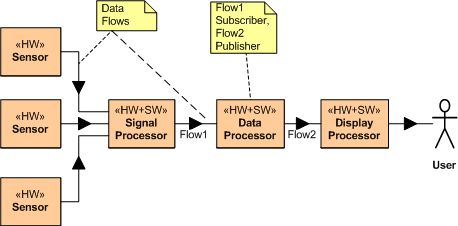
Consider the example distributed, data-centric, sensor system application layer design below. If this application sits on top of a DDS middleware layer, there is no “intrusion” of a (single point of failure) CORBA broker into the application layer. Each application layer system component simply boots up, subscribes to the topic (message) streams it needs, starts crunching them with it’s app-specific algorithms, and publishes its own topic instances (messages) to the other system components that have subscribed to the topic.
Now consider a CORBA broker-based instantiation of this application example (refer to the figure below). Because of the CORBA requirement for each system component to register with an all knowing centralized ORB (Object Request Broker) authority, CORBA “leaks” into the application layer design. After registration, and after each service has found (via post-registration ORB lookup) the other services it needs to subscribe to, the ORB can disappear from the application layer – until a crash occurs and the system gets hosed. DDS avoids leakage into the value-added application layer by avoiding the centralized broker concept and providing for fully distributed, under-the-covers, “auto-discovery” of publishers and subscribers. No DDS application process has to interact with a registrar at startup to find other components – it only has to tell DDS which topics it will publish and which topics it needs to subscribe to. Each CORBA component has to know about the topics it needs and the services it needs to subscribe to.
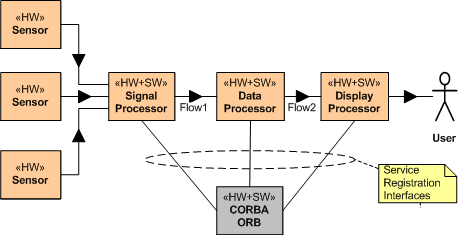
The more a system is required to accommodate future growth, the more inapplicable a centralized ORB-based architecture is. Relative to a fully distributed coordination and auto-discovery mechanism that’s transparent to each application component, attempting to jam fit a single, centralized coordinator into a large scale distributed system so that the components can find and interact with each other reduces robustness, fault tolerance, and increases long term maintenance costs.

Why am I here?
WTF?
Meh!
D'oh!

My BTC Address



 Bulldozer00's Blog