Archive
Blind, Ignorant, Deaf
In “The Thought Leader Interview“, HCL Technologies CEO Vineet Nayar describes his shocking “Employees First, Customers Second” method of management to a pair of Strategy+Business magazine reporters. In keeping with my biased approach of culling only those quotes and passages that support my view of what the wildly successful company of the future looks like, I’ve assembled this self-serving list for your consideration:
Somebody said to me about the Employees First program, “Vineet, your competitors will copy this, and therefore, it will not be a differentiator.” My response was, “If our competitors can post the results of 360-degree evaluations, more power to them.”
The moment the recession hit we went out to our employees and said, “We have a problem. We’re going to solve it together.” We had thousands of ideas coming in, and we implemented them. Most of them were operational: There were no new products, services, geographies, or contracts. But HCL grew 23 percent and increased global market share by 21 percent. Our employees felt they were a part of everything we were doing, because of our inclusive approach. Even if it may take a bit longer to arrive at decisions, this approach helps ensure that implementations are smooth and that initiatives are sustained after the initial hype.
We created a 360-degree process where anybody can give feedback to anybody, including to me. We post the results internally so that all employees can see them. Good or bad, we all learn from the results. It’s open, it’s transparent, and the impact is positive. We find that this practice is motivating people to change their behavior. They try harder.
We also looked for symbolic ways to be a model of openness. One thing I did was publicly dance in front of all my employees. This was to remove the halo that a CEO has around his head. Meaningful conversation happens after you have set the stage in this way, after you make clear that you are as open as anyone else — crazy but effective.
So I held an open house with a group of employees. “I’m feeling pretty bad,” I said. “Nobody is saying what is positive about our company. Do you think I’ve unlocked a genie that is spreading demotivation?” Their answer was interesting. They said it is good to wash dirty linen in public, in this case on the blog, because it builds trust. There are no rumors. We discuss everything openly and honestly. We don’t always have solutions to problems, but at least we expose them.
Whatever trust is left in command-and-control management structures has been deeply tested during the recession. I am told that in business in general, employee trust in management is at its lowest point ever.
Even though Mr. Nayar is a breath of fresh air, I’m not too optimistic that his ideas on effective corpo governance will spread like wildfire to a company near you. You see, Ricardo Semler, CEO of Semco Inc., was Vineet Nayar twenty years before Vineet Nayar. Of course, since Mr. Semler’s version of participative management was also an all out assault on the draconian, patriarchical, system of management that pervades the globe today, he was ignored by mainstream business too.
The Sparfish
On a tip from HCL Technologies CEO Vineet Nayar, I purchased and started reading “The Starfish And The Spider“. In the book, authors Brafman and Beckstrom define seven principles of decentralized orgs of people:
- When attacked, a decentralized org tends to become even more open and decentralized.
- It’s easy to mistake decentralized orgs (starfish) for centralized orgs (spiders).
- A decentralized org doesn’t have central intelligence; the intelligence is spread throughout the system.
- A decentralized org can easily mutate.
- A decentralized org sneaks up on you.
- As industries become decentralized, overall profits decrease.
- Put people into a decentralized org and they’ll automatically want to contribute.
Because of numbers 3 and 6, owners and SCOLs of centralized command and control hierarchies will never embrace the “starfish” concept. The self-centered need for SCOLs to project the image that “I’m great and you’re not” (number 3) and the constant external pressure to generate increasing profits (number 6) guarantee the status quo for all but the most enlightened leaders. However, because number 7 is the holy grail for the CGHs that sit on the throne, they try their best to feign being a starfish while remaining a spider. This systemic and self-defeating behavior is recursively nested all the way down the CCH; from the upper echelon of VPs and directors down through the fatty middle management layers and ultimately down to the BMs that rule at the interface with the DICforce.
Like Mr. Nayer, I don’t buy into the Brafman/Beckstrom set of principles 100%. Their starfish/spider metaphor works well up to a point. For example, a spider is much more mobile than a starfish; which enables it to be more proactive in acquiring the resources it needs to survive. Specifically, I believe that a hybrid “sparfish” org can increase profits while simultaneously providing an environment in which all members automatically want to contribute. By distributing resources more equitably via democracy and implementing a true meritocracy, the best of both species can be merged. The trick is figuring out how to freakin’ do it, no?

Empowerment Examples
Everyone’s heard of the worn and tired “employee empowerment” exhortation, but does anyone really walk the talk? Here are two specific and quantifiable empowerment examples from the same company. You be the judge.
Example 1 (via Gary Hamel: HCL’s Vineet Nayar on its ‘Management Makeover’ – Gary Hamel’s Management 2.0 – WSJ):
For example, our annual planning process for FY 2010 included a review of business plans for HCL customer accounts not only by top management but by 8,000 people throughout the organization. Under the program, dubbed My Blueprint, the plans were available on a portal where customer-facing employees, who would be charged with implementing those plans, could comment on them. This produced a flood of feedback and prompted the re-engineering of several plans.
Example 2 (via The world’s most modern management – In India):
Every employee rates their boss, their boss’ boss, and any three other company managers they choose, on 18 questions using a 1-5 scale. Such 360-degree evaluations are not uncommon, but at HCL all results are posted online for every employee to see.
Is This A CEO Talking?
From Who’ll Catalyze Change: Us or Them? – Harvard Business Review, HCL Technologies CEO Vineet Nayar says:
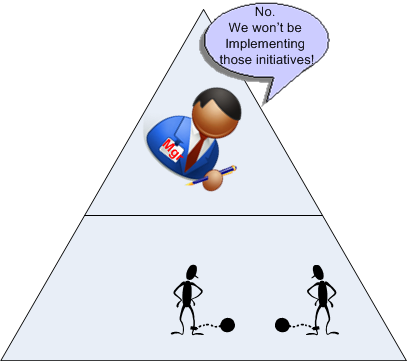
We at HCL have embraced a philosophy that’s based on an inversion of the management pyramid, with managers becoming as responsible to employees as employees are to managers.
Vineet’s joking, right? Nah, he’s fibbing to cover up the reality that he rules with a Stalinistic iron fist at HCL, no? This joker follows up with an even bigger whopper:
Too many people caution us about acting on instinct and conviction. But we must surround ourselves with employees that dare to try new things in new ways. They may not achieve perfect results, but if they focus on getting better each day with one more attempt, they will solve many problems that appear unsolvable.
Acting on “instinct and conviction” and not on objectively measured scientific “proof” (that really camouflages subjective, random, self-serving, opinion)? WTF? This Vineet dude needs to be cast out of the guild of management and “put in his place“, no?

I Found Another Gem
Whoo hoo! I’ve stumbled upon another rare gem in a massive pile of ugly rocks. As the graphic below shows, I’ve added HCL Technologies to my list of favorite companies. Led by their visionary CEO, Vineet Nayar, HCL is one of the few models for successful companies of the future. Since the vast majority of corpo Executive Teams are stuck in the mechanistic Sloan/Taylor mindset of the 1900s with no intention of changing the way they manage, err, impose control, it’s always refreshing and exciting to discover a new game changer.

So, how do I decide whether a company is a cut above the rest? Via subjective evaluation of external observations, of course. Financial performance, which is of course important, is of secondary concern. Here’s my unscientific list of “research” methods:
* Read third party accounts of experience given by former and current non-management employees.
* Read, listen, and watch interviews with CEOs and executives.
* Scour publicly available mission statements, visions, core values and cultural descriptions for authenticity, lack of corpo jargon, and attention to detail.
* Stay away from glossy annual reports – which are all clones of each other.
* Ignore whatever the hand picked company spokesperson(s) say – propaganda city.
Of course, my methods aren’t perfect, but do you know of any better ones?
Related Articles
- Why HCL Technologies puts employees ahead of customers (tech.fortune.cnn.com)
- HCL Technologies Annual Revenues up 24.1 % YoY; Quarterly Revenues up by 21.5% YoY and 7.7% Sequentially; Europe Annual Revenues up by 20.6% YoY in FY10 (prnewswire.com)
- Management Innovation: Extreme Management Makeover (petervan.wordpress.com)
- Indian outsourcer HCL Technologies quarterly profit up 6.9 percent to $74M on strong demand (taragana.com)
Where Is Point A?
In the “Managing The Unmanageable” techonomy video discussion, HCL Technologies CEO Vineet Nayar says something like: “If your people don’t know where point A is, then they won’t know how to get to point B“. Vineet said this in response to a question regarding the concern that the more transparent your company is, the more your competitors can copy you. Vineet, along with the other two 21st century CEOs on the panel stated that the benefits of transparency far out weigh the risks of “giving away the family jewels“.
Look at the figure below. On the left side, through transparency and continuous full disclosure, your people know where you are (point A) and your people know where you and they want to be in the future (point B). Thus, you and your people can figure out what problems need to be solved and what new actions need to be taken. On the right side of the figure, everyone knows where point B is, but nobody (except for maybe a “select few” high up in the CCH) knows where they’re starting from. Where the frig is point A?

Related Articles
- Techonomy – Managing the Unmanageable: The New Empowered Workforce (nextbigfuture.com)
- Why HCL Technologies puts employees ahead of customers (tech.fortune.cnn.com)
- Techonomy: a new philosophy of progress (petervan.wordpress.com)

Why am I here?
WTF?
Meh!
D'oh!

My BTC Address



 Bulldozer00's Blog