Archive
Human_Being:preserveSelf
As the UML sequence diagram below shows, an “unnamed” Nature object with an infinite lifeline asynchronously creates and, uh, kills Human_Being objects at will. Sorry about that.

So, what’s this preserveSelf routine that we loop on until nature kicks our bucket? I’m glad you asked:

Have a nice day! 🙂
The Old Is New Again
Because Moore’s law has seemingly run its course, vertical, single processor core speed scaling has given way to horizontal multicore scaling. The evidence of this shift is the fact that just about every mobile device and server and desktop and laptop is shipping with more than one processor core these days. Thus, the acquisition of concurrent and distributed design and programming skills is becoming more and more important as time tics forward. Can what Erlang’s Joe Armstrong coined as the “Concurrent Oriented Programming” style be usurping the well known and widely practiced object-oriented programming style as we speak?
Because of their focus on stateless, pure functions (as opposed to stateful objects), it seems to me that functional programming languages (e.g. Erlang, Haskell, Scala, F#) are a more natural fit to concurrent, distributed, software-intensive systems development than object-oriented languages like Java and C++; even though both these languages provide basic support for concurrent programming in the form of threads.
Likewise, even though I’m a big UML fan, I think that “old and obsolete” structured design modeling tools like Data and Control Flow Diagrams (DFD, CFD) may be better suited to the design of concurrent software. Even better, I think a mixture of the UML and DFD/CFD artifacts may be the best way (as Grady Booch says) to “visualize and reason” about necessarily big software designs prior to coding up and testing the beasts.
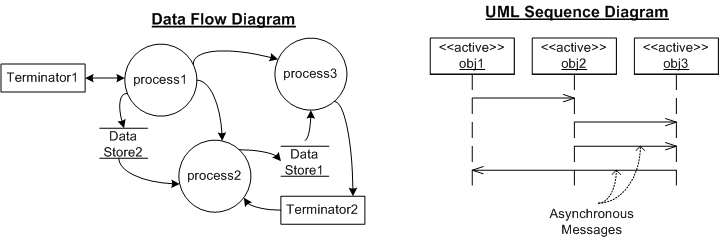
So, what do you think? Should the old become new again? Should the venerable DFD be resurrected and included in the UML portfolio of behavior diagrams?
Empty Lifeline
Check out this “bent” pair of UML sequence diagrams:
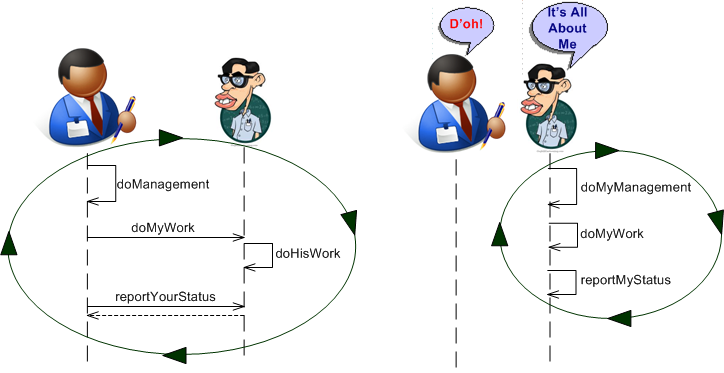
The system on the right is pretty loosely coupled, no?
Visualizing And Reasoning About
I recently read an interview with Grady Booch in which the interviewer asked him what his proudest technical achievement was. Grady stated that it was his involvement in the creation of the Unified Modeling Language (UML). Mr. Booch said it allowed for a standardized way (vs. ad-hoc) of “visualizing and reasoning about software” before, during, and/or after its development.

Levels Of Testing
Using three equivalent UML class diagrams, the graphic below conveys how to represent a system design using the “C” terminology of the aerospace and defense industry. On the left, the system “contains” CSCIs and CSCIs contain CSCs, etc. In the middle, the system “has” CSCIs. On the right, CSCIs “reside within” the system.

Leaving aside the question of “what the hell’s a unit“, let’s explore four “levels of testing” with the aid of the multi-graphic below that uses the “reside within” model.

In order to test at any given level, some sort of test harness is required for that level. The test harness “system” is required to:
- generate inputs (for a CSU, CSC, CSCI, or the system),
- inject the inputs into the “Item Under Test” (CSU, CSC, or CSCI),
- collect the actual outputs from the IUT,
- compare the actual outputs with expected outputs.
- declare success or failure for each test
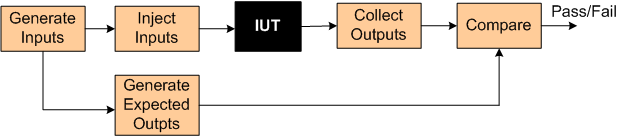
When planning a project up front, it’s easy to issue the mandate: “we’ll formally test and document at all four levels; progressing from the bottom CSU level up to the system level“. However, during project execution, it’s tough to follow “the plan” when the schedule starts to, uh, expand, and pressure mounts to “just shipt it, damn it!“.
Because:
- the number of IUTs in a level decreases as one moves up the ladder of abstraction (there’s only a single IUT at the top – the system),
- the (larger and fewer) IUTs at a given level are richer in complex behavior than the (smaller and more plentiful) IUTs at the next lowest level,
- it is expensive to develop high fidelity, manual and/or automated test harnesses for each and every level
- others?
there’s often a legitimate ROI-based reason to eschew all levels of formal testing except at the system level. That can be OK as long as it’s understood that defects found during final system level testing will be more difficult and time consuming ($$$) to localize and repair than if lower levels of isolated testing had been performed prior to system testing.
To mitigate the risk of increased time to localize/repair from skipping levels of testing, developers can build in test visibility points that can be turned on/off during operation.

The tradeoff here is that designing in an extensive set of runtime controllable test points adds complexity, code, and additional CPU/memory loading to both the system and test harness software. To top it off, test point activation is often needed most when the system is being stressed with capacity test scenarios where the nastiest of bugs tend surface – but the additional CPU and memory load imposed on the system/harness may itself cause tests to fail and mutate bugs into looking like they are located where they are not. D’oh! Ain’t life a be-otch?
Well Architected
The UML component diagram below attempts to model the concept and characteristics of a well architected software-intensive system.

What other attributes of well architected/designed systems are there?
Without a sketched out blueprint like this, if you start designing and/or coding and cobbling together components randomly selected out of the blue and with no concept of layering/balancing, the chance that you end up will a well architected system is nil. You may get it “working” and have a nice GUI pasted on top of the beast, but under the covers it will be fragile and costly to extend/maintain/debug – unless a miracle has occurred.
If you or your management don’t know or care or are “allowed” to expose, capture, and continuously iterate on that architecture/design dwelling in your faulty and severely limited mind and memory, then you deserve what you get. Sadly, even though they don’t deserve it, every other stakeholder gets it too: your company, your customers, your fellow downstream maintainers, etc….
The BD00 Process
I believe that human beings love personal stories and direct experiential reports. Thus, even though it’s highly proprietary and super secret, I’m going to expose the somewhat repeatable “process” that I use for whipping up dumbass blog posts.
Here’s how BD00 does the dirty deed…
- Every morning, after going to bed between 8-9 PM, I wake up between 4-5 AM.
- I fire up a pot of coffee and then sit down at the computer.
- I navigate to the wordpress.com BD00 dashboard.
- I mine “fieldstone” writing ideas from: my “gym notes“, my quotes pages, an interesting interaction or tainted observation at work, random web surfing, my kindle highlights, a twitter post.
- I wait…..
- A freakin’ miracle occurs!
- I start writing words or drawing a picture, or both.
- I chaotically jump back and forth ‘tween writing and drawing – iteration city.
- Sometimes, I write some words, draw a picture, and then finish the words.
- Sometimes, I write all the words first and then re-scan them for drawing ideas.
- Sometimes, I draw a partial picture, write some words, and then I finish the pic.
- Sometimes, I draw a complete picture first and then I write the words that go with it.
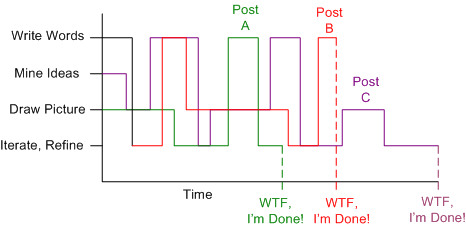
- I iterate over the words + picture combo multiple times until…. I say “WTF, I’m done!“
Of course, even though the BD00 process is expressed as a nice and tidy bulleted list above, it’s not a procedure. To highlight the non-sequential nature of the process, here’s the UML state machine diagram model:
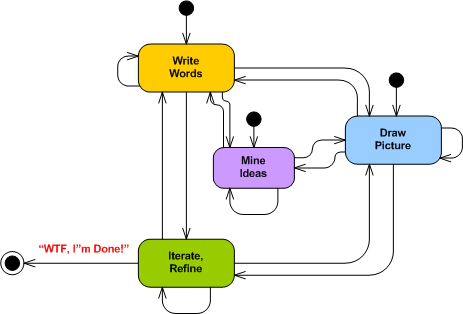
Note the numerous initial entry points and that every state has an iterative transition “to self“. That’s because I Am A Strange Loop.
Attack And Advance
Check out this recent Grady Booch tweet on the topic of “why” he, James Rumbaugh, and Ivar Jacobson syntegrated their individual modeling technologies into what became the UML standard:

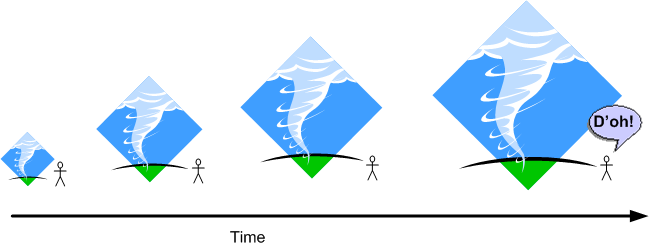
Over 20+ years ago, when the rate of global change was just a mere inkling of what it is today, my friend Bill Livingston stated in HFAW that: “complexity has a bright future“. He was right on the money and I admire people like Bill and the three UML amigos for attacking complexity (a.k.a ambiguity) head-on – especially when lots of people seem to love doing the exact opposite – piling complexity on top of complexity.
Extreme complexity may not be vanquishable, but (I think) it can be made manageable with the application of abstract “systems thinking” styles and concrete tools/techniques/processes created by smart and passionate people, no?
Levels, Components, Relationships
In the Crosstalk Journal, Michael Tarullo has written a nice little article on documenting software architectures. Using the concept of abstract levels (a necessary, but not sufficient tool, for understanding complex systems) and one UML component diagram per level, he presents a lightweight process for capturing big software system architecture decisions out of the ether.
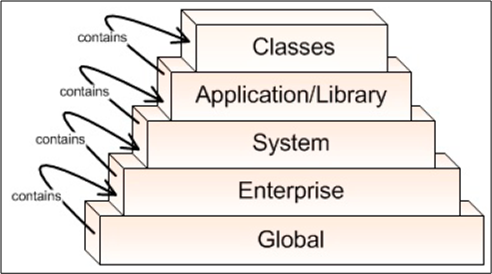
Levels Of Abstraction
Mr. Tarullo’s 5 levels of abstraction are shown below (minor nit: BD00 would have flipped the figure upside down and shown the most abstract level (“Global“) at the top.
Components Within A Level
Since “architecture” focuses on the components of a system and the relationships between them, Michael defines the components of concern within each of his levels as:
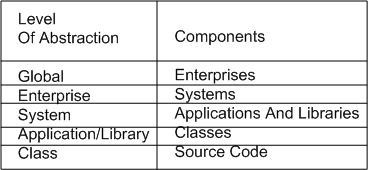
(minor nit: because the word “system” is too generic and overused, BD00 would have chosen something like “function” or “service” for the third level instead).
Relationships
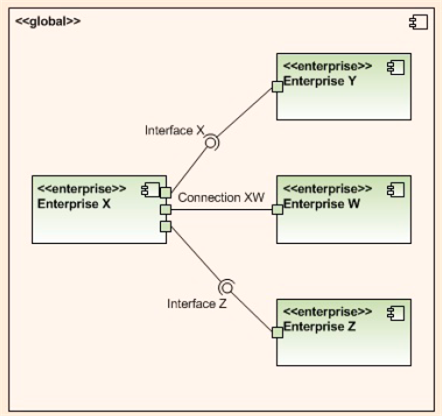
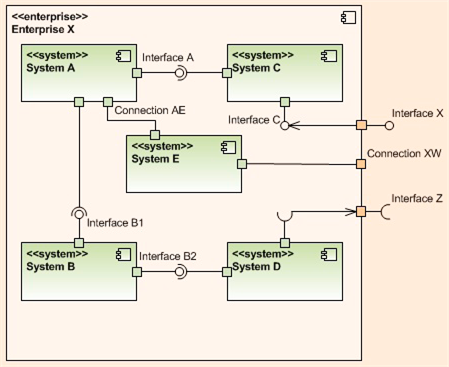
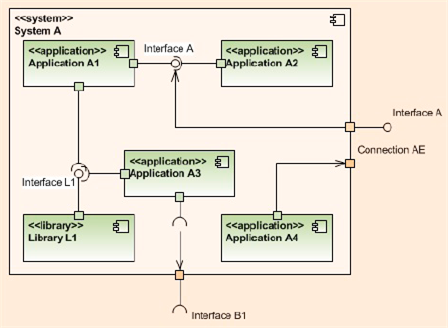
Within a given level of abstraction, Mr. Tarullo uses a UML component diagram with ports and ball/socket pairs to model connections, interfaces (provides/requires), and to bind the components together. He also maintains vertical system integrity by connecting adjacent levels together via ports/balls/sockets.
The three UML component diagrams below, one for each of the top, err bottom, three levels of abstraction in his taxonomy, nicely illustrate his lightweight levels plus UML component diagram approach to software architecture capture.
But what about the next 2 levels in the 5 level hierarchy: the Application/Library and Classes levels of the architecture? Mr. Tarullo doesn’t provide documentation examples for those, but it follows that UML class and sequence diagrams can be used for the Application/Library level, while activity diagrams and state machine diagrams can be good choices for the atomic class level.
Providing and vigilantly maintaining a minimal, lightweight stack of UML “blueprint” diagrams like these (supplemented by minimal “hole-filling” text) seems like a lower cost and more effective way to maintain system integrity, visibility, and exposure to critical scrutiny than generating a boatload of DOD template mandated write-once-read-never text documents, no?
Alas, if:
- you and your borg don’t know or care to know UML,
- you and your borg don’t understand or care to understand how to apply the complexity and ambiguity busting concepts of “layering and balancing“,
- your “official” borg process requires the generation of write-once-read-never, War And Peace sized textbook monstrosities,
then you, your product, your customers, and your borg are hosed and destined for an expensive, conflict filled future. (D’oh! I hate when that happens.)
Scrumming For Dollars
“Systems Engineering with SysML/UML” author Tim Weilkiens recently tweeted:

Tim’s right. Check it out yourself: Scrum Guide – 2011.
Before Tim’s tweet, I didn’t know that “software” wasn’t mentioned in the guide. Initially, I was surprised, but upon further reflection, the tactic makes sense. Scrum creators Ken Schwaber and Jeff Sutherland intentionally left it out because they want to maximize the market for their consulting and training services. Good for them.
As a byproduct of synthesizing this post, I hacked together a UML class diagram of the Scrum system and I wanted to share it. Whatcha think? A useful model? Errors, omissions? Does it look like Scrum can be applied to the development of non-software products?


Why am I here?
WTF?
Meh!
D'oh!

My BTC Address



 Bulldozer00's Blog