Archive
Obfuscators And Complexifiers
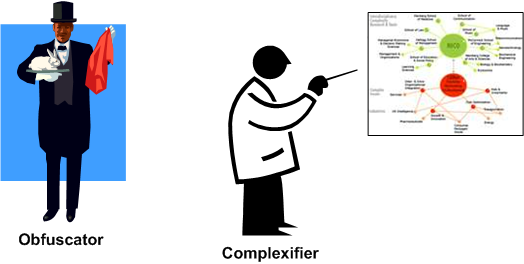
Since I’m pretty unsuccessful at it, one of my pet peeves is having to deal with obfuscators and complexifiers (OAC). People who chronically exhibit these behaviors serve as formidable obstacles to progress by preventing the right info from getting to the right people at the right time. “They” do so either because they’re innocently ignorant or because they’re purposefully trying to camouflage their lack of understanding on the topic of discussion for fear of “looking bad”. I have compassion for the former, but great disdain for the latter – blech!
The condundrum is, in CCH corpocracies, there’s an unwritten law that says DICs aren’t “allowed” to publicly expose purposeful OACs if the perpetrators are above a certain untouchable rank in the infallible corpo command chain. In extremely dysfunctional mediocracies, no one is allowed to call any purposeful OAC out onto the mat, regardless of where the dolt is located in the tribal caste system. In either case, retribution for the blasphemous transgression is always swift, effective, and everlasting. Bummer.
CCP
Relax right wing meanies, it’s not CCCP. It’s CCP, and it stands for Context, Content, and Process. Context is a clear but not necessarily immutable definition of what’s in and what’s out of the problem space. Content is the intentionally designed static structure and dynamic behavior of the socio-technical solution(s) to be applied in an attempt to solve the problem. Process is the set of development activities, tasks, and toolboxes that will be used to pre-test (simulate or emulate), construct, integrate, post-test, and carefully introduce the solution into the problem space. Like the other well-known trio, schedule-cost-quality, the three CCP elements are intimately coupled and inseparable. Myopically focusing on the optimization of one element and refusing to pay homage to the others degrades the performance of the whole.
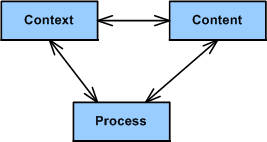
I first discovered the holy trinity of CCP many years ago by probing, sensing, and interpreting the systems work of John Warfield via my friend, William Livingston. I’ve been applying the CCP strategy for years to technical problems that I’ve been tasked to solve.
You can start using the CCP problem solving process by diving into any of the three pillars of guidance. It’s not a neat, sequential, step-by-step process like those documented in your corpo standards database (that nobody follows but lots of experts are constantly wasting money/time to “improve”). It’s a messy, iterative, jagged, mistake discovering and correcting intellectual endeavor.
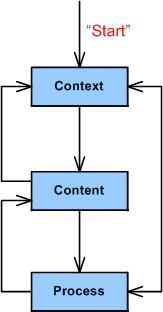
I usually start using CCP by spending a fair amount of time struggling to define the context; bounding, iterating and sketching fuzzy lines around what I think is in and what is out of scope. Next, I dive into the content sub-process; using the context info to conjure up solution candidates and simulate them in my head at the speed of thought. The first details of the process that should be employed to bring the solution out of my head and into the material world usually trickle out naturally from the info generated during the content definition sub-process. Herky-jerky, iterative jumping between CCH sub-processes, mental simulation, looping, recursion, and sketching are key activities that I perform during the execution of CCP.
What’s your take on CCP? Do you think it’s generic enough to cover a large swath of socio-technical problem categories/classes? What general problem solving process(es) do you use?
Open, Closed, Inquiring
“Every man, wherever he goes, is encompassed by a cloud of comforting convictions, which move with him like flies on a summer day.” – Bertrand Russell
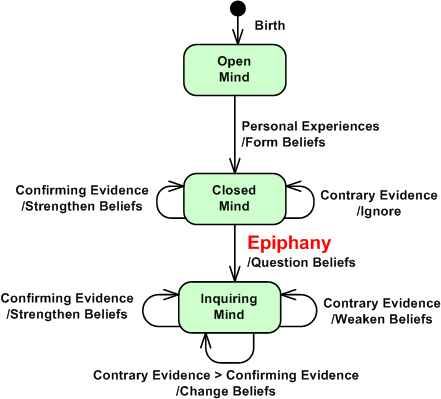
Out of the chute, so to speak, we’re all born with open minds. As we age and accumulate one experience after another, we naturally start forming beliefs based on those experiences. The experiences of other individuals (like our friends and parents) and institutions (like our schools, our corpocracies, and our government) are also impressed upon us. The more similar our new experiences to our previous experiences, the more attached we become to our beliefs. Unknowingly, we’ve started to construct our own very personal “unshakable cognitive burden” (UCB) from the ground up.

As our attachment to (at least some of) those beliefs hardens through exposure to more and more confirming evidence, our minds close up and we start suffering more and more. We tend to conveniently ignore, or violently reject, disconfirming evidence to the contrary in order to preserve our hard earned sense of safety and security. Each subsequent experience causes a nearly instantaneous transition out of, and back into, the closed mind state. Once a core belief (the earth is flat, the sun revolves around the earth, “they” are always right, “—-ism” is infallible) has hardened, intellectual and spiritual growth stops. Stasis sets in. Bummer.

So, how does one break the infinite loop of self-transitions out of, and then back into, the closed UCB mind state? Does another more flexible state exist? I think one may exist- the “Inquiring Mind” state, but I don’t have a clue on how to make the jump to get there. In this state, beliefs still exist but our attachment to them is not absolute. Our level of attachment is fluid and ever changing. As a consequence, our suffering, and more importantly, the suffering of those around us, decreases. The world becomes a kinder and gentler place to live in. We start to recognize our connectedness to all “things” and we empathize with people who still hold fast to their core beliefs.
The state machine below shows one speculative way out of the closed mind state and into the inquiring mind state – the experience of an instantaneous, life-changing epiphany. It’s speculation on my part because I don’t know squat and it’s just a belief that is a brick in my UCB.
Let’s Be Careful Out There!
Based on a recommendation from fellow whack-job W. L. Livingston, I’m currently trying to read “The Theory Of The Leisure Class” by Thorstein Veblen (cool name, eh?). Man, this guy’s a tough read. The vocabulary that Thor(?) uses and his huge paragraphs often cause my CPU to overheat and spew blue smoke, but the self-imposed intellectual torture is worth the pain.
I love exploring the ideas and thoughts of guys like Veblen because they are so far off the beaten path and mind stretching that they cause new, but previously unused synaptic sub-networks to be instantaneously created in my brain. For me, spiritual and intellectual growth is painful but inspiring. The acts of continuously trying to widen my horizons, destroying old and obsolete mental models, and exposing myself to the ideas of others makes me feel vibrantly alive.
When you consciously choose to explore and probe weird and non-standard ideas that go against the norm, you’ve got to watch out for yourself. Internalizing and then subsequently espousing your new learnings in public can be detrimental to your health. If people are really set in their ways and you don’t take their feelings into account, you could trigger the fight or flight response in them. In one-on-one exchanges, the blowback that you experience may not be so bad. However, publicizing your new thoughts in a meeting with a group of clanthinkers can cause you considerable external and internal damage.
“Let’s Be Careful Out There” – Sergeant Esterhaus

Collapsing The Wavefunction
I’m in the process of reading a third book on quantum physics. It’s called “The Self-Aware Universe”, and it is written by physicist Amit Gotswami. According to Q-physics, no localized object exists until a conscious observation is made. The universe is comprised of non-localized, infinitely distributed “waves” described by Schrodinger’s wave function equation. The wave function equation characterizes the “waviness” of matter and it displaces Newton’s F=ma as the universal law of motion. Even though Newton has been convincingly dethroned as the king of “materialistic reality”, Q-physics is consistent with Newton’s classical physics for “big” objects, which are all comprised of quantum waves. Thus, for (almost) all practical purposes, Newton’s laws can be leveraged in the macro world to “control” and enhance our environment to some extent.
When a subjective and conscious observation is made and discrete objects are “detected” at a point in space and time, the instantaneous collapse of the wave function occurs. The figure below woefully attempts to graphically depict this mysterious and miraculous process. On the left, we have “no”-things, just an infinite collection of waves. On the right, we have a bunch of (supposedly) independent “some”-things after the collapse. If, as most rational and educated people think, conscious observation is subjective and person specific, then why is there so much consensus on the post-collapse appearance of the world? In other words, why do most people see the same set of objects after they each independently and subjectively collapse the wave function? If you’re thinking that I have an answer for this subjective vs. consensus enigma, then you’re mistaken. I’m dumbfounded but enamored with the mystery of it all. How about you?

Suppose that you and I separately “collapse the wave function” and (miraculously?) agree on the appearance of the external world the engulfs us. Referring to the example above, assume that we transcend the first communication barrier between us and we agree that a post-collapse triangle exists, a rectangle exists, a pair of ellipses exist, etc.
Now assume that the group of objects that we’ve manifested (created ?) is comprised of people and some type of observable behavior emanating from that group is “bothering” us. Also, assume that we want to influence the group to change it’s behavior so that we are less distressed. What do we do? We consciously form a personal System-Of-Interest (SOI) and we try to understand what’s causing us the distress. We try to make sense of the dynamic interactions taking place between those people encircled in our own personal SOI and then we act to change it. Here’s where our original consensus starts to diverge. Since, as the figure below illustrates, our personally created SOIs will most likely be different, our interpretation of who and what is causing us our distress will be different. Thus, our ideas and thoughts regarding corrective actions will be different.
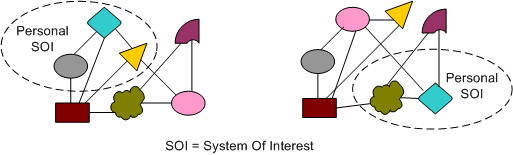
Note that even though we initially agreed on the number and types of objects=people present in our collapsed wave function worlds, the number and nature of the connections between those people are likely to be different for you and me. In the SOI example above, my SOI on the left contains three people and yours on the right only contains two. My SOI on the left doesn’t include the pink ellipse in the “problem” sub-group but yours on the right does. Your SOI doesn’t include an interface ‘tween the gray ellipse and blue diamond but mine does. Thus, our interpretations of what ails us will most likely differ. Add a third, fourth, fifth, etc., SOI to the mix and all kinds of diverging interpretations will emerge.
Now, apply this example to a work environment. If I’m the “boss” and you disagree with my interpretation of the problem situation, but are “afraid” of speaking truth to power because of standard stifling corpo culture norms, then you may just go along with my interpretation even though you’re pretty sure that your interpretation and solution is “right”. Since I’m the boss, all knowing and all powerful, I’m always “right” – even if I’m not. 🙂
Analysis Paralysis Vs. 59 Minutes
“If I had an hour to save the world, I would spend 59 minutes defining the problem and one minute finding solutions” – Albert Einstein
If they didn’t know that Einstein said the quote above, MBA taught and metrics-obsessed “go-go-go” textbook managers would propose that the person who did say it was a slacker who suffered from “analysis paralysis”. In the Nike age of “just do it” and a culture of “act first and think later” (in order to show immediate progress regardless of downstream consequences), not following Einstein’s sage advice often leads to massive financial or human damage when applied to big, multi-variable hairball problems.
The choice between “act first, think later” (AFTL) and “think first, act later” (TFAL) is not so simple. For small, one dimensional problems where after-the-fact mistakes can be detected quickly and readjustments can be made equally as quickly, AFTL is the best way to go. However, most managers, because they are measured on schedule and cost performance and not on quality (which is notoriously difficult to articulate and quantify), apply the AFTL approach exclusively. They behave this way regardless if the situation cries out for TFAL because that’s the way that hierarchical structured corpo orgs work. Since the long term downstream effects of crappy decisions may not be traceable back to the manager who made them, and he/she will likely be gone when the damage is discovered, everybody else loses – except the manager, of course. Leaders TFAL and managers AFTL.
Past Present Future
How do you “allocate” your thinking time? Do you spend the largest percentage of your time fearing the future? Regretting the past? Constantly switching between worrying about the future and regretting the past? Experiencing and feeling the wonders that are happening in the present moment?

Let’s say that you are self-aware enough to realize that your thinking state is dominated by circular rumination over what has happened in the past. What techniques/practices can one employ to redirect more of your thinking time to the present moment? Can one actually “control” their thinking state?
In my case, I tend to spend most of my “thinking time” regretting the past and missing out on the grace and glory of the present moment. In the cases where I do recognize that I’m continuously spinning on the stale past, just the act of “thought recognition” brings me back into the present moment. However, just as soon as I transition into the present moment, I unconsciously switch out of that tranquil state and go back to the same old, same old. I’ve made, and continue to make, many half-assed attempts at meditation in order to spend more time in the present moment, but I’ve frustrated myself out of diligently practicing this ancient art of self-actualization.
Lost In Thought

How And What
“Never tell people how to do things. Tell them what to do and they will surprise you with their ingenuity.” – George S. Patton
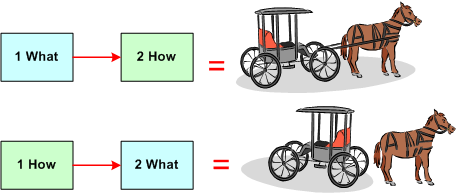
One of my pet peeves is when a bozo manager dictates the how, but has no clue of the what – which he/she is supposed to define:
“Here’s how you’re gonna create the what (whatever the what ends up being): You will coordinate Fagan inspections of your code, write code using Test First Design, comply with the corpo coding standards, use the corpo UML tool, run the code through a static analyzer, write design and implementation documents using the corpo templates, yada-yada-yada. I don’t know or care what the software is supposed to do, what type of software it is, or how big it will end up being, but you shall do all these things by this XXX date because, uh, because uh, be-be-because that’s the way we always do it. We’re not burger king, so you can’t have it your way.”
Focusing on the means regardless of what the ends are envisioned to be is like setting a million monkeys up with typewriters and hoping they will produce a Shakespear-ian masterpiece. It’s a failure of leadership. On the other hand, allowing the ends to be pursued without some constraints on the means can lead to unethical behavior. In both cases, means-first or ends-first, a crappy outcome may result.
On the projects where I was lucky to be anointed the software lead in spite of not measuring up to the standard cookie cutter corpo leadership profile, I leaned heavily toward the ends-first strategy, but I tried to loosely constrain the means so as not to suffocate my team: “eliminate all compiler warnings, code against the IDD, be consistent with your coding style, do some kind of demonstrable unit and integration testing and take notes on how you did it.”

Why am I here?
WTF?
Meh!
D'oh!

My BTC Address



 Bulldozer00's Blog