Archive
The Weltanschauung Filter
I love the word “weltanschauung“. Alas, there are two reasons why I don’t use it more often: 1) I can’t freakin’ pronounce it; 2) I have to freakin’ look up its spelling every time.

Reckless Meritocracies
Being a staunch advocate of democratic meritocracy, when I stumbled across the title of this potentially UCB-loosening op-ed by Ross Douthat; “Our Reckless Meritocracy“, I dove right in. I was intrigued by the use of the word “reckless” in the title.
Ross commences his opinion piece by telling the rags-to-riches-to-rags story of Jon Corzine:
- Boy grows up in rural Illinois
- Boy’s grandfather was a farmer who lost everything in the great depression
- Boy graduates from Illinois state university
- Boy goes into Marine Corps
- Boy gets MBA
- Boy works for regional bank
- Boy works for Goldman Sachs
- Boy becomes Goldman Sachs CEO
- Boy serves in US senate
- Boy serves as governer of NJ
- Boy returns to Wall St. as CEO of MF Global
- MF Global files for bankruptcy after “mislaying” $600M
- Boy resigns in disgrace (but with plenty of dough in the bank)
Ross uses this lead-in to postulate that the US has “created what seems like the most capable, hardworking, high-I.Q. elite in all of human history – and we’ve watched this same elite lead us off a cliff“.
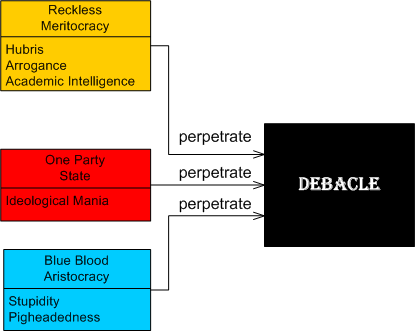
Ross then theorizes on how catastrophies are perpetrated by the rich and powerful in reckless meritocracies, hereditary aristocracies, and one-party states:
- Hereditary aristocracies: debacles caused by stupidity and pigheadedness
- One Party States: debacles caused by ideological mania
- Reckless Meritocracies: debacles caused by hubris
Relative to the other two forms of governance, at least scores of little people aren’t physically massacred in reckless meritocracies. They’re simply thrust into poverty. The real genius of reckless meritocracy is that when a meritocrat falls, he/she isn’t beheaded. At worst, he/she goes to jail. At best, he/she gets away with a huge bag of loot.
So, what’s a democratically run institution to do? Mr. Douthat rightly states that “it will do America no good to replace the arrogant with the ignorant, the overconfident with the incompetent“. (Didn’t you see the movie “Idiocracy“?)
We need intelligent leaders with a sense of their own limits, experienced people whose lives have taught them caution. We still need the best and brightest, but we need them to have somehow learned humility along the way. – Ross Douthat
If you made it thus far into this post, you may be wondering why BD00 is wasting your time by simply parroting Ross Douthat in yet another meta-blog post? It’s because BD00 wanted to display his fledgling UML skill again:
But wait! It may ironically be because of BD00’s own personal lack of humility and the fact that BD00 gets off on reading funny spammer comments like these:
Death Wish
Over the span of many years, a handful of people have told me that they admire (lol) my courage for “speaking truth” to power. But it’s not like that. First, I speak my version of the so-called “truth“. Second, I don’t “speak to“, I “write about” power. Third, there’s absolutely no courage involved. The only way I can describe this so-called talent is that it’s a weird “death wish” type of affliction.

The feelings that rush forth when I spew potentially hurtful (but maybe indirectly helpful?) ideas and assertions are excitement, exhilaration, and aliveness. But wait, that’s not all. Feelings of guilt, isolation, and mostly, fear, also weave themselves into the witches brew. D’oh! I hate when that happens.

Even though it’s (always) about me, enough about me. What about you, dear reader? What’s your story? Do you write, speak, to, about, power? What’s your style, and do you think it’s effective? What feelings emerge in real-time when you skirt the edge of the prevailing power culture’s “appropriateness” threshold?
In addition to fellow DICsters, I’m especially interested in those readers, if any, who are actually in positions of power in a hierarchy. In your particular case, does power speak truth to power? There’s gotta be a couple of you out there willing to share, no?
Monkey Mind
For ego-dominated people like me, “I-thoughts” run rampant through the mind. Buddhists call this malady the “monkey mind“, with thoughts jumping randomly to and fro in chaotic happenstance.
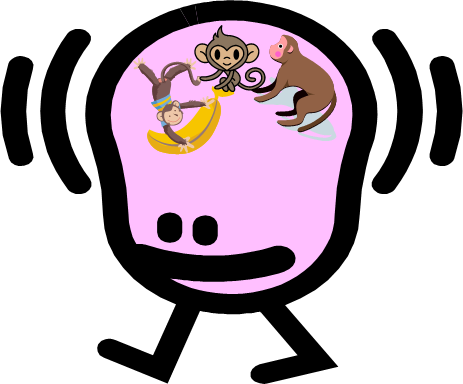
Psychological discord arises because, as one wise man has said, “we can’t bear to sit still with ourselves for one minute“.
Different Perceptions
In the spirit of reducing costs through the holy grail of “reuse“, this post leverages the (so-called) work done in the recent “One Of Four” post….
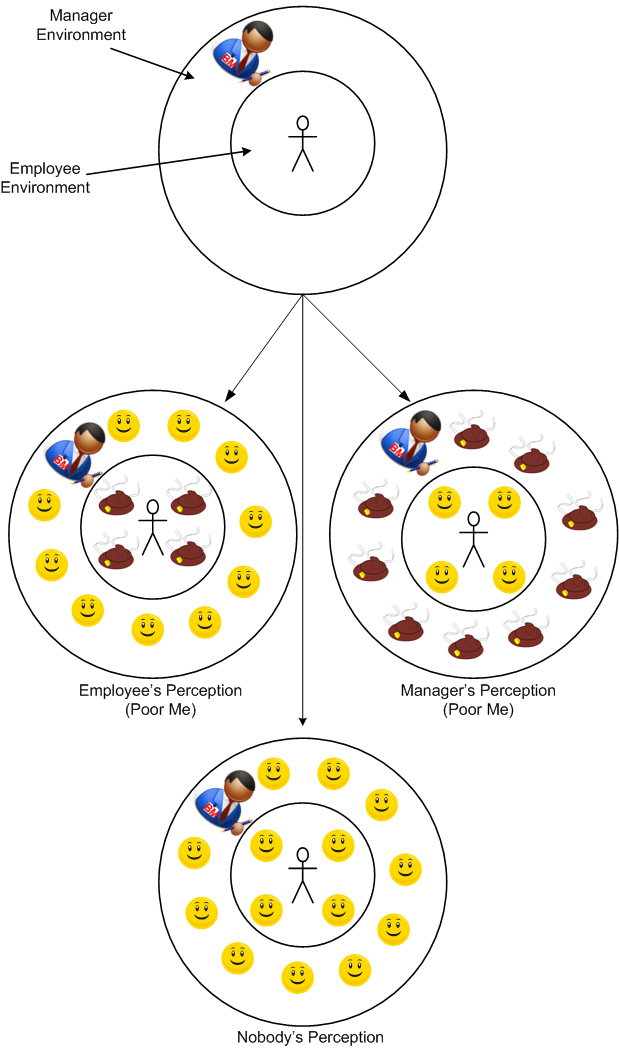
In DYSCOs and CLORGs, this is everybody’s perception:
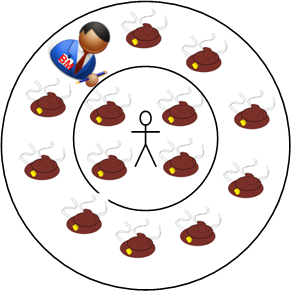
Man, I wish I could cure myself of the addiction to use grumpies in my e-drawings. The practice is unprofessional and childish, but I deploy the putrid piles for the following purposes: 1) to ratchet up the impact, 2) as a differentiating “branding” gimmick, and 3) to coverup the lack of substance in the accompanying words. The acerbic words and sophomoric readme.txt acronyms may already do the trick though, no?
What do you think, dear reader? Should BD00 dispense with all the crap? Do you think BD00 is capable of, and willing to, step into the alien world of respectable discourse?
Ideologues
This may sound hypocritical to some, but I find it frustratingly difficult to deal with ideologues. An ideologue is a closed-minded, binary, absolutist when it comes to “beliefs” that he/she is passionate about.
Experts don’t think, they know (just like BD00).
As soon as you start to question assertions from an ideologue or suggest an alternative idea/concept/belief, in the blink of an eye you automatically become an enemy to be annihilated. The rhetoric starts ratcheting up and personal attacks may start spewing forth. Unless you’re the Buddha, it’s incredibly easy to get sucked into the vortex and start playing the ISTY game with an ideologue. On the up side, if you deal with ideologues often, with a little self-awareness, you can get better and better at handling interactions with them more gracefully.
Being a passionate person myself on topics that are near and dear to me, I can definitely empathize with ideologues. I “believe” that if you’re not passionate about something, then you’re living an incredibly boring and unfulfilled life. But hey… it’s just a BD00 “belief“.

I believe that there is such a thing as objective truth, but a lot of people have an objective truth that differs from mine. – Cynthia Tucker
The Null Set
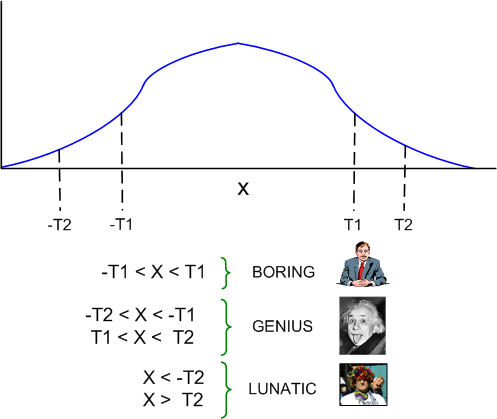
Few would argue that Martin Luther King and Albert Einstein didn’t change the world for the betterment of the human race. These two stunningly similar quotes unveil one of the keys to their hard won success:
Many people fear nothing more terribly than to take a position which stands out sharply and clearly from prevailing opinion. – Martin Luther King
Few people are capable of expressing with equanimity opinions which differ from the prejudices of their social environment. Most people are even incapable of forming such opinions. – Albert Einstein
Something tells me that this is an ironic twist on the cliche that “great minds think alike“. Great minds think alike, but so do mediocre minds. It’s just that on matters of importance, great minds don’t think like mediocre minds. D’oh!
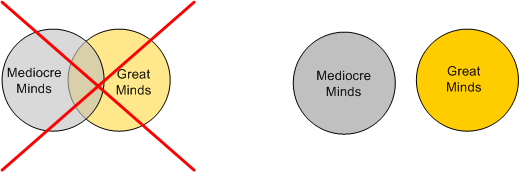
Boring, Genius, Lunatic
Renunciation
I was listening to an Eckhart Tolle talk the other day (via an mp3 file deposited on a USB stick plugged into my new Subaru WRX audio system). He started talking about the key to inner peace. In order to prepare his audience for the bombshell he was about to launch, he asked them to “please don’t be shocked“. Eckhart then said, in his characteristically slow, deliberate, and relaxed tone, that the key to awakening and inner peace is….. the renunciation of thought. D’oh, and WTF?
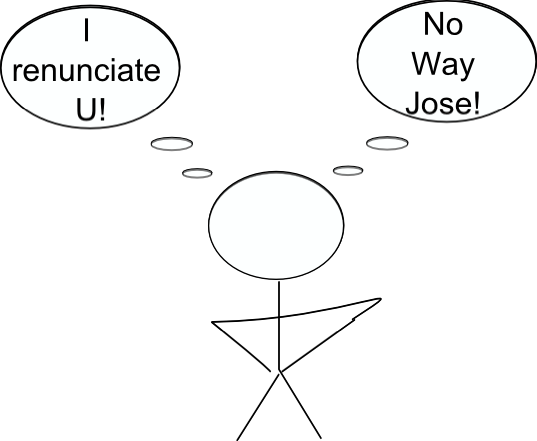
Years ago, when I was more lost than I am today, I would have thought that Mr. Tolle was a charlatan on the level of Jimmy Swaggart and Jim Bakker. Today, knowing what I know, but can’t express in words, I think he is wise. How about you? What do you think?
Note: I usually use Microsft Visio to generate the dorky diagrams on this blog. The pic in this post is my first one using the freely downloadable Inkscape package.
Procedural, Object-Oriented, Functional
In this interesting blog post, Dr Dobbs – Whither F#?, Andrew Binstock explores why he thinks “functional” programming hasn’t displaced “object-oriented” programming in the same way that object-oriented programming started slowly displacing “procedural” programming in the nineties. In a nutshell, Andrew thinks that the Return On Investment (ROI) may not be worth the climb:
“F# intrigued a few programmers who kicked the tires and then went back to their regular work. This is rather like what Haskell did a year earlier, when it was the dernier cri on Reddit and other programming community boards before sinking back into its previous status as an unusual curio. The year before that, Erlang underwent much the same cycle.”
“functional programming is just too much of a divergence from regular programming. ”
“it’s the lack of demonstrable benefit for business solutions — which is where most of us live and work. Erlang, which is probably the closest to showing business benefits across a wide swath of business domains, is still a mostly server-side solution. And most server-side developers know and understand the problems they face.”
So, what do you think? What will eventually usurp the object-oriented way of thinking for programmers and designers in the future? The universe is constantly in flux and nothing stays the same, so the status quo loop modeled by option C below will be broken sometime, somewhere, and somehow. No?


Why am I here?
WTF?
Meh!
D'oh!

My BTC Address



 Bulldozer00's Blog