Archive
A Thing In Context

Can’t And May

Amity and Enmity I
If you’re looking to tax your mind to the fullest and explore a novel and rigorous approach to sociological science, check out Dr. Rudolf Starkermann’s new web site, “Amity and Enmity”. The site was recently placed online by e-colleague Byron Davies and the wonderful story behind the site’s creation deserves its own separate, forthcoming blog post (Amity and Enmity II).
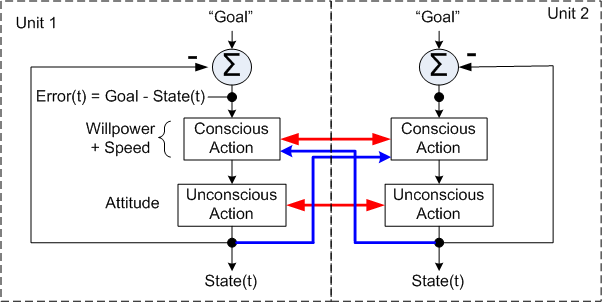
By syntegrating social concepts (e.g. willpower, consciousness, attitude, the unconscious, goal-seeking) with the concepts and mathematics from the engineering discipline of automatic control theory (e.g. amplification, error signal, feedback, transfer functions, stability, homeostasis, PID control), Dr. Starkermann models a living social “unit” as a self-realization seeking loop that is influenced by other social units via conscious observations/actions and subconscious “attitudes“. A social unit can represent a person, group, institution, or even a nation.
The first figure below shows a simplified first order model of the Starkermann social dualism. The second figure exposes the model’s intricately dense complexity. If you painstakingly trace out and count the number of loops in the socially coupled system, you’ll find that there are 12 of them. D’oh!

Did you have trouble finding the loops in the dualism? Well, don’t fret because here they are:
 Double D’oh!
Even if you’re not an engineer who’s taken a course in automatic controls theory, you may get something out of “Amity And Enmity“. Dr. Starkermann valiantly tries to make his work accessible to the non-mathematical layman via many careful and empathic explanations throughout the treatise.
By fixing some parameters and varying others, Rudy has “calculated the behavior” of the dualism in a multitude of scenarios in order to discover what his models reveal about amity and enmity. Here’s a sample list of his “stark” conclusions:
- Nature favors enmity and sets amity second.
- Hostility is fast, consent is slow.
- The faster a “unit” thinks, acts, the larger its willpower can be before it runs into instability and the better and faster it reaches its goal.
- The probability is almost non-existent that a hate-relation changes into a friendship.
- Hostility is solid. Friendship is fragile.
While sloowly making my way through the dense thicket that is “Amity And Enmity“, the following quote keeps coming to mind:
All models are wrong, but some are useful – George Box

Behavior Compression
I’m gonna be an “absolutist” in today’s post. I’m gonna use the word “all” instead of “most“.
In all man-made orgs, as one ascends the hierarchy, the range of behaviors exhibited by members of a given level is compressed relative to the level below it:

So, why is this? It’s because org members unconsciously understand that as one’s stature rises via anointed promotion, an unseen pressure to project an image of infallibility increases. In order to be perceived as perfectly omniscient and omnipotent, behaviors that can be interpreted as less than impeccably pristine by the population below must be jettisoned. So, why is this? Well, it’s just… because BD00 said so.
The sad thing about this system behavior is that it takes a lot of energy and work to shed deviant behaviors and exude a false image of perfection. Instead of asking “Do you have what it takes to get to the top?“, maybe the question that should be asked is “Do you have what it doesn’t take to get to the top?“.

Unfriendly Fire
In Nancy Leveson’s new book, “Engineering A Safer World“, she analyzes (in excruciating detail) all the little screw-ups that occurred during an accident in Iraq where two F-15 fighters shot down two friendly black hawk helicopters – killing all aboard. To set the stage for dispassionately explaining the tragedy, Ms. Leveson provides the following hierarchical command and control model of the “system” at the time of the fiasco:
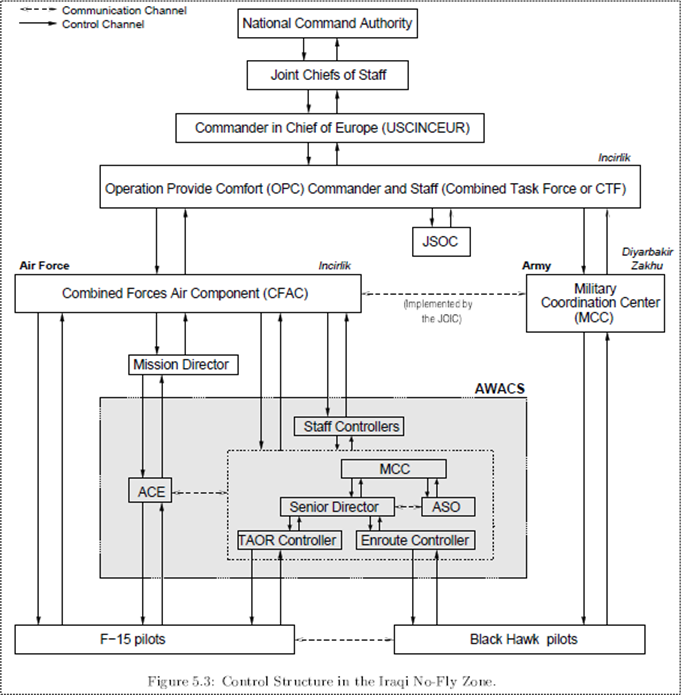
Holy shite! That’s a lot of levels of “approval required“, no?
In typical BD00 fashion, the dorky figure below dumbs down and utterly oversimplifies the situation so that he can misunderstand it and jam-fit it into his flawed UCB mental model. Holy shite! That’s still a lot of levels of “ask me for permission before you pick your nose“, no?
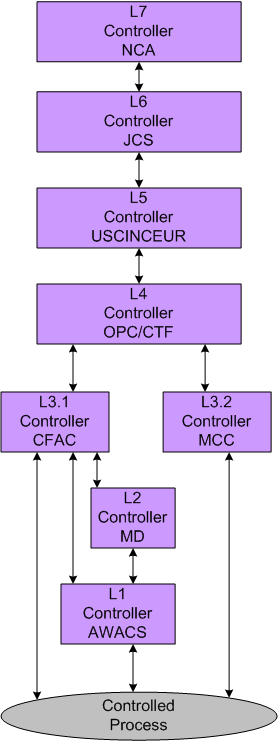
So, what’s the point here? It’s that every swingin’ dick wants to be an esteemed controller and not a low level controlleee. Why? Because….
“Work is of two kinds: first, altering the position of matter at or near the earth’s surface relatively to other such matter; second, telling other people to do so. The first kind is unpleasant and ill paid; the second is pleasant and highly paid.” – Bertrand Russell
People who do either kind of work can be (but perhaps shouldn’t be) judged as bozos, or non-bozos. The bozo to non-bozo ratio in the “pleasant” form of work is much higher than the “unpleasant” form of work. – BD00
Borgbot
I’m not sure you should worry much about the effect your behavior has on the organization overall, because there’s lots of data that suggests the organization doesn’t care much about you. – Jeffrey Pfeffer
That quote by Stanford University’s Jeffrey Pfeffer can be found in The Purpose of Power. From one systems point of view, a corpricracy as a whole is an inflexible and conscienceless borgbot with a single purpose – to make as much money it can, in any way it can. If the borgbot needs to chop off its nose or sell its mother into slavery or bankrupt millions of people outside its walls to fulfill its mission, it will.
The fascinating thing about borgbot behavior is that it ingeniously guilts its members into compliance (“aren’t you a team player?“, “if you don’t do it, you’re selfish and you’ll hurt the company“, “how dare you question management decisions“, “you’re a disloyal ingrate for speaking out“, yada-yada-yada) and rationalizes any unethical behavior away without blinking an eye.
Like most of us, Pfeffer wishes large-scale organizations were paragons of meritocracy where competence and influence are always perfectly correlated, but he knows that’s not the case – Gary Hamel
Notice the usage of the term “large-scale organizations” in Mr. Hamel’s quote. It implies that there’s hope – in small scale organizations. It makes self-righteous BD00 wonder why borgbots are obsessed with growth. Oh, I almost forgot; to make as much money as they can in any way they can.

Executive Proposal
The lowly esteemed and dishonorable BD00 proposes to executives everywhere:
Whenever you change your org, supply the minions with TWO complementary org charts: the usual (yawn) who-reports-to-whom chart and a system operational structure chart.

Creating the first one is an easy task; the second one, not-so. That’s why you’ve never seen one.
The funny thing is, every borg has a “System Operational Structure” chart regardless of whether it’s known or (most likely) not. Reshuffling the “Who-Reports-To-Whom” chart without knowing and consulting with the “Systems Operational Structure” chart doesn’t improve operations (unless the reshuffler gets lucky), it justs changes who to blame when sub par performance persists after the latest and greatest reshuffle.
Confined Safety
In ho-hum, yawner borgs, a meticulously followed but mysteriously unwritten rule is that Domain Analysts (DA) and Software Developers (SD) remain safely within the confines of their area of expertise:

The borg’s job classification, compensation, and status-award sub-systems ensure that this “confined safety” rule is firmly in place; and silently enforced. No encroachment is allowed, lest social punishment be inflicted to “right the wrong“.
When turf transgressions in the form of hard-to-answer questions and “suggested” alternatives from an encroacher occur:

a rebuke from the (Jim) encroachee is sure to follow. If that tactic doesn’t flatten and widen the boundary curve back into place, then the big gun is rolled out: management. D’oh! Watchout!
In effective, world class orgs, there is no “confined safety” rule:

This non-horizontal, continuous, and smooth interface boundary between disciplines is not only an anomaly, but when it does miraculously manifest, it’s only temporary and local, no?
Hell, there are no rules here. We’re trying to accomplish something. – Thomas Alva Edison
Growing Wings On The Way
If you don’t have wings and you jump off a cliff, you better hope to grow a pair before you go splat. With this lame ass intro, I introduce you to the title of the latest systems thinking book that I finished reading: “Growing Wings On The Way“.

GWOTW is yet another terrific systems thinking book from small British publishing house “Triarchy Press“. The book defines and explains a myriad of tools/techniques for coming to grips with, understanding, and improving, socio-technical “messes“. Through numerous examples, including a very personal one, Rosalind Armson develops the thought processes and methods of inquiry that can allow you to generate rich pictures, influence diagrams, system maps, multiple-cause diagrams, and human activity system diagrams for addressing your “messes“. If you want a solid and usable intro to soft systems thinking, then this may be your book.
90 Degree Rotation
The figure below shows a 3 group system that efficiently transforms a stream of raw inputs into a stream of valued outputs (they’re valued because customers want to pay for them) via the application of talent, knowledge, and skill. In this system, since all groups are on the same horizontal plane of importance, negative feedback channels are embraced, and hence, the information that flows within them blunts the rate of increase in entropy while providing a source of reflective learning.
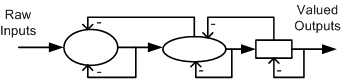
Now, let’s introduce vertical levels of “perceived importance” by rotating the system in the clockwise direction by 90 degrees:

So, you ask “why were those red verboten x’s introduced during the rotation? “. I put them there because once people start perceiving that the levels above are more important than them, they stop giving negative feedback – even when the inputs they’re given to work with turn into POPs over time. After all, if someone/group is perceived as more important than someone else, the “someone else” is likely to think that whatever they’re given as an input to work with must be good – regardless of its real quality.
Now, let’s introduce a culture of fear (which usually goes hand-in-hand with hierarchical levels of importance) into the system:

So, you ask “why were those feedback loops to “self” crossed out? “. You see, when a sub-group is an integral part in a fearful hierarchy of importance, it doesn’t critically evaluate its own work and it covers up mistakes – lest it be perceived as unworthy for promotion to the next higher level of importance by those in said level.
As startups grow, unless their founders exert Herculean force to prevent it, they start rotating to the right. The rate of rotation is often so sloooow that no one notices it until it’s too late . The feedback loops are broken, product/service quality erodes, and the fit hits the shan. D’oh! I hate when that happens. Don’t you?

Why am I here?
WTF?
Meh!
D'oh!

My BTC Address



 Bulldozer00's Blog