Archive
An Answer 10 Years Later
I’ve always questioned why one of my mentors from afar, Steve Mellor, was one of the original signatories of the “Agile Manifesto” 10 years ago. He’s always been a “model-based” guy and his fellow pioneer agile dudes were obsessed with the idea that source code was the only truth – to hell with bogus models and camouflage documents. Even Grady Booch, another guy I admire, tempered the agilist obsession with code by stating something like this: “the code is the truth, but not the whole truth“.
Stephen recently sated my 10 year old curiosity in this InfoQ interview: “A Personal Reflection on Agile Ten Years On“. Here’s Steve’s answer to the question that haunted me fer 10 ears:
The other signatories were kind enough, back in 2001, to write the manifesto using the word “software” (which can include executable models), not “code” (which is more specific.) As such I felt able, in good conscience, to become a signatory to the Manifesto while continuing to promote executable modeling. Ten years on we have a standard action language for agile modeling. – Stephen J. Mellor
The reason I have great respect for Stephen (and his cohort Paul Ward) is this brilliant trilogy they wrote waaaayy back in the mid 80s:
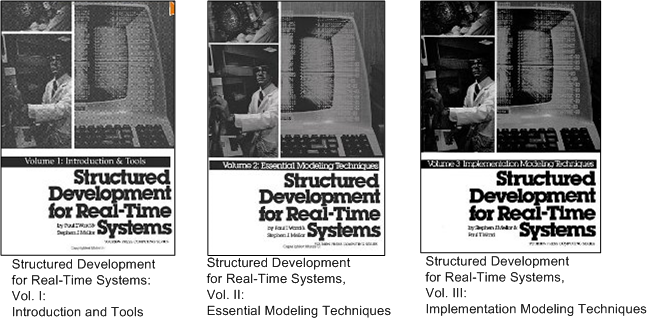
Despite the dorky book covers and the dates they were written, I think the info in these short tomes is timeless and still relevant to real-time systems builders today. Of course, they were created before the object-oriented and multi-core revolutions occurred, but these books, using simple DeMarco/Plauger structured analysis modeling notation (before UML), nail it. By “it”, I mean the thinking, tools, techniques, idioms, and heuristics required to specify, design, and build concurrent, distributed, real-time systems that work. Buy em, read em, decide for yourself, bookmark this post, and please report your thoughts back to me.

Why am I here?
WTF?
Meh!
D'oh!

My BTC Address



 Bulldozer00's Blog