Archive
Make Meaning
Can you make meaning out of this freakin’ sketch? I can’t. As I drew it, I struggled to come up with some profound (lol!) words to express my thoughts on the thick and impenetrable “personal filter” (a.k.a UCB) that prevents us from experiencing what’s truly real – which is nothing, er, “no thing“?

Follow Me!
The Amazon Kindle has a kool “share” feature. You can highlight a passage in the book you’re reading, write an introductory note for it, and then e-send the note-link pair to twitter. Here’s what one of these shared note-link pairs looks like in a Twitter timeline:

The link displayed in the tweet points to an online stored version of the highlighted text that is visible to the public. Here’s an example book snippet that I recently tweeted:

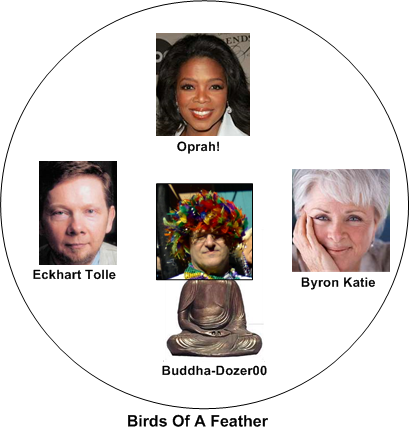
Sometimes, after sharing a passage from a spiritual book, I get one or two new Twitter followers the next day. Of course, they sign up to follow me cuz I’m wise and insightful, not because they have something they want to sell to me. Someday, I’ll move into the upper echelon of the spirituo-sphere with the big boys and girls:
Don’t Stop There
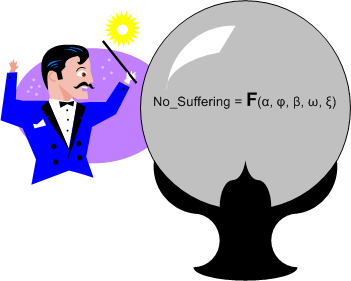
Buddha said that “life is suffering“. Many people, especially those stuck inside their head like me, stop there and say “no shit sherlock“. However, what if one continues on with “and if, by an act of grace, you come to realize this profound truth in your bones, your suffering will start to fade“?.
For the legions of skeptics out there, I do have a rigorous and irrefutable mathematical proof of this truth, but my sale price hasn’t been met yet.
Five Levels
According to Russell Ackoff, there are five types of conceptual content. In order of increasing scarcity, they are Data, Information, Knowledge, Understanding, and Wisdom.
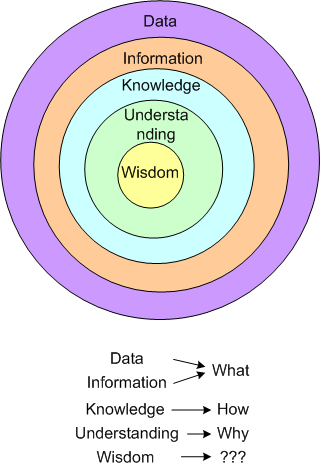
Data and information answer “what something is” questions. Knowledge answers “how something works” questions. Understanding answers “why something is the way it is” questions. Wisdom, the rarest form of conceptual content, is altogether a different beast. It answers all questions.
The acts of probing, sensing, and measuring produce raw data. The filtering, integration and association of data fragments creates information. The mistake-prone application of information and learning from errors leads to knowledge. The application of holistic, systems thinking to knowledge creates understanding.
Unlike the other four types of content, which integrate up and progress sequentially from each other, wisdom may not. Wisdom may appear instantaneously on its own by the grace of some higher power. It has to be that way. If it wasn’t, then only highly educated and experienced intellectuals would be capable of acquiring wisdom – and we know that isn’t true, don’t we? Wisdom is accessible to all human beings regardless of race, age, culture, wealth, or any other trait. The trouble is that society, especially western societies, wants us to think otherwise. No?
Fighting With The Present Moment
Scott Kiloby is the most recent spiritual teacher that I’ve been listening to. In “Love’s Quiet Revolution“, he says that people spend the vast majority of, if not all, their psychological time in one of three states:
- Regretting the past,
- Worrying about the future,
- Resisting/fighting with the present.
I’ve heard of the first two states, but the third one was depressingly new to me. To test out this assertion, I googled my horrendously inadequate memory to dig up several instances where I “fought” with the present moment yesterday:
- I got pissed when the dumb bell weights I use in my workout routine were missing from their slots.
- I got pissed off when the shower water turned scalding hot after someone flushed the terlet.
- I got pissed off when I spilled my bottle of Brute in the gym.
And these events happened within the space of just one hour at the gym! If I tried to recall all my bouts with the present moment yesterday, I’d probably need several more pages to recount them. How about you? How many fights with the present moment were you in yesterday?

If You Want To Write
Brenda Ueland’s “If You Want To Write” is not just about learning how to write. As Guy Kawasaki has noted, it’s a moving tribute to the human spirit and the innate ability to create that resides in each of us.
If you’re not into spirituality, you won’t buy into what I’m going to say next. IYWTW impacted me like some of the best spiritual works that I’ve read; but without using explicit, spiritual terms like “enlightenment, awakening, surrender, non-duality, universal consciousness“, etc. The best spiritual works are hard to describe and summarize in words. They must be felt and experienced via graceful tingles and enveloping shivers down your spine. They can’t be understood by the rational mind. IYWTW is one such work.
If you want to explore spirituality from an unusual and different point of view, then you may want check out IYWTW because it contains much more than its title suggests. The book brought, if only for a few brief moments, “the peace that passeth all understanding” to me, and it may for you.

How Many Tines….
…does a fork have? Hoytee-toytee forks have three, and regular-people forks have four. On a totally different plane of thought, how many tines have you considered taking decisive action on something that really mattered to you but decided not to because of your fear of “what other people (especially the hoytee-toytee dudes with authority over you) would think“? Even worse, how many tines have you not taken action on something important to you, but you didn’t know you remained inert because you weren’t aware of your subconscious tendency to submit to authority? Obviously, you couldn’t count how many tines you did this because if you weren’t aware, you wouldn’t have any freakin’ idea of when to increment your counter.
It is only by risking our persons from one hour to another that we live at all.”- William James

Seeking Trouble
I’ve had the Kindle version of it for awhile, but I’ve finally got around to reading “Gurdjieff” by John Shirley. I’m glad I did because early in the book, this passage stirred up some internal energy:
According to the Gospel of Thomas, Jesus said, ‘ Let him who seeks continue seeking, until he finds. When he finds, he will become troubled. When he becomes troubled, he will be astonished, and he will rule over all.'”
It caused an energy surge because I’ve seeked and found trouble, deep trouble, multiple times. I’ve found that virtually everyone, both individually and collectively, behaves unconsciously according to the selfish “I” thought. Of course, this mass of humanity includes me, especially.
So, I’ve seeked, found trouble, and became astonished. However, I’ve yet to “rule over all”, which I think wasn’t meant to be taken literally. Hell, I’d settle for just ruling over my false self. How about you, have you found trouble?

From Searcher To Explorer
Most spiritual teachers advise students to “stop the search!”. Like many other frustrated spiritual aspirants, I don’t know of any other strategy for attaining enlightenment, an awakening, inner peace, relief from suffering, separation from ego, or whatever you want to call it.
To me, “searching” means looking for something specific, like lost keys or oil. Since I don’t have a freakin’ clue as to what “enlightenment” is and I do want to follow the advice of those who purportedly have dissolved the ego (or at least have rid themselves of ego-dominance), I’ve stopped being a searcher. As of today, I’m now (drum roll please) an explorer! Since exploring means probing and sensing for the new and unknown, that’s what I will do from now on.

OK, OK, back to reality. This post is just another self-delusional attempt to fill a new bottle with the same old wine, err, vinegar. Ergo, on with the search!
Academic Authors
I read quite a few books penned by science authors. Those that I can actually understand are very informative and entertaining. Every single one of the books always has one or more great stories regarding historical confrontations between different warring factions over who’s theory and experimental data are more “truthful“. If you believe what’s written, some of those confrontations were really nasty.
Isn’t it ironic that people who are deemed so intelligent often resort to (so-called) childish tactics in order to discredit others and prove themselves right? Nah, because underneath the veneer of revered intelligence they’re just regular freakin’ people like you and me. They’re human beings with feelings, egos, and the instinct to survive and prosper no matter what the cost. Gasp!
Science books written for laymen always seem to include words like “prestigious”, “world reknowned”, “Nobel laureate”, and “respected” in order to influence the readers beliefs via appeals to authority. The more compliments that I read, the more cautious I become in evaluating the subject matter. Being the closet non-conformist that I am, I tend to cast those words aside and gravitate toward those arguments and logic that appeal to my inner soul in the form of resonant feelings. How un-scientific of whacky me.
Anyone who conducts an argument by appealing to authority is not using his intelligence; he is just using his memory. – Leonardo daVinci
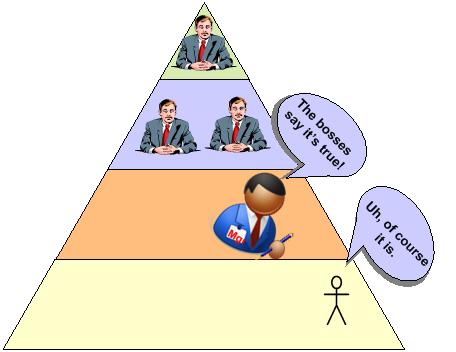
In case you haven’t noticed, I’m a total hypocrite. I appeal to authority all the time in feeble attempts to promote my views. I do it by inserting quotes from respected people into a lot of my blog posts, uh, like this one. Of course, I’m not using my intelligence. I’m using google.

Why am I here?
WTF?
Meh!
D'oh!

My BTC Address



 Bulldozer00's Blog