Archive
System Architecture Notation
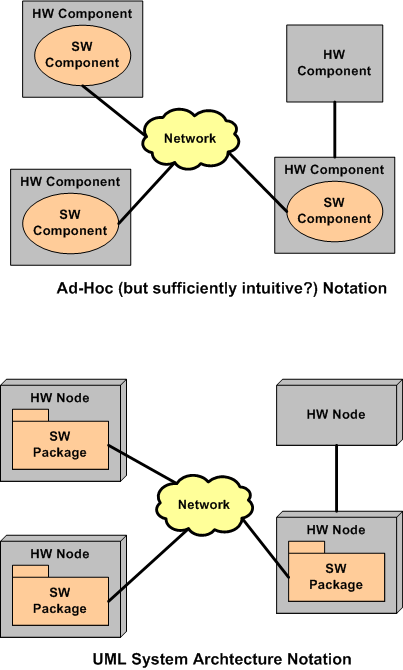
For years and years, I’ve used the simple circle and square notation shown in the top half of the figure below in order to communicate (mostly to myself) multi-technology system designs. I did it because UML hadn’t been invented yet, and circles/squares were trivial to draw with any software drawing tool.
Now that UML has been out for quite a while, I’m gonna (try) and switch to the UML notation shown in the bottom half of the diagram. Even though packages and nodes are slightly harder to draw than circles and squares with most mainstream drawing tools, every UML tool makes it as easy as pie. Even Visio (my favorite engineering graphics tool) has templates for easily generating UML notation.
Contained And Container
In Russell Ackoff‘s excellent book titled Idealized Design , he talks about container and contained systems. He essentially states that optimizing the contained system without changing the container system is a failure in waiting. The figure below depicts what often happens when a change agent succeeds in improving the contained system without consideration of the container system.
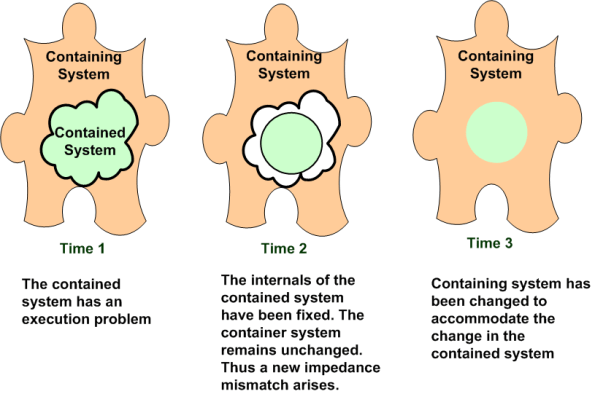
At time 1, the change agent realizes that there is an efficiency problem within the contained system. After an epic battle against the forces conspiring to keep the status quo intact, he/she succeeds in smoothing out the operation of the contained system at time 2. However, since the container system was neglected, it still operates according to the old rules and interfaces of time 1. Thus, an impedance mismatch between the container and contained system interface has appeared. This impedance mismatch can cause organizational performance to be worse than before the change (the cure is worse than the disease) to the contained system!
In an ideal system change effort, both the container and contained systems are improved. Done correctly, a smooth and high performing system-of-systems, like the above model at time 3, can be achieved. Compare the smooth circular integrated interface at time 3 with the previous inefficient and cloudy interfaces of the previous 2 times.

Why am I here?
WTF?
Meh!
D'oh!

My BTC Address



 Bulldozer00's Blog