Archive
The Vertical And Horizontal Dimensions
“A person is smart, people are stupid.” – Agent K (Men in Black)
I’m forever fascinated by how large groups of bright and well-meaning individuals often behave so dysfunctionally as a “whole“. How can that be? It’s because the individual “parts” of an organization don’t determine the behavior of the whole. It’s the part-to-part interactions enabled by, and (more importantly) disabled by, the structure of an organization that determines system behavior. By default, hierarchically structured orgs suppress collaborative communications in the horizontal dimension while catalyzing top down command and control communications in the vertical dimension.

In the vertical dimension, the fact that bosses get to unconditionally decide on how to divvy out tasks and rewards to their “subordinates” below ensures that the dweebs in the lower tiers will do whatever the boss wants them to do with little, if any, frictional blowback. In the horizontal dimension, crucial information can be withheld and collaborative communication suppressed because of peer-to-peer competition for the limited number of coveted slots available upstairs in the ever narrowing pyramid.
Thanks, But No Thanks
When it comes down to it, the primary function of management is to allocate finite org resources to efforts that will subsequently increase revenues and/or decrease costs. By resources, I mean people and money (for salaries, materials, tools, training, etc) and time.
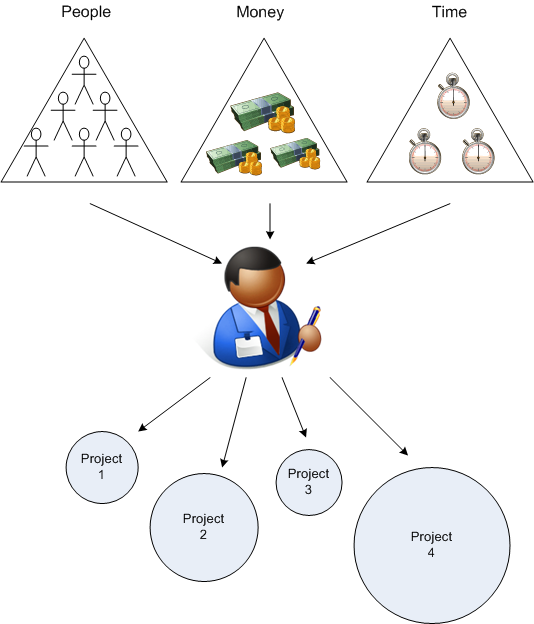
Since projects vary wildly in complexity/importance/size, required skill-sets, and they (should) have end points, correctly allocating resources to, and amongst, projects is a huge challenge. Both over and under allocation of resources can threaten the financial viability of the org and, thus, everyone within it. Under-allocation can lead to a stagnant product/service portfolio and over-allocation can lead to an expensive product/service portfolio. Note that either under or over allocation can produce individual project failures.
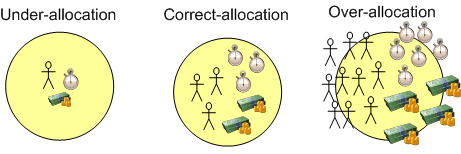
To correctly allocate resources to projects, especially the “human resources“, some things must be semi-known about them. Besides desired outcomes and required execution skills, project parameters like size and/or complexity should be estimated to some level of granularity. That’s why, for the most part, I think the #noestimates and #noprojects people are full of bullocks. Like agile coaches, they mean well and their Utopian ideas sound enticing. Thanks, but no thanks.

Result-Focused, Or State-Focused?
As I continue to explore/evaluate the relevance of the SEMAT Kernel to the future of software engineering, I’m finding that I’m liking it less and less. (For a quick introduction to the SEMAT Kernel, please go read this post, “Revolution, Or Malarkey?“, and then return back here if you’re still interested in what BD00 has to say.)
One of the principal creators of the SEMAT movement, Ivar Jacobson, subjectively asserts that:
“…using the SEMAT kernel to drive team behavior makes the team result focused instead of document driven or activity centric.” – Ivar Jacobson
Using the patented BD00 method of distorted analysis, let’s explore this bold proclamation further.
In the current definition of the SEMAT kernel, each of the seven top-level alphas in the SEMAT Kernel has a state whose value at any given moment is determined by the sub-states of a set of criteria items in a checklist. In addition, each sub-alpha itself has a checklist-determined state.
“Each state has a checklist that specifies the criteria needed to reach the state. It is these states that make the kernel actionable and enable it to guide the behavior of software development teams.” – “The Essence Of Software Engineering“
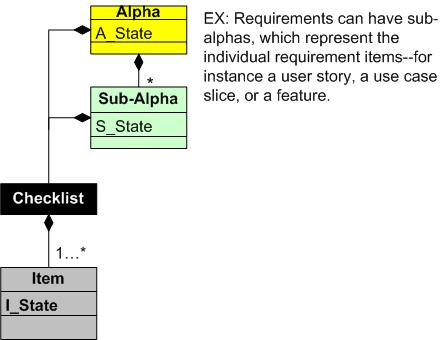
So, let’s look at some numbers for a small, hypothetical, SEMAT-based project. Assume the following definition of our project:
- 7 Alphas
- Each alpha has 3 Sub-Alphas
- Each checklist has 5 Items
With these metrics characterizing our project, we need to continuously track/update:
- 7 alpha states
- 7 * 3 = 21 Sub-alpha states
- 7 * 3 * 5 = 105 checklist item states
Man, that’s a lotto states for our relatively small, 21 sub-alpha project, no? It seems like the SEMAT team could be spending a lot of time in a state of confusion updating the checklist document(s) that dynamically track the state values. Thus,
“…using the SEMAT kernel to drive team behavior makes the team state focused instead of result focused.” – BD00
Unless result == state, Ivar may be mistaken.
Daunting Challenges
Fresh from Tom Gilb’s “Advanced Agile Practices” presentation, I give you Dave Rico’s 14 pitfalls of agile methods:
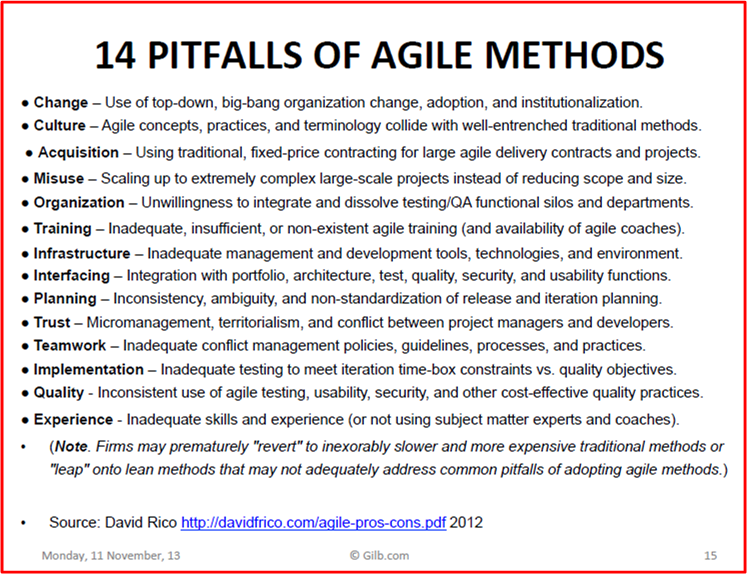
If you look closely at the list, the entries don’t just apply to attempts at agilization. They are daunting challenges for any aspiring corpo change agent who wishes to make a sweeping change to “the way we develop products“.
Where To Start?
The purpose of abstraction is not to be vague, but to create a new semantic level in which one can be absolutely precise. — Edsger Dijkstra
With Edsger’s delicious quote in mind, let’s explore seven levels of abstraction that can be used to reason about big, distributed, systems:

At level zero, we have the finest grained, most concrete unit of design, a single puny line of “source code“. At level seven, we have the coarsest grained, most abstract unit of design, the mysterious and scary “system” level. A line of code is simple to reason about, but a “system” is not. Just when you think you understand what a system does, BAM! It exhibits some weird, perhaps dangerous, behavior that is counter-intuitive and totally unexpected – especially when humans are the key processing “nodes” in the beast.
Here are some questions to ponder regarding the seven level stack: Given that you’re hired to build a big, distributed system, at what level would you start your development effort? Would you start immediately coding up classes using the much revered TDD “best practice” and let all the upper levels of abstraction serendipitously “emerge”? Relatively speaking, how much time “up front” should you spend specifying, designing, recording, communicating the structures and behaviors of the top 3 levels of the stack? Again, relatively speaking, how much time should be allocated to the unit, integration, functional, and system levels of testing?
Formal Waterfall Events
If ur customer *requires* formal waterfall events like “Sys Reqs Review”, “Prelim Design Review”, “Critical Design Review”, gotta do them.
— Tony DaSilva (@Bulldozer0) March 30, 2014
The customers of all the big government-financed sensor system programs I’ve ever worked on have required the aforementioned, waterfall, dog-and-pony shows as part of their well-entrenched acquisition process. Even prior to commencing a waterfall death march, as part of the pre-win bidding process, customers also (still) require contractors to provide detailed schedule and cost commitments in their proposal submissions – right down to the CSCI level of granularity.
If you think it’s tough to get your internal executive customers to wholeheartedly embrace an “agile adoption” or “no estimates” initiative, try to wrap your mind around the cosmic difficulty of doing the same to a large, fragmented, distributed authority, external acquisition machine whose cogs are fine-tuned to: cover their ass, defend their turf, and doggedly fight to keep the extant process that justifies their worth in place. Good luck with that.

Trivial Trivia
I was going through some old project stuff and stumbled upon the chart below. I developed it back when I was the software lead of a nine person sub-team on an embedded system product development effort:

Putting all those indecipherable acronyms adorning the chart aside, note that the project was performed in 2004 – a mere 3 years after the famous “Agile Manifesto” was hatched. I can’t remember if I knew about (or read) the manifesto at the time, but I do know that Tom Gilb’s “Evo“ and Barry Boehm’s “Spiral“ processes had radically changed my worldview of software development. Specifically, the (now-obvious) concept of incremental development and delivery rang my bell as the best way to mitigate risk on challenging, software-intensive, projects.
As the chart illustrates, the actual hand-off of each of the seven builds (to the system integration test team) was pretty much dead nuts right on target. Despite the fact that the project front end (requirements definition and software design) was managed as a “waterfall” endeavor, the targets were met. Thus, I’m led to believe the following trivial trivia:
Not all agile projects succeed and not all waterfall projects fail.
Not That Different, No?
Check out this slide I plucked from a pitch that will remain unnamed:
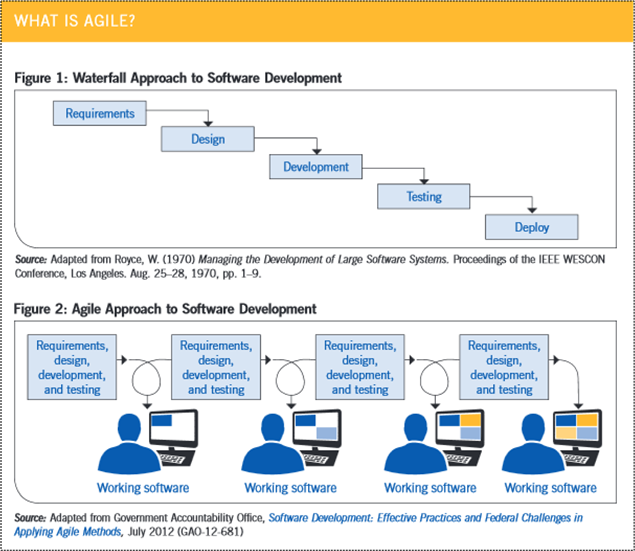
Notice the note under the waterfall diagram. Now, let’s look at the original, “unadapted” version and accompanying quote from Winston W. Royce’s classic 1970 paper:
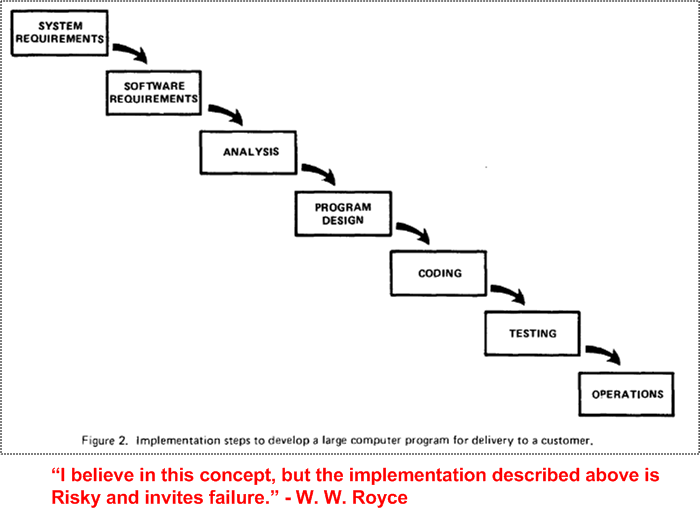
Notice that Mr. Royce clearly noted in his paper that the sequential, never-look-back, waterfall process is a stone cold loser. Next, let’s look at another diagram from Mr. Royce’s paper; one that no fragilista ever mentions or shows:
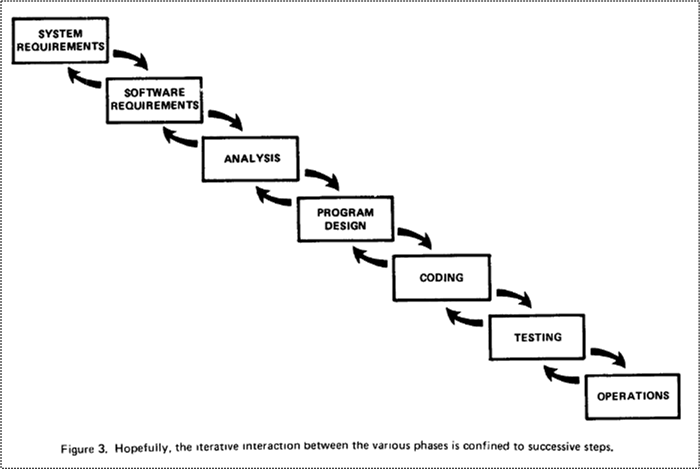
OMG! An iterative waterfall with feedback loops? WTF!
Finally, let’s look at BD00’s syntegrated version of the agile, lower half of our consultant’s diagram and the iterative waterfall diagram from Mr. Royce’s paper:
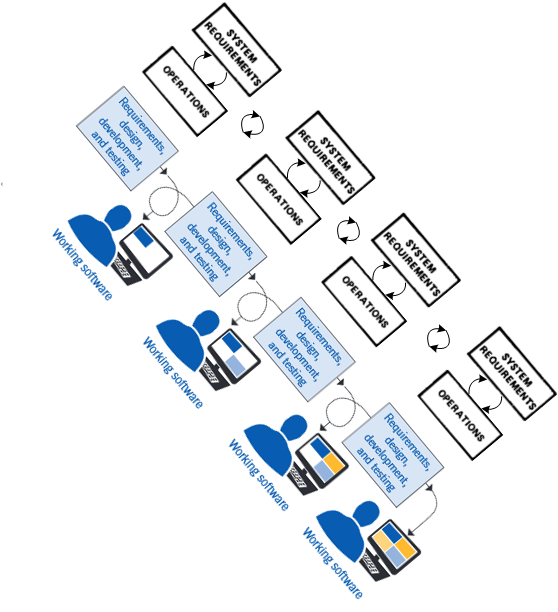
Comparing the agile and “chunked“, iterative, waterfall models shows that, taken in the right context, they’re not that different…. no?
Variable Sized MWs
Rewritten in “old school” terminology, the five Scrum process events can be expressed as follows:
- Sprint Planning = Requirements definition and capture
- Sprint = Requirements analysis, design, coding, unit testing, integration testing, code review
- Daily Stand Up = Daily status meeting
- Sprint Review = Post-mortem
- Sprint Retrospective = Continuous process improvement
So, someone with an intentionally warped mind like BD00 may interpret a series of Scrum sprints as nothing more than a series of camouflaged Mini-Waterfalls (MW).
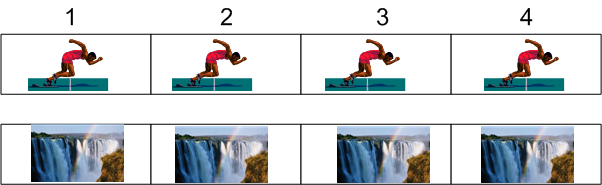
But ya know what? Executing a project as a series of MWs may be a good thing – as long as an arbitrary, fixed-size, time-box is not imposed on the team. After all, since everything else is allowed to dynamically change during a Scrum project, why not the size of the Sprint too?
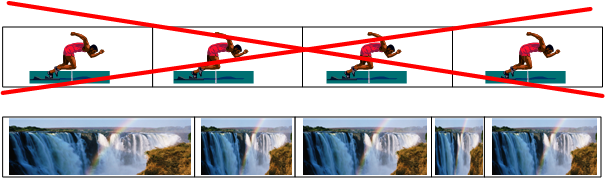
Instead of estimating what features can be done in the next 30 days, why not simply estimate how many days will be needed to complete the set of features that marks the transition into the next MW? If, during the MW, it is learned that the goal won’t be achieved, then in addition to cancelling the MW outright, two other options can be contemplated:
- Extend the length of the MW
- Postpone the completion of one or more of the features currently being worked on
Let the Design Emerge, But Not The Architecture
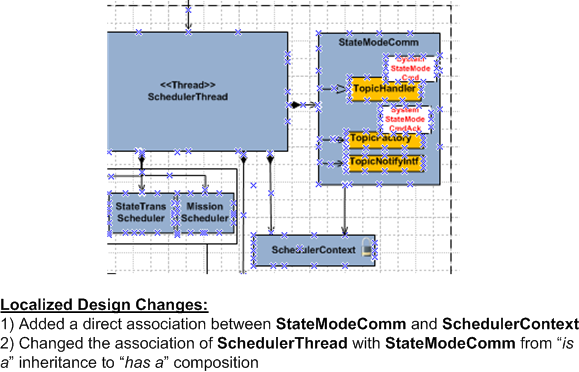
I’m not a fan of “emergent global architecture“, but I AM a fan of “emergent local design“. To mitigate downstream technical and financial risk, I believe that one has to generate and formally document an architecture at a high level of abstraction before starting to write code. To do otherwise would be irresponsible.
The figure below shows a portion of an initial “local” design that I plucked out of a more “global” architectural design. When I started coding and unit testing the cluster of classes in the snippet, I “discovered” that the structure wasn’t going work out. The API of the architectural framework within which the class cluster runs wouldn’t allow it to work without some major, internal, restructuring and retesting of the framework itself.

After wrestling with the dilemma for a bit, the following workable local design emerged out of the learning acquired via several wretched attempts to make the original design work. Of course, I had to throw away a bunch of previously written skeletal product and test code, but that’s life. Now I’m back on track and moving forward again. W00t!

Why am I here?
WTF?
Meh!
D'oh!

My BTC Address



 Bulldozer00's Blog