Archive
Too Detailed, Too Fast
One of the dangers system designers continually face is diving into too much detail, too fast. Given a system problem statement, the tendency is to jump right into fine-grained function (feature) definitions so that the implementation can get staffed and started pronto. Chop-chop, aren’t you done yet?
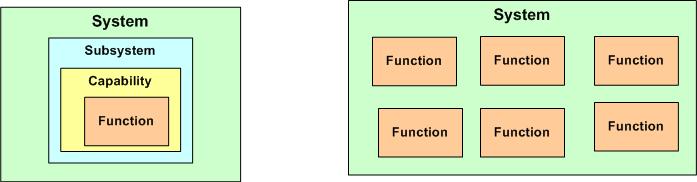
The danger in bypassing a multi-leveled analysis/synthesis effort and directly mapping the problem elements into concrete, buildable functions is that important, unseen, higher level relationships can be missed – and you may pay the price for your haste with massive downstream rework and integration problems. Of course, if the system you’re building is simple enough or you’re adding on to an existing system, then the skip level approach may work out just fine.
Irritated
Unsurprisingly, one of BD00’s posts irritated a reader who stumbled upon it. For some strange reason, BD00’s scribblings have that effect on some people. In the irritating post, “The Old Is New Again“, BD00 referred to Data and Control Flow diagrams as “old and obsolete“. In caustic BD00 fashion, the reader commented:
Use Cases and Activity Diagrams, in contrast (to the Data Flow diagram), offer little guidance in effective partitioning. They rely upon the age old “sledge hammer” approach to partitioning” (ie, just break-er-up any way you can). Sledge hammer partitioning is what cave men used to partition entities. So in a critical sense, DFD’s are new and hip, while Use Cases and Activity Diagrams are based upon logic that is older than dirt.
BD00 likes all visual modeling tools – including the DFD hatched during the heyday of structured analysis. BD00 only meant “old and obsolete” in the sense that DFDs pre-dated the arrival of the UML and the object-oriented approach to system analysis and design. However, BD00 did feel the need to correct the reader’s misunderstanding of the features and capabilities that UML Activity Diagrams offer up to analysts/designers.
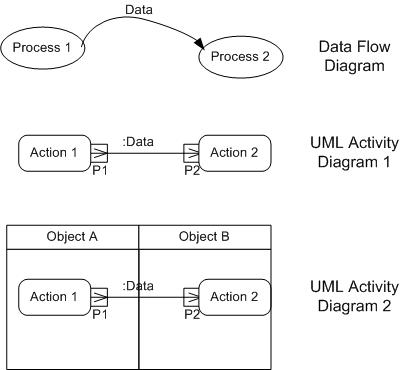
Both the DFD and UML activity diagram pair below equivalently capture an analyst’s partitioning design decision (where DFD Process X == Activity Diagram Action X). Via “swimlanes“, the lower activity diagram makes the result of a second design decision visible: the conscious allocation of the Actions to the higher level Objects that will perform them during system operation. So, how are UML activity diagrams inferior to DFDs in supporting partitioning? A rich palette of other symbols (forks, joins, decisions, merges, control flows, signals) are also available to analysts (if needed) for capturing design decisions and exposing them for scrutiny.
DFDs and UML diagrams are just tools – job performance aids. Learning how to use them, and learning how to use them effectively, are two separate challenges. Design “guidance” for system partitioning, leveling, balancing, etc, has to come from somewhere else. From a mentor? From personal experience learning how to design systems over time? From divine intervention?
Bounded Solution Spaces
As a result of an interesting e-conversation with my friend Charlie Alfred, I concocted this bogus graphic:
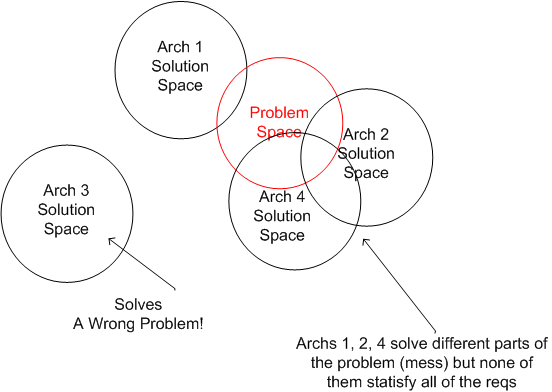
Given a set of requirements, the problem space is a bounded (perhaps wrongly, incompletely, or ambiguously) starting point for a solution search. I think an architect’s job is to conjure up one or more solutions that ideally engulf the entire problem space. However, the world being as messy as it is, different candidates will solve different parts of the problem – each with its own benefits and detriments. Either way, each solution candidate bounds a solution space, no?
Beginner, Intermediate, Expert
Check out this insightful quote from Couchbase CTO Damien Katz:

Threads are hard because, despite being extremely careful, it’s ridiculously easy to code in hard to find, undeterministic, data races and/or deadlocks. That’s why I always model my multi-threaded programs (using the MML, of course) to some extent before I dive into code:
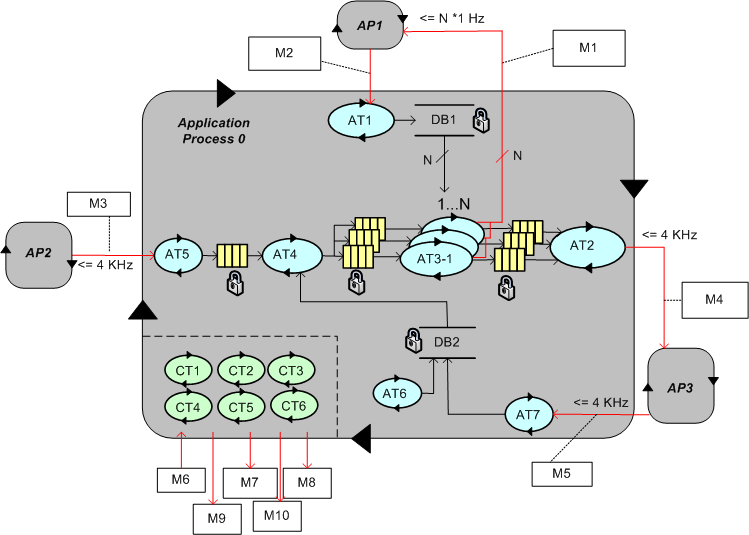
Note that even though I created and evolved (using paygo, of course) the above, one page “agile model” for a program I wrote, I still ended up with an infrequently occurring data race that took months, yes months, to freakin’ find. The culprit ended up being a data race on the (supposedly) thread-safe DB2 data structure accessed by the AT4, AT6, and AT7 threads. D’oh!
What’s Next?
I was browsing through some old powerpoint pitches and I cam across this potentially share-worthy graphic:
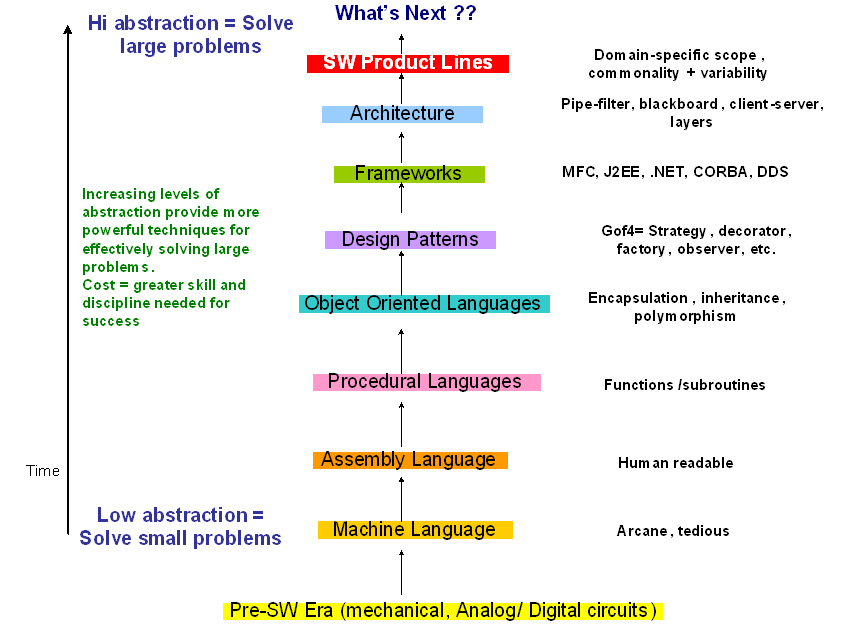
I’m sorry for the poor resolution. I was too lazy to spruce it up.
Out Of One, Many
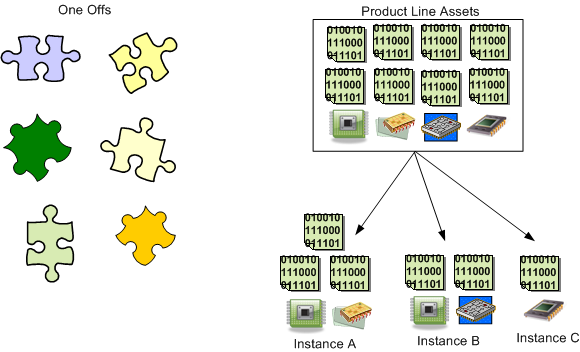
A Software Product Line (SPL) can be defined as “a set of software-intensive systems that share a common, managed set of features satisfying the specific needs of a particular market segment or mission and that are developed from a common set of core assets in a prescribed way“.
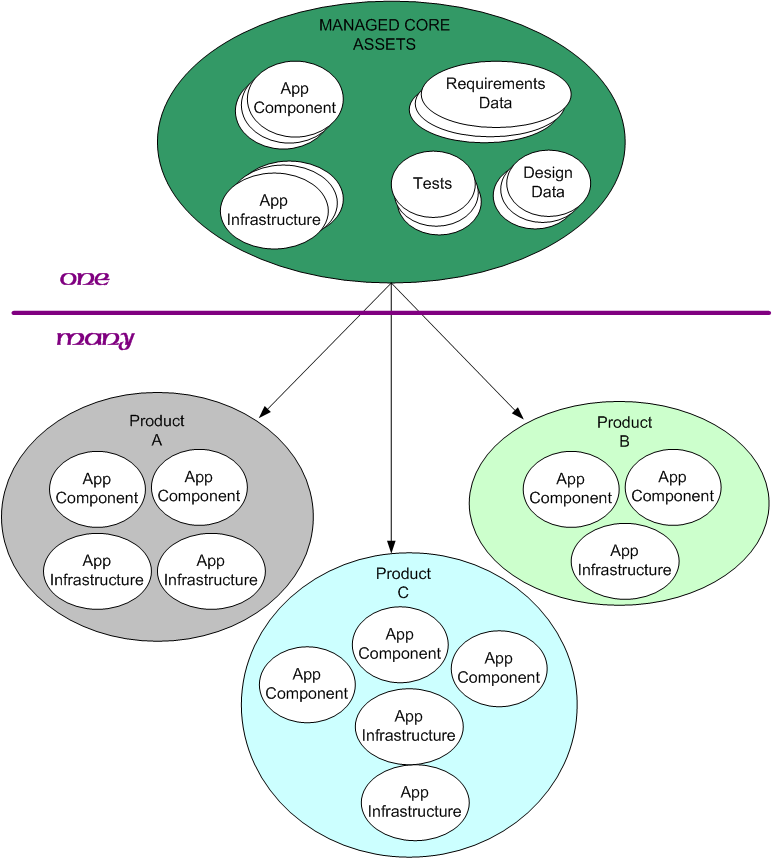
The keys to developing and exploiting the value of an SPL are
- specifying the interfaces and protocols between app components and infrastructure components
- the granularity of the software components: 10-20K lines of code,
- the product instantiation and test process,
- the disciplined management of changes to the app and infrastructure components.
- managing obsolescence of open source components/libs used in the architecture
- keeping the requirements and design data in synch with the code base
Any others?
Starting Point
Unless you’re an extremely lucky programmer or you work in academia, you’ll spend most of your career maintaining pre-existing, revenue generating software for your company. If your company has multiple products and you don’t choose to stay with one for your whole career, then you’ll also be hopping from one product to another (which is a good thing for broadening your perspective and experience base – so do it).
For your viewing pleasure, I’ve sketched out the structure and provided some code-level metrics on the software-intensive product that I recently started working on. Of course, certain portions of the graphic have been redacted for what I hope are obvious reasons.
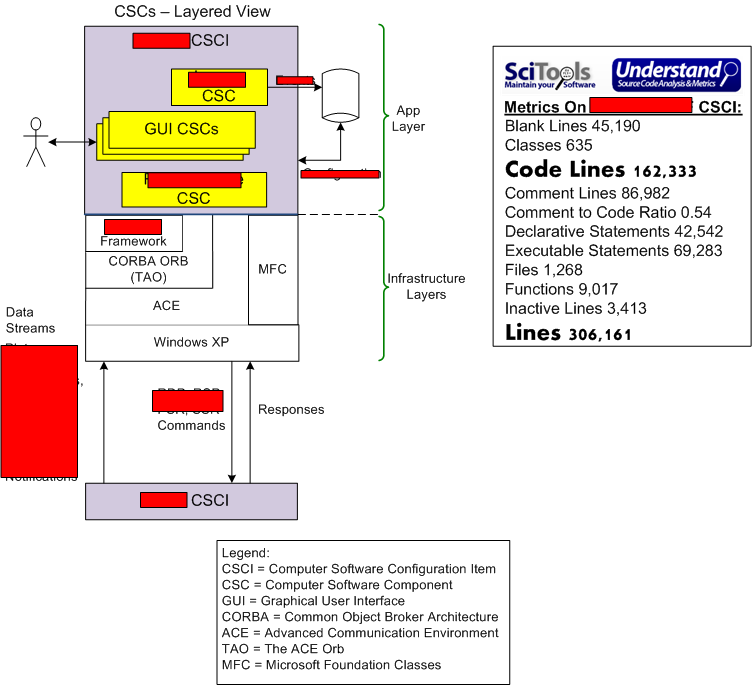
How about you? What does your latest project look like?
Visualizing And Reasoning About
I recently read an interview with Grady Booch in which the interviewer asked him what his proudest technical achievement was. Grady stated that it was his involvement in the creation of the Unified Modeling Language (UML). Mr. Booch said it allowed for a standardized way (vs. ad-hoc) of “visualizing and reasoning about software” before, during, and/or after its development.

Product Line Blueprint
Here it is, the blueprint (patent pending) you’ve been waiting for:
Need a little less abstraction? Well, how about this refinement:
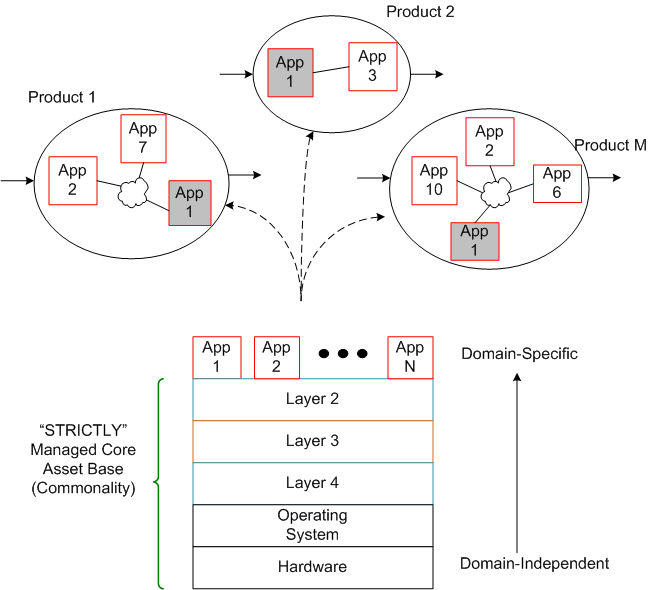
Piece of cake, no? It’s easy to “figure out“:
- the number of layers needed in the platform,
- the functionality and connectivity within and between each of the layers in the stack
- the granularity of the peer entities that go into each layer and which separates the layers
- the peer-to-peer communication protocols and dependencies within each layer
- the interfaces provided by, and required by, each layer in the stack
- what your horizontally, integrate-able App component set should be for specific product instantiations
- how much time, how much money, and how many people it will take to stand up the stack
- how many different revenue-generating product variants will initially be needed for economic viability
- how to secure all the approvals needed
- how to manage the inevitable decrease in conceptual integrity and increase in entropy of the product factory stack over time – the maintenance problem
Perhaps easiest of all is the last bullet; the continuous, real-time management of the core asset base IF the product factory stack is actually built and placed into operation. After all, it’s not like trying to herd cats, right?
Please feel free to use this open source (LOL!) product line template to instantiate, build, and exploit your own industry and domain specific product line(s). Enough intellectualizing and “strategizing” about doing it in useless committees, task forces, special councils, tiger teams, and blue ribbon panels. There’s money to be made, joy to be distributed, and toes to be stepped on; so just freakin’ do it.
Is this post still too abstract to be of any use? Let’s release some more helium from our balloon and descend from the sky just a wee bit more so that we can get a glimpse of what is below us. Try out “revision 0” of this blueprint instantiation for a hypothetical producer of radar systems:
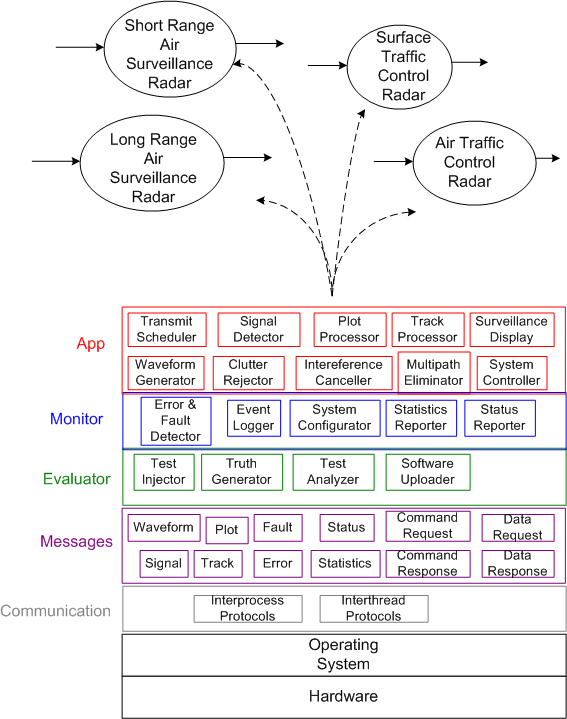
Did you notice the increase in tyranny of detail and complexity as we transcended the 3 levels of abstraction in this post? Well, it gets worse if we continue on cuz we don’t yet have enough information, knowledge, or understanding to start cutting code, building, testing, and standing up the stack – not nearly enough. Thus, let’s just stop right here so we can retain a modicum of sanity. D’oh! Too late!
Fellow Tribe Members
Being a somewhat skeptical evaluator of conventional wisdom myself, I always enjoy promoting heretical ideas shared by unknown members of my “tribe“. Doug Rosenberg and Matt Stephens are two such tribe members.
Waaaay back, when the agile process revolution against linear, waterfall process thinking was ignited via the signing of the agile manifesto, the eXtreme Programming (XP) agile process burst onto the scene as the latest overhyped silver bullet in the software “engineering” community. While a religious cult that idolized the infallible XP process was growing exponentially in the wake of its introduction, Doug and Matt hatched “Extreme Programming Refactored: The Case Against XP“. The book was a deliciously caustic critique of the beloved process. Of course, Matt and Doug were showered with scorn and hate by the XP priesthood as soon as the book rolled off the presses.
Well, Doug and Matt are back for their second act with the delightful “Design Driven Testing: Test Smarter, Not Harder“. This time, the duo from hell pokes holes in the revered TDD (Test Driven Design) approach to software design – which yet again triggered the rise of another new religion in the software community; or should I say “commune“.
BD00’s hat goes off to you guys. Keep up the good work! Maybe your next work should be titled “Lowerarchy Design: The Case Against Hierarchy“.


Why am I here?
WTF?
Meh!
D'oh!

My BTC Address



 Bulldozer00's Blog