Archive
Machine Age Thinking, Systems Age Thinking
In Ackoff’s Best, Mr. Russell Ackoff states the following
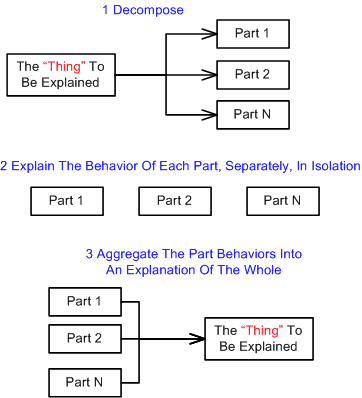
…Machine-Age thinking: (1) decomposition of that which is to be explained, (2) explanation of the behavior or properties of the parts taken separately, and (3) aggregating these explanations into an explanation of the whole. This third step, of course, is synthesis.
The figure below models the classical machine age, mechanistic thinking process described by Ackoff. The problem with this antiquated method of yesteryear is that it doesn’t work very well for systems of any appreciable complexity – especially large socio-technical systems (every one of which is mind-boggingly complex). During the decomposition phase, the interactions between the parts that animate the “thing to be explained” are lost in the freakin’ ether. Even more importantly, the external environment in which the “thing to be explained” lives and interacts is nowhere to be found. This is a huge mistake because the containing environment always has a profound effect on the behavior of the system as a whole.
Mr. Ackoff professes that the antidote to mechanistic thinking is……. system thinking (duh!):
In the systems approach there are also three steps:
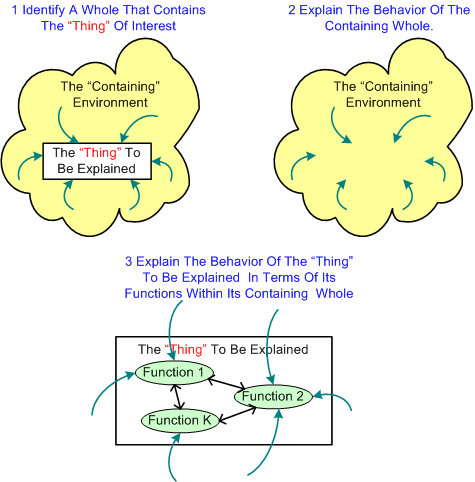
1. Identify a containing whole (system) of which the thing to be explained is a part.
2. Explain the behavior or properties of the containing whole.
3. Then explain the behavior or properties of the thing to be explained in terms of its role(s) or function(s) within its containing whole.
Note that in this sequence, synthesis precedes analysis.
The figure below graphically depicts the systems thinking process. Note that the relationships between the “thing to be explained” and its containing whole are first class citizens in this mode of thinking.
 One of the primary reasons why we seek to understand systems is so that we can diagnose and solve problems that arise within established systems; or to design new systems to solve problems that need to be controlled or ameliorated. By applying the wrong thinking style to a system problem, the cure often ends up being worse than the disease. D’oh!
Growth And Development
Two of my favorite bureaucracy-busting systems thinkers, Russell Ackoff and John Warfield, died this year. I’ll miss them both because whenever I’ve read something written by these guys, I always learned something new.
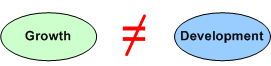
In a tribute to Mr. Ackoff, I’m currently reading Ackoff’s Best: His Classic Writings On Management. One of his off-the-beaten-path insights that he’s passed on to me is the independence between growth and development. Growth is an increase in size or wealth, while development is an increase in capability or competence as a result of learning. According to Ackoff, dumb-ass corpocracies automatically and unquestioningly equate growth with development, and that’s why the vast majority of orgs are obsessed with growth at all costs. Of course, growth and development can, and often do, reinforce each other, but neither is necessary for the other.
Ackoff points out that a system can experience growth without development, and vice versa. A heap of rubbish, or equivalently, a bureaucracy, can grow indefinitely without developing, and artists can develop without growing. If an undeveloped company or company is showered with money, it becomes richer but not more developed. On the other hand, if a well developed company or country is suddenly deprived of wealth, it doesn’t become less developed.
 What is your org doing? Growing? Developing? Both? Neither?
Contained And Container
In Russell Ackoff‘s excellent book titled Idealized Design , he talks about container and contained systems. He essentially states that optimizing the contained system without changing the container system is a failure in waiting. The figure below depicts what often happens when a change agent succeeds in improving the contained system without consideration of the container system.
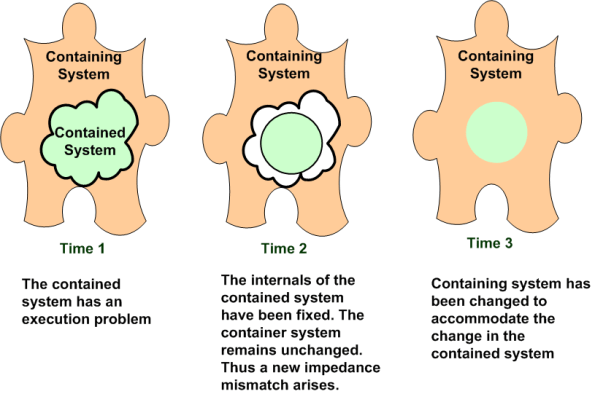
At time 1, the change agent realizes that there is an efficiency problem within the contained system. After an epic battle against the forces conspiring to keep the status quo intact, he/she succeeds in smoothing out the operation of the contained system at time 2. However, since the container system was neglected, it still operates according to the old rules and interfaces of time 1. Thus, an impedance mismatch between the container and contained system interface has appeared. This impedance mismatch can cause organizational performance to be worse than before the change (the cure is worse than the disease) to the contained system!
In an ideal system change effort, both the container and contained systems are improved. Done correctly, a smooth and high performing system-of-systems, like the above model at time 3, can be achieved. Compare the smooth circular integrated interface at time 3 with the previous inefficient and cloudy interfaces of the previous 2 times.

Why am I here?
WTF?
Meh!
D'oh!

My BTC Address



 Bulldozer00's Blog