Archive
Synthanalysis
According to Russell Ackoff, there are two thinking tools for developing an understanding of how existing socio-technical systems work: analysis (reductionism) and synthesis (constructionism). Since analysis is taught in school (and synthesis is not – except in the arts), analysis is a well known tool to problem solvers. Synthesis is not taught in schools because it’s hard to teach – it’s a less methodical and more metaphysical technique than analysis.
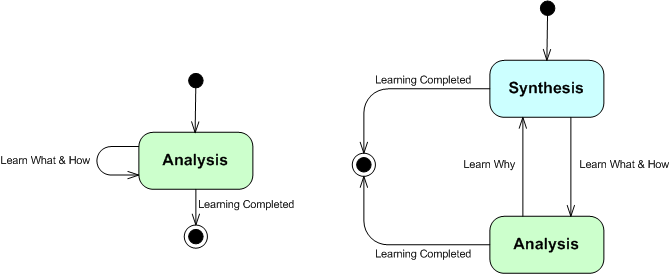
The UML state machine diagram below models the behavior of two different problem solvers – one that exclusively uses analysis and one that bounces non-deterministically between analysis and synthesis. Note that the purpose of entering and dwelling in the synthesis state is to learn the holistic “why” of a system – which always lies outside of the system.
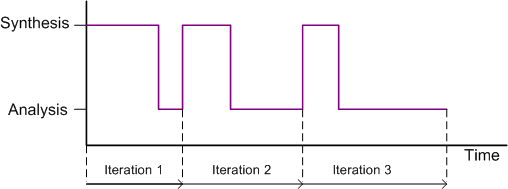
The figure below shows a typical example trace of a synthanalyst problem solver’s behavior over time. Over each iteration toward a viable solution to the problem at hand, a synthanalyst dwells less and less in the synthesis state and more and more in the analysis state. The behavior trace for a one dimensional analyzer is not shown because it’s trivial. It’s a boring and unadventurous flat line – one that self-smug managers trace out every day at work.
Five Levels
According to Russell Ackoff, there are five types of conceptual content. In order of increasing scarcity, they are Data, Information, Knowledge, Understanding, and Wisdom.
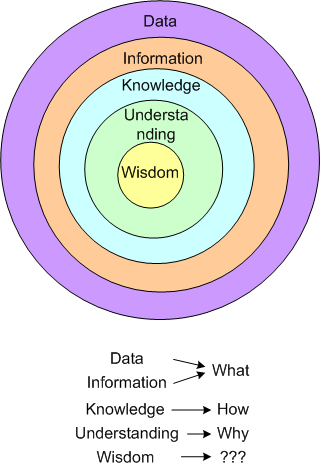
Data and information answer “what something is” questions. Knowledge answers “how something works” questions. Understanding answers “why something is the way it is” questions. Wisdom, the rarest form of conceptual content, is altogether a different beast. It answers all questions.
The acts of probing, sensing, and measuring produce raw data. The filtering, integration and association of data fragments creates information. The mistake-prone application of information and learning from errors leads to knowledge. The application of holistic, systems thinking to knowledge creates understanding.
Unlike the other four types of content, which integrate up and progress sequentially from each other, wisdom may not. Wisdom may appear instantaneously on its own by the grace of some higher power. It has to be that way. If it wasn’t, then only highly educated and experienced intellectuals would be capable of acquiring wisdom – and we know that isn’t true, don’t we? Wisdom is accessible to all human beings regardless of race, age, culture, wealth, or any other trait. The trouble is that society, especially western societies, wants us to think otherwise. No?
Improving, Exploring, Ensuring, Promoting
In Michael C. Jackson‘s rich and engrossing “Systems Thinking: Creative Holism For Managers“, Mr. Jackson describes 10 holistic systems thinking approaches designed to solve complex social managerial problems. As the tables below illustrate, Mr. Jackson allocates the approaches to four classes depending on the main purpose of the approach. For example, he asserts that Stafford Beer‘s “Team Syntegrity” approach is employed primarily to ensure fairness during the process of solving a complex social systems problem.
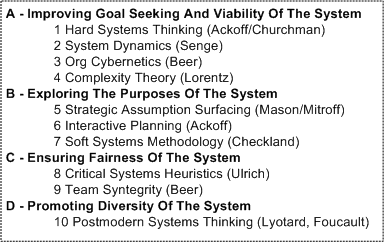
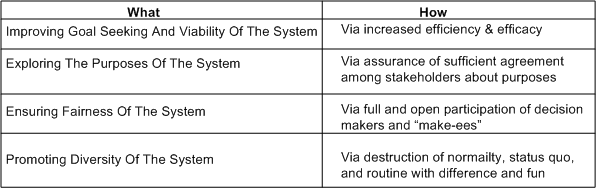
I really like Jackson’s book because of its breadth, vocabulary, and the way he covers each of the 10 systems approaches from its philosophical roots, to theory, to methods. He also supplies a real application example for each approach. In the final part of the book, Jackson integrates all of the approaches into a supra-holistic (?) approach that advocates mixing and matching elements of each approach and tailoring the “Creative Holism” meta-methodology to the specific “mess” at hand.
The last book that I read twice in a row was the brilliant Quantum Enigma by Fred Kuttner and Bruce Rosenblum. I’m gonna do the same with this masterpiece.
Deterministic, Animated, Social
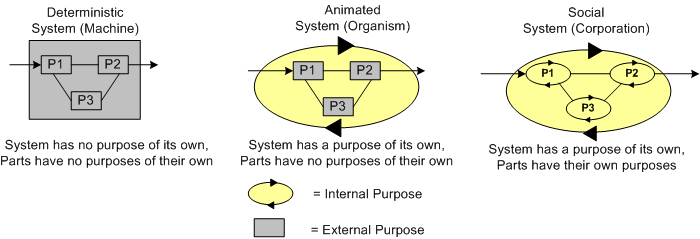
Unless you object, of course, a system can be defined as an aggregation of interacting parts built by a designer for a purpose. Uber systems thinker Russell Ackoff classified systems into three archetypes: deterministic, animated, and social. The main criterion Ackoff uses for mapping a system into its type is purpose; the purpose of the containing whole and the purpose(s) of the whole’s parts.
The figure below attempts to put the Ackoff “system of system types” 🙂 into graphic form.
Deterministic Systems
In a deterministic system like an automobile, neither the whole nor its parts have self-purposes because there is no “self”. Both the whole and its parts are inanimate objects with fixed machine behavior designed and assembled by a purposeful external entity, like an engineering team. Deterministic systems are designed by men to serve specific, targeted purposes of men. The variety of behavior exhibited by deterministic systems, while possibly being complex in an absolute sense, is dwarfed by the variety of behaviors capable of being manifest by animated or social systems.
Animated Systems
In an animated system, the individual parts don’t have isolated purposes of their own, but the containing whole does. The parts and the whole are inseparably entangled in that the parts require services from the whole and the whole requires services from the parts in order to survive. The non-linear product (not sum) of the interactions of the parts manifest as the external observable behavior of the whole. Any specific behavior of the whole cannot be traced to the behavior of a single specific part. The human being is the ultimate example of an animated system. The heart, lungs, liver, an arm, or a leg have no purposes of their own outside of the human body. The whole body, with the aid of the product of the interactions of its parts produces a virtually infinite range of behaviors. Without some parts, the whole cannot survive (loss of a functioning heart). Without other parts, the behavior of the whole becomes constrained (loss of a functioning leg).
Social Systems
In a social system, the whole and each part has a purpose. The larger the system, the greater the number and variety of the purposes. If they aren’t aligned to some degree, the product of the purposes can cause a huge range of externally observed behaviors to be manifest. When the self-purposes of the parts are in total alignment with whole, the system’s behavior exhibits less variety and greater efficiency at trying to fulfill the whole’s purpose(s). Both internal and external forces continually impose pressure upon the whole and its parts to misalign. Only those designers who can keep the parts’ purpose aligned with the whole’s purpose have any chance of getting the whole to fulfill its purpose.
System And Model Mismatch
Ackoff states that modeling a system of one type with the wrong type for the purpose of improving or replacing it is the cause of epic failures. For example, attempting to model a social system as a deterministic system with an underlying mathematical model causes erroneous actions and decisions to be made by ignoring the purposes of the parts. Human purposes cannot be modeled with equations. Likewise, modeling a social system as an animated system also ignores the purposes of the many parts. These mismatches assume the purposes of the parts align with each other and the purpose of the whole. Bad assumption, no?
Busy Doing Nothing
The British created a civil service job in 1803 calling for a man to stand on the Cliffs of Dover. The man was supposed to ring a bell if he saw Napolean coming….. The job was abolished in 1945. – Robert Townsend.
The battle of Waterloo, in which Napolean’s army was routed, was fought in 1815. Thus, the series of dudes who stood guard for 130 years after the fall of the egotistical French emperor were busy doing nothing but pissing and pooping off the cliffs every few hours – and gettin’ paid for it.

In “Ackoff’s Best: His Classic Writings On Management“, uber systems thinker Russell Ackoff rails against bureaucracies:
A bureaucracy is an organization whose principle objective is to keep people busy doing nothing. They are preoccupied with what we call make-work…. The problem created by people who are busy doing nothing is that they frequently obstruct others who have real work to do. They impose unproductive requirements on others…. Bureaucracies obstruct development. They retard improvement of quality of life…. Bureaucrats want all parts of an organization to conform to one set of rules and regulations…. Conformity is treated as good in itself, an ultimate good. – Russell Ackoff
Mr. Ackoff not only rages against the machine, he advises on how to beat the system with a bevy of hilarious real-life examples in which individuals successfully “fought city hall” and won. He follows each ditty with a moral. Buy the book and read it for the delicious details of every battle.
Ackoff On Systems Thinking
Russell Ackoff, bless his soul, was a rare, top echelon systems thinker who successfully avoided being assimilated by the borg. Checkout the master’s intro to systems thinking in the short series of videos below.
What do you think?
A New Title Should Do It
“To solve our decreasing revenue and rising cost problems, we’ll just create a new title and insert the position into the org (thereby adding another layer to the stratified corpo cake). Voila! The problem will be solved (so let’s give ourselves a special bonus for being so smart).”
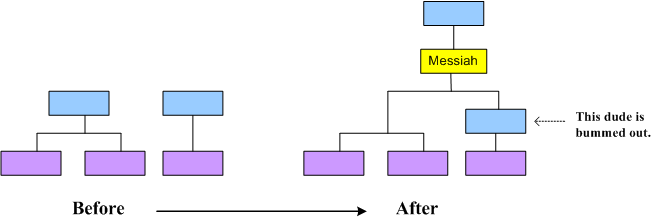
“But wait. What should the title be? Supervisor, Manager, Deputy Manager, Director, Deputy Director, General Manager? Should we bump it up by attaching a “Chief” and/or VP to the label? “We must be careful because the loftier the title, the more we’ll have to pay our new colleague (who will no doubt accomplish what we have failed to do).”

Such is the mindset of MBA trained corpo elites and their stooge press magazines like Business Week, Forbes, Fortune, et al. Do ya really think parachuting a messiah in to jumpstart an org with:
- an apathetic DICforce that is not as stupid as the head shed assumes and doesn’t appreciate management’s patronizing attitude
- an aging product development and manufacturing infrastructure (e.g. tools, processes, know how)
- an old and tired product portfolio that’s continually being usurped by competitor offerings
- a culture of undiscussable but obvious inter-group rivalry and disrespect
is realistic? Fragmented, hero-worshipping mindsets don’t clean up what Russell Ackoff calls, for lack of a better word, “messes”. Systemic thinking, along with the willingness to skinny dip, fully exposed, into the stinky mess is the only way to understand and clean up messes. Sadly, even if one or two dudes in the head shed junta are closet system thinkers and they try to speak out or take action, they’re promptly put back into their assigned slot….. and business resumes as usual…. while the mess grows ominously larger.
And now, for the bad news….. 🙂
Bone Rattlers

Peter Senge is a colleague of dear, departed Russell Ackoff. Peter recently wrote a passionate tribute to his friend on the Ackoff Center Weblog and he rang my bell with these bone-rattling quotes:
So long as people think in fragmented ways they will act similarly – Peter Senge
The inherited traditions over generations toward patriarchy, authoritarian views of leadership, and rigid systems of institutional power will not change in a generation – Peter Senge
How long will we preserve the belief that power comes from institutional position versus connection to the creative flow of the universe? – Peter Senge
The forces for change come from “life’s longing for itself,” not from ego-based human striving – Peter Senge
That last quote is really a zinger because I’ve been wrestling with my ego ever since I finally came to the realization that it dominates my (and the vast majority of other people’s) thinking and external behavior. Sadly, I (the real self) don’t have the upper hand on the “I” (the imposter) thought, but some day I hope to do so. Hence, my spiritual quest continues in a seemingly self-referential infinite looping attempt to use the ego to beat the ego into submission.
How about you? Do you realize that you’re not living up to your full potential because your ego is in charge? Do you care, or is everything just peachy keen for you the way you are?
Loyal, Or Disloyal?
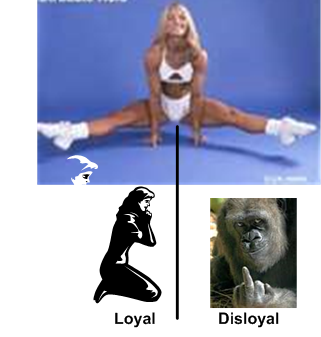
In virtually every organization comprised of a large group of human beings, one individual or sub-group always holds absolute “power over” the members who hold the “power to” get things done. Because of the innate primal human desire to retain power and remain in control, there’s a dangerous fine line that every “power to” member should be acutely aware of.
On one side of the line is “loyalty”. On the other side is “disloyalty”. Those in charge, of course, are the ultimate arbiters of where you stand in relation to line. I like to straddle the line (see below), but it’s not within my power to judge where I stand.
Note: I borrowed the “power over” and “power to” concepts from Russell Ackoff, a true management genius – that everyone in the mainstream ignores, of course.
Nested Bureaucracies
By definition, ineffective bureaucracies (are there any effective ones?) consume more resources than they produce in equivalent value to their users/consumers. According to Russell Ackoff, the only way an ineffective bureaucracy can remain in place is by external subsidization that is totally disconnected with its performance. In other words, bureaucracies rely on clueless sugar daddies supplying them with operating budgets without regard to whether they are contributing more to “the whole” than they are withdrawing. Unchecked growth of internal bureaucracies siphons off profits and it can, like a cancer, kill the hosting org.
The figure below shows a simplistic bird’s eye view of an American economic system dominated by CCH bureaucracies. The irony in this situation is that even though the Corpo Granite Heads (CGH) in charge of the CCHs are staunch supporters of the distributed free market model which rewards value creation and punishes under-performance, they run their own orgs like the old Soviet Union. Ala GM and most huge government departments, they operate as centralized, nested bureaucracies where the sloth at the top trickles money down to the mini-bureaucracies below – without regard to value produced.
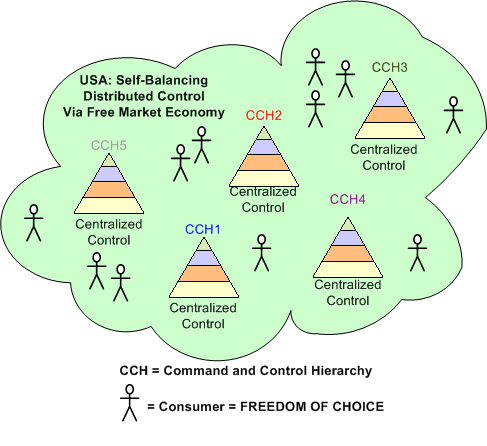
Bureaucracies, being what they are and seeking to survive at all costs, jump through all kinds of hoops to camouflage their worthlessness and keep the money flowing down from the heavens. Since the cabal at the top is too ignorant to recognize that it’s a bureaucracy in its own right, it’s an expert camouflage spinner to the corpocracy’s stakeholders (who gobble up the putrid camouflage with nary a whimper) and it sucks much more out of the corpo coffers than it adds value without being “discovered and held accountable”. In the worst nested bureaucracies, none of the groups in the hierarchy, from the top layer all the way down the tree to the bottom layer, produce enough value to offset their ravenous appetite for resources. They collapse under the weight of their own incompetence and then wonder WTF happened. From excellence to bankruptcy in 24 hours.
The really sad part is that before a bureaucracy auto-snaps into place, it wasn’t a bureaucracy in the first place. Everybody in the “startup” contributed more than they withdrew from the whole, and the excess value translated into external sales and internal profits. Like the boiled frog story, the transformation into a bureaucracy was slooow and undetectable to the CGHs in charge. Bummer.
The answer to this cycle of woe, according to Ackoff, is for the leaders in an org to operate the whole (including themselves) as a system of nested free markets, where each internal consumer of services gets to choose whether it will purchase needed services from internal groups, or external groups. Each internal group, including the formerly untouchable head shed, must operate as a measurable profit and loss center. Mr. Ackoff describes all the details of nested free market operation, including responses to many of the “it can’t work because of……” elite whiners, in his insightful book: Ackoff’s Best. Check it out, if you dare.

Why am I here?
WTF?
Meh!
D'oh!

My BTC Address



 Bulldozer00's Blog