Archive
Functional Allocation V
Holy cow! We’re up to the fifth boring blarticle that delves into the mysterious nature of “Functional Allocation”. Let’s start here with the hypothetical 6 level allocation reference tree that was presented earlier.
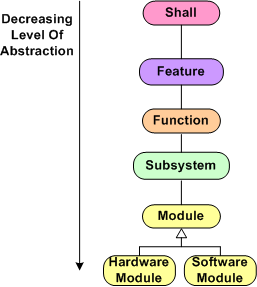
Assume that our company is smart enough to define and standardize a reference tree like this one in their formal process documentation. Now, let’s assume that our company has been contracted to develop a Large And Complex (LAC) software-intensive system. My fuzzy and un-rigorous definition of large and complex is:
“The product has, (or will have after it’s built) lots of parts, many different kinds of parts, lots of internal and external interfaces, and lots of different types of interfaces”.
The figure below shows a partial result of step one in the multi-level process; the Shall-To-Feature (STF) allocation process. Given a set of 5 customer-supplied abstract “shalls”, someone has made the design decisions that led to the identification and definition of 3 less-abstract features that the product must provide in order to satisfy the customer shalls.We’ve started the movement from the abstract to the less abstract.
Just imagine what the model below would look like in the case where we had 100s of shalls to wrestle with. How could anyone possibly conclude up front that the set of shalls have been completely covered by the feature set? At this stage of the game, I assert that you can’t. You have to make a commitment and move on. In all likelihood, the initial STF allocation result won’t work. Thus, if your process doesn’t explicitly include the concept of “iterating on mistakes made and on new knowledge gained” as the product development process lurches forward, you’ll get what you deserve.
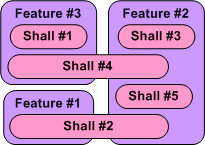
Note that in the simple example above, there is no clean and proper one-to-one STF mapping and there are 2 cross-cutting “shalls”. Also, note that there is no logical rule or mathematical formula grounded in physics that enables a shallocator (robot or human) to mechanically compute an “optimum” feature set and perform the corresponding STF allocation. It’s abstract stuff, and different qualified people will come up with different designs. Management, take heed of that fact.
So, given the initial finished STF allocation output (recorded and made accessible and visible for others to evaluate, of course) how was it arrived at? Could the effort be codified in a step-by-step Standard Operating Procedure (SOP) so that it can be classified as “repeatable and predictable”? I say no, regardless of what bureaucrats and process managers who’ve never done it themselves think. What about you, what do you think?
Functional Allocation IV
Part IV is a continuation of our discussion regarding the often misunderstood and ill-defined process of “functional allocation”. In this part we’ll, explore the nature of the “shallocation” task, some daunting organizational obstacles to its successful completion, and the dependency of quality of output on the specific persons assigned (or allocated?) to the task.
If you can find one, the process description of functional allocation starts out assuming that a human allocator is given a linear text list, which maybe quite large, of “shalls” supplied by an external customer or internal customer advocate. Of course, these “shalls” are also assumed to be unambiguous, consistent, non-contradictory, complete, and intelligently organized (yeah, right).
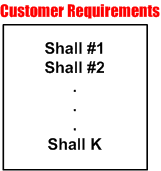
My personal experience has been that the “shalls” are usually strewn all over the place and the artifact that holds them is severely lacking in what Fred Brooks called “conceptual integrity”. Sometimes, the “shalls” seem to randomly jump back and forth from high level abstractions down to physical properties – a mixed mess hacked together by a group of individuals with different agendas. In addition, some customers (especially government bureaucracies) often impose some overconstraining “shalls” on the structure of the development team and the processes that the team is required to use during the development of the solution to their problem (control freaks). Even worse, in order to project a false image of “we know what we’re doing” infallibility and the fact that they don’t have to do the hard value-creation work themselves, helpful managers of developer orgs often discourage, or downright prevent, clarification questions from being asked of the customer by development team members. All communciations must be filtered through the “proper” chain of command, regardless of how long it takes or whether technical questions get filtered and distorted to incomprehensibilty through non-technical wonks with a fancy title. Bummer.
Because we want to move forward with this discussion, assume the unassume-able; the customer “shall” list is perfectly complete and understood by the developer org’s system engineers. What’s next? The figure below shows the “initialization” state. The perfect list of “shalls” must be shallocated to a set of non-existent product functions. Someone, somehow, has got to conceive of and define the set of functions and the logical inter-function connectivity that will satisfy the perfectly clear and complete “shalls” list.
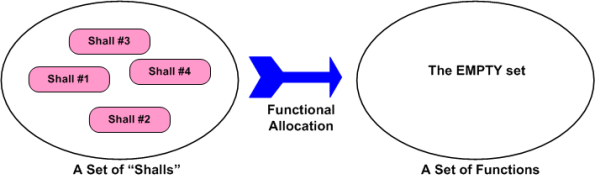
Piece of cake, right? The task of shallocation is so easy and well described by many others (yeah, right), that I won’t even waste any e-space giving the step by step recipe for it. The figure below shows the logical functional structure of the product after the trivial shallocation process is completed by a robot or an expensive automated software tool.
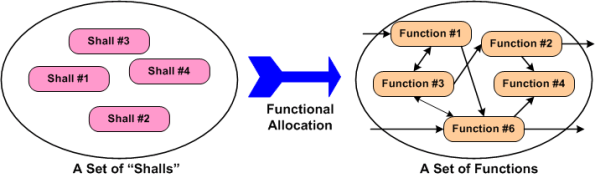
Realistically, in today’s world the shallocation process can’t be automated away, and it’s highly person-specific. As the example in the figure below shows, given the same set of “shalls”, two different people will, “after a miracle occurs”, likely conjure up a different set of functions in an attempt to meet the customer’s product requirements. Not only can the number of functions, and the internal nature of each function be different, the allocation of shalls-to-functions may be different. Expecting a pristine, one-to-one shall-to-function mapping is unrealistically utopian.
What the example below doesn’t show is the person-specific creation of the inter-function logical connectivity (see the right portion of the previous figure) that is required for the product system to “work”. After all, a set of unconnected functions, much like a heap of car parts, doesn’t do anything but sit there looking sophisticated. It’s the interactions between the functions during operation that give a product it’s power to maybe, just maybe, solve a customer’s problem.
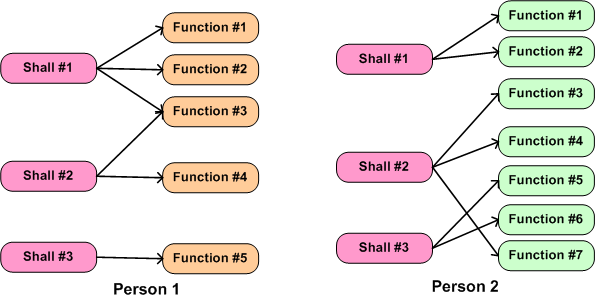
The purpose of part IV in this seemingly endless series of blarticles on “functional allocation” was to basically point out the person-specific nature of the first step in a multi-level nested allocation process. It also hinted at some obstacles that conspire to thwart the effective performance of the task of shallocation.
Functional Allocation I
Some system engineering process descriptions talk about “Functional Allocation” as being one of the activities that is performed during product development. So, what is “Functional Allocation”? Is it the allocation of a set of interrelated functions to a set of “something else”? Is it the allocation of a set of “something else” to a set of function(s)? Is it both? Is it done once, or is it done multiple times, progressing down a ladder of decreasing abstraction until the final allocation iteration is from something abstract to something concrete and physically measurable?
I hate the word “allocation”. I prefer the word “design” because that’s what the activity really is. Given a specific set of items at one level of abstraction, the “allocator” must create a new set of items at the next lower level of abstraction. That seems like design to me, doesn’t it? Depending on the nature and complexity of the product under development, conjuring up the next lower level set of items may be very difficult. The “allocator” has an infinite set of items to consciously choose from and purposefully interconnect. “Allocation” implies a bland, mechanistic, and deterministic procedure of apportioning one set of given items to another different set of given items. However, in real life only one set of items is “given” and the other set must be concocted out of nowhere.
The figure below shows four different types of functional allocations: shalls-to-functions, features-to-functions, functions-to-modules, and functions-to-subsystems. Each allocation example has a set of functions involved. In the first two examples, the set of functions have been allocated “to”, and in the last two examples, the set of functions have been allocated “from”.
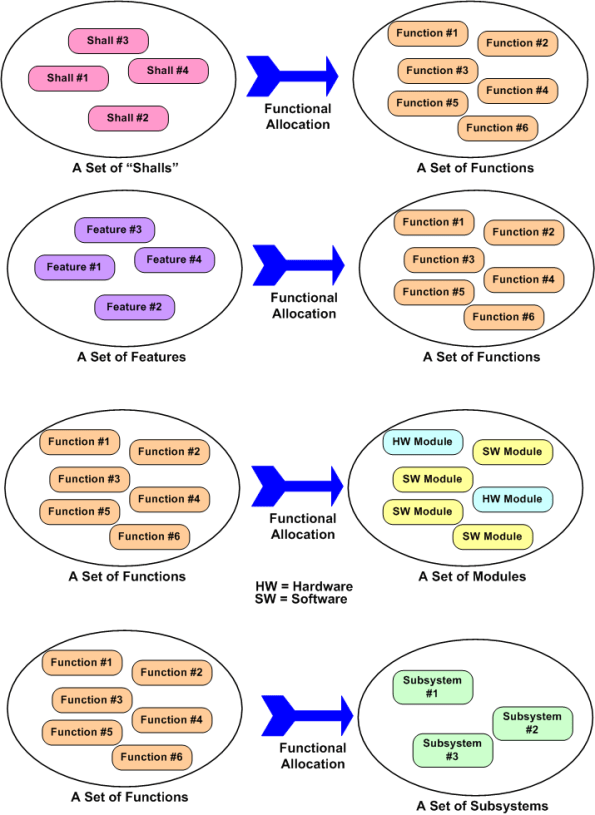
So, again I ask, what is functional allocation? To managers who love to remove people from the loop and automate every activity they possibly can to reduce costs, can human beings ever be removed from the process of functional allocation? If you said no, then what can you do to help make the process of allocation more efficient?
Upstream Bullies
In the aerospace and defense industry, a system engineer is the equivalent of a business analyst. They’re supposed to specify and record clear and unambiguous software requirements for the software development team, and then help the team get the requirements right.
In my experience, excellent system engineers are very hard to come by. The vast majority of them drop open-ended one line bombshells like “The system shall detect targets with a probability of detection of 95%” on the development team. Then these “shallocators” disconnect and distance themselves from the programming team and morph into glorified project managers, but without the responsibility. I call these types of system engineers upstream bullies because they’re always looking over your shoulder and telling you how to do your job even though they’ve never written anything bigger than “Hello World!”. Upstream bullies also demand that programmers dot the I’s and cross the T’s even though their own work, which is the input to the software team’s work, is a useless POS.

Ever wonder why you frequently read about large software-intensive government projects that are massively late and over budget? Besides poor leadership, another big reason is that upstream bullies are at work. If you’re a software developer and you have a choice, stay away from upstream bully shall-meisters.

Why am I here?
WTF?
Meh!
D'oh!

My BTC Address



 Bulldozer00's Blog