Archive
Respect From The Top, Disdain From The Bottom
In Scott Berkun‘s blog post, “Why Project Managers (PM) get no respect“, he gets to the heart of his assertion of why “output producers” don’t harbor much professional respect for “output managers“:
The core problem is perspective. Our culture does not think of movie directors, executive chefs, astronauts, brain surgeons, or rock stars as project managers, despite the fact that much of what these cool, high profile occupations do is manage projects. Everything is a project. The difference is these individuals would never describe themselves primarily as project managers. They’d describe themselves as directors, architects or rock stars first, and as a projects manager or team leaders second. They are committed first to the output, not the process. And the perspective many PMs have is the opposite: they are committed first to the process, and their status in the process, not the output.
If one doesn’t understand the “project output” to some degree, especially what makes for a high quality output, there is no choice but to focus on process over output. And as one goes higher up in the corpo status chain, the preference for concentrating on process and its artifacts (spreadsheets, specifications, presentations, status reports) over output tends to increase because meta-managers have much in common with lesser “output managers” and not much in common with “output producers“. It is what it is, and unless so-called process champions are continuously educated on the specific types of “outputs” their institutions produce, it will remain what it is.
It’s About The People, Stupid
Check out the chapter names in part III of a brand spanking new “Project Manager‘s Handbook“:
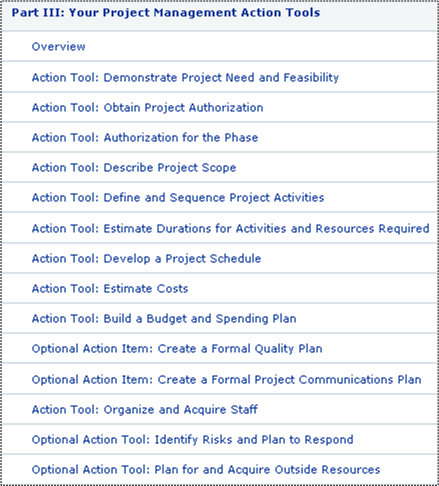
So much for valuing “people and interactions over tools and processes“, no? The closest the book comes to mentioning people is that the word “staff” is mentioned once and “resources” twice. And no, the first two parts don’t emphasize the importance of people either:

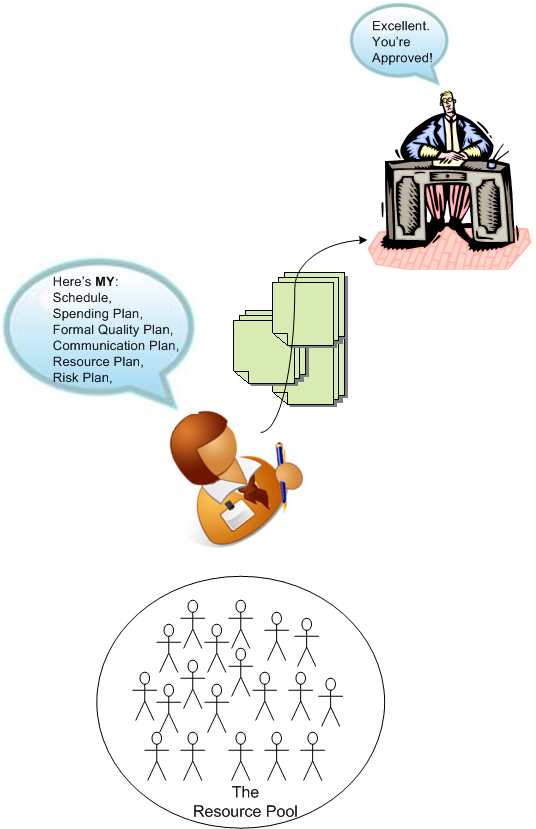
So, aspiring young project manager, it’s obviously all about you. All ya gotta do to be successful is mechanistically follow the infallible recipe; dot the i’s and cross the t’s. Fuggedabout developing trusting, helpful, two-way relationships with the people who will be executing your project work. It’s not important or even necessary. All you have to do is: develop the plan, “acquire the resources”, and push the “go” button. 1-2-3.
To be semi-fair, I haven’t (and don’t plan to) read the book. The author may indeed address the thorny issues associated with monitoring progress and product quality, guiding the effort, and ensuring the well being of the people so that they’re willing to do their best – but I doubt it.
Effective But Destructive
In “I’m Feeling Lucky”: Google Employee No. 59 Tells All , Douglas Edwards tells one story about mercurial Google co-founder Larry Page:
How Larry reorganized the engineering department, for example. He didn’t like the fact that project managers were getting between him and engineers, so he called a meeting and told them very publicly that he didn’t need them–.
I’ll assert that in lots of companies, the reverse is true. In those that are DYSCOs and CLORGs, head cheeses don’t care to understand what goes on down in the boiler rooms and they desperately need project managers to tell them what’s going on. The funny part is that the project managers most likely don’t know either. D’oh!
 There’s a second part to this post and the message is at the tail end of the full version of Mr. Edwards’s quote:
How Larry reorganized the engineering department, for example. He didn’t like the fact that project managers were getting between him and engineers, so he called a meeting and told them very publicly that he didn’t need them–and those people felt humiliated. I think Larry took a lesson from that, and I think he became more adept over time at managing. A young startup entrepreneur might share some of the characteristics of Larry. “If there’s a problem, reboot, fix it, move on.” That can be effective but can also be destructive. It can tear down relationships.

Why am I here?
WTF?
Meh!
D'oh!

My BTC Address



 Bulldozer00's Blog