Archive
The Promotion Strategy
On the left side of the following figure, we have a typical mega-project structure with a minimal Overhead-to-Production personnel ratio (O/P). If all goes well, the O/P ratio stays the same throughout the execution phase. However, if the originally planned schedule starts slipping, there’s a tendency of some orgs to unconsciously exacerbate the slippage. In order to reign in the slippage via exercising tighter control, the org “promotes” one or more senior personnel out of the realm of production and into the ranks of overhead to help things along.
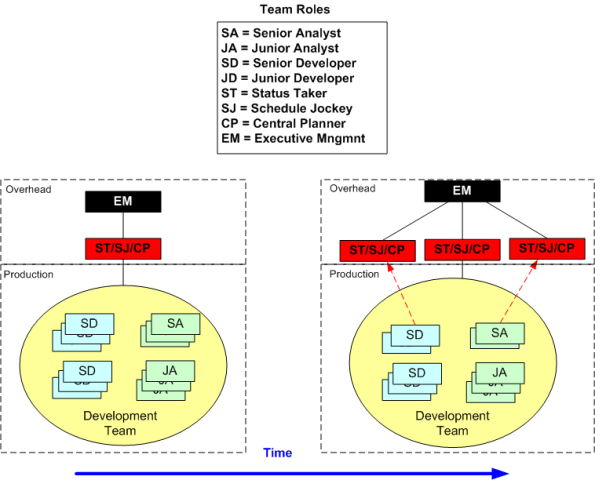
By executing the “promotion strategy“, the O/P ratio increases – which is never a good thing for profit margins. In addition, the remaining “unpromoted” senior + junior analysts and developers are left to pick up the work left behind by the newly minted overhead landlords.
So, if you’re in the uncomfortable position of being pressured to increase execution efficiency in order to pull in a slipping schedule, you might want to think twice about employing the “promotion strategy” to get things back on track.
The brilliant Fred Brooks famously stated something akin to “Adding people to a late project only makes it later“. In this infamous post, dimwit BD00 states that “Promoting personnel from production to overhead on a late project only makes it later“.
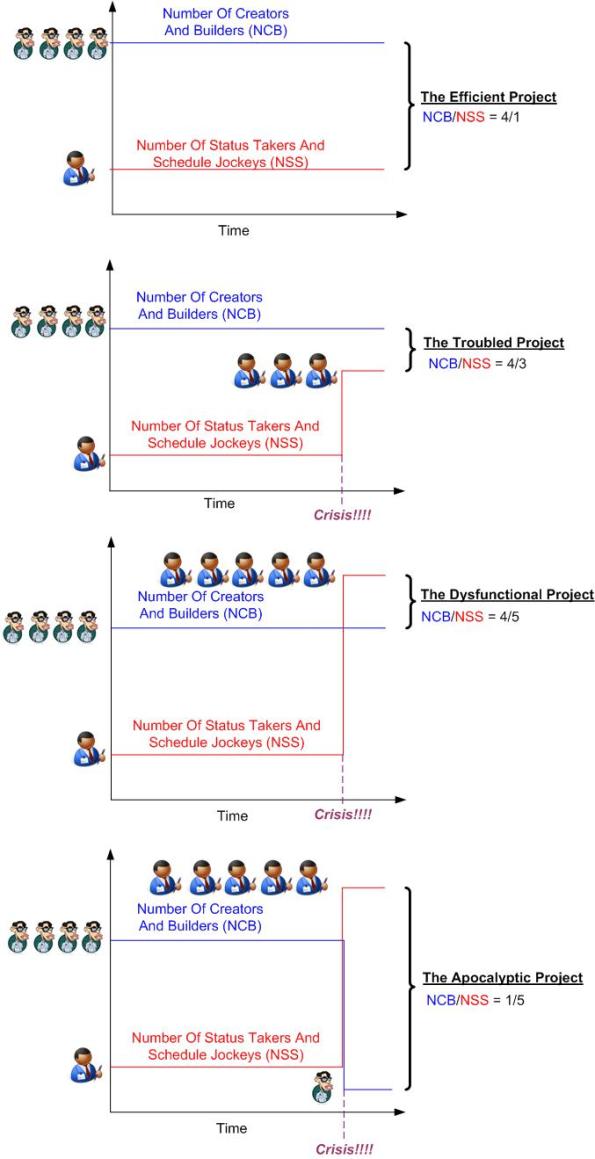
The Efficient, The Troubled, The Dysfunctional, The Apocalyptic
Deal Of The Year
Hot off the presses, I just received a Groupon offer to take a $99 online Scrum Master certification course. Holy crap! Instead of paying $2000 and taking 3 consecutive days off from work, I can learn how to become a micro-managing process enforcer from the comfort of my own home; munching on chips while lounging around in my skivvies.

How can I refuse such a great deal? Just look at all those smart, well-dressed, professional, micro-managers in the advertisement staring at a burndown chart. It’s an especially nice touch that the marketing team put a pair of eyeglasses in Katherine Heigl’s hand.
From the course description:
CSMs understand Scrum values, practices, and applications and provide a level of knowledge and expertise above and beyond that of typical project managers.
If you’re a “typical project manager“, your days are numbered. The sky is falling and all that uncool PMI and EVM training you suffered through is sooooo yesterday.

Satirical Substitution
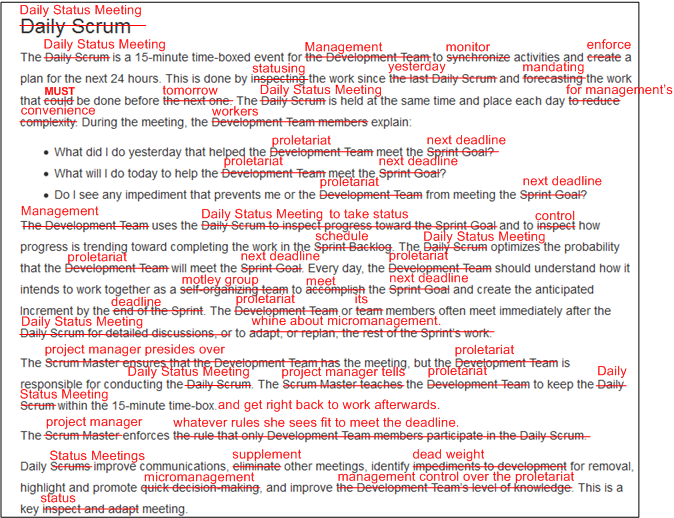
Here’s how a Theory-X indoctrinated manager interprets the definition of the Daily Scrum as written in the official Scrum Guide:
A No Go For Me
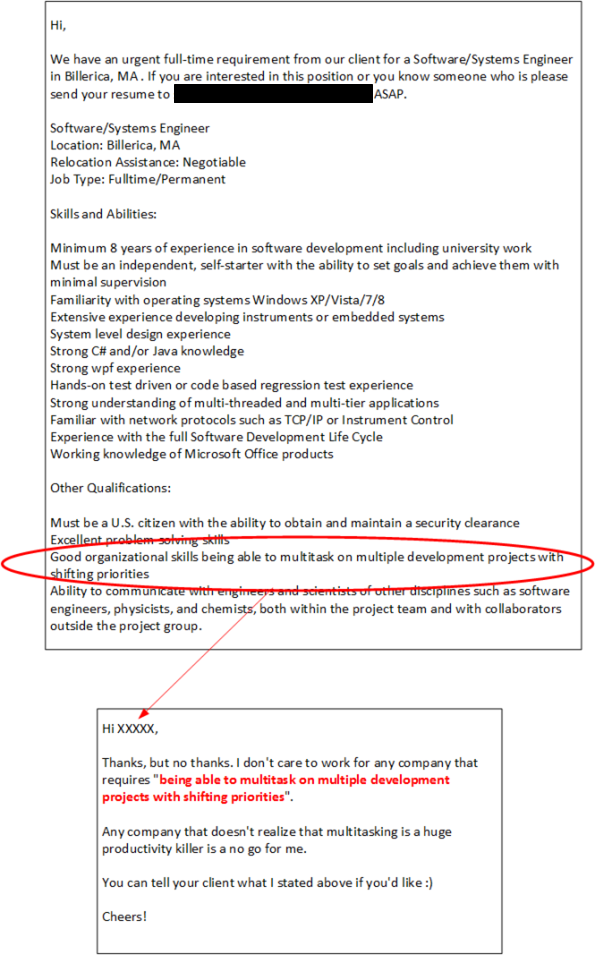
Of course, if I was unemployed, or actively looking for a new job, I would have replied differently to the solicitation. Wouldn’t you have?
It’s All About That Jell
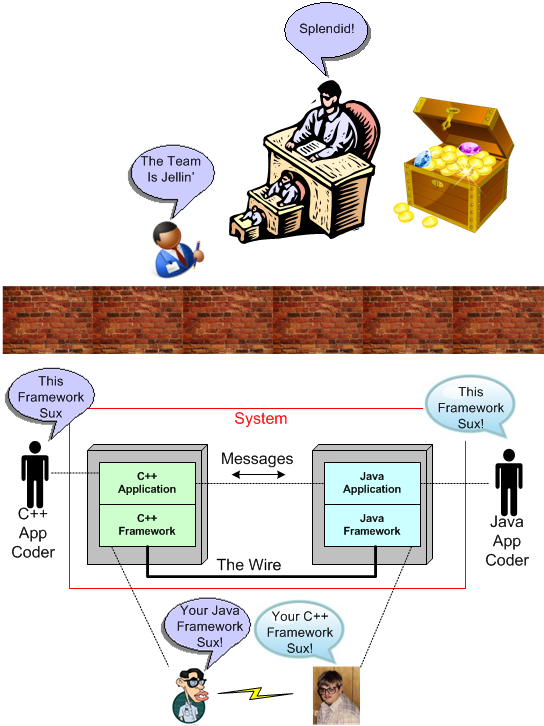
Agile, Traditional, Lean, Burndown Charts, Kanban Boards, Earned Value Management Metrics, Code Coverage, Static Code Analysis, Coaches, Consultants, Daily Standup Meetings, Weekly Sit Down Meetings, Periodic Program/Project Reviews. All the shit managers obsess over doesn’t matter. It’s all about that Jell, ’bout that jell, ’bout that jell.

VCID, ACID, SCID
First, we have VCID:
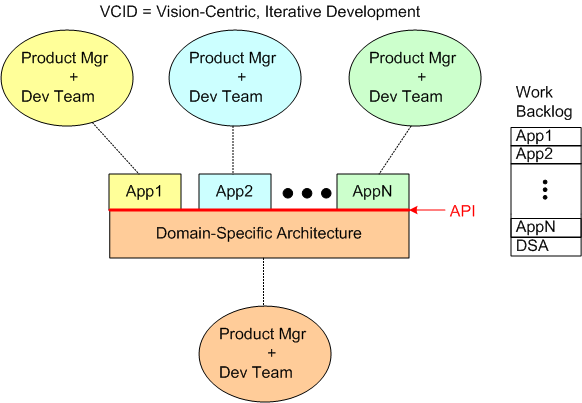
In VCID mode, we iteratively define, at a coarse level of granularity, what the Domain-Specific Architecture (DSA) is and what the revenue-generating portfolio of Apps that we’ll be developing are.
Next up, we have ACID:
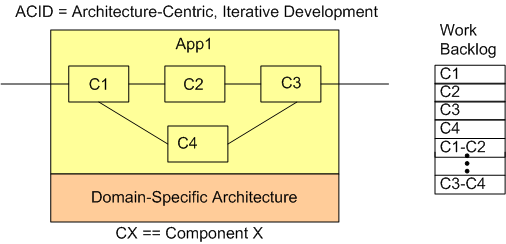
In ACID mode, we’ll iteratively define, at at finer level of detail, what each of our Apps will do for our customers and the components that will comprise each App.
Then, we have SCID, where we iteratively cut real App & DSA code and implement per-App stories/use cases/functions:
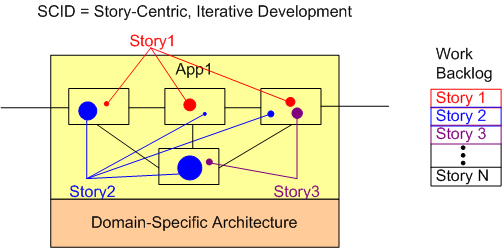
But STOP! Unlike the previous paragraphs imply, the “CID”s shouldn’t be managed as a sequential, three step, waterfall execution from the abstract world of concepts to the real world of concrete code. If so, your work is perhaps doomed. The CIDs should inform each other. When work in one CID exposes an error(s) in another CID, a transition into the flawed CID state should be executed to repair the error(s).
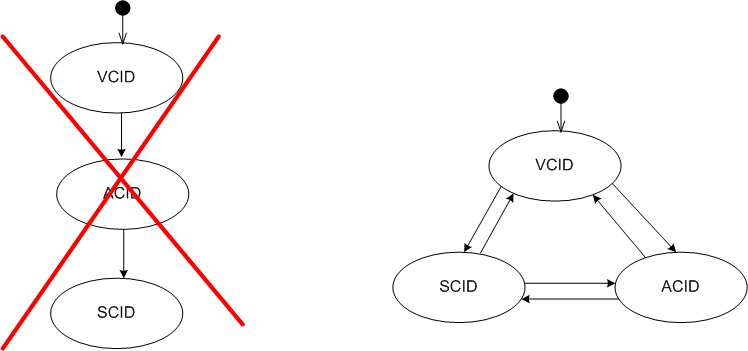
Managed correctly, your product development system becomes a dynamically executing, inter-coupled, set of operating states with error-correcting feedback loops that steer the system toward its goal of providing value to your customers and profits to your coffers.
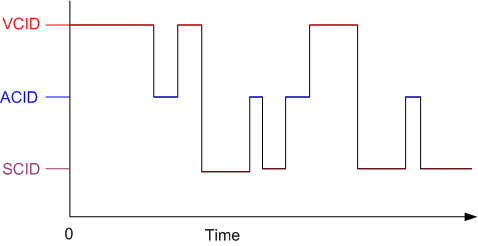
Tradagile
Even though hard-core agilistas (since every cause requires an evil enemy) present it as thus:

For large, complex, multi-disciplined, product developments, it should be as thus:

The Trees And The Forest
As a result of an online Twitter exchange with Mr. Jon Quigley, I was able to purchase a copy of his and Kim Pries’s book, “Project Management Of Complex And Embedded Systems“. In exchange for a half-price deal, I promised to blog a review of the book and, thus, this is it.

As indicated by the book title, the subject matter is all about the methods and tools commonly used by program/project managers for orchestrating large, capital-intensive, multi-disciplined, product development endeavors. Specifically, the content focuses on how the automotive industry successfully manages the development and production of products composed of thousands of electro-mechanical parts and hundreds of networked processors, some of which run safety-critical software. Even though we tend to take them for granted, when you think about it, an automobile is an extremely complex distributed system requiring lots of coordinated mental, physical, and automated, labor to produce.
The book provides comprehensive, yet introductory, coverage of the myriad of tools and processes used in the world of big project management. It’s more of a broad, sweeping, reference book than a detailed step-by-step prescription for executing a specific set of processes. It’s jam packed with lots of useful lists, figures, tables, and graphs. The end of each chapter even includes a specific “war story” experienced by one or both of the authors over their long careers.
As a long time software developer of complex embedded systems in the aerospace and defense industry, much of the book’s subject matter is familiar to me. RFPs, SOWs, WBSs, EVM, BOMs, V&V, SRRs, PDRs, CDRs, TRRs, FMEA, staged-gate phases, prime-subcontractor relationships, master schedules, multi-level approvals, quality metrics, docu-centric information exchanges, etc, are amongst the methods used to facilitate, focus, constrain, and guide end-to-end system development. Many of the chapter-ending war stories tickled my funny bone too!
For the types of projects Mssrs. Pries and Quigley target in the book, kicking off a project at sprint 0 with a self-organizing team of eight cross-functional developers and a primed product backlog of user stories just doesn’t cut it. So, if you’re a young, naive, cloistered software developer or scrum master or product owner who belittles all “traditional“, rigorous, non-agile processes, I highly recommend this book. It will give you a glimpse into a whole different world and broaden your horizons – perhaps allowing you to see both the trees and the forest.
The Only Approval That Matters
At its core, process agility is all about continuous learning, fast feedback loops, and fluid changeability. Unlike pre-agile methods (and even some currently purported agile methods), which assume that people are forward-marching automatons who “better not make mistakes” and must defend the fort against all external forces of change, process agility accommodates the mental limitations and fallibility of REAL human beings.
Having said that, how agile do you think a process which includes a sign-off list like this is:
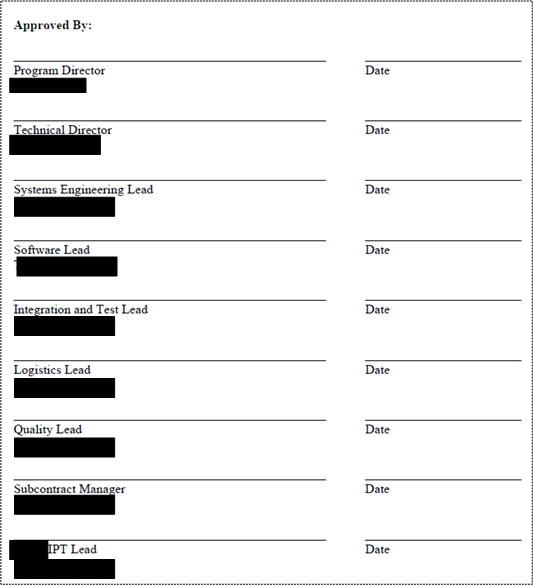
Imagine that whatever has been “approved” by a ceremonial sheet like this is post-facto found to be laced with errors, inconsistencies, and ambiguities due to natural human fallibility. How likely do you think that finders-of-mistakes will publicly point them out, demand a production line stoppage to fix the turds, and suggest that the director-manager-lead approval gauntlet be traversed again? Conversely, how likely do you think that finders-of-mistakes will say “f*ck-it!“, keep their mouths shut, and keep goose-stepping forward with the herd.

Fear not, dear reader. BD00 has a simple and clean solution to the director-manager-lead approval gauntlet problem. Collapse the list of approvers down to one – the only one that matters:
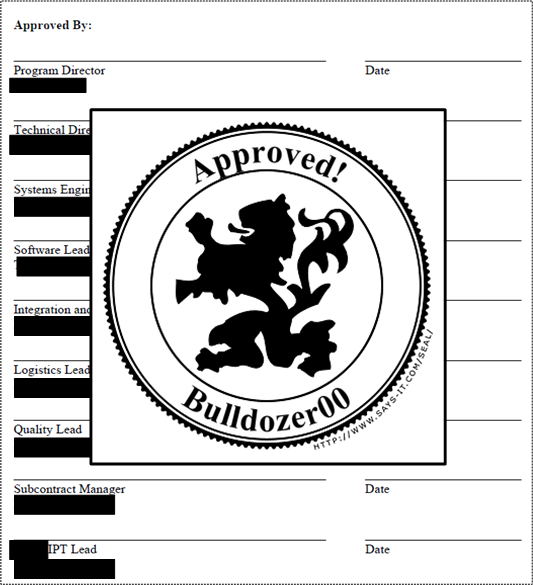
Please submit your plans for BD00 approval in the comments section. As his executive assistant, I can assure you that his stamp/no-stamp decision will be made pronto. However, don’t call us. We’ll call you.

Why am I here?
WTF?
Meh!
D'oh!

My BTC Address



 Bulldozer00's Blog