Archive
Popularity Contest
The TIOBE Programming Community index is an indicator of the popularity of programming languages. The index is updated once a month. The ratings are based on estimates of the number of skilled engineers world-wide, available training courses, and third party vendors. The results are computed (somehow) from the web’s most popular search engines; Google, Bing, Yahoo!, Wikipedia, YouTube, and Baidu.
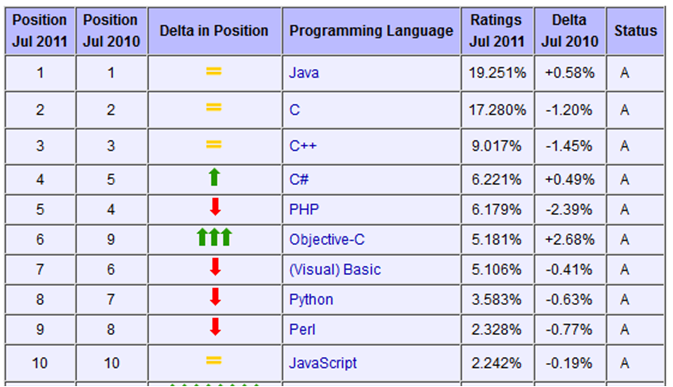
My favorite language, C++, is in third place, but quite a bit behind Java and C. I think that Objective-C took a big jump relative to last year because of the Apple iPad juggernaut. I’m bummed that my second favorite language, Erlang, didn’t even make the top 20.
State Of The Union
For the multi-threaded CSCI that I’m developing, I’ve got to receive and decode serialized messages off of “the wire” that conform to the design below. Depending on the value of “payloadType” in the message, each instance of the “WireMessage” class will have either an instance of “DataBlock1” or “DataBlock2” embedded within it.

After contemplating how to implement the deserialized replica of the message within my code, I decided to use a union to keep the message at a fixed size as it is manipulated and propagated forward through the non-polymorphic queues that connect the threads together in the CSCI.
The figure below shows side by side code snippets of the use of a union within a class. The code on the left compiled fine, but the compiler barfed on the code on the right with a “data member with constructor not allowed in union” error. WTF?
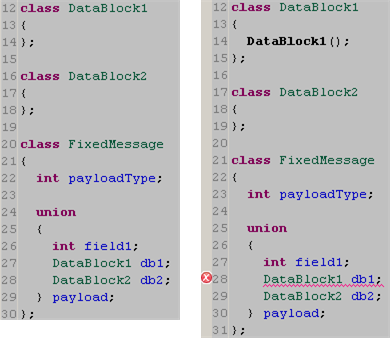
At first, I didn’t understand why the compiler didn’t like the code on the right. But after doing a little research, it made sense.
Unlike the code on the left, which has empty compiler-generated ctor, dtor, and copy operations, the DataBlock1 class on the right has a user-declared ctor – which trips up the compiler even though it is empty. When an object of FixedMessage type is created or destroyed, the compiler wouldn’t know which union member constructor or destructor to execute for the two class members in the union (built-in types like “int” don’t have ctors/dtors). D’oh!
Note: After I wrote this post, I found this better explanation on Bjarne Stroustrup’s C++0x FAQ page:
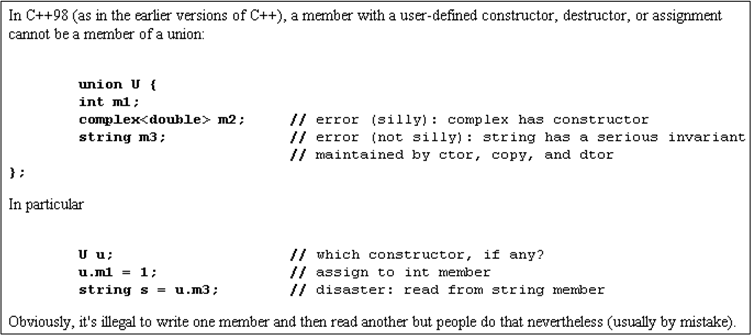
But of course, the restrictions on which user-defined types may be included in a union will be relaxed a bit in C++11. The details are in the link provided above.
The Emergence Of The STL
In the preface to the 2006 Japanese translation of “The Design and Evolution of C++“, Bjarne Stroustrup writes about how the C++ STL containers/iterators/algorithms approach to generic programming came into being. Of particular interest to me was how he struggled with the problem of “intrusive” containers:
The STL was a revolutionary departure from the way we had been thinking about containers and their use. From the earliest days of Simula, containers (such as lists) had been intrusive: An object could be put into a container if and only if its class had been (explicitly or implicitly) derived from a specific “Link” or “Object” class containing the link information needed by the compiler (to traverse the container). Basically, such a container is a container of references to Links. This implies that fundamental types, such as ints and doubles, can’t be put directly into containers and that the array type, which directly supports fundamental types, must be different from other containers. Furthermore, objects of really simple classes, such as complex and Point, can’t remain optimal in time and space if we want to put them into a container. It also implies that such containers are not statically type safe. For example, a Circle may be added to a list, but when it is extracted we know only that it is an Object and need to apply a cast (explicit type conversion) to regain the static type.
The figure below illustrates an “intrusive” container. Note that container users (like you and me) must conform to the container’s requirement that every application-specific, user-defined class (Element) inherits from an “overhead” Object class in order for the container to be able to traverse its contents.
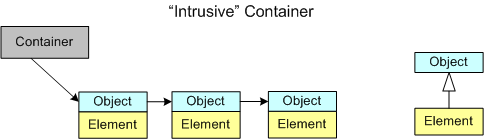
As the figure below shows, the STL’s “iterator” concept unburdens the user’s application classes from having to carry around the extra overhead burden of a “universal“, “all-things-to-all people”, class.

The “separation of concerns” STL approach unburdens the user by requiring each library container writer to implement an Iterator class that knows how to move sequentially from user-defined object to object in accordance to how the container has internally linked the objects (tree, list, etc) and regardless of the object’s content. The Iterator itself contains the container-specific equivalent navigational information as the Object class in the “intrusive” container model. For contiguous memory type containers (array, vector), it may be implemented as a simple pointer to the type of objects stored in the container. For more complex containers (map, list) the Iterator may contain multiple pointers for fast, container-specific, traversal/lookup/insertion/removal.
I don’t know about you, but I think the STL’s implementation of containers and generic programming is uber cool. It is both general AND efficient – two desirable properties rarely found together in a programming language library:
…the performance of the STL is that it – like C++ itself – is based directly on the hardware model of memory and computation. The STL notion of a sequence is basically that of the hardware’s view of memory as a set of sequences of objects. The basic semantics of the STL maps directly into hardware instructions allowing algorithms to be implemented optimally. The compile-time resolution of templates and the perfect inlining they support is then key to the efficient mapping of high level expression of the STL to the hardware level.
One Size Fits All
On Bjarne Stroustrup’s FAQ page, he state’s his opinion on the utility of object oriented programming:
The strength of OOP is that there are many problems that can be usefully expressed using class hierarchies – the main weakness of OOP is that too many people try to force too many problems into a hierarchical mould. Not every program should be object-oriented. As alternatives, consider plain classes, generic programming, and free-standing functions (as in math, C, and Fortran).
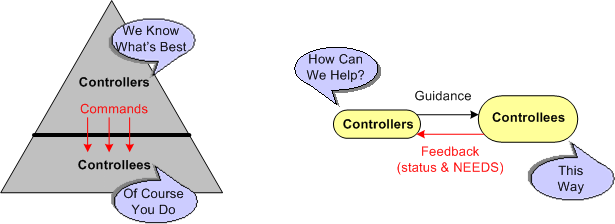
The same could be said of organizations of people, no? Of course, in a purposeful org of people and machines, the goal is to produce and distribute material wealth to all stakeholders: products/services to its customers and financial well-being to its employees and owners. Thus, some sort of controller-controllee structure is required to keep the org from deviating too far from its purpose. There are alternative structures to hierarchy but, as Bjarne sez, “too many people try to force too many problems into a hierarchical mould“. Bummer.
“As-Built” Vs “Build-To”
The figure below shows one (way too common) approach for developing computer programs. From an “understanding” in your head, you just dive into the coding state and stay there until the program is “done“. When it finally is “done“: 1) you load the code into a reverse engineering tool, 2) press a button, and voila, 3) your program “As-Built” documentation is generated.
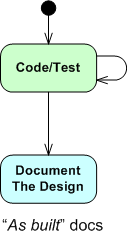
For trivial programs where you can hold the entire design in your head, this technique can be efficient and it can work quite well. However, for non-trivial programs, it can easily lead to unmaintainable BBoMs. The problem is that the design is “buried” in the code until after the fact – when it is finally exposed for scrutiny via the auto-generated “as-built” documentation.
With a dumb-ass reverse engineering tool that doesn’t “understand” context or what the pain points in a design are, the auto-generated documentation is often overly detailed, unintelligible, camouflage in which a reviewer/maintainer can’t see the forest for the trees. But hey, you can happily tick off the documentation item on your process checklist.
Two alternative, paygo types of development approaches are shown below. During development, the “build-to” design documentation and the code are cohesively produced manually. Only the important design constructs are recorded so that they aren’t buried in a mass of detail and they can be scrutinized/reviewed/error-corrected in real-time during development – not just after the fact.

I find that I learn more from the act of doing the documentation than from pushing an “auto-generate” button after the fact. During the effort, the documentation often speaks to me – “there’s something wrong with the design here, fix me“.
Design is an intimate act of communication between the creator and the created – Unknown
Of course, for developers, especially one dimensional extreme agilista types who have no desire to “do documentation” or learn UML, the emergence of reverse engineering tools has been a Godsend. Bummer for the programmer, the org he/she works for, the customer, and the code.
My Erlang Learning Status – IV
I haven’t progressed forward at all on my previously stated goal of learning how to program idiomatically in Erlang. I’m still at the same point in the two books (“Erlang And OTP In Action“; “Erlang Programming“) that I’m using to learn the language and I’m finding it hard to pick them up and move forward.
I’m still a big fan (from afar) of Erlang and the Erlang community, but my initial excitement over discovering this terrific language has waned quite a bit. I think it’s because:
- I work in C++ everyday
- C++11 is upon us and learning it has moved up to number 1 on my priority list.
- There are no Erlang projects in progress or in the planning stages where I work. Most people don’t even know the language exists.
Because of the excuses, uh, reasons above, I’ve lowered my expectations. I’ve changed my goal from “learning to program idiomatically” in Erlang to finishing reading the two terrific books that I have at my disposal.

Note: If you’re interested in reading my previous Erlang learning status reports, here are the links:
Cpp, Java, Go, Scala Performance
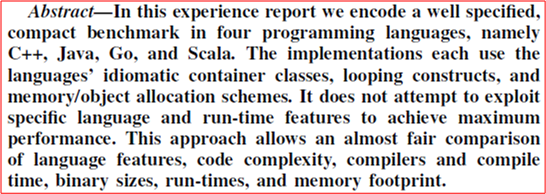
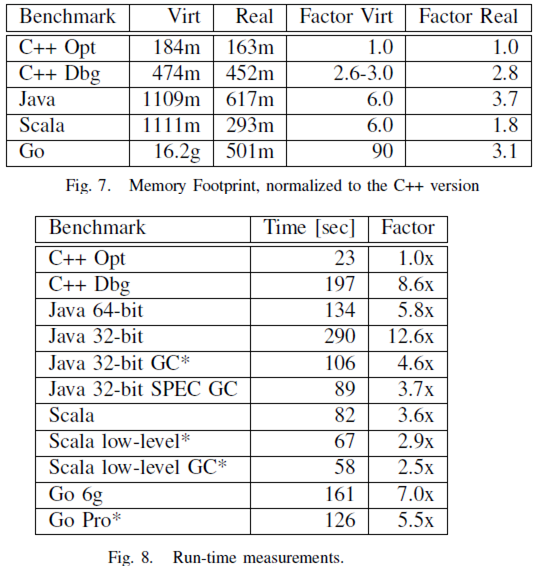
I recently stumbled upon this interesting paper on programming language performance from Google researcher Robert Hundt : Loop Recognition in C++/Java/Go/Scala. You can read the details if you’d like, but here are the abstract, the conclusions, and a couple of the many performance tables in the report.
Abstract
Conclusions

Runtime Memory Footprint And Performance Tables
Of course, whenever you read anything that’s potentially controversial, consider the sources and their agendas. I am a C++ programmer.
Unneeded And Unuseful
On Bjarne Stroustrup’s C++ Style and Technique FAQ web page, he answers the question of why C++ doesn’t have a “universal” Object class from which all user-defined C++ classes automatically inherit from:

I felt the need to post this here because I’m really tired of hearing Java programmers using the “lack of a universal Object class” as one reason to stake the claim that their language of choice is superior to C++. Of course, there are many other reasons in their arsenal that undoubtedly show the superiority of Java over C++.
Milliseconds Since The Epoch
On a recent project, our team needed a fast and portable C++ way to time stamp messages flowing into our system at high rates – down to the millisecond level of resolution. Here’s the boost-based implementation that I concocted. Notice the classic “midnight, January 1, 1970” epoch and the 64 bits required to preclude multiple rollovers in milliseconds since the epoch. What would your fast and portable C++ solution look like?


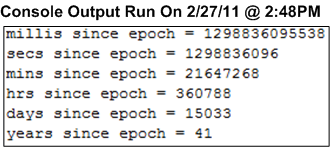
Update 1/5/13: Ever since C++11 arrived on the scene, Boost.Date_Time is longer needed for high resolution timing. As the “Milliseconds Since The Epoch 2” post shows, this functionality is now standard in the <chrono> library.
Using The New C++ DDS API
PrismTech‘s Angelo Corsaro is a passionate and tireless promoter of the OMG’s Data Distribution Service (DDS) distributed system communication middleware technology. (IMHO, the real power of DDS over other messaging services and messaging-based languages like Erlang (which I love) is the rich set of Quality of Service (QoS) settings it supports). In his terrific “The Present and Future of DDS” pitch, Angelo introduces the new, more streamlined, C++ and Java DDS APIs.
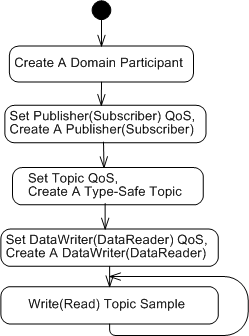
The UML activity diagram below illustrates the steps for setting up and sending (receiving) topic samples over DDS: define a domain; create a domain participant; create a QoS configured, domain-resident publisher (or subscriber); create a QoS configured and type-safe topic; create a QoS configured, publisher-resident, and topic-specific dataWriter; and then go!
Concrete C++ implementations of the activity diagram, snipped from Angelo’s presentation, are presented below. Note the incorporation of overloaded insertion operators and class templates in the new API. Relatively short and sweet, no?
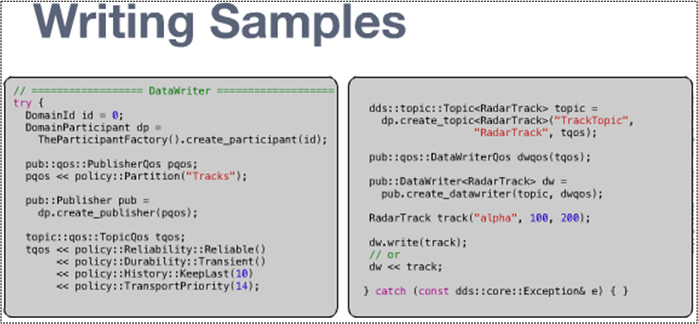
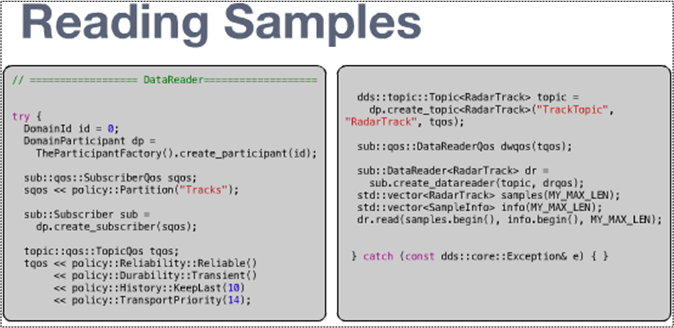
Even though the sample code shows non-blocking, synchronous send/receive usage, DDS, like any other communication service worth its salt, provides API support for blocked synchronous and asynchronous notification usage.
So, what are you waiting for? Skidaddle over to PrismTech’s OpenSplice DDS page, download the community edition libraries for your platform, and start experimenting!

Why am I here?
WTF?
Meh!
D'oh!

My BTC Address



 Bulldozer00's Blog