Archive
Out With The Old And In With The New
Nancy Leveson has a new book coming out that’s titled “Engineering A Safer World” (the full draft of the book is available here: EASW). In the beginning of the book, Ms. Leveson asserts that the conventional assumptions, theory, and techniques (FMEA == Failure Modes and Effects Analysis, Fault Tree Analysis == FTA, Probability Risk Assessment == PRA) for analyzing accidents and building safe systems are antiquated and obsolete.
The expert, old-guard mindset in the field of safety engineering is still stuck on the 20th century notion that systems are aggregations of relatively simple, electro-mechanical parts and interfaces. Hence, the steadfast fixation on FMEA, FTA, and PRA. On the contrary, most of the 21st century safety-critical systems are now designed as massive, distributed, software-intensive systems.
As a result of this emerging, brave new world, Ms. Leveson starts off her book by challenging the flat-earth assumptions of yesteryear:
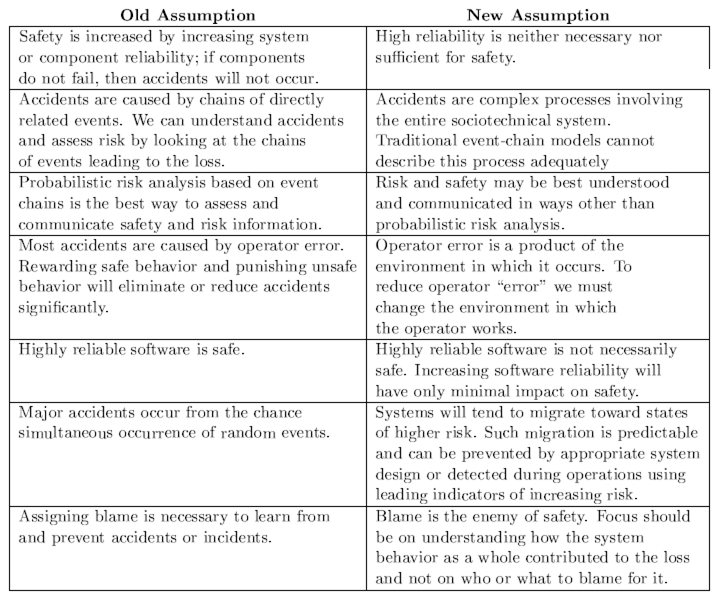 Note that Ms. Leveson tears down the former truth of reliability == system_safety. After proposing her set of new assumptions, Ms. Leveson goes on to develop a new model, theory, and set of techniques for accident analysis and hazard prevention.
Since the subject of safety-critical systems interests me greatly, I plan to write more about her novel approach as I continue to progress through the book. I hope you’ll join me on this new learning adventure.
Six “C”s
Whoo Hoo! I found another non-mainstream heretic to learn from: Mr. Alfie Kohn.
I’m currently in the process of reading Mr. Kohn’s book: “Punished By Rewards“. PBR is a well researched and eloquently written diatribe against anything that reeks of the Skinnerian dogma: “Do This And You’ll Get That“. Mr. Kohn is a staunch opponent of rewards, punishments and any other form of external control.
People don’t resist change. They resist being changed. – Unknown
Applying his rhetoric to parenting, the classroom, and the corpricracy, Alfie cites study after study and experiment after experiment in which all external motivational actions perpetrated by “authorities” achieve only short term results while destroying intrinsic motivation and ensuring long term, negative consequences – like reluctant compliance and uncreative, mechanistic doing.
The classic (and reasonable) question posed most often to Mr. Kohn is “if rewards and punishments don’t work, what alternatives are there Mr. Smartie Pants?“. Of course, he doesn’t have a nice and tidy answer, but he cites three “C”s: Choice, Collaboration, and Content, as the means of bringing out the willful best in children, students, and employees.
Much like Dan Pink‘s big 3 (mastery, autonomy, and purpose), creating an environment and supporting culture in which Alfie’s three “C”s are manifest is devilishly difficult. In familial, educational, and corporate systems, their hierarchical structures naturally suppress Alfie’s 3 “C”s while nurturing this 3 “C” alternative:

Shipped!
Woot! They’ve been shipped! What’s been shipped? Why, the free “cog diss” T-shirts silly:

In case you were born yesterday, or this is the first time you’ve stumbled upon this ridiculous time-waster of a blawg, here’s the scoop.
Not too long ago, BD00 celebrated his fitty-turd birthday by offering up the obnoxious T-shirt to the first two substantive evaluators of this blog. The first winner was (unsurprisingly) the chameleonic fish dude who frequently visits here and serves up funny blowback under pen names such as: oldfishfart, bottom-feeder-fish, finding-neo-fish, dwindling-resources-fish, Fishbert, lord-of-the-fish, etc. Mr. Fishilicious came through on a request to send BD00 a pic of him wearing the highly coveted collectors item. Vera Wang, eat your heart out.
The second winner was a surprise. He’s a first time commenter from the great country of Espana who came out of the shadows to thoughtfully pitch in his two cents. Perhaps the sleeping bull in BD00’s coat of arms evoked an image of Spain’s world renowned “running of the bulls” event? Look – here’s a vision of my new friend running like Usain Bolt in next year’s running of DA BULSE:

After hoofing it down to the USPS on Saturday and filling out a customs form in triplicate, the second turdy tee was off to Spain. BD00 now anxiously awaits the arrival of a pic of his Spanish friend donning the dung. Preferably, an adventurous one like the one above?
Miraculous Recovery
It’s a miracle, a true blue spectacle, a miracle come true – Barry Manilow
The business equation is as simple as can be: profits = revenues – costs. For the moment, assume that increasing revenues is not in the cards. Thus, as the graph below shows, the only way of increasing profits is to reduce costs.

By far, the quickest, most efficient, and least challenging method of reducing costs is by shrinking the org. However, the well known unintended consequences of reducing costs by jettisoning people are:
- increased workload on those producers “lucky enough” to remain
- the loss of bottom up trust and loyalty,
- lowered morale, increased apathy and skepticism
- less engagement, lowered productivity
- the loss of even more good people seeking out a better future
Unless these not-so-visible unintended consequences are compensated for (which they usually aren’t), the increase in profits may be short-lived. Sometime later, revenues may start decreasing as a result of customer defections triggered by deteriorating product and service quality.
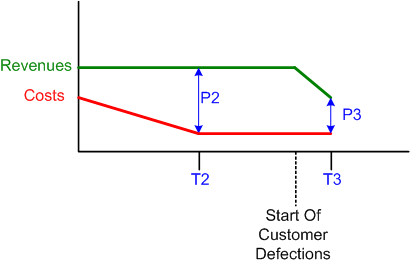
As the system dynamics influence diagram below shows, the start of customer defections may trigger a vicious downward spiral into oblivion in the form of a positive feedback loop. An increase in customer defections leads to an acceleration in the decrease in profits, which leads to an increase in cost cutting measures, which accelerates decreased product/service quality, which increases the number of customer defections.

Once the vicious cycle commences, unless the loop is broken somehow, the extinction of the org and all of its “innards” is a forgone conclusion:

So, how can the cycle be broken? Well duh, by increasing revenues. So, how can revenues be increased? By somehow “miraculously”:
- Creating new products/services that customers want and competitors don’t have yet
- Enhancing the existing product/service portfolio to distinguish the org’s offerings from the moo herd’s crappy products/services
But wait, you say. How can an org enhance their products and/or create new ones with no capital to invest because of decreasing (or no) profits? Then, uh, that’s where the “miraculously” comes in.

In a tough business environment, it doesn’t take much to cut costs (that’s what dime-a-dozen MBAs and mercenary hatchet men are for). It takes talent, ingenuity, lots of luck, and real leadership to increase revenues when little to no investment resources are available. No matter how sincere, text book exhortations, rah rah speeches, and appeals for increased focus/dedication/loyalty (with no reciprocating commitment for compensation should the ship be righted), aren’t characteristic of real leadership. They’re manifestations of fear.
I’ll Skip This One
“The Back Of The Napkin” author Dan Roam is hatching a new book titled “Blah Blah Blah: What To Do When Words Don’t Work”.
Being a graphics-oriented dude myself, I loved reading TBOTN. However, since I’m spoiled from buying Kindle books for $9.99, I’m gonna skip purchasing this one because I refuse to pay the $14.99 price that the publisher wants for the e-version. It makes BD00 wonder what the publisher-publishee split is from the sale of each unit.

I love the fact that self-publishing is on the rise and that sites like lulu.com are eating into dinosaur publishing house profits. The big pub house strategic plan may be to phase out the costly-to-produce physical versions of their books while jacking up the price for the non-touchable e-versions. For now at least, I’m not hoppin’ on that train.
The Ultimate External Controller
Control theory postulates that in order to make effective goal-seeking decisions, one of the requirements imposed on an external controller, human or otherwise, is that it contain an accurate model of the “real” process to be controlled.
When an external controller’s process model matches the “real” process taking place, effective control may be, but isn’t guaranteed to be, achieved. When there’s a mismatch, all hope is lost.
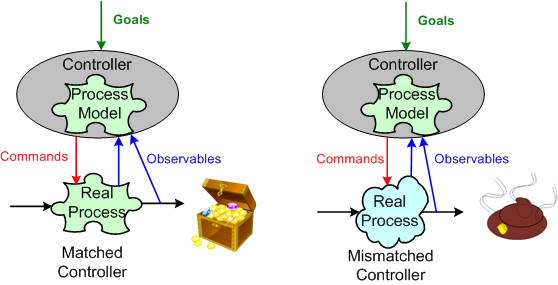
The ultimate external controller is no external controller. It’s intimately integrated within, and distributed across, the process itself.

House Of Cards
Wanna play cards?

Invisible, Thus Irrelevant
A system that has a sound architecture is one that has conceptual integrity, and as (Fred) Brooks firmly states, “conceptual integrity is the most important consideration in system design”. In some ways, the architecture of a system is largely irrelevant to its end users. However, having a clean internal structure is essential to constructing a system that is understandable, can be extended and reorganized, and is maintainable and testable.
The above paragraph was taken from Booch et al’s delightful “Object-Oriented Analysis And Design With Applications“. BD00’s version of the bolded sentence is:
In some ways, the architecture of a system is largely irrelevant to its end users, its developers, and all levels of management in the development organization.
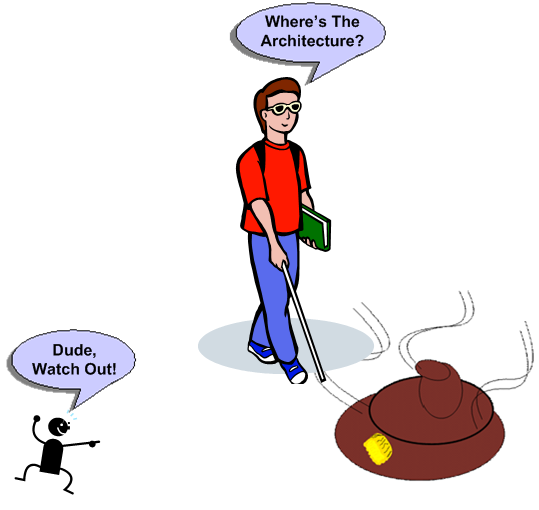
If the architecture is invisible because of the lack of a lightweight, widely circulated, communicated, and understood, set of living artifacts, then it can’t be relevant to any type of stakeholder – even a developer. As the saying goes: “out of site, out of mind“.
Despite the long term business importance of understandability, extendability, reorganizability, maintainability, and testability, many revenue generating product architectures are indeed invisible – unlike short term schedulability and budgetability; which are always highly visible.
Borgbot
I’m not sure you should worry much about the effect your behavior has on the organization overall, because there’s lots of data that suggests the organization doesn’t care much about you. – Jeffrey Pfeffer
That quote by Stanford University’s Jeffrey Pfeffer can be found in The Purpose of Power. From one systems point of view, a corpricracy as a whole is an inflexible and conscienceless borgbot with a single purpose – to make as much money it can, in any way it can. If the borgbot needs to chop off its nose or sell its mother into slavery or bankrupt millions of people outside its walls to fulfill its mission, it will.
The fascinating thing about borgbot behavior is that it ingeniously guilts its members into compliance (“aren’t you a team player?“, “if you don’t do it, you’re selfish and you’ll hurt the company“, “how dare you question management decisions“, “you’re a disloyal ingrate for speaking out“, yada-yada-yada) and rationalizes any unethical behavior away without blinking an eye.
Like most of us, Pfeffer wishes large-scale organizations were paragons of meritocracy where competence and influence are always perfectly correlated, but he knows that’s not the case – Gary Hamel
Notice the usage of the term “large-scale organizations” in Mr. Hamel’s quote. It implies that there’s hope – in small scale organizations. It makes self-righteous BD00 wonder why borgbots are obsessed with growth. Oh, I almost forgot; to make as much money as they can in any way they can.

Unjustifiable Precision
In “Object-Oriented Analysis and Design with Applications“, Grady Booch bluntly states:
Unjustifiable precision—in requirements or plans—has proven to be a substantial yet subtle recurring obstacle to success. Most of the time, early precision is just plain dishonest and serves to provide a façade for more progress of more quality than actually exists. – Grady Booch
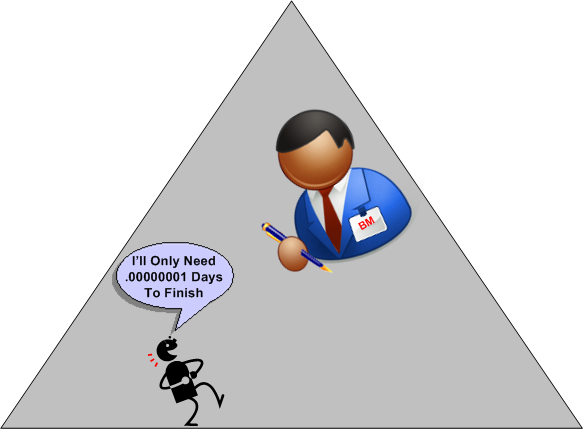
Pretty harsh, but wise, words, no? So, why do managers, directors, and executives repeatedly demand micro-granularized schedules and commitments from knowledge workers from day one throughout the life of a project?
- Because “that’s the way it has always been done“
- To maintain the illusion of control
- To flex their muscles and “hold people accountable” each time a micro-commitment is broken

Why am I here?
WTF?
Meh!
D'oh!

My BTC Address



 Bulldozer00's Blog